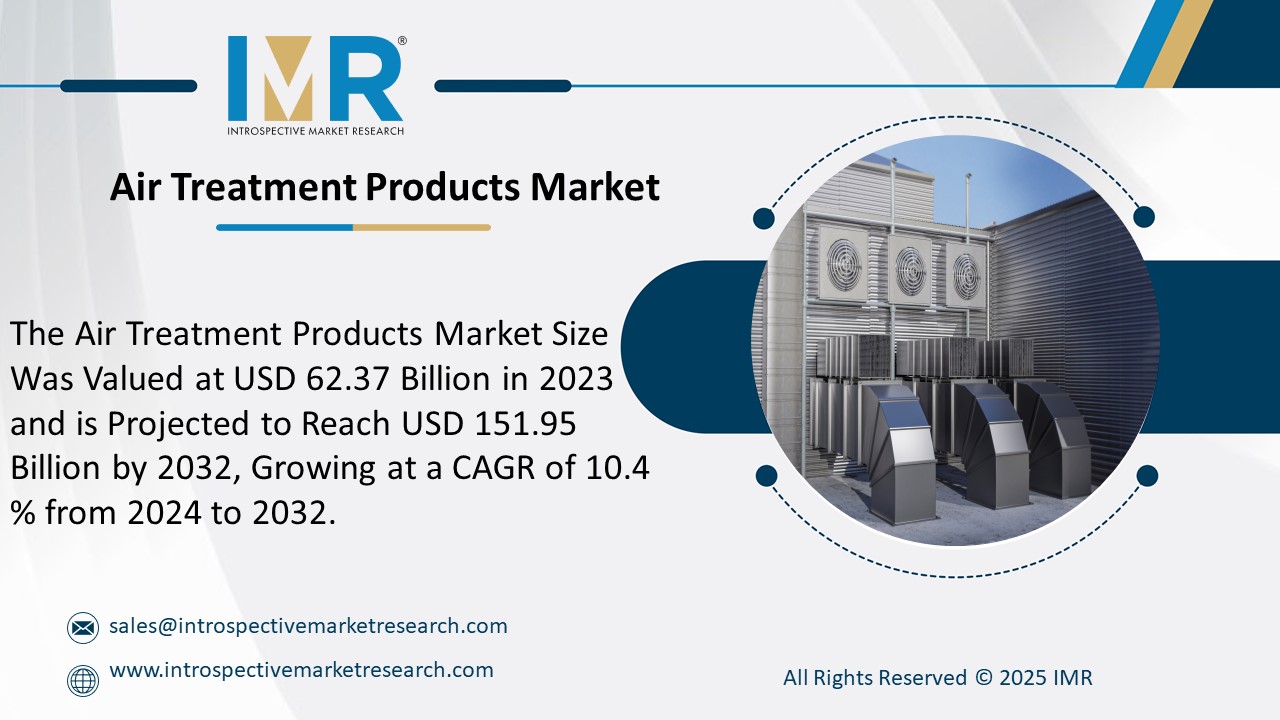
According to a new report published by Introspective Market Research, titled, Air Treatment Products Market by Product Type, Application, End-User, and Region, The Global Air Treatment Products Market Size Was Valued at USD 62.37 Billion in 2023 and is Projected to Reach USD 151.95 Billion by 2032, Growing at a CAGR of 10.4 % from 2024 to 2032.
The Air Treatment Products market comprises devices and systems designed to improve indoor and industrial air quality, including air purifiers, dehumidifiers, humidifiers, filters, and associated components. These solutions remove particulate matter, allergens, volatile organic compounds (VOCs), and microbial contaminants, thereby protecting human health and equipment. Compared to conventional ventilation alone, advanced air treatment products incorporate filtration, adsorption, UV, ionization and smart controls to deliver more effective purification and environmental comfort.
Increasing urbanization, rising pollution levels, and heightened awareness of respiratory illnesses are driving demand across residential, commercial, and industrial sectors. In particular, industries such as HVAC, healthcare, manufacturing, and data centers rely on air treatment systems to maintain safe, sterile, or controlled environments. The growing push for healthier indoor environments and compliance with regulatory standards further supports market expansion.
The Air Treatment Products Market is segmented into Product Type, Application, and End-User. By Product Type, the market is categorized into (Air Purifiers, Humidifiers/Dehumidifiers, Filters & Cartridges, Ventilation Systems, Others). By Application, the market is categorized into (Residential, Commercial, Industrial). By End-User, the market is categorized into (Households, Offices & Buildings, Healthcare & Hospitals, Manufacturing & Process, Others).
One key growth driver for the Air Treatment Products market is the increasing concern regarding indoor air quality and health risks associated with long-term exposure to pollutants. As awareness of airborne diseases, allergens, and VOCs grows, both consumers and organizations are investing in advanced air treatment technologies to improve living and working conditions. This demand is amplified by the COVID-19 pandemic’s legacy, tighter building standards, and increasing regulatory focus on indoor air safety.
A significant opportunity lies in the integration of smart, connected air treatment systems with IoT and AI-driven control features. Products that monitor air quality parameters in real time and adjust purification levels dynamically appeal to tech-savvy consumers and commercial buyers. Such intelligent systems promise better energy efficiency, predictive maintenance, and seamless user experience — creating differentiation and premium value in a competitive market.
Air Treatment Products Market, Segmentation
The Air Treatment Products Market is segmented on the basis of Product Type, Application, and End-User.
Product Type
The Product Type segment is further classified into Air Purifiers, Humidifiers/Dehumidifiers, Filters & Cartridges, Ventilation Systems, and Others. Among these, the Air Purifiers sub-segment accounted for the highest market share in 2023. As consumers increasingly prioritize clean indoor air, the demand for purifiers with HEPA, activated carbon, UV, and hybrid technologies has surged. Their versatility across homes, offices, and healthcare settings, along with continuous innovation in smart capabilities, has cemented their dominance.
Application
The Application segment is further classified into Residential, Commercial, and Industrial. Among these, the Residential sub-segment accounted for the highest market share in 2023. Rising health consciousness, increased time spent indoors, and disposable income growth have fueled household adoption of air treatment products. Many residential users now select units based on room size, noise levels, filter lifespan, and smart connectivity, pushing product differentiation and upgrades in this segment.
Some of The Leading/Active Market Players Are-
- Daikin Industries, Ltd. (Japan)
- Honeywell International Inc. (USA)
- LG Electronics (South Korea)
- Panasonic Corporation (Japan)
- Samsung Electronics (South Korea)
- Sharp Corporation (Japan)
- Blueair AB (Sweden)
- Coway Co., Ltd. (South Korea)
- Dyson Ltd. (UK)
- MANN+HUMMEL GmbH (Germany)
- Other active players.
Key Industry Developments
-
In July 2025, Samsung launched a new series of smart air purifiers with multi-stage filtration and IoT connectivity.
Samsung’s new lineup integrates HEPA, activated carbon, and UV-C modules with real-time air quality sensors and smartphone app control. The devices are designed for both residential and commercial usage, featuring AI-based mode switching and filter health notifications. This launch underscores growing competition in smart indoor air quality solutions and aims to deepen Samsung’s presence in air treatment markets globally. - In June 2025, LG introduced air purifiers equipped with advanced PM1.0 particle sensors for enhanced indoor air monitoring.
LG’s upgraded appliances incorporate high-resolution sensors to detect ultrafine particulates, enabling precise adjustments to filtration speed and power. The enhanced models also offer stronger connectivity to home automation systems. This move reflects a trend toward more responsive, health-centric air treatment devices, and positions LG to compete more aggressively on performance and smart features.
Key Findings of the Study
- Air Purifiers dominate the product type segment due to broad residential and commercial use
- Residential users contribute the largest application share, driven by health awareness
- Smart, IoT-enabled systems represent a key growth frontier
- Asia-Pacific and North America lead in adoption due to urbanization and regulation
- Manufacturer innovation and regulatory pressure are key market accelerators