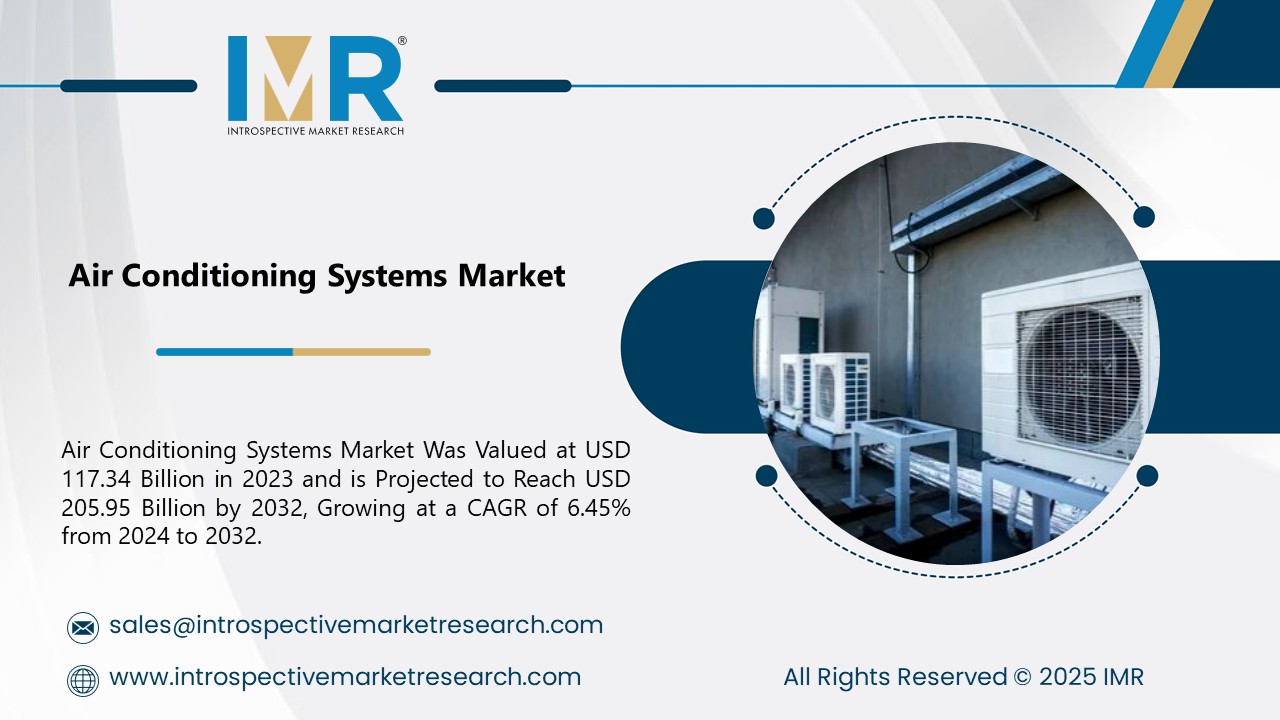
According to a new report published by Introspective Market Research, titled, Air Conditioning Systems Market by Type, Technology, and End-Use Industry,” The Global Air Conditioning Systems Market Size Was Valued at USD 117.34 Billion in 2023 and is Projected to Reach USD 205.95 Billion by 2032, Growing at a CAGR of 6.45%. the global Air Conditioning Systems Market is witnessing strong growth driven by rising demand for energy-efficient cooling systems, rapid urbanization, and increasing disposable incomes. Air conditioning systems are essential components in both residential and commercial infrastructures, offering improved indoor air quality and thermal comfort. These systems include various types such as split, window, portable, and centralized units, each tailored to meet specific consumer and industrial needs.
Air conditioning systems play a crucial role across industries such as automotive, healthcare, data centers, and manufacturing, where temperature regulation and air quality are vital. Technological advancements, such as inverter-based and smart connected systems, are enhancing performance while reducing energy consumption. With global temperatures rising and a growing focus on sustainable cooling solutions, the market continues to expand significantly across developed and emerging economies.
One of the key growth drivers of the Air Conditioning Systems Market is the increasing global temperature levels and the growing need for energy-efficient climate control systems. Rising urbanization and the expansion of the construction industry in emerging economies are fueling demand for modern HVAC systems. Additionally, government regulations promoting eco-friendly refrigerants and energy conservation are encouraging manufacturers to develop sustainable and smart air conditioning solutions.
A major market opportunity lies in the integration of IoT and smart technologies in air conditioning systems. Consumers are increasingly seeking connected and intelligent cooling solutions that offer real-time monitoring, remote control, and optimized energy usage. The adoption of AI-driven predictive maintenance and automation in commercial and industrial applications is expected to create lucrative opportunities for manufacturers in the coming years.
Air Conditioning Systems Market, Segmentation
The Air Conditioning Systems Market is segmented on the basis of Type, Technology, and End-Use Industry.
Type
- The Type segment is further classified into Split AC, Window AC, Portable AC, and Central AC. Among these, the Split AC sub-segment accounted for the highest market share in 2023. Split ACs are widely preferred in both residential and small commercial setups due to their energy efficiency, quiet operation, and ease of installation. The availability of inverter-based split units further enhances their appeal by reducing electricity consumption, making them a top choice for environmentally conscious consumers.
Technology
- The Technology segment is further classified into Inverter AC and Non-Inverter AC. Among these, the Inverter AC sub-segment accounted for the highest market share in 2023. Inverter technology allows compressors to operate at variable speeds, significantly improving energy efficiency and reducing operational costs. The growing consumer inclination toward sustainable and cost-effective cooling solutions is accelerating the adoption of inverter-based systems globally.
Some of The Leading/Active Market Players Are—
- Daikin Industries Ltd. (Japan)
- Mitsubishi Electric Corporation (Japan)
- LG Electronics Inc. (South Korea)
- Samsung Electronics Co., Ltd. (South Korea)
- Carrier Global Corporation (U.S.)
- Panasonic Corporation (Japan)
- Haier Group Corporation (China)
- Hitachi Ltd. (Japan)
- Midea Group Co., Ltd. (China)
- Johnson Controls International Plc (Ireland)
- Toshiba Corporation (Japan)
- Gree Electric Appliances, Inc. (China)
- Lennox International Inc. (U.S.)
- Fujitsu General Ltd. (Japan)
- Trane Technologies plc (Ireland)
Key Industry Developments
- In April 2024, Daikin Industries announced the launch of its new R-32 refrigerant-based inverter air conditioners designed for enhanced energy efficiency and lower carbon emissions.
This innovation aims to meet rising consumer demand for eco-friendly solutions while aligning with global environmental sustainability standards. - In January 2025, LG Electronics introduced a new line of AI-enabled air conditioning systems capable of optimizing cooling based on room occupancy and climate conditions.
The product launch strengthens LG’s position in the smart home appliance market and demonstrates the company’s focus on integrating advanced technologies for energy-efficient comfort solutions.