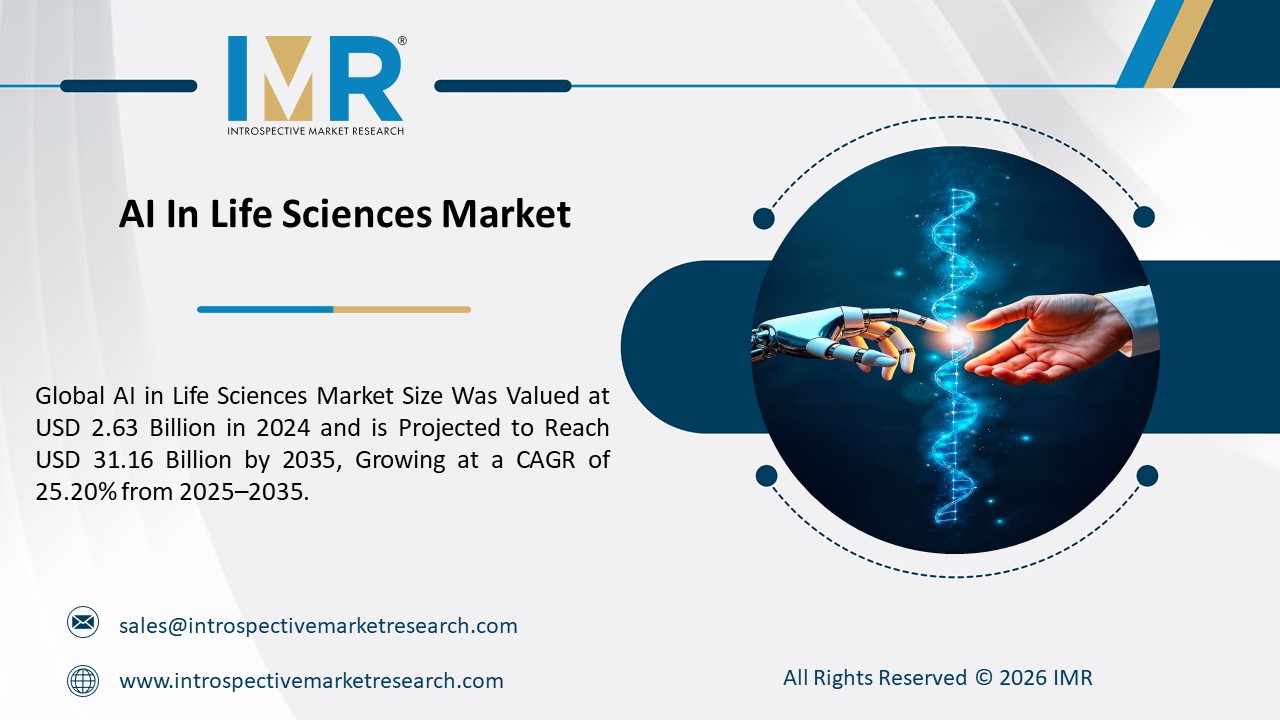
“According to a new report published by Introspective Market Research, titled, AI in Life Sciences Market by Component, Application, and End User, The Global AI in Life Sciences Market Size Was Valued at USD 2.63 Billion in 2024 and is Projected to Reach USD 31.16 Billion by 2035, Growing at a CAGR of 25.20% from 2025–2035.”
The AI in Life Sciences market is rapidly transforming the healthcare and biotechnology landscape by integrating advanced artificial intelligence technologies such as machine learning, deep learning, natural language processing, and computer vision into life science workflows. These technologies enable faster data analysis, improved accuracy, and predictive insights across drug discovery, clinical trials, diagnostics, and personalized medicine, offering significant advantages over traditional, manual, and time-intensive research methods.
AI-driven solutions are increasingly being adopted to process large volumes of biological and clinical data, reduce research and development costs, and accelerate time-to-market for new therapies. Compared to conventional analytical tools, AI systems deliver enhanced efficiency, scalability, and decision-making support, enabling life science organizations to address complex challenges such as disease heterogeneity and treatment optimization.
The market finds widespread application across pharmaceutical and biotechnology companies, research institutions, contract research organizations (CROs), and healthcare providers. Growing demand for precision medicine, rising investments in digital health technologies, and the increasing availability of big data in genomics and proteomics are further propelling the adoption of AI in life sciences globally.
Market Segmentation
The AI in Life Sciences Market is segmented into Component, Application, and End User.
- By Component, the market is categorized into Software, Hardware, and Services.
- By Application, the market is categorized into Drug Discovery, Medical Imaging & Diagnostics, Clinical Trials, Precision Medicine, and Others.
- By End User, the market is categorized into Pharmaceutical & Biotechnology Companies, Healthcare Providers, Research Laboratories, and Contract Research Organizations (CROs).
Growth Driver
One of the key growth drivers of the AI in Life Sciences market is the increasing demand for accelerated drug discovery and development processes. Traditional drug development is costly, time-consuming, and prone to high failure rates. AI-powered platforms significantly reduce these challenges by enabling predictive modeling, virtual screening, and real-time analysis of complex biological data. As pharmaceutical companies strive to improve R&D productivity and reduce development timelines, AI adoption continues to rise, driving substantial market growth during the forecast period.
Market Opportunity
A major market opportunity lies in the expanding adoption of AI-driven precision and personalized medicine solutions. Advances in genomics, proteomics, and real-world evidence generation are creating vast datasets that require intelligent analytics. AI enables the identification of patient-specific treatment pathways, early disease detection, and improved clinical outcomes. As healthcare systems worldwide shift toward value-based care and personalized treatment models, AI-powered life sciences solutions are expected to witness strong demand, opening new revenue opportunities for market players.
Detailed Segmentation
AI in Life Sciences Market, Segmentation
The AI in Life Sciences Market is segmented on the basis of Component, Application, and End User.
Component
The Component segment is further classified into Software, Hardware, and Services. Among these, the Software sub-segment accounted for the highest market share in 2024. AI software platforms play a critical role in data integration, predictive analytics, and automation across life science applications. Their flexibility, scalability, and compatibility with cloud-based infrastructures make them highly attractive to pharmaceutical and biotech companies. Continuous advancements in AI algorithms and analytics capabilities further support the dominance of the software segment.
Application
The Application segment is further classified into Drug Discovery, Medical Imaging & Diagnostics, Clinical Trials, and Precision Medicine. Among these, the Drug Discovery sub-segment accounted for the highest market share in 2024. AI-driven drug discovery tools enable rapid target identification, molecule screening, and optimization, significantly reducing development timelines and costs. The growing need for innovative therapies and the rising prevalence of chronic and rare diseases continue to drive the adoption of AI in drug discovery workflows.
Some of The Leading/Active Market Players Are-
• IBM Corporation (U.S.)
• Microsoft Corporation (U.S.)
• Google LLC (U.S.)
• NVIDIA Corporation (U.S.)
• Oracle Corporation (U.S.)
• SAP SE (Germany)
• Siemens Healthineers (Germany)
• Illumina Inc. (U.S.)
• BenevolentAI (U.K.)
• Atomwise Inc. (U.S.)
• Insilico Medicine (Hong Kong)
• Exscientia plc (U.K.)
• Tempus Labs (U.S.)
• Recursion Pharmaceuticals (U.S.)
• and other active players.
Key Industry Developments
In March 2024, several pharmaceutical companies expanded partnerships with AI technology providers to accelerate drug discovery initiatives.These collaborations focus on leveraging machine learning platforms to identify novel drug candidates, optimize clinical trial designs, and reduce R&D costs, highlighting the growing strategic importance of AI in life sciences.
In October 2024, leading AI software vendors introduced advanced generative AI models tailored for life sciences research.These models are designed to improve molecular design, biomarker discovery, and predictive analytics, enabling faster innovation and supporting the growing adoption of AI across pharmaceutical and biotechnology sectors.
Key Findings of the Study
• Software and drug discovery segments dominate the market landscape.
• North America leads the market due to strong R&D investments and AI adoption.
• Accelerated drug development is a primary growth driver.
• Rising focus on precision medicine and data-driven healthcare trends supports long-term market expansion.