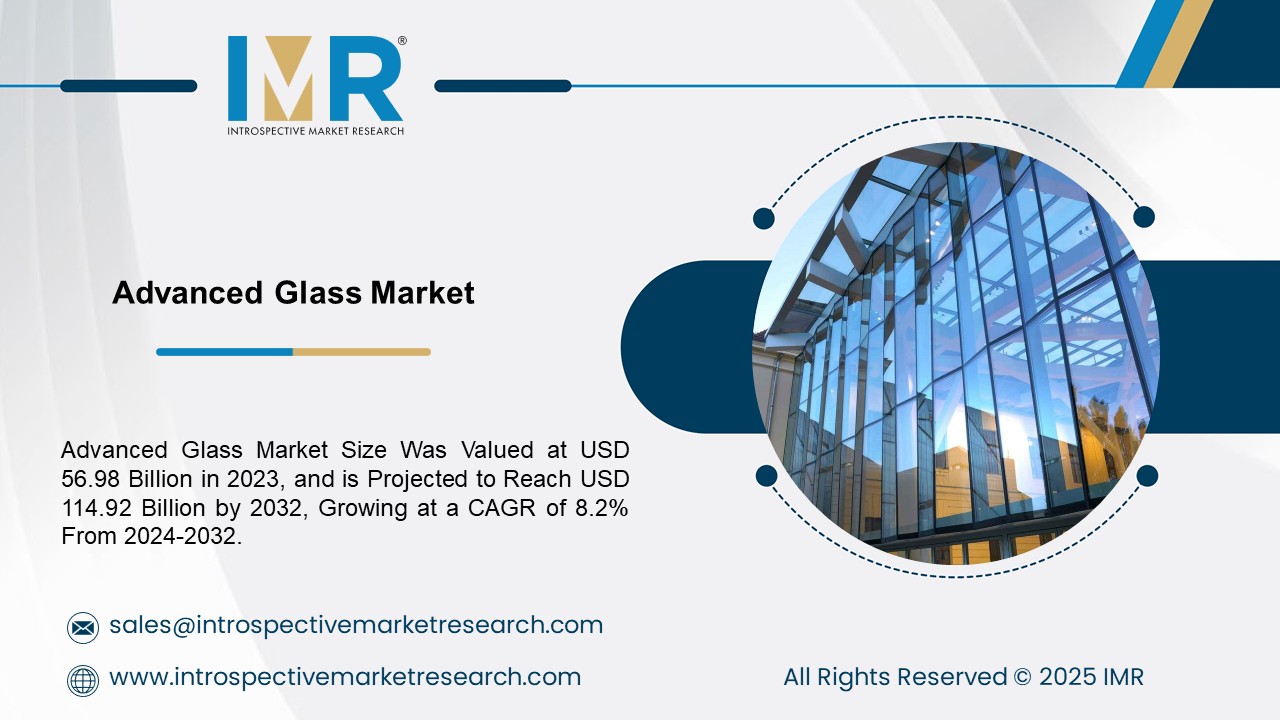
According to a new report published by Introspective Market Research, titled, Advanced Glass Market by Type (Coated Glass, Laminated Glass, Toughened Glass, Ceramic Glass), by Function (Safety & Security, Solar Control, Aesthetics, Energy Efficiency), by Application (Building & Construction, Automotive, Electronics, Solar Power, Healthcare), The Global Advanced Glass Market Size Was Valued at USD 56.98 Billion in 2023 and is Projected to Reach USD 114.92 Billion by 2032, Growing at a CAGR of 8.2%. The Advanced Glass Market encompasses a diverse range of specialized glass products engineered with enhanced properties beyond those of traditional float glass. These innovations include features such as superior strength, improved insulation, solar control, self-cleaning capabilities, and integrated electronic functionalities. Advanced glass offers significant advantages over conventional glass, providing greater energy efficiency, enhanced safety and security, improved aesthetics, and broader functional applications across various sectors.
These high-performance glass products are increasingly utilized in critical industries worldwide. In building and construction, advanced glass contributes to energy-efficient facades, smart windows, and robust security glazing. The automotive sector integrates it for lightweight windshields, panoramic roofs, and display applications. Electronics benefit from specialized glass for touchscreens and protective covers, while the solar power industry relies on it for high-transparency panels. Furthermore, in healthcare, it finds use in sterile environments and laboratory equipment, demonstrating its versatility and indispensable role in modern technological advancements.
The Advanced Glass Market is segmented into Type, Function, and Application. By Type, the market is categorized into Coated Glass, Laminated Glass, Toughened Glass, and Ceramic Glass. By Function, the market is categorized into Safety & Security, Solar Control, Aesthetics, and Energy Efficiency. By Application, the market is categorized into Building & Construction, Automotive, Electronics, Solar Power, and Healthcare.
A key growth driver for the advanced glass market is the increasing demand for energy-efficient building materials and sustainable construction practices. With stringent energy regulations and a global push towards reducing carbon footprints, architects and builders are actively seeking materials that improve thermal performance and reduce reliance on heating and cooling systems. Advanced glass, particularly low-emissivity (low-e) and insulated glass units, significantly contributes to energy savings by minimizing heat transfer, thus driving its widespread adoption in both new construction and renovation projects worldwide.
A significant market opportunity lies in the burgeoning demand for smart glass technologies. Smart glass, which can change its light transmission properties (e.g., tint, opacity) on demand, is gaining traction in both architectural and automotive applications. This technology offers dynamic control over privacy, glare, and solar heat gain, enhancing user comfort and energy efficiency. As integration with IoT and smart building systems becomes more prevalent, the ability to control glass properties digitally presents a vast area for innovation and market penetration, especially in high-end residential, commercial, and automotive sectors.
Advanced Glass Market, Segmentation
The Advanced Glass Market is segmented on the basis of Type, Function, and Application.
Type
- The Type segment is further classified into Coated Glass, Laminated Glass, Toughened Glass, and Ceramic Glass. Among these, the Coated Glass sub-segment accounted for the highest market share in 2023. Coated glass, particularly low-emissivity (low-e) glass, is highly sought after for its exceptional thermal insulation and solar control properties. These microscopic metallic coatings reflect infrared light while allowing visible light to pass through, significantly reducing heat gain in summer and heat loss in winter. Its ability to enhance energy efficiency in buildings and automotive applications makes it a dominant and continuously growing segment.
Function
- The Function segment is further classified into Safety & Security, Solar Control, Aesthetics, and Energy Efficiency. Among these, the Energy Efficiency sub-segment accounted for the highest market share in 2023. The global focus on sustainable development and stricter energy consumption regulations drives the demand for glass solutions that reduce energy expenditure in buildings and vehicles. Advanced glass products designed for energy efficiency, such as insulated glass units and low-e coatings, minimize heat transfer, leading to lower HVAC costs and a reduced carbon footprint. This environmental and economic benefit positions energy efficiency as a paramount functional driver.
Some of The Leading/Active Market Players Are-
- AGC Inc. (Japan)
- Saint-Gobain S.A. (France)
- NSG Group (Japan)
- Guardian Industries (US)
- Corning Incorporated (US)
- Schott AG (Germany)
- PPG Industries, Inc. (US)
- Vitro Architectural Glass (Mexico)
- Euroglas GmbH (Germany)
- Xinyi Glass Holdings Limited (China)
- Fuyao Glass Industry Group Co., Ltd. (China)
- Taiwan Glass Industry Corporation (Taiwan)
- Asahi India Glass Limited (India)
- Sisecam (Turkey)
- CSG Holding Co., Ltd. (China).
Key Industry Developments
- In January 2024, Corning Incorporated announced the development of a new generation of Gorilla Glass for mobile devices, offering enhanced drop protection and scratch resistance. This innovation addresses consumer demand for more durable smartphone screens, even with thinner and lighter designs. The continuous advancements in Gorilla Glass technology reinforce its position as a leading material for consumer electronics, improving device longevity and user experience.
- In September 2023, Saint-Gobain S.A. introduced a new line of intelligent windows that integrate dynamic tinting technology, allowing occupants to control natural light, glare, and thermal comfort. This smart glass solution can be controlled via an app or building management system, providing personalized comfort and contributing to significant energy savings. The launch highlights Saint-Gobain's commitment to sustainable and technologically advanced building materials.
Key Findings of the Study
- Coated glass leads the market by type, driven by energy efficiency needs.
- Energy efficiency is the dominant functional segment, reflecting sustainability trends.
- Market growth is fueled by increasing demand for sustainable building materials.
- Smart glass technology presents a significant future market opportunity.
- The market is set for robust expansion, expected to double its value by 2032.