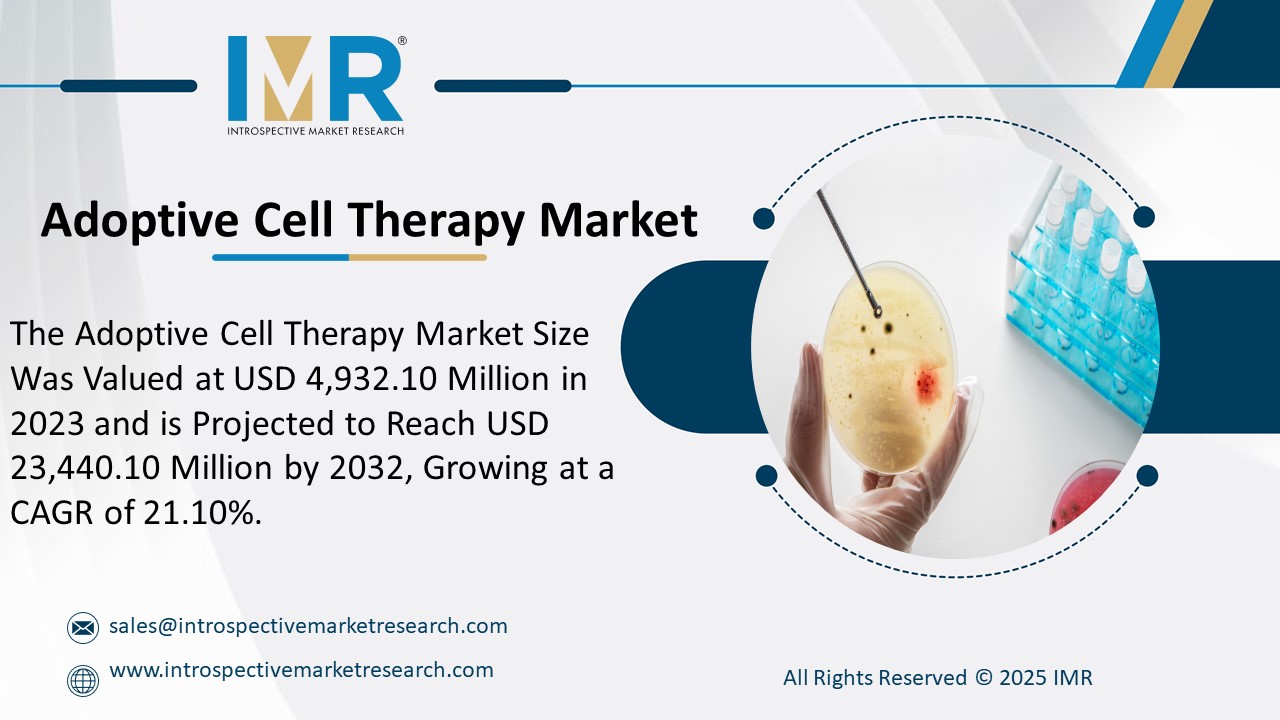
According to a new report published by Introspective Market Research, titled, Adoptive Cell Therapy Market by Therapy Type, Application, and End User, The Global Adoptive Cell Therapy Market Size Was Valued at USD 4,932.10 Million in 2023 and is Projected to Reach USD 23,440.10 Million by 2032, Growing at a CAGR of 21.10%. The global Adoptive Cell Therapy (ACT) Market is witnessing transformative growth, driven by the rising demand for personalized and targeted cancer therapies. Adoptive cell therapy represents a breakthrough approach in immuno-oncology, where immune cells are engineered or modified to enhance their ability to target and eliminate cancer cells effectively.
This innovative treatment strategy is increasingly being recognized as a vital component of modern oncology due to its high success rate in refractory cancers, particularly hematologic malignancies. The market’s growth is propelled by increasing investment in cell-based research, rising approvals of CAR-T and TCR therapies, and the growing prevalence of cancer worldwide.
Moreover, advancements in gene editing technologies, such as CRISPR-Cas9, are enabling faster and safer production of genetically engineered T cells, accelerating clinical adoption. Supportive regulatory frameworks and strong pipeline development by biotech firms are expected to sustain the market’s upward trajectory over the next decade.
The Adoptive Cell Therapy Market is segmented into Therapy Type, Application, and End User. By Therapy Type, the market is categorized into (CAR-T Cell Therapy, TCR-T Cell Therapy, NK Cell Therapy, and Tumor-Infiltrating Lymphocyte Therapy).
By Application, the market is categorized into (Hematologic Malignancies and Solid Tumors). By End User, the market is categorized into (Hospitals, Cancer Treatment Centers, and Research Institutes).
A key growth driver for the Adoptive Cell Therapy Market is the increasing number of FDA approvals and clinical trials for CAR-T cell therapies. Companies such as Novartis, Gilead, and Bristol Myers Squibb have achieved landmark successes, validating ACT’s potential in treating cancers previously considered incurable. The growing acceptance of these therapies among clinicians and patients underscores their efficacy and market potential.
A significant opportunity lies in the development of next-generation allogeneic (off-the-shelf) adoptive cell therapies. These products eliminate the need for patient-specific manufacturing, reducing costs and treatment timelines. With advances in cell engineering and cryopreservation technologies, biotech firms can scale up production and expand access, opening new frontiers in global cancer care.
Adoptive Cell Therapy Market, Segmentation
The Adoptive Cell Therapy Market is segmented on the basis of Therapy Type, Application, and End User.
Therapy Type
The Therapy Type segment is further classified into CAR-T Cell Therapy, TCR-T Cell Therapy, NK Cell Therapy, and Tumor-Infiltrating Lymphocyte Therapy. Among these, CAR-T Cell Therapy accounted for the highest market share in 2024. Its rapid clinical success, robust funding, and expanding regulatory approvals have positioned CAR-T therapy as the most commercially successful segment within ACT.
Application
The Application segment is further classified into Hematologic Malignancies and Solid Tumors. Among these, Hematologic Malignancies accounted for the highest market share in 2024. CAR-T cell therapies such as Kymriah and Yescarta have demonstrated strong efficacy in treating leukemias and lymphomas, setting new standards for cancer remission and survival rates.
Some of The Leading/Active Market Players Are-
- Novartis AG (Switzerland)
- Gilead Sciences, Inc. (U.S.)
- Bristol Myers Squibb Company (U.S.)
- Iovance Biotherapeutics, Inc. (U.S.)
- Adaptimmune Therapeutics plc (U.K.)
- Fate Therapeutics, Inc. (U.S.)
- Bluebird Bio, Inc. (U.S.)
- Tessa Therapeutics Ltd. (Singapore)
- Autolus Therapeutics plc (U.K.)
- Atara Biotherapeutics, Inc. (U.S.)
- Sorrento Therapeutics, Inc. (U.S.)
- Cellectis S.A. (France)
- Legend Biotech Corporation (China)
- Bellicum Pharmaceuticals, Inc. (U.S.)
- Nkarta, Inc. (U.S.)
- and other active players.
Key Industry Developments
-
In March 2024, Iovance Biotherapeutics received FDA approval for its TIL therapy, Amtagvi, the first tumor-infiltrating lymphocyte therapy for advanced melanoma patients.
This approval marked a major milestone in ACT’s evolution, validating the clinical efficacy of personalized cell therapies for solid tumors and expanding the therapeutic horizon beyond blood cancers. - In June 2024, Gilead Sciences announced positive phase III results for Yescarta in treating large B-cell lymphoma, demonstrating superior progression-free survival rates.
The study reinforced the commercial potential of CAR-T therapy, driving investor confidence and motivating other biopharmaceutical firms to accelerate research into novel ACT modalities.
Key Findings of the Study
• CAR-T Cell Therapy remains the dominant therapy type.
• Hematologic malignancies lead by application segment.
• Rapid FDA approvals drive strong commercial adoption.
• Allogeneic ACT offers a scalable market opportunity.
• North America dominates due to strong clinical infrastructure and R&D funding.