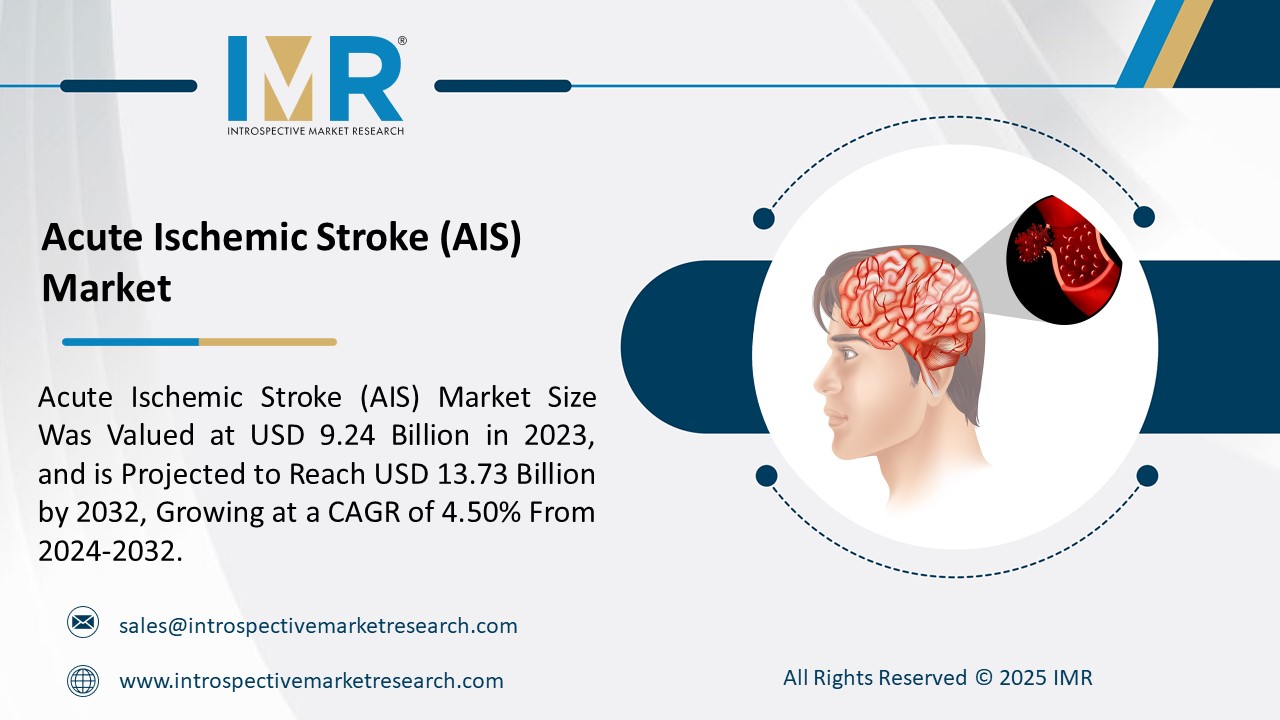
According to a new report published by Introspective Market Research, titled, Acute Ischemic Stroke (AIS) Market by Treatment (Thrombolytic Therapy, Antiplatelet Therapy, Anticoagulant Therapy, Neuroprotective Agents, Other), by Diagnostics (CT Scans, MRI, Carotid Ultrasound, Cerebral Angiography, Other), by End-user (Hospitals, Specialty Clinics, Ambulatory Surgical Centers), The Global Acute Ischemic Stroke (AIS) Market Size Was Valued at USD 9.24 Billion in 2023 and is Projected to Reach USD 13.73 Billion by 2032, Growing at a CAGR of 4.50%. The Acute Ischemic Stroke (AIS) market is experiencing steady growth, driven by the increasing prevalence of stroke globally, coupled with advancements in diagnostic techniques and therapeutic interventions. Acute ischemic stroke occurs when a blood clot blocks blood flow to the brain, leading to neurological damage. Timely and effective treatment is critical for improving patient outcomes, reducing disability, and enhancing quality of life. The market encompasses a range of diagnostic tools used for rapid and accurate identification of stroke, as well as pharmaceutical and device-based therapies aimed at restoring blood flow and protecting brain tissue.
Advantages over traditional, less effective approaches include a greater emphasis on rapid diagnosis and reperfusion therapies, which have revolutionized stroke management. The continuous research and development efforts in neuroprotection and minimally invasive procedures are further shaping the market. The widespread impact of stroke on public health and healthcare systems underscores the critical need for advanced solutions, making the AIS market a significant area of focus for medical innovation.
A key growth driver for the Acute Ischemic Stroke (AIS) market is the rising global geriatric population, which is inherently more susceptible to stroke. As individuals age, the risk factors for stroke, such as hypertension, diabetes, and atrial fibrillation, become more prevalent. This demographic shift directly translates into an increasing number of stroke incidents worldwide, thereby elevating the demand for effective diagnostic tools and therapeutic interventions for AIS. The need for specialized care and prompt treatment for this growing patient demographic is a major impetus for market expansion.
A significant market opportunity lies in the development and adoption of advanced neuroprotective agents and innovative drug delivery systems. While thrombolytics and thrombectomy are effective in restoring blood flow, there is an unmet need for therapies that can minimize brain damage during and after an ischemic event. Research into neuroprotective drugs that can protect brain cells from secondary injury, or novel methods to deliver existing treatments more effectively and safely, represents a substantial area for growth. Such advancements could significantly improve patient outcomes and expand the therapeutic window for intervention.
Acute Ischemic Stroke (AIS) Market, Segmentation
The Acute Ischemic Stroke (AIS) Market is segmented on the basis of Treatment, Diagnostics, and End-user.
Treatment
- The Treatment segment is further classified into Thrombolytic Therapy, Antiplatelet Therapy, Anticoagulant Therapy, Neuroprotective Agents, and Other. Among these, the Thrombolytic Therapy sub-segment accounted for the highest market share in 2023. Thrombolytic therapy, particularly intravenous tissue plasminogen activator (tPA), remains the cornerstone of acute ischemic stroke treatment due to its ability to dissolve blood clots and restore blood flow to the brain. Its proven efficacy and well-established guidelines for early administration within a critical time window make it the primary pharmacological intervention for suitable AIS patients. Ongoing research continues to refine its use and explore combination therapies.
Diagnostics
- The Diagnostics segment is further classified into CT Scans, MRI, Carotid Ultrasound, Cerebral Angiography, and Other. Among these, the CT Scans sub-segment accounted for the highest market share in 2023. CT (Computed Tomography) scans are the initial and most crucial diagnostic tool for suspected acute ischemic stroke due to their rapid acquisition time, widespread availability, and ability to quickly rule out hemorrhagic stroke, which requires different management. Non-contrast CT is essential for making immediate treatment decisions, especially for thrombolytic therapy. Advanced CT techniques like CT angiography and CT perfusion further aid in assessing cerebral blood flow and identifying salvageable brain tissue.
Some of The Leading/Active Market Players Are-
- Bayer AG (Germany)
- Bristol Myers Squibb Company (USA)
- Genentech, Inc. (a subsidiary of F. Hoffmann-La Roche Ltd.) (USA)
- Boehringer Ingelheim International GmbH (Germany)
- Merck & Co., Inc. (USA)
- Pfizer Inc. (USA)
- Johnson & Johnson (USA)
- Daiichi Sankyo Company, Limited (Japan)
- Sanofi S.A. (France)
- Portola Pharmaceuticals, Inc. (USA) (now part of Alexion Pharmaceuticals, Inc.)
- Medtronic plc (Ireland)
- Stryker Corporation (USA)
- Penumbra, Inc. (USA)
- Siemens Healthineers AG (Germany)
- GE Healthcare (USA)
- other active players.
Key Industry Developments
- In January 2023, Medtronic plc received FDA clearance for its new generation of stent retrievers, designed for improved clot removal in acute ischemic stroke patients undergoing mechanical thrombectomy. This innovation aims to enhance the safety and efficacy of endovascular procedures, leading to better clinical outcomes for patients. The advanced design allows for more efficient clot capture and retrieval, reducing procedure times and potentially minimizing further brain damage.
- In October 2022, a major pharmaceutical company announced positive phase 2 clinical trial results for a novel neuroprotective agent aimed at reducing brain injury after an ischemic stroke. This news highlighted the ongoing efforts to develop therapies that complement reperfusion strategies by directly protecting neurons. The promising data could pave the way for new treatment options that significantly improve recovery for stroke survivors, addressing a critical unmet medical need.
Key Findings of the Study
- Thrombolytic therapy remains the dominant treatment segment for AIS.
- CT Scans are the leading diagnostic method due to their speed and availability.
- The aging global population is a primary driver for market growth.
- Development of novel neuroprotective agents and advanced diagnostics represents significant opportunities.