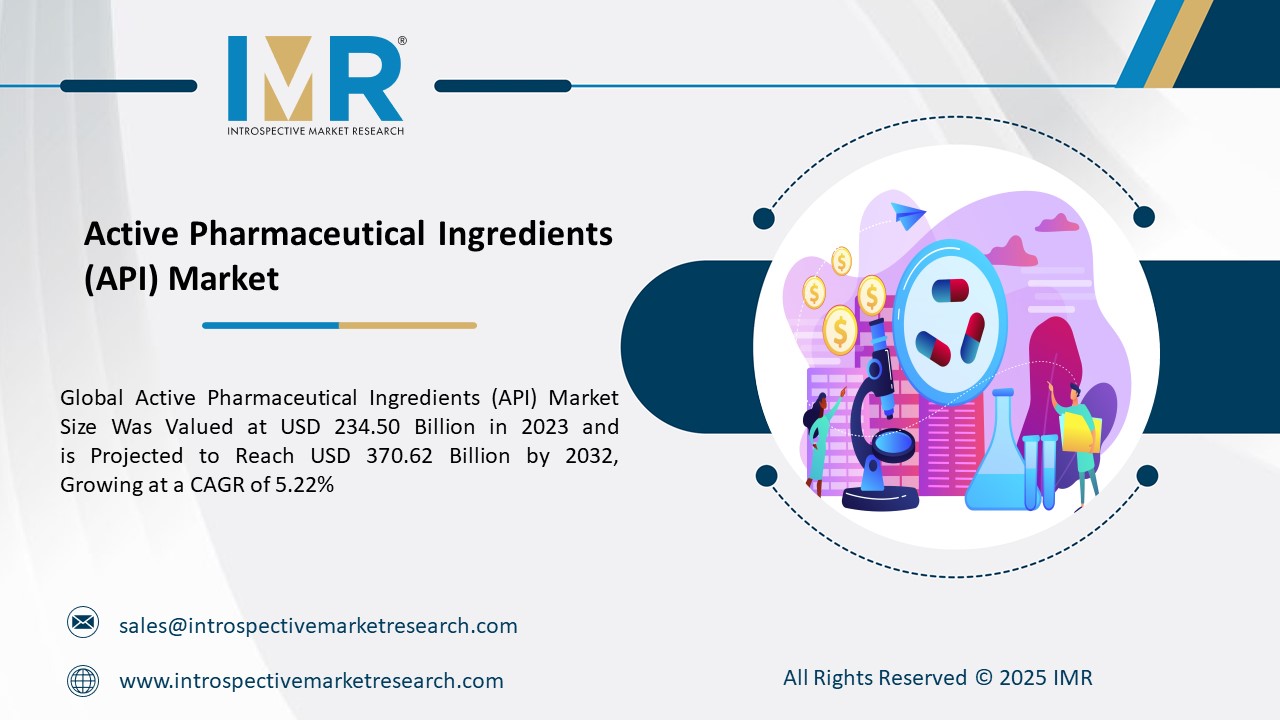
According to a new report published by Introspective Market Research, titled, Active Pharmaceutical Ingredients (API) Market by Type, Manufacturer, and Application, The Global Active Pharmaceutical Ingredients (API) Market Size Was Valued at USD 234.50 Billion in 2023 and is Projected to Reach USD 370.62 Billion by 2032, Growing at a CAGR of 5.22%.The Active Pharmaceutical Ingredients (API) Market stands as the cornerstone of the global pharmaceutical sector, underpinning drug efficacy, safety, and innovation. APIs are the biologically active components in medications responsible for producing their therapeutic effects. The market encompasses both chemically synthesized and biotechnologically produced APIs, serving applications ranging from cardiovascular treatments and anti-infectives to advanced oncology and neurotherapeutics.
Growing prevalence of chronic diseases, increased demand for personalized and targeted therapies, and rapid biopharmaceutical innovation are propelling the API industry worldwide. Manufacturers are leveraging advanced synthesis methods, contract manufacturing, and regulatory harmonization to address global healthcare needs, improve drug quality, and streamline supply chains. This dynamic sector supports pharmaceutical expansion, generics market growth, and ongoing technological evolution.
The Active Pharmaceutical Ingredients (API) Market is segmented into Type, Manufacturer, and Application.
-
By Type: Synthetic Chemical APIs, Biological APIs, Highly-Potent APIs (HPAPIs), and Others.
-
By Manufacturer: Captive API Manufacturers, Merchant API Manufacturers, Contract Manufacturing Organizations (CMOs)/Contract Development and Manufacturing Organizations (CDMOs).
-
By Application: Cardiovascular Diseases, Oncology, Anti-Infectives, CNS & Neurology, Diabetes, Pain Management, Others.
Expanding demand for APIs is driven by the rising global prevalence of chronic health conditions—including cancer, cardiovascular diseases, and metabolic disorders—necessitating continuous introduction of innovative and effective therapeutics. Growth is reinforced by escalating generic drug production, an aging population, and strong government support for local manufacturing. Contract manufacturing, continuous processing, and compliance with evolving regulatory guidelines (such as those from US FDA and EMA) provide a robust environment for API development and scale.
A substantial opportunity lies in the shift toward biopharmaceutical APIs and high-potency APIs (HPAPIs), especially for targeted therapies and rare disease treatments. Increasing adoption of green chemistry, environmentally sustainable production, and expansion in emerging markets further spur growth. Strategic investments in advanced manufacturing platforms, personalized medicine, and outsourcing to qualified CMOs/CDMOs will ensure supply stability and quality, positioning market stakeholders to meet the evolving needs of modern healthcare providers and patients.
Active Pharmaceutical Ingredients (API) Market, Segmentation
The Active Pharmaceutical Ingredients (API) Market is segmented on the basis of Type, Manufacturer, and Application.
Type
The Type segment is further classified into Synthetic Chemical APIs, Biological APIs, Highly-Potent APIs (HPAPIs), and Others. Among these, Synthetic Chemical APIs accounted for the highest market share in 2023. Their dominance stems from broad utility in essential medications (cardiovascular, anti-infective, pain management), well-established manufacturing protocols, and cost-effectiveness. Continuous improvements in synthesis and regulatory compliance have solidified their foundation in global pharma supply chains.
Application
The Application segment is classified into Cardiovascular Diseases, Oncology, Anti-Infectives, CNS & Neurology, Diabetes, Pain Management, and Others. Oncology held the largest share in 2023, as cancer therapies remain a critical priority for drug development and investment. The application of HPAPIs and biopharmaceuticals in oncology is supported by clinical advancements, regulatory approvals, and growing incidence rates worldwide.
Some of The Leading Market Players Are
- Merck & Co., Inc. (United States)
- Pfizer Inc. (United States)
- Novartis AG (Switzerland)
- Sanofi S.A. (France)
- Teva Pharmaceutical Industries Ltd. (Israel)
- Bristol-Myers Squibb Company (United States)
- Aurobindo Pharma Limited (India)
- Sun Pharmaceutical Industries Ltd. (India)
- Dr. Reddy’s Laboratories Ltd. (India)
- AbbVie Inc. (United States)
- Cipla Ltd. (India)
- Boehringer Ingelheim International GmbH (Germany)
- Albemarle Corporation (United States)
- Viatris Inc. (United States)
- Aspen Pharmacare Holdings Limited (South Africa)
- Other active players.
Key Industry Developments
- In January 2025, Dr. Reddy’s Laboratories launched a range of highly-potent APIs for global oncology markets, increasing supply reliability through advanced containment and process technologies.This initiative is set to accelerate the adoption of next-generation therapeutics and positions Dr. Reddy’s among the top global HPAPI suppliers targeting complex diseases.
- In March 2025, Merck & Co. expanded its European API manufacturing operations using green chemistry protocols to minimize waste and emissions.The project aims at sustainability leadership and adds capacity for biologically derived APIs, supporting the company’s fast-growing immunology and oncology drug pipeline.
Key Findings of the Study
- Synthetic chemical APIs and oncology applications dominate global market share.
- North America and Europe lead due to advanced pharma ecosystems and regulatory strength.
- Contract manufacturing, green chemistry, and personalized therapies drive growth opportunities.
- API innovation, biopharmaceutical expansion, and supply chain optimization are key market trends.