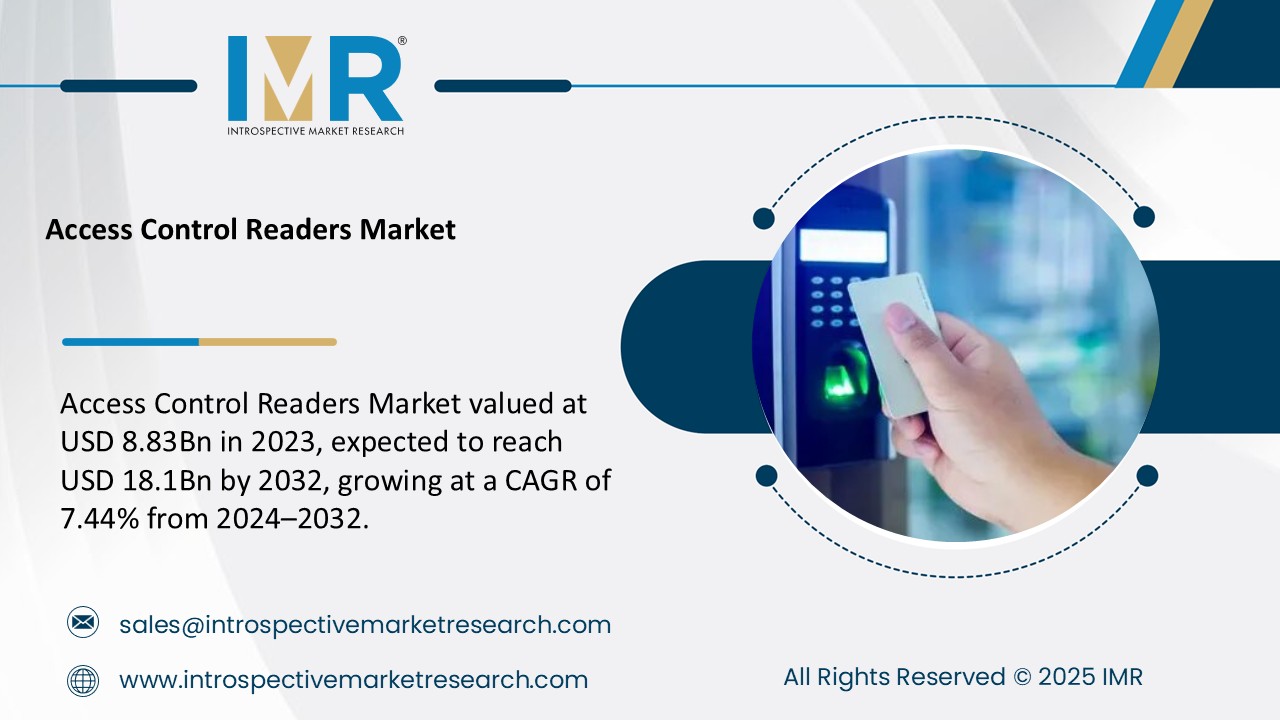
According to a new report published by Introspective Market Research, titled, Global Access Control Readers Market by Reader Type, Technology, End-User, and Region, the Global Access Control Readers Market Size Was Valued at USD 8.83 Billion in 2023 and is Projected to Reach USD 18.1 Billion by 2032, Growing at a CAGR of 7.44%.The Access Control Readers Market is witnessing substantial growth driven by the rising demand for security and surveillance solutions across a wide range of sectors. Access control readers are critical components in physical security systems, allowing or denying entry based on credentials like key cards, biometrics, PIN codes, or mobile devices. These systems ensure authorized access to buildings, rooms, or sensitive areas, thereby safeguarding assets, data, and personnel.
Modern access control readers offer significant advantages over traditional mechanical locks. They are more secure, scalable, and easily integrated with digital identity management systems, offering real-time access logs, centralized control, and remote administration. These features make them ideal for commercial buildings, data centers, airports, government facilities, and residential complexes.
As businesses prioritize security modernization, access control systems are increasingly shifting toward cloud-based platforms and mobile-enabled readers. Biometric technologies like facial recognition and fingerprint scanning are also gaining prominence due to their higher accuracy and convenience, further propelling market demand.
The Global Access Control Readers Market is segmented into Reader Type, Technology, and End-User. By Reader Type, the market is categorized into (Card-Based Readers, Biometric Readers, Mobile-Based Readers, Keypad Readers). By Technology, the market is categorized into (RFID, NFC, Bluetooth, Biometric, Smart Card). By End-User, the market is categorized into (Commercial, Government, Industrial, Residential, Healthcare, BFSI, Others).
One of the major growth drivers in the Access Control Readers Market is the increasing demand for high-security access systems in commercial and industrial sectors. With the rising number of cyber and physical threats, organizations are seeking integrated security infrastructure that not only controls physical access but also interfaces with enterprise-level IT systems. This demand is leading to higher adoption of advanced reader technologies that support multi-factor authentication, encrypted communications, and real-time data analytics for improved monitoring and incident response.
A significant market opportunity lies in the adoption of mobile-based and cloud-integrated access control solutions. As work environments become more flexible and hybrid, enterprises are investing in access readers that support smartphones and mobile credentials over NFC or Bluetooth. Cloud-based access systems allow remote control and centralized management across multiple sites, making them ideal for large organizations and franchises. This trend is further fueled by the cost-effectiveness and scalability of SaaS-based models in the physical security domain.
Global Access Control Readers Market, Segmentation
The Global Access Control Readers Market is segmented on the basis of Reader Type, Technology, and End-User.
Reader Type
The Reader Type segment is further classified into Card-Based Readers, Biometric Readers, Mobile-Based Readers, and Keypad Readers. Among these, the Biometric Readers sub-segment accounted for the highest market share in 2024. Biometric readers offer enhanced security by using unique human identifiers such as fingerprints, iris patterns, or facial recognition, reducing the risks associated with lost or stolen credentials. They are increasingly preferred in high-security environments like government facilities, financial institutions, and data centers due to their accuracy, reliability, and ability to create auditable logs of access events.
Technology
The Technology segment is further classified into RFID, NFC, Bluetooth, Biometric, and Smart Card. Among these, the RFID sub-segment accounted for the highest market share in 2024. RFID readers offer fast, contactless credential authentication and can be used across various applications such as employee attendance, parking management, and asset tracking. Their widespread compatibility and low cost make them suitable for both small and large installations, driving their adoption across diverse industries from education to transportation.
Some of The Leading/Active Market Players Are-
- HID Global (USA)
- Honeywell International Inc. (USA)
- Bosch Security Systems (Germany)
- ASSA ABLOY AB (Sweden)
- Johnson Controls (Ireland)
- dormakaba Holding AG (Switzerland)
- IDEMIA (France)
- Allegion plc (Ireland)
- Suprema Inc. (South Korea)
- Gallagher Group (New Zealand)
- Nedap N.V. (Netherlands)
- Avigilon Corporation (Canada)
- ZKTeco Co., Ltd. (China)
- …and other active players.
Key Industry Developments
- In June 2025, HID Global launched a new line of biometric access control readers with built-in AI analytics.
The new reader series integrates facial recognition and behavioral analytics to detect anomalies in user patterns, enhancing threat detection capabilities. The devices support multi-factor authentication and are compatible with major access control platforms, expanding HID’s portfolio in high-security markets like airports, defense, and critical infrastructure. - In April 2025, ASSA ABLOY announced its acquisition of a mobile access startup to strengthen its smart access solutions.
This acquisition enhances ASSA ABLOY’s ability to deliver mobile-first security solutions tailored for commercial buildings and co-working spaces. The acquired company specializes in secure digital keys and mobile credential management, enabling seamless and flexible access control for modern workplaces.
Key Findings of the Study
- Biometric Readers lead the market due to their high accuracy and enhanced security benefits.
- RFID remains the dominant technology segment for its cost-efficiency and broad compatibility.
- North America and Europe are key regional markets, driven by regulatory compliance and infrastructure upgrades.
- Rising adoption of mobile and cloud-based access systems represents a significant growth opportunity.
- Commercial and government sectors remain the highest adopters of access control solutions.