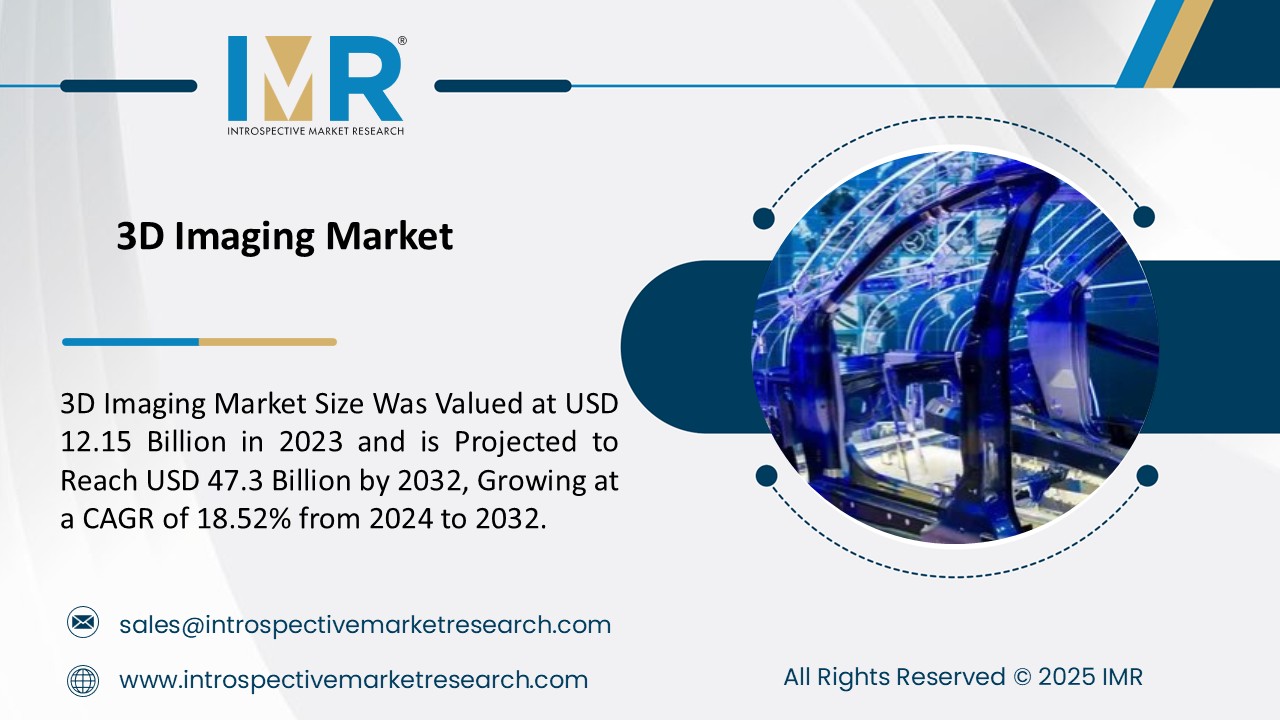
According to a new report published by Introspective Market Research, titled, Global 3D Imaging Market by Component, Deployment Type, End-Use Industry, and Region, The Global 3D Imaging Market Size Was Valued at USD 12.15 Billion in 2023 and is Projected to Reach USD 47.3 Billion by 2032, Growing at a CAGR of 18.52% from 2024 to 2032. The Global 3D Imaging Market is witnessing a rapid surge in adoption as industries transition toward immersive, high-precision visualization technologies. 3D imaging refers to the process of creating three-dimensional representations of objects or environments using various sensors, cameras, and software. These images provide depth, volume, and structure, offering a more detailed and realistic perspective than traditional 2D visuals.
This technology is revolutionizing sectors such as healthcare, automotive, aerospace, media & entertainment, and construction. In healthcare, 3D imaging enables enhanced diagnostics and surgical planning, while in manufacturing, it supports product design and quality control. Compared to traditional 2D imaging, 3D imaging delivers higher accuracy, better visualization of complex structures, and improved user interaction—driving its widespread appeal across industries.
The market is further fueled by growing demand for advanced imaging solutions, increasing adoption of augmented reality (AR) and virtual reality (VR), and technological advancements in sensor and imaging hardware. Cloud-based solutions and AI-integrated platforms are also contributing to the scalability and intelligence of 3D imaging systems.
The Global 3D Imaging Market is segmented into Component, Deployment Type, and End-Use Industry. By Component, the market is categorized into (Hardware, Software, Services). By Deployment Type, the market is categorized into (On-Premise, Cloud-Based). By End-Use Industry, the market is categorized into (Healthcare, Media & Entertainment, Automotive, Manufacturing, Construction, Aerospace & Defense, and Others).
One of the key drivers accelerating growth in the 3D Imaging Market is the increasing demand for enhanced diagnostic imaging in the healthcare sector. Medical professionals now rely heavily on high-resolution, three-dimensional visualizations for accurate diagnosis, surgical planning, and treatment assessment. 3D imaging technologies such as CT, MRI, and ultrasound provide detailed anatomical insights, improving patient outcomes. The integration of AI for real-time 3D rendering and automated anomaly detection further enhances diagnostic speed and precision, making 3D imaging an essential tool in modern medicine.
A major opportunity for the Global 3D Imaging Market lies in the integration of 3D imaging with AR and VR applications. The immersive capabilities of 3D imaging are being leveraged across industries for simulations, training, product design, and entertainment. This synergy is transforming user experiences in gaming, education, and industrial design. As AR/VR adoption rises, particularly with the rollout of 5G and advancements in wearable devices, the need for robust, real-time 3D imaging solutions is expected to surge—opening up substantial opportunities for innovation and growth.
Global 3D Imaging Market, Segmentation
The Global 3D Imaging Market is segmented on the basis of Component, Deployment Type, and End-Use Industry.
Component:
The Component segment is further classified into Hardware, Software, and Services. Among these, the Hardware sub-segment accounted for the highest market share in 2024. The demand for high-performance 3D cameras, sensors, and scanners has risen significantly, particularly in industrial, medical, and automotive applications. Hardware forms the core of any 3D imaging system, and continuous innovation in sensor resolution, accuracy, and miniaturization is enhancing system performance and affordability. With advancements in LiDAR, depth-sensing cameras, and portable 3D scanners, the hardware segment continues to dominate the market.
Deployment Type:
The Deployment Type segment is further classified into On-Premise and Cloud-Based. Among these, the Cloud-Based sub-segment accounted for the highest market share in 2024. The scalability, cost-efficiency, and ease of remote access offered by cloud solutions have led to widespread adoption, especially among small to mid-sized enterprises. Cloud-based 3D imaging platforms enable real-time collaboration and data sharing, critical for applications like remote diagnostics, telemedicine, and global design teams. The increasing integration of AI and machine learning through cloud infrastructure is also propelling this segment’s growth.
Some of The Leading/Active Market Players Are–
- GE Healthcare (USA)
- Philips Healthcare (Netherlands)
- Siemens Healthineers (Germany)
- Canon Medical Systems Corporation (Japan)
- Autodesk Inc. (USA)
- Trimble Inc. (USA)
- FARO Technologies Inc. (USA)
- Hexagon AB (Sweden)
- Dassault Systèmes (France)
- Topcon Corporation (Japan)
- Panasonic Corporation (Japan)
- Microsoft Corporation (USA)
- …and other active players.
Key Industry Developments
- In June 2025, Siemens Healthineers launched a next-generation 3D imaging platform integrated with AI for advanced diagnostics.
The platform, named "Acus 3D," enables real-time rendering and segmentation of complex anatomical structures, improving radiologist efficiency and patient outcomes. It is designed for use in both hospitals and outpatient centers and supports remote collaboration among care teams.
- In August 2025, FARO Technologies partnered with Autodesk to develop a cloud-native 3D imaging and modeling tool for the construction industry.
This collaboration aims to streamline workflows for building design, renovation, and digital twin creation. The platform allows real-time 3D scanning, editing, and visualization through mobile and desktop interfaces, enhancing construction accuracy and project management efficiency.
Key Findings of the Study
- Hardware dominates the 3D imaging market due to high demand for sensors, scanners, and cameras.
- Cloud-based deployment leads due to scalability and cost-efficiency for remote applications.
- Healthcare remains the primary driver, fueled by demand for accurate diagnostics and imaging tools.
- Integration with AR/VR technologies offers significant growth opportunities.
- North America and Europe lead due to strong industrial adoption and R&D investment.