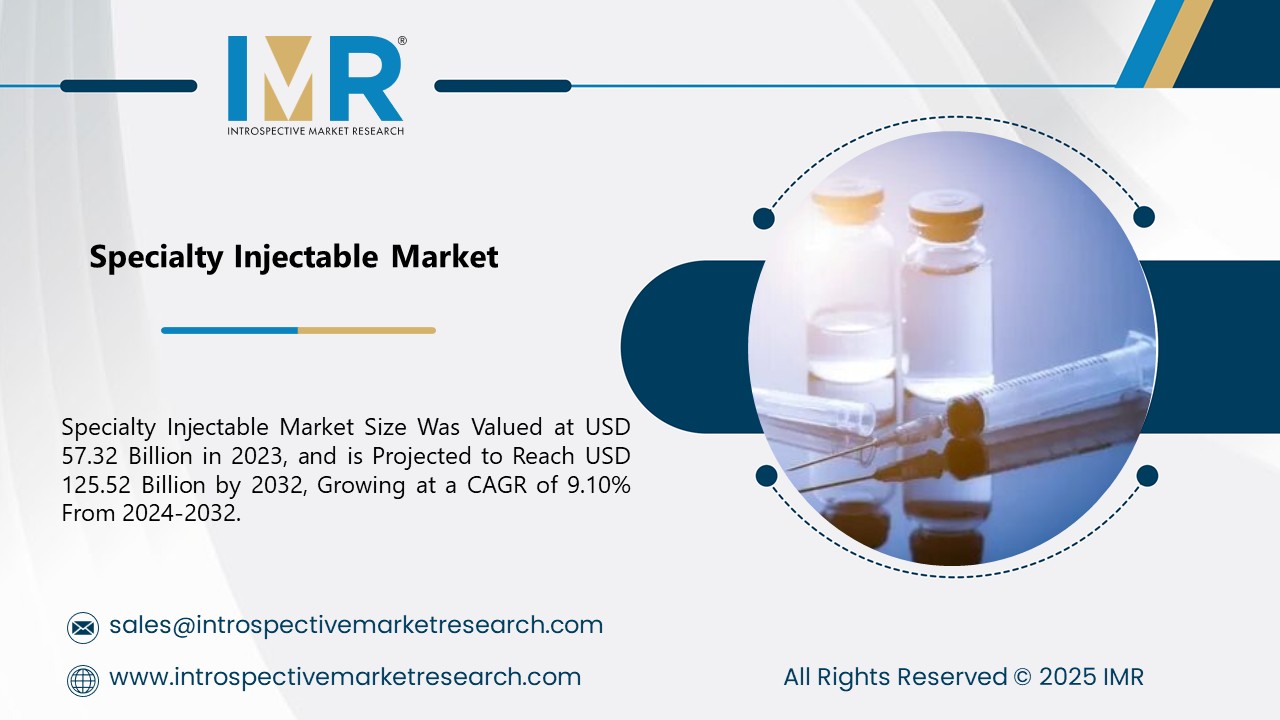
According to a new report published by Introspective Market Research, titled, Specialty Injectable Market by Type, Application, and Distribution Channel, The Global Specialty Injectable Market Size Was Valued at USD 57.32 Billion in 2023 and is Projected to Reach USD 125.52 Billion by 2032, Growing at a CAGR of 9.10%.The specialty injectable market is a rapidly expanding segment within the pharmaceutical industry, characterized by high-value, complex biological and small molecule drugs administered via injection. These advanced therapeutics are designed to treat chronic and complex conditions such as autoimmune disorders, cancer, infectious diseases, and rare genetic illnesses. Unlike traditional oral medications, specialty injectables often require precise dosing, specific administration techniques, and careful patient monitoring, offering targeted efficacy and improved outcomes for patients with unmet medical needs.
The advantages of specialty injectables over conventional treatments include enhanced bioavailability, faster onset of action, and the ability to deliver drugs that would otherwise be degraded in the digestive system. They play a crucial role in modern medicine, providing life-altering and life-saving options across various therapeutic areas. The market's growth is fueled by continuous innovation in drug development, increasing prevalence of chronic diseases, and a growing understanding of disease mechanisms, leading to more targeted and effective treatment modalities.
The Specialty Injectable Market is segmented into Type, Application, and Distribution Channel. By Type, the market is categorized into (Monoclonal Antibodies, Immunoglobulins, Cytokines, and Others). By Application, the market is categorized into (Oncology, Autoimmune Diseases, Infectious Diseases, Hormonal Disorders, and Others). By Distribution Channel, the market is categorized into (Hospital Pharmacies, Retail Pharmacies, and Online Pharmacies).
A primary growth driver for the specialty injectable market is the increasing global prevalence of chronic and complex diseases. Conditions such as various cancers, autoimmune disorders like rheumatoid arthritis and Crohn's disease, and an expanding range of rare diseases require highly specialized and often injectable treatments. As diagnostic capabilities improve and populations age, the incidence of these conditions rises, creating a sustained demand for innovative therapeutic solutions that specialty injectables provide. This demographic and epidemiological shift underscores the critical role these drugs play in modern healthcare.
A significant market opportunity within the specialty injectable sector lies in the continuous advancement of biologics and biosimilars. The development of novel monoclonal antibodies, gene therapies, and cell therapies represents the cutting edge of pharmaceutical innovation, promising highly targeted and effective treatments for previously intractable diseases. Simultaneously, the growing acceptance and market penetration of biosimilars—cost-effective alternatives to expensive biologic drugs—present a substantial opportunity to expand patient access and reduce healthcare costs, thereby broadening the market's reach and impact.
Specialty Injectable Market, Segmentation
The Specialty Injectable Market is segmented on the basis of Type, Application, and Distribution Channel.
Type
- The Type segment is further classified into Monoclonal Antibodies, Immunoglobulins, Cytokines, and Others. Among these, the Monoclonal Antibodies sub-segment accounted for the highest market share in 2023. Monoclonal antibodies (mAbs) are a cornerstone of modern specialty injectables due to their high specificity and efficacy in targeting disease-causing cells or molecules. Their application spans oncology, autoimmune diseases, and infectious diseases, offering precise therapeutic actions with reduced off-target effects. The continuous research and development of novel mAbs for a wider range of indications contribute significantly to their dominant market position.
Application
- The Application segment is further classified into Oncology, Autoimmune Diseases, Infectious Diseases, Hormonal Disorders, and Others. Among these, the Oncology sub-segment accounted for the highest market share in 2023. Specialty injectables have revolutionized cancer treatment, offering targeted therapies that improve patient outcomes and quality of life. From immunotherapies that harness the body's immune system to fight cancer to targeted drugs that block specific pathways involved in tumor growth, injectables are crucial in managing various types of cancer. The ongoing research and introduction of new oncology drugs continue to bolster this segment's leading position.
Some of The Leading/Active Market Players Are-
- AbbVie Inc. (USA)
- Amgen Inc. (USA)
- Bristol-Myers Squibb Company (USA)
- Eli Lilly and Company (USA)
- Gilead Sciences Inc. (USA)
- Johnson & Johnson (USA)
- Merck & Co. Inc. (USA)
- Novartis AG (Switzerland)
- Pfizer Inc. (USA)
- Roche Holding AG (Switzerland)
- Sanofi S.A. (France)
- Takeda Pharmaceutical Company Limited (Japan)
- Novo Nordisk A/S (Denmark)
- Biogen Inc. (USA)
- CSL Limited (Australia)
- Other active players.
Key Industry Developments
- In March 2023, Amgen Inc. announced the acquisition of Horizon Therapeutics for approximately $27.8 billion, significantly expanding its portfolio of rare disease and inflammatory specialty injectables.
This acquisition bolstered Amgen's presence in the specialty pharmaceutical market, adding several key products that treat rare, autoimmune, and severe inflammatory diseases, further strengthening its leadership in high-growth therapeutic areas. - In November 2023, Eli Lilly and Company received FDA approval for a new specialty injectable for the treatment of obesity, marking a significant advancement in metabolic health.
This approval introduced an innovative therapeutic option for patients struggling with obesity, leveraging a novel mechanism of action to provide substantial weight loss benefits and address a major global health challenge.
Key Findings of the Study
- Monoclonal Antibodies dominate the market, driven by high specificity and efficacy.
- Oncology is the leading application segment, benefiting from continuous therapeutic innovations.
- Rising prevalence of chronic and complex diseases is a primary growth driver.
- Advancements in biologics and biosimilars present significant market opportunities.
- The market is characterized by high R&D investment and a focus on targeted therapies.