
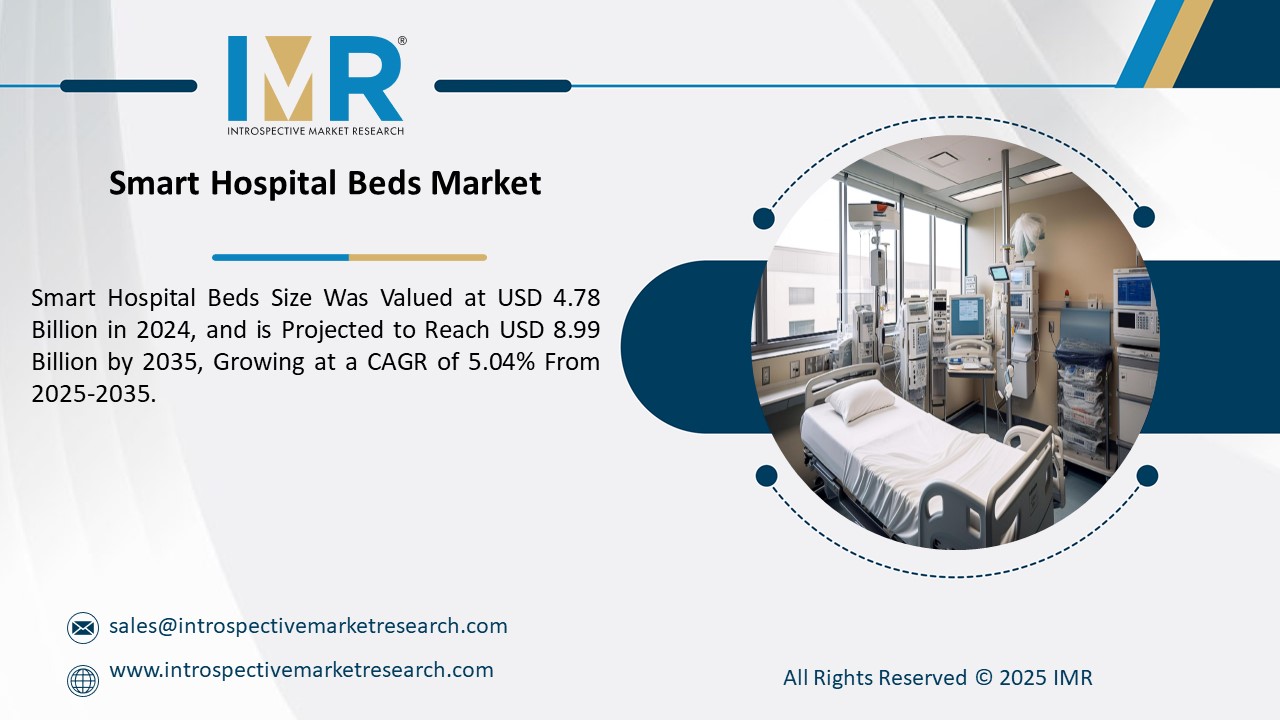
The Smart Hospital Beds Market is revolutionizing patient care and healthcare management by integrating advanced technology with traditional hospital bed systems. These beds feature automated positioning, patient monitoring sensors, weight detection, and connectivity with hospital information systems to ensure safety, comfort, and operational efficiency.
Smart hospital beds are increasingly being adopted in hospitals, clinics, and long-term care facilities to enhance patient outcomes and streamline clinical workflows. The rising prevalence of chronic illnesses, growing elderly populations, and the global push toward smart healthcare infrastructure are major factors fueling market growth.
Furthermore, the integration of Internet of Things (IoT), artificial intelligence (AI), and data analytics within these beds allows for real-time patient monitoring and predictive health management. These advancements support healthcare professionals in delivering timely and precise interventions, reducing manual workloads, and improving overall hospital efficiency.
One of the key growth drivers for the Smart Hospital Beds Market is the increasing adoption of IoT-enabled healthcare devices for patient monitoring and management. Smart beds equipped with sensors and connected systems allow real-time tracking of patient vitals, bed occupancy, and movement, significantly reducing the risk of pressure ulcers, falls, and other hospital-acquired conditions. This data-driven approach not only enhances patient safety but also improves healthcare staff efficiency and hospital resource utilization.
An emerging opportunity in the Smart Hospital Beds Market lies in the integration of artificial intelligence (AI) and predictive analytics. These technologies enable smart beds to detect abnormal patient patterns, predict critical health events, and alert medical staff proactively. The demand for such intelligent solutions is expected to grow as hospitals increasingly focus on remote care, telemedicine integration, and predictive maintenance of hospital equipment to ensure seamless patient management.
Smart Hospital Beds Market, Segmentation
The Smart Hospital Beds Market is segmented on the basis of Type, Application, and End User.
Type
- The Type segment is further classified into Manual, Semi-Automatic, and Fully Automatic Beds. Among these, the Fully Automatic Beds sub-segment accounted for the highest market share in 2024. These beds are designed with automated adjustments for height, tilt, and backrest, ensuring enhanced patient comfort and reduced dependency on nursing staff. Their integration with IoT platforms enables advanced monitoring and data transmission, supporting hospitals in delivering efficient, technology-driven care.
Application
- The Application segment is further classified into General, Intensive Care, and Maternity. Among these, the Intensive Care sub-segment accounted for the highest market share in 2024. Intensive care units demand advanced beds equipped with monitoring systems, multi-positioning features, and quick emergency responses. The growing number of critical care cases and the focus on minimizing human error have accelerated the adoption of smart ICU beds in healthcare facilities.
End User
- The End User segment is categorized into Hospitals, Specialty Clinics, and Homecare Settings. Among these, Hospitals accounted for the largest market share in 2024. The rapid digital transformation of hospital infrastructure and the increasing focus on patient safety and comfort are key factors driving this dominance.
Some of The Leading/Active Market Players Are:
• Hill-Rom Holdings, Inc. (U.S.)
• Stryker Corporation (U.S.)
• Invacare Corporation (U.S.)
• LINET Group SE (Czech Republic)
• Paramount Bed Holdings Co., Ltd. (Japan)
• Arjo AB (Sweden)
• Stiegelmeyer GmbH & Co. KG (Germany)
• Span-America Medical Systems, Inc. (U.S.)
• Drive DeVilbiss Healthcare (U.S.)
• Joerns Healthcare LLC (U.S.)
• Malvestio S.P.A. (Italy)
• Favero Health Projects (Italy)
• Savion Industries (Israel)
• Gendron Inc. (U.S.)
• Antano Group (Italy)
and other active players.
Key Industry Developments
- In March 2024, Hillrom (a part of Baxter International) announced the launch of an upgraded version of its Centrella Smart+ Bed equipped with advanced patient monitoring and fall-prevention sensors. The innovation aims to enhance patient safety and enable hospitals to integrate real-time data analytics for early detection of health deterioration.
- In August 2023, LINET Group SE introduced its Eleganza 5 Bed featuring hybrid mattress technology and integrated mobility sensors. The product enhances patient comfort, supports dynamic positioning, and optimizes nursing workflows, aligning with the company’s goal of advancing smart healthcare solutions.
Key Findings of the Study
• Fully automatic beds dominated the market in 2024.
• Hospitals remain the largest end-user segment.
• North America led the market, driven by healthcare modernization.
• IoT integration and AI-based patient monitoring are key trends.
• Demand for remote care and predictive analytics to fuel growth.





