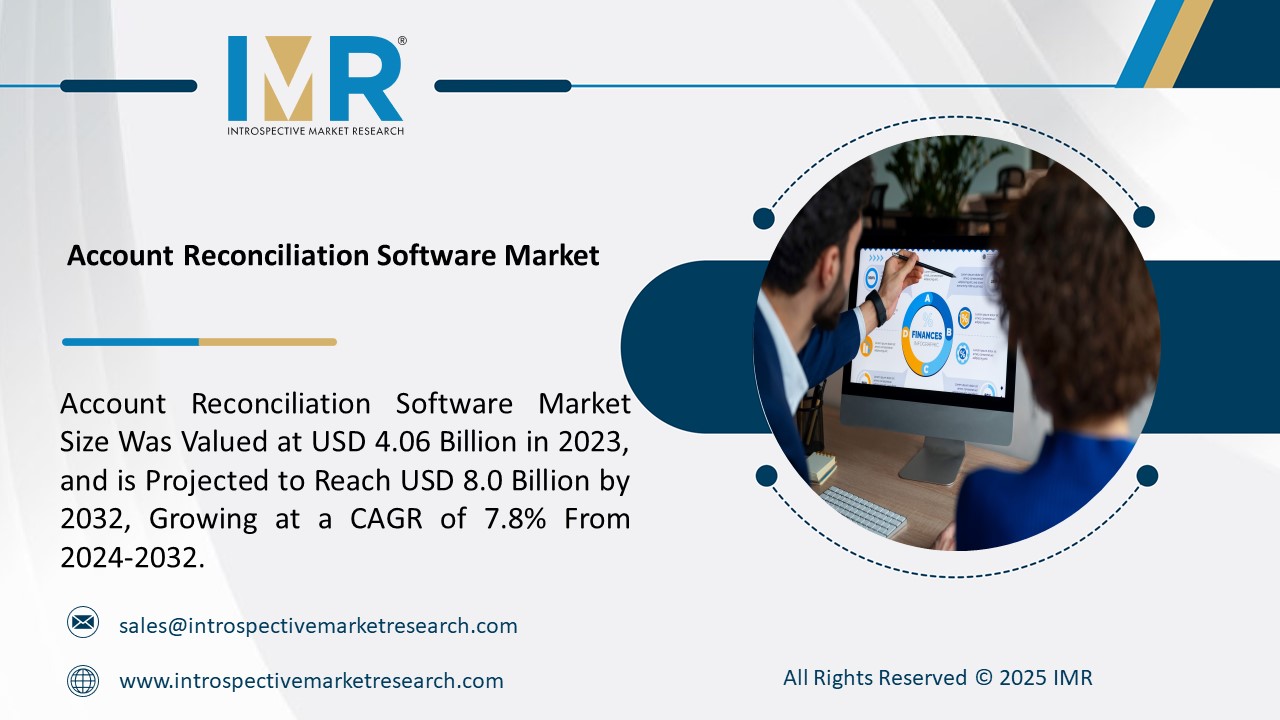
According to a new report published by Introspective Market Research, titled, Account Reconciliation Software Market by Deployment, Organization Size, and End-Use, The Global Account Reconciliation Software Market Size Was Valued at USD 4.06 Billion in 2023 and is Projected to Reach USD 8.0 Billion by 2032, Growing at a CAGR of 7.8%. The global Account Reconciliation Software market is experiencing steady growth as organizations increasingly seek automation to streamline their financial processes. Account reconciliation software helps companies manage discrepancies between internal records and external statements, ensuring accuracy, compliance, and audit readiness. It is particularly critical for industries dealing with large volumes of transactions such as banking, insurance, and enterprise-level finance departments.
Traditional manual reconciliation processes are time-consuming, error-prone, and resource-intensive. Modern account reconciliation software automates these tasks, providing real-time monitoring, exception management, and comprehensive reporting. This reduces operational risks, improves financial transparency, and accelerates month-end and year-end closing processes. Organizations are also adopting these solutions to comply with regulatory standards such as SOX, IFRS, and GAAP. The software’s ability to integrate with existing ERP systems and cloud-based platforms allows companies to achieve seamless financial operations, providing an opportunity for improved decision-making and operational efficiency.
The Account Reconciliation Software Market is segmented into Deployment, Organization Size, and End-Use. By Deployment, the market is categorized into (On-Premises, Cloud-Based). By Organization Size, the market is categorized into (Small & Medium Enterprises (SMEs), Large Enterprises). By End-Use, the market is categorized into (Banking & Financial Services, Insurance, IT & Telecommunications, Healthcare, Manufacturing, and Others). A major growth driver for the account reconciliation software market is the rising demand for process automation and digital financial transformation across industries. Organizations are under pressure to reduce manual errors, improve audit readiness, and meet compliance requirements efficiently. Automated reconciliation platforms streamline financial operations, minimize operational risk, and allow finance teams to focus on strategic initiatives. The increased adoption of cloud-based solutions further supports scalability, remote access, and cost efficiency, driving adoption among enterprises of all sizes.
One of the key opportunities in the market is the growing shift toward cloud-based reconciliation platforms. Cloud solutions offer flexibility, real-time access, and integration capabilities with ERP and other financial systems, reducing IT overhead and enabling faster deployment. Additionally, small and medium enterprises (SMEs) are increasingly adopting cloud reconciliation software to enhance financial transparency and efficiency. The continuous integration of AI and machine learning also opens opportunities for predictive analytics, anomaly detection, and intelligent exception handling, significantly improving overall financial management.
Account Reconciliation Software Market, Segmentation
The Account Reconciliation Software Market is segmented on the basis of Deployment, Organization Size, and End-Use.
By Deployment: The Deployment segment is further classified into On-Premises and Cloud-Based. Among these, the Cloud-Based sub-segment accounted for the highest market share in 2023. Cloud-based software is increasingly preferred due to its scalability, cost-effectiveness, and ease of integration with ERP and other financial systems. Organizations can access real-time reconciliation reports, automate repetitive tasks, and reduce reliance on IT infrastructure, enabling faster financial closing and improved compliance.
By Organization Size: The Organization Size segment is further classified into Small & Medium Enterprises (SMEs) and Large Enterprises. Among these, the Large Enterprises sub-segment accounted for the highest market share in 2023. Large enterprises handle complex and high-volume financial transactions, making automated reconciliation crucial for accuracy and efficiency. Advanced solutions help reduce manual errors, manage regulatory compliance, and improve audit processes, allowing financial teams to focus on strategic decision-making and process optimization.
Some of The Leading/Active Market Players Are
- BlackLine, Inc. (USA)
- Trintech, Inc. (USA)
- Oracle Corporation (USA)
- SAP SE (Germany)
- Workiva Inc. (USA)
- ReconArt (UK)
- Adra by Trintech (USA)
- FloQast (USA)
- CCH Tagetik (Italy)
- Serrala (Germany)
- HighRadius (USA)
- Intuit Inc. (USA)
- APTOS Financial Systems (UK)
- Vena Solutions (Canada) and other active players.
Key Industry Developments
-
In March 2024, BlackLine announced the launch of its enhanced AI-driven reconciliation module to improve automation and exception handling. The new solution automates high-volume transaction matching, detects anomalies using machine learning, and provides predictive insights. Enterprises benefit from reduced manual intervention, faster month-end closings, and improved compliance with financial reporting standards.
- In July 2023, Trintech partnered with Microsoft to integrate its Cadency reconciliation platform with Microsoft Dynamics 365. The integration enables real-time data synchronization, seamless workflow automation, and cloud-based reporting. It enhances operational efficiency for finance teams, reduces errors, and ensures adherence to global compliance regulations while enabling scalability for growing enterprises.
Key Findings of the Study
- Cloud-Based deployment leads the market, offering scalability and integration advantages.
- Large Enterprises dominate due to high-volume financial transactions.
- Banking & Financial Services and Insurance are leading end-use sectors.
- Automation, AI integration, and regulatory compliance are primary growth drivers.
- Cloud adoption and intelligent exception management present major market opportunities.