




Zircon Sand Market Synopsis:
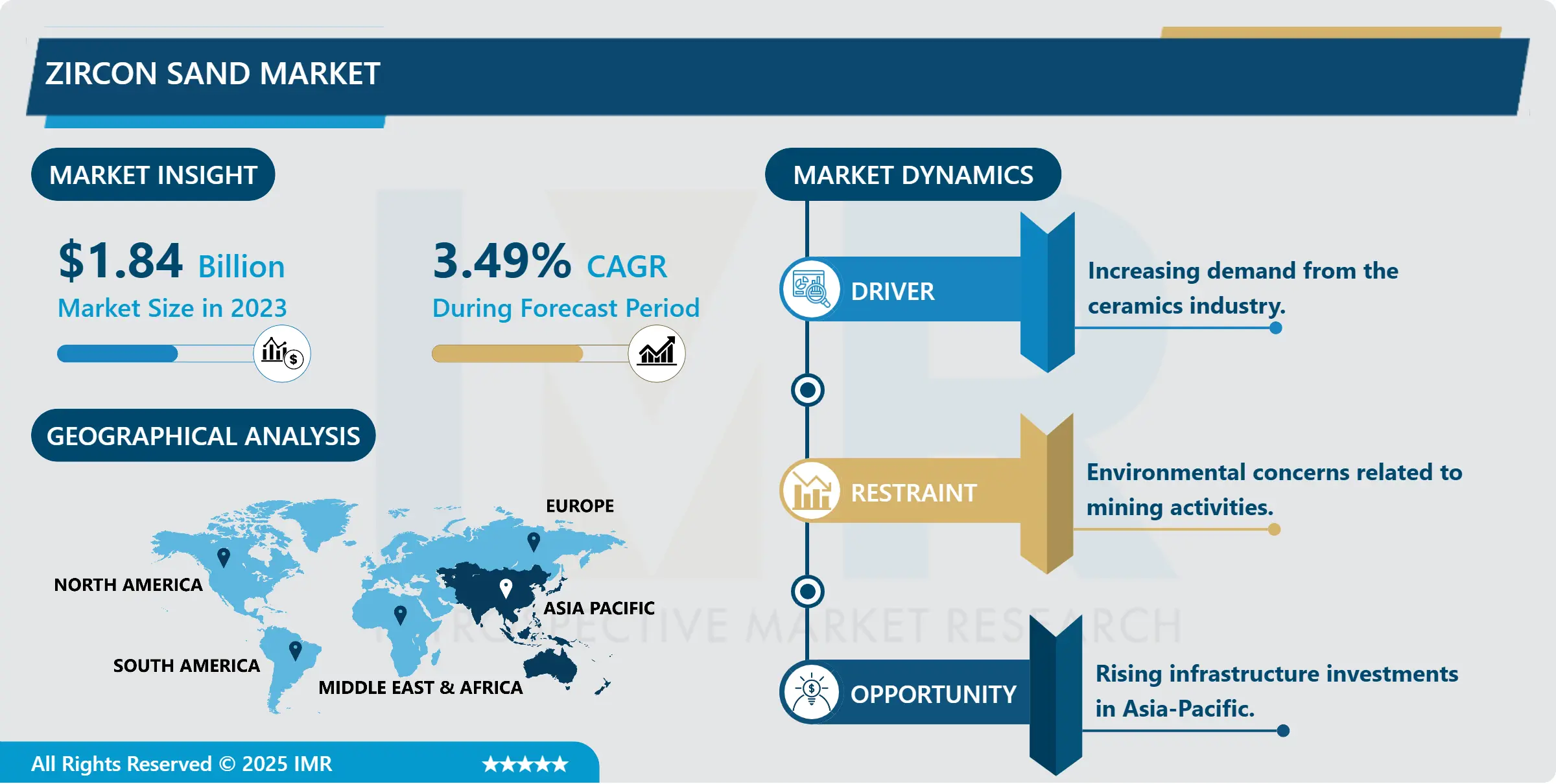
Zircon Sand Market Size Was Valued at USD 1.84 Billion in 2023, and is Projected to Reach USD 2.5 Billion by 2032, Growing at a CAGR of 3.49% From 2024-2032.
Zircon sand is mineral consist of mainly of zirconium silicate which is obtained from mineral sand containing other minerals such as ilmenite and rutile. Zircon sand is commonly employed in ceramics, refractory, and foundries industries as an excellent raw material used in high temperature applications due to possessing high melting with the ability to resist corrosion. It is widely used in cement production and, in the growing application areas of tiles, sanitary ware, and glass, as well as in casting and Mold production.
It has been noted elsewhere that the zircon sand market has been characterized by good growth within the past few years particularly due to its use in industrial applications such as ceramics and refractory. High heat resistance together with other qualities make zircon sand to be used in areas where it is needed most such as in the production of ceramics. Lately, ceramic industry has a great demand for zircon sand since it mostly used in manufacturing tiles and sanitary wares. Ongoing construction activities in the developed as well as the developing nations along with the expansion of the global infrastructure projects has fuelled the need for ceramics and therefore the zircon sand.
The Market is also driven by demand from foundry application and various metal industries where demand of zirconium is relatively high. By reviewing the historical and current trends in the consumption of zircon sand, the authors discovered that its application in the foundry industry has a positive trend because the material is heat resistant and, therefore, suitable for applying in the production of Molds used in casting processes. Moreover, technological developments are shifting companies to more appropriate utilization of zirconium assets. This demand growth is further complemented by attempts to improve zircon on extraction of this material and its purification from impurities that put the zircon sand market as an indispensable commodity in the present-day industrial sector.
Zircon Sand Market Trend Analysis:
Sustainability and Resource Efficiency
-
Environmentally friendly product and recycling of zircon_ products are emerging as major issues that have formed sustainability as a trend in the zircon sand market. There has been a tendency by companies to look for ways whereby the use of zircon sand may be reduced while consumption is at the same time minimized by looking for methods of recycling the zircon sand. Technological progression is providing avenues for the recycling of zircon in a manner that not only preserves the material but also brings down the cost to user organizations, which is making zircon more and more viable. For example, more sustainable casting processes have included the use of recycled zircon sand for Mold making especially where high quality is required such as in the foundries. Further, there is a move towards sustainable mining which is coming into practice as most mining companies look forward to achieving low levels of emissions, water use, and the negative impact they have on the land consequent to zircon sand extraction.
- Governments and various non-governmental environmental organizations are also using forces on companies by implementing key environmental standards. It would therefore be expected that there would be increased use of recycled zircon sand in such markets due to both increased regulatory pressures to use recycled materials and the fact that customers are warming up to using products made from recycled material. This trend is expected to not only assist to conserve resources to meet the market operational costs but also assist to reduce most of the operational costs hence positively contributing to the long-term success of the market.
Growing Demand in Asia-Pacific
-
The Asia Pacific region seems to offer a great potential of growth in zircon sand market due to higher pace in industrialization and urbanization. In Addition, as China, India and the southeast Asian counties grow their construction automotive, electronics industries need for zircon in ceramics and refractory is increasing. In China, where ceramics manufacturing Industry is highly developed, zircon is used for tile and high-quality glass manufacturing and there is ever growing demand from the middle class population which is looking for durable commodities.
Zircon Sand Market Segment Analysis:
Zircon Sand Market Segmented on the basis of Type, Application, End user, and Region.
By Type, Fine Grain segment is expected to dominate the market during the forecast period
-
The Fine Grain segment is presumed to maintain its leading edge over the other options in the zircon sand market during the forecast period since this component has more application across the Industries which needs high precision and smooth surface like Ceramics, Glass, and Foundry Casting etc. However, fine grain zircon sand particles are universally popular in ceramics manufacturing because they allow for a more refined surface finish improving quality of tiles, sanitary ware and other premium ceramic end products. Further, in foundry application fine grain zircon serves better heat-resistant properties and better mould strength which is essential for manufacturing standard metal casting. This segment’s demand is further fostered by higher construction activities and urbanization across the world in combination with the higher tendency to utilize premium and sturdy products, especially in the developing countries.
By Application, Ceramics segment expected to held the largest share
-
The Ceramics segment is seen to capture strongest market for the zircon sand since it is widely used in ceramic tiles, sanitaryware and tableware. Because of its high melting point, chemical inactivity, and positive impact on durability, zircon sand is an ingredient of ceramic glaze which imparts lustre, strength and abrasive resistance. Increased activity in the residential and commercial construction, especially in the developing world has boosted the demand for ceramic tiles and sanitary products hence the growth of this segment. Furthermore, as consumer preference goes up for superior quality, resilient ceramics as home interior decoration materials, the significance of ceramics segment’s dependency on zircon sand becomes stronger, thereby endorsing the market titanic position.
Zircon Sand Market Regional Insights:
Asia- Pacific is Expected to Dominate the Market Over the Forecast period
-
Asia-Pacific is at the moment the leading market for zircon sand since the region has a large market for ceramics and construction industries. About 40% of the global demand for zircon sand was estimated to have occurred and occurred in the Asia-Pacific region in 2023. This is especially due to the large demand mostly from the two leading ceramic and tiles consuming nations, which are china and India who prefer the high-quality zircon. With rapidly growing infrastructure, the middle class who prefer better quality zircon products and a large population of consumers boost the demand for zircon. Moreover, large mining and refining activities in Australia, the largest zircon mineral exporter, boosts the dominance of the Asia-Pacific market by providing sufficient zircon sand resources to the Asia-Pacific region, low-quality zircon sand.
Active Key Players in the Zircon Sand Market
-
Alkane Resources (Australia)
- Astron Corporation (Australia)
- Base Resources (Australia)
- Eramet (France)
- Iluka Resources (Australia)
- Imerys (France)
- Indian Rare Earths Limited (India)
- Kenmare Resources (Ireland)
- MZI Resources (Australia)
- Rio Tinto (United Kingdom)
- The Chemours Company (United States)
- Tormin Mineral Sands (South Africa)
- Tronox Holdings (United States)
- VV Mineral (India)
- Zhejiang Jinhai High-Tech Co. Ltd. (China)
- Other Active Players.
|
Global Zircon Sand Market |
|||
|
Base Year: |
2023 |
Forecast Period: |
2024-2032 |
|
Historical Data: |
2017 to 2023 |
Market Size in 2023: |
USD 1.84 Billion |
|
Forecast Period 2024-32 CAGR: |
3.49% |
Market Size in 2032: |
USD 2.5 Billion |
|
Segments Covered: |
By Type |
|
|
|
By Application |
|
||
|
End Users |
|
||
|
By Region |
|
||
|
Key Market Drivers: |
|
||
|
Key Market Restraints: |
|
||
|
Key Opportunities: |
|
||
|
Companies Covered in the report: |
|
||
Chapter 1: Introduction
1.1 Scope and Coverage
Chapter 2:Executive Summary
Chapter 3: Market Landscape
3.1 Market Dynamics
3.1.1 Drivers
3.1.2 Restraints
3.1.3 Opportunities
3.1.4 Challenges
3.2 Market Trend Analysis
3.3 PESTLE Analysis
3.4 Porter's Five Forces Analysis
3.5 Industry Value Chain Analysis
3.6 Ecosystem
3.7 Regulatory Landscape
3.8 Price Trend Analysis
3.9 Patent Analysis
3.10 Technology Evolution
3.11 Investment Pockets
3.12 Import-Export Analysis
Chapter 4: Zircon Sand Market by Type
4.1 Zircon Sand Market Snapshot and Growth Engine
4.2 Zircon Sand Market Overview
4.3 Fine Grain
4.3.1 Introduction and Market Overview
4.3.2 Historic and Forecasted Market Size in Value USD and Volume Units (2017-2032F)
4.3.3 Key Market Trends, Growth Factors and Opportunities
4.3.4 Fine Grain: Geographic Segmentation Analysis
4.4 Coarse Grain)
4.4.1 Introduction and Market Overview
4.4.2 Historic and Forecasted Market Size in Value USD and Volume Units (2017-2032F)
4.4.3 Key Market Trends, Growth Factors and Opportunities
4.4.4 Coarse Grain): Geographic Segmentation Analysis
4.5
4.5.1 Introduction and Market Overview
4.5.2 Historic and Forecasted Market Size in Value USD and Volume Units (2017-2032F)
4.5.3 Key Market Trends, Growth Factors and Opportunities
4.5.4 : Geographic Segmentation Analysis
Chapter 5: Zircon Sand Market by Application
5.1 Zircon Sand Market Snapshot and Growth Engine
5.2 Zircon Sand Market Overview
5.3 Ceramics
5.3.1 Introduction and Market Overview
5.3.2 Historic and Forecasted Market Size in Value USD and Volume Units (2017-2032F)
5.3.3 Key Market Trends, Growth Factors and Opportunities
5.3.4 Ceramics: Geographic Segmentation Analysis
5.4 Foundry Casting
5.4.1 Introduction and Market Overview
5.4.2 Historic and Forecasted Market Size in Value USD and Volume Units (2017-2032F)
5.4.3 Key Market Trends, Growth Factors and Opportunities
5.4.4 Foundry Casting: Geographic Segmentation Analysis
5.5 Refractories
5.5.1 Introduction and Market Overview
5.5.2 Historic and Forecasted Market Size in Value USD and Volume Units (2017-2032F)
5.5.3 Key Market Trends, Growth Factors and Opportunities
5.5.4 Refractories: Geographic Segmentation Analysis
5.6 Jewellery)
5.6.1 Introduction and Market Overview
5.6.2 Historic and Forecasted Market Size in Value USD and Volume Units (2017-2032F)
5.6.3 Key Market Trends, Growth Factors and Opportunities
5.6.4 Jewellery): Geographic Segmentation Analysis
5.7
5.7.1 Introduction and Market Overview
5.7.2 Historic and Forecasted Market Size in Value USD and Volume Units (2017-2032F)
5.7.3 Key Market Trends, Growth Factors and Opportunities
5.7.4 : Geographic Segmentation Analysis
Chapter 6: Zircon Sand Market by End User
6.1 Zircon Sand Market Snapshot and Growth Engine
6.2 Zircon Sand Market Overview
6.3 Ceramics Industry
6.3.1 Introduction and Market Overview
6.3.2 Historic and Forecasted Market Size in Value USD and Volume Units (2017-2032F)
6.3.3 Key Market Trends, Growth Factors and Opportunities
6.3.4 Ceramics Industry: Geographic Segmentation Analysis
6.4 Foundry Industry
6.4.1 Introduction and Market Overview
6.4.2 Historic and Forecasted Market Size in Value USD and Volume Units (2017-2032F)
6.4.3 Key Market Trends, Growth Factors and Opportunities
6.4.4 Foundry Industry: Geographic Segmentation Analysis
6.5 Chemical Industry
6.5.1 Introduction and Market Overview
6.5.2 Historic and Forecasted Market Size in Value USD and Volume Units (2017-2032F)
6.5.3 Key Market Trends, Growth Factors and Opportunities
6.5.4 Chemical Industry: Geographic Segmentation Analysis
6.6 Refractory Industry
6.6.1 Introduction and Market Overview
6.6.2 Historic and Forecasted Market Size in Value USD and Volume Units (2017-2032F)
6.6.3 Key Market Trends, Growth Factors and Opportunities
6.6.4 Refractory Industry: Geographic Segmentation Analysis
6.7 Jewellery Industry)
6.7.1 Introduction and Market Overview
6.7.2 Historic and Forecasted Market Size in Value USD and Volume Units (2017-2032F)
6.7.3 Key Market Trends, Growth Factors and Opportunities
6.7.4 Jewellery Industry) : Geographic Segmentation Analysis
Chapter 7: Company Profiles and Competitive Analysis
7.1 Competitive Landscape
7.1.1 Competitive Benchmarking
7.1.2 Zircon Sand Market Share by Manufacturer (2023)
7.1.3 Industry BCG Matrix
7.1.4 Heat Map Analysis
7.1.5 Mergers and Acquisitions
7.2 ILUKA RESOURCES (AUSTRALIA)
7.2.1 Company Overview
7.2.2 Key Executives
7.2.3 Company Snapshot
7.2.4 Role of the Company in the Market
7.2.5 Sustainability and Social Responsibility
7.2.6 Operating Business Segments
7.2.7 Product Portfolio
7.2.8 Business Performance
7.2.9 Key Strategic Moves and Recent Developments
7.2.10 SWOT Analysis
7.3 RIO TINTO (UK)
7.4 TRONOX HOLDINGS (US)
7.5 KENMARE RESOURCES (IRELAND)
7.6 MZI RESOURCES (AUSTRALIA)
7.7 OTHER ACTIVE PLAYERS
Chapter 8: Global Zircon Sand Market By Region
8.1 Overview
8.2. North America Zircon Sand Market
8.2.1 Key Market Trends, Growth Factors and Opportunities
8.2.2 Top Key Companies
8.2.3 Historic and Forecasted Market Size by Segments
8.2.4 Historic and Forecasted Market Size By Type
8.2.4.1 Fine Grain
8.2.4.2 Coarse Grain)
8.2.4.3
8.2.5 Historic and Forecasted Market Size By Application
8.2.5.1 Ceramics
8.2.5.2 Foundry Casting
8.2.5.3 Refractories
8.2.5.4 Jewellery)
8.2.5.5
8.2.6 Historic and Forecasted Market Size By End User
8.2.6.1 Ceramics Industry
8.2.6.2 Foundry Industry
8.2.6.3 Chemical Industry
8.2.6.4 Refractory Industry
8.2.6.5 Jewellery Industry)
8.2.7 Historic and Forecast Market Size by Country
8.2.7.1 US
8.2.7.2 Canada
8.2.7.3 Mexico
8.3. Eastern Europe Zircon Sand Market
8.3.1 Key Market Trends, Growth Factors and Opportunities
8.3.2 Top Key Companies
8.3.3 Historic and Forecasted Market Size by Segments
8.3.4 Historic and Forecasted Market Size By Type
8.3.4.1 Fine Grain
8.3.4.2 Coarse Grain)
8.3.4.3
8.3.5 Historic and Forecasted Market Size By Application
8.3.5.1 Ceramics
8.3.5.2 Foundry Casting
8.3.5.3 Refractories
8.3.5.4 Jewellery)
8.3.5.5
8.3.6 Historic and Forecasted Market Size By End User
8.3.6.1 Ceramics Industry
8.3.6.2 Foundry Industry
8.3.6.3 Chemical Industry
8.3.6.4 Refractory Industry
8.3.6.5 Jewellery Industry)
8.3.7 Historic and Forecast Market Size by Country
8.3.7.1 Russia
8.3.7.2 Bulgaria
8.3.7.3 The Czech Republic
8.3.7.4 Hungary
8.3.7.5 Poland
8.3.7.6 Romania
8.3.7.7 Rest of Eastern Europe
8.4. Western Europe Zircon Sand Market
8.4.1 Key Market Trends, Growth Factors and Opportunities
8.4.2 Top Key Companies
8.4.3 Historic and Forecasted Market Size by Segments
8.4.4 Historic and Forecasted Market Size By Type
8.4.4.1 Fine Grain
8.4.4.2 Coarse Grain)
8.4.4.3
8.4.5 Historic and Forecasted Market Size By Application
8.4.5.1 Ceramics
8.4.5.2 Foundry Casting
8.4.5.3 Refractories
8.4.5.4 Jewellery)
8.4.5.5
8.4.6 Historic and Forecasted Market Size By End User
8.4.6.1 Ceramics Industry
8.4.6.2 Foundry Industry
8.4.6.3 Chemical Industry
8.4.6.4 Refractory Industry
8.4.6.5 Jewellery Industry)
8.4.7 Historic and Forecast Market Size by Country
8.4.7.1 Germany
8.4.7.2 UK
8.4.7.3 France
8.4.7.4 The Netherlands
8.4.7.5 Italy
8.4.7.6 Spain
8.4.7.7 Rest of Western Europe
8.5. Asia Pacific Zircon Sand Market
8.5.1 Key Market Trends, Growth Factors and Opportunities
8.5.2 Top Key Companies
8.5.3 Historic and Forecasted Market Size by Segments
8.5.4 Historic and Forecasted Market Size By Type
8.5.4.1 Fine Grain
8.5.4.2 Coarse Grain)
8.5.4.3
8.5.5 Historic and Forecasted Market Size By Application
8.5.5.1 Ceramics
8.5.5.2 Foundry Casting
8.5.5.3 Refractories
8.5.5.4 Jewellery)
8.5.5.5
8.5.6 Historic and Forecasted Market Size By End User
8.5.6.1 Ceramics Industry
8.5.6.2 Foundry Industry
8.5.6.3 Chemical Industry
8.5.6.4 Refractory Industry
8.5.6.5 Jewellery Industry)
8.5.7 Historic and Forecast Market Size by Country
8.5.7.1 China
8.5.7.2 India
8.5.7.3 Japan
8.5.7.4 South Korea
8.5.7.5 Malaysia
8.5.7.6 Thailand
8.5.7.7 Vietnam
8.5.7.8 The Philippines
8.5.7.9 Australia
8.5.7.10 New Zealand
8.5.7.11 Rest of APAC
8.6. Middle East & Africa Zircon Sand Market
8.6.1 Key Market Trends, Growth Factors and Opportunities
8.6.2 Top Key Companies
8.6.3 Historic and Forecasted Market Size by Segments
8.6.4 Historic and Forecasted Market Size By Type
8.6.4.1 Fine Grain
8.6.4.2 Coarse Grain)
8.6.4.3
8.6.5 Historic and Forecasted Market Size By Application
8.6.5.1 Ceramics
8.6.5.2 Foundry Casting
8.6.5.3 Refractories
8.6.5.4 Jewellery)
8.6.5.5
8.6.6 Historic and Forecasted Market Size By End User
8.6.6.1 Ceramics Industry
8.6.6.2 Foundry Industry
8.6.6.3 Chemical Industry
8.6.6.4 Refractory Industry
8.6.6.5 Jewellery Industry)
8.6.7 Historic and Forecast Market Size by Country
8.6.7.1 Turkiye
8.6.7.2 Bahrain
8.6.7.3 Kuwait
8.6.7.4 Saudi Arabia
8.6.7.5 Qatar
8.6.7.6 UAE
8.6.7.7 Israel
8.6.7.8 South Africa
8.7. South America Zircon Sand Market
8.7.1 Key Market Trends, Growth Factors and Opportunities
8.7.2 Top Key Companies
8.7.3 Historic and Forecasted Market Size by Segments
8.7.4 Historic and Forecasted Market Size By Type
8.7.4.1 Fine Grain
8.7.4.2 Coarse Grain)
8.7.4.3
8.7.5 Historic and Forecasted Market Size By Application
8.7.5.1 Ceramics
8.7.5.2 Foundry Casting
8.7.5.3 Refractories
8.7.5.4 Jewellery)
8.7.5.5
8.7.6 Historic and Forecasted Market Size By End User
8.7.6.1 Ceramics Industry
8.7.6.2 Foundry Industry
8.7.6.3 Chemical Industry
8.7.6.4 Refractory Industry
8.7.6.5 Jewellery Industry)
8.7.7 Historic and Forecast Market Size by Country
8.7.7.1 Brazil
8.7.7.2 Argentina
8.7.7.3 Rest of SA
Chapter 9 Analyst Viewpoint and Conclusion
9.1 Recommendations and Concluding Analysis
9.2 Potential Market Strategies
Chapter 10 Research Methodology
10.1 Research Process
10.2 Primary Research
10.3 Secondary Research
|
Global Zircon Sand Market |
|||
|
Base Year: |
2023 |
Forecast Period: |
2024-2032 |
|
Historical Data: |
2017 to 2023 |
Market Size in 2023: |
USD 1.84 Billion |
|
Forecast Period 2024-32 CAGR: |
3.49% |
Market Size in 2032: |
USD 2.5 Billion |
|
Segments Covered: |
By Type |
|
|
|
By Application |
|
||
|
End Users |
|
||
|
By Region |
|
||
|
Key Market Drivers: |
|
||
|
Key Market Restraints: |
|
||
|
Key Opportunities: |
|
||
|
Companies Covered in the report: |
|
||


