




Wetsuits Market Synopsis:
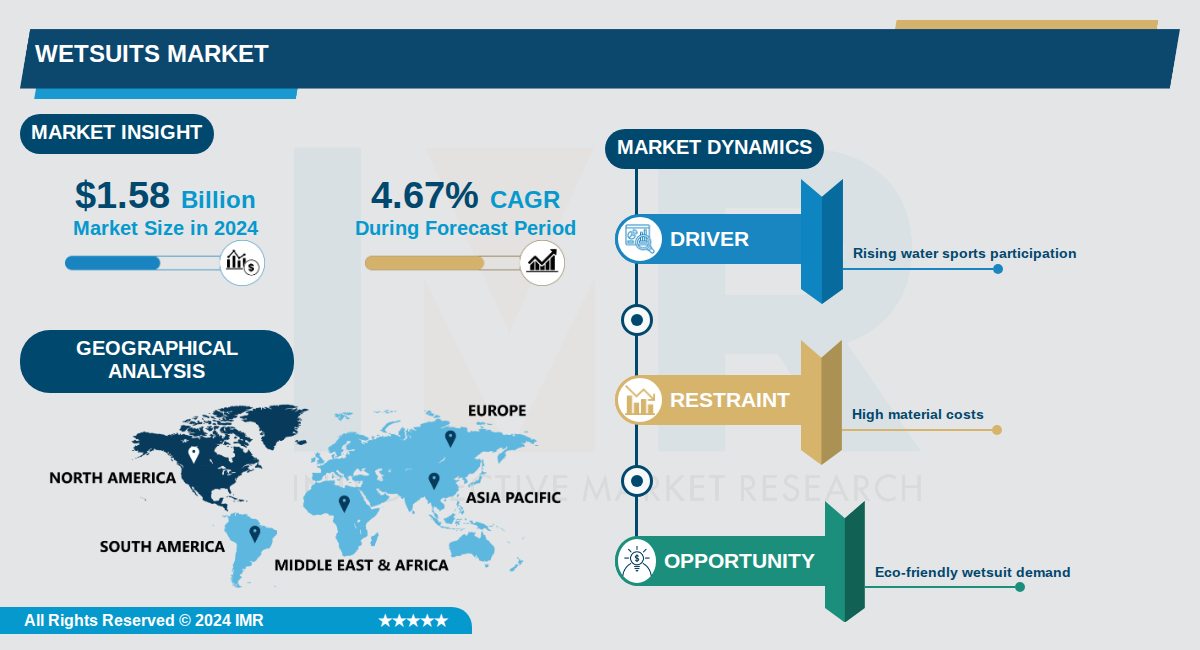
Wetsuits Market Size Was Valued at USD 1.58 Billion in 2024, and is Projected to Reach USD 2.61 Billion by 2035, Growing at a CAGR of 4.67% From 2024-2035.
The global wetsuits market was valued at $1.58 billion in 2024 and is projected to reach $2.61 billion by 2035, growing at a compound annual growth rate (CAGR) of 4.67%. This expansion reflects steady demand for thermal protection gear in water sports and recreational activities, with estimates varying across sources from approximately $1.4-7.39 billion in 2024 to $2.13-20.84 billion by 2035 at CAGRs ranging from 4.7% to 9.88%. North America holds the largest market share, while Asia-Pacific is the fastest-growing region due to rising aquatic sports participation.
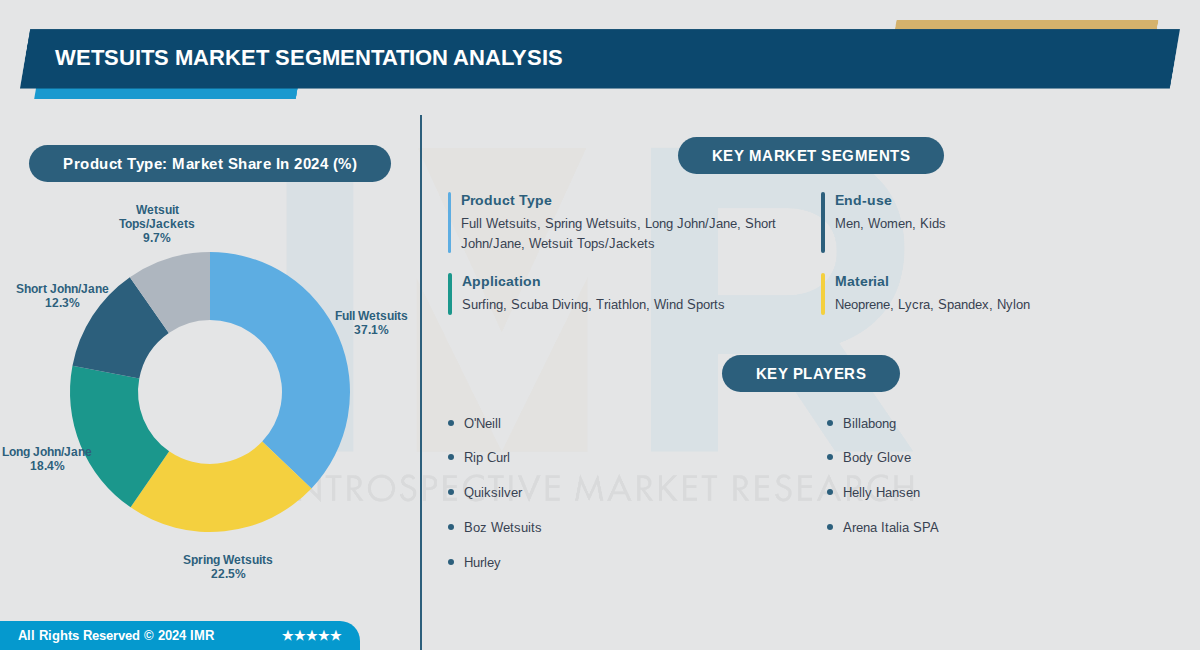
Full wetsuits dominate the product segment, capturing significant revenue shares due to their versatility in surfing, diving, and triathlons, while semi-dry and short wetsuits are gaining traction for specific uses. Key applications include water sports like surfing and wind sports, with the water sports segment valued at around $1.33 billion in recent years. Major players such as O'Neill, Rip Curl, Quiksilver, and Patagonia drive competition through innovation in neoprene materials and sustainability.
Market dynamics are shaped by technological advancements in lightweight, stretchable, and eco-friendly materials, alongside increasing e-commerce penetration and coastal tourism. Regional trends show North America contributing over 40% of growth, supported by robust outdoor recreation culture, while emerging markets in APAC fuel expansion.
Wetsuits Market Trend Analysis:
Adoption of Sustainable and Eco-Friendly Materials
- Consumers are driving demand for wetsuits made from recycled plastics, natural rubber like Yulex, and limestone-based neoprene to reduce environmental impact from traditional petroleum-derived materials. O’Neill has introduced plant-based Yulex natural rubber wetsuits, while Patagonia’s R4 Regulator uses Yulex with attached hoods for premium eco-performance. In 2022, major brands launched advanced eco-friendly neoprene alternatives, and by 2023 Q3, companies invested heavily in recycling programs for old wetsuits, cutting carbon footprints significantly.
- This shift aligns with circular economy principles, as Rip Curl and Billabong integrate recycled neoprene liners and water-based adhesives to minimize VOC emissions. The market responds to regulatory pressures and eco-conscious buyers, with post-consumer recycled fibers now standard in liner fabrics. Global wetsuit market growth from USD 4.03 billion in 2025 to USD 4.38 billion in 2026 partly stems from these sustainable innovations boosting sales by 20-40% in preorder volumes for brands adopting them.
- Manufacturers like XCEL are blending these materials with graphene-enhanced linings for thermal efficiency, appealing to both amateurs and pros. Inland wave pools and surf culture expansion amplify demand, as sustainable options become essential for broader accessibility beyond coastal areas.
Rise of Customization and Personalization
- Custom wetsuits are surging due to body-scanning technology ensuring perfect fit, addressing issues like poor generic sizing and enhancing comfort for diverse body types. In 2024 H1, brands widely adopted this tech, offering bespoke suits tailored to individual measurements and sport needs, such as enhanced paddling mobility for surfing. Companies like those in OEM sectors for Europe and North America report strong B2B growth from personalized wholesale supply.
- This trend caters to women’s and youth segments with gender-specific fits and modular designs for seasonal use, proliferating lightweight spring suits and hybrid styles. Retail preorder growth hit +20% for SS25 and +40% for new styles, driven by customization options in colorways and features. Surfers and kayakers benefit from long johns preserving limb mobility while protecting the core.
- Personalization extends to sport-specific adaptations, like ultra-thin insulating layers for SUP or durable builds for kitesurfing, boosting user satisfaction and repeat purchases.
Integration of Technological Advancements
- Innovations in material science deliver lighter, more flexible wetsuits with advanced thermal linings, seamless construction, and ergonomic designs reducing water entry. O’Neill leverages graphene-enhanced linings and multi-pane thermal structures from XCEL for cold-water sports, while 2023 Q1 saw smart wetsuit prototypes with integrated heating for extreme conditions. These features improve flexibility, insulation, and durability, with modern neoprene blends enhancing paddling and mobility.
- Smart textiles emerge with performance-tracking sensors, temperature regulation, and emergency signaling, mainly in high-end segments. Chest-zip and zip-free designs gain popularity among surfers for maximum shoulder flexibility, harmonizing ergonomics with performance. By 2024 H2, new materials added UV protection and antimicrobial properties, expanding appeal to recreational users.
- The surfing segment leads growth via seam technology and flexible blends, fueled by artificial wave pools democratizing the sport globally.
Wetsuits Market Segment Analysis:
Wetsuits Market is Segmented on the basis of By Product Type, By End-use, By Application
By Product Type, Full Wetsuits segment is expected to dominate the market during the forecast period
- Full Wetsuits dominate due to their extensive use in diving and surfing, providing comprehensive thermal insulation and buoyancy for prolonged water exposure.
- They account for the largest revenue share as they are essential for professional and recreational activities in varied water conditions globally.
By End-use, Men segment is expected to dominate the market during the forecast period
- Men dominate due to higher engagement rates in surfing, diving, and adventure tourism activities worldwide.
- Manufacturers prioritize men's sizing and designs, reflecting larger production capacities and demographic preferences in water sports.
By Application, Surfing segment is expected to dominate the market during the forecast period
- Surfing leads as the primary application due to its massive global participation and year-round demand in coastal regions like California and Australia.
- It drives the highest market share through consistent recreational and competitive usage requiring durable, flexible wetsuits.
By Material, Neoprene segment is expected to dominate the market during the forecast period
- Neoprene dominates because of its superior thermal insulation, flexibility, and buoyancy properties essential for wetsuit performance.
- It is the standard material in over two-thirds of wetsuits, favored by manufacturers for durability in harsh marine environments.
Wetsuits Market Regional Insights:
North America is Expected to Dominate the Market Over the Forecast Period
- North America dominates the wetsuits market, particularly led by the United States and Canada, which hold the largest market share due to high participation in water sports. The region benefits from extensive coastlines along the Pacific and Atlantic, including areas like California, Hawaii, Florida, and the Pacific Northwest, fostering year-round surfing, diving, and triathlon activities. This established water sports culture drives significant demand for premium wetsuits.
- The region's dominance is supported by strong consumer purchasing power, advanced retail infrastructure like specialty surf shops, and a focus on technologically advanced products such as full suits and modular layering systems. Extensive water bodies including lakes and rivers provide diverse opportunities for watersports, while innovation centers develop cutting-edge wetsuit technologies. Favorable market conditions and high spending on recreational gear further solidify its leading position.
- Major players and industry brands are densely concentrated in North America, with the U.S. alone accounting for a substantial revenue share, such as around 78.8% of the North American market generating USD 326.6 million in 2025. Key developments include hosting major events like triathlons and adventure tourism growth, alongside brands innovating in thermal insulation and sustainable materials. Recent market analyses highlight North America's 43.2% global share valued at USD 0.6 billion, underscoring ongoing leadership.
Active Key Players in the Wetsuits Market:
- O'Neill (USA)
- Billabong (Australia)
- Rip Curl (Australia)
- Body Glove (USA)
- Quiksilver (USA)
- Helly Hansen (Norway)
- Boz Wetsuits (UK)
- Arena Italia SPA (Italy)
- Hurley (USA)
- Patagonia (USA)
- Hyperflex Wetsuits (USA)
- Speedo (UK)
- GUL (UK)
- Typhoon (UK)
- Isurus (France)
- Xcel (USA)
- Vissla (USA)
- Prolimit (Netherlands)
- Other Active Players
|
Wetsuits Market |
|||
|
Base Year: |
2024 |
Forecast Period: |
2024-2035 |
|
Historical Data: |
2017 to 2024 |
Market Size in 2024: |
USD 1.58 Billion |
|
Forecast Period 2024-2035 CAGR: |
4.67 % |
Market Size in 2035: |
USD 2.61 Billion |
|
Segments Covered: |
By Product Type |
|
|
|
By End-use |
|
||
|
By Application |
|
||
|
By Material |
|
||
|
By Region |
|
||
|
Key Market Drivers: |
|
||
|
Key Market Restraints: |
|
||
|
Key Opportunities: |
|
||
|
Companies Covered in the report: |
|
||
Chapter 1: Introduction
1.1 Scope and Coverage
Chapter 2: Executive Summary
Chapter 3: Market Landscape
3.1 Market Dynamics and Opportunity Analysis
3.1.1 Growth Drivers
3.1.2 Limiting Factors
3.1.3 Growth Opportunities
3.1.4 Challenges and Risks
3.2 Market Trend Analysis
3.3 Industry Ecosystem
3.4 Industry Value Chain Mapping
3.5 Strategic PESTLE Overview
3.6 Porter's Five Forces Framework
3.7 Regulatory Framework
3.8 Pricing Trend Analysis
3.9 Intellectual Property Review
3.10 Technology Evolution
3.11 Import-Export Analysis
3.12 Consumer Behavior Analysis
3.13 Investment Pocket Analysis
3.14 Go-To Market Strategy
Chapter 4: Wetsuits Market by Product Type (2017-2035)
4.1 Wetsuits Market Snapshot and Growth Engine
4.2 Market Overview
4.3 Full Wetsuits
4.3.1 Introduction and Market Overview
4.3.2 Historic and Forecasted Market Size in Value USD and Volume Units
4.3.3 Key Market Trends, Growth Factors, and Opportunities
4.3.4 Geographic Segmentation Analysis
4.4 Spring Wetsuits
4.5 Long John/Jane
4.6 Short John/Jane
4.7 Wetsuit Tops/Jackets
Chapter 5: Wetsuits Market by End-use (2017-2035)
5.1 Wetsuits Market Snapshot and Growth Engine
5.2 Market Overview
5.3 Men
5.3.1 Introduction and Market Overview
5.3.2 Historic and Forecasted Market Size in Value USD and Volume Units
5.3.3 Key Market Trends, Growth Factors, and Opportunities
5.3.4 Geographic Segmentation Analysis
5.4 Women
5.5 Kids
Chapter 6: Wetsuits Market by Application (2017-2035)
6.1 Wetsuits Market Snapshot and Growth Engine
6.2 Market Overview
6.3 Surfing
6.3.1 Introduction and Market Overview
6.3.2 Historic and Forecasted Market Size in Value USD and Volume Units
6.3.3 Key Market Trends, Growth Factors, and Opportunities
6.3.4 Geographic Segmentation Analysis
6.4 Scuba Diving
6.5 Triathlon
6.6 Wind Sports
Chapter 7: Wetsuits Market by Material (2017-2035)
7.1 Wetsuits Market Snapshot and Growth Engine
7.2 Market Overview
7.3 Neoprene
7.3.1 Introduction and Market Overview
7.3.2 Historic and Forecasted Market Size in Value USD and Volume Units
7.3.3 Key Market Trends, Growth Factors, and Opportunities
7.3.4 Geographic Segmentation Analysis
7.4 Lycra
7.5 Spandex
7.6 Nylon
Chapter 8: Company Profiles and Competitive Analysis
8.1 Competitive Landscape
8.1.1 Competitive Benchmarking
8.1.2 Wetsuits Market Share by Manufacturer/Service Provider (2024)
8.1.3 Industry BCG Matrix
8.1.4 Partnerships, Mergers & Acquisitions
8.2 O'NEILL
8.2.1 Company Overview
8.2.2 Key Executives
8.2.3 Company Snapshot
8.2.4 Role of the Company in the Market
8.2.5 Sustainability and Social Responsibility
8.2.6 Operating Business Segments
8.2.7 Product Portfolio
8.2.8 Business Performance
8.2.9 Recent News & Developments
8.2.10 SWOT Analysis
8.3 BILLABONG
8.4 RIP CURL
8.5 BODY GLOVE
8.6 QUIKSILVER
8.7 HELLY HANSEN
8.8 BOZ WETSUITS
8.9 ARENA ITALIA SPA
8.10 HURLEY
8.11 PATAGONIA
8.12 HYPERFLEX WETSUITS
8.13 SPEEDO
8.14 GUL
8.15 TYPHOON
8.16 ISURUS
8.17 XCEL
8.18 VISSLA
8.19 PROLIMIT
Chapter 9: Global Wetsuits Market By Region
9.1 Overview
9.2. North America Wetsuits Market
9.2.1 Key Market Trends, Growth Factors and Opportunities
9.2.2 Top Key Companies
9.2.3 Historic and Forecasted Market Size by Segments
9.2.4 Historic and Forecast Market Size by Country
9.3. Eastern Europe Wetsuits Market
9.3.1 Key Market Trends, Growth Factors and Opportunities
9.3.2 Top Key Companies
9.3.3 Historic and Forecasted Market Size by Segments
9.3.4 Historic and Forecast Market Size by Country
9.4. Western Europe Wetsuits Market
9.4.1 Key Market Trends, Growth Factors and Opportunities
9.4.2 Top Key Companies
9.4.3 Historic and Forecasted Market Size by Segments
9.4.4 Historic and Forecast Market Size by Country
9.5. Asia Pacific Wetsuits Market
9.5.1 Key Market Trends, Growth Factors and Opportunities
9.5.2 Top Key Companies
9.5.3 Historic and Forecasted Market Size by Segments
9.5.4 Historic and Forecast Market Size by Country
9.6. Middle East & Africa Wetsuits Market
9.6.1 Key Market Trends, Growth Factors and Opportunities
9.6.2 Top Key Companies
9.6.3 Historic and Forecasted Market Size by Segments
9.6.4 Historic and Forecast Market Size by Country
9.7. South America Wetsuits Market
9.7.1 Key Market Trends, Growth Factors and Opportunities
9.7.2 Top Key Companies
9.7.3 Historic and Forecasted Market Size by Segments
9.7.4 Historic and Forecast Market Size by Country
Chapter 10: Analyst Viewpoint and Conclusion
Chapter 11: Research Methodology
11.1 Research Process
11.2 Primary Research
11.3 Secondary Research
Chapter 12: Case Study
Chapter 13: Appendix
13.1 Sources
13.2 List of Tables and Figures
13.3 Short Forms and Citations
13.4 Assumption and Conversion
13.5 Disclaimer
|
Wetsuits Market |
|||
|
Base Year: |
2024 |
Forecast Period: |
2024-2035 |
|
Historical Data: |
2017 to 2024 |
Market Size in 2024: |
USD 1.58 Billion |
|
Forecast Period 2024-2035 CAGR: |
4.67 % |
Market Size in 2035: |
USD 2.61 Billion |
|
Segments Covered: |
By Product Type |
|
|
|
By End-use |
|
||
|
By Application |
|
||
|
By Material |
|
||
|
By Region |
|
||
|
Key Market Drivers: |
|
||
|
Key Market Restraints: |
|
||
|
Key Opportunities: |
|
||
|
Companies Covered in the report: |
|
||


