




Veterinary Surgical Instruments Market Synopsis:
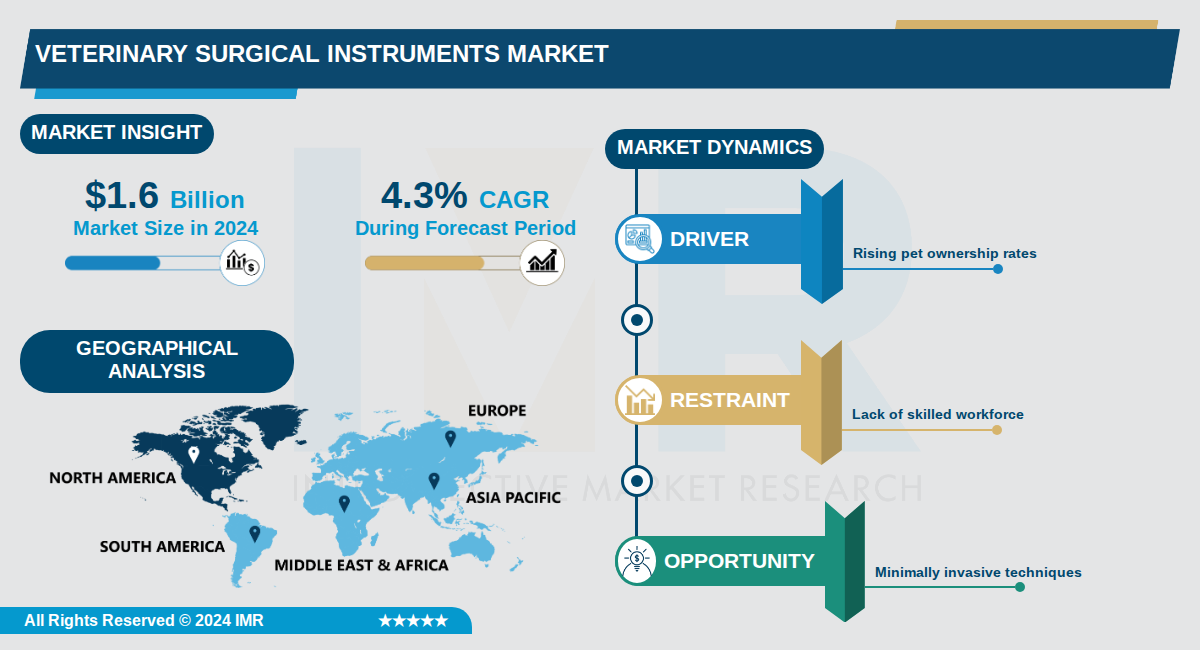
Veterinary Surgical Instruments Market Size Was Valued at USD 1.6 Billion in 2024, and is Projected to Reach USD 2.5 Billion by 2035, Growing at a CAGR of 4.3% From 2024-2035.
The Veterinary Surgical Instruments Market is valued at $1.6 billion in 2024 and is projected to reach $2.5 billion by 2035, growing at a CAGR of 4.3%. This expansion reflects increasing demand for advanced tools in companion animal and livestock surgeries, driven by rising pet ownership and livestock health focus.
North America leads the market with significant shares, such as 37.7% in 2023 and 40.36% in 2024, supported by high pet ownership rates—66% of U.S. households—and advanced healthcare infrastructure. Handheld devices and large animal segments dominate, holding over 38% and 52% respectively in recent years.
Technological innovations like AI, electrosurgery, and minimally invasive tools such as endoscopy and laparoscopy are transforming veterinary procedures, enhancing precision, diagnostics, and recovery times. Veterinary hospitals, the leading end-use segment, drive demand for specialized equipment in orthopedic, dental, and soft tissue surgeries.
Veterinary Surgical Instruments Market Trend Analysis:
Adoption of 3D Printed Custom Surgical Instruments
- Veterinary practices are increasingly using 3D printing to create customized surgical instruments tailored to specific patient anatomies, reducing production time from weeks to hours. Companies like those partnering with AVMA-recommended services scan animal anatomy with high-precision software to model and print tools such as incision guides and bone scaffolds in medical-grade materials. This approach has lowered costs by up to 50% compared to traditional machining, enabling small clinics to access bespoke instruments without investing in expensive printers.
- For orthopedic surgeries in dogs and horses, 3D printed instruments provide exact fits that minimize tissue trauma and improve success rates. Veterinary surgeons report fewer complications in procedures like fracture repairs, where custom scaffolds promote faster bone regeneration. Services from specialized firms handle design-to-delivery workflows, integrating seamlessly with electronic medical records for repeatable use across similar cases.
- The trend extends to prototyping new instrument designs, allowing vets to test ergonomics before mass production. In 2024, adoption surged with over 30% of large animal clinics using 3D services, driven by cases like custom prosthetics for injured wildlife rehabilitation.
Integration of AI-Enhanced Digital Radiography
- AI integration with digital radiography systems is transforming preoperative planning by automating image analysis and reducing diagnostic errors by 40% in veterinary surgeries. Tools from platforms like those in AVMA guidelines evaluate metrics such as vertebral heart scores instantly, allowing surgeons to visualize fractures or tumors with superior clarity before incisions. This eliminates film processing, cutting procedure times by 25% and radiation exposure for staff.
- Systems like Dinbeat's AI-driven software combine radiography with machine learning to detect patterns in bone density, aiding precise instrument selection for orthopedics. In 2025 projections, 60% of U.S. veterinary hospitals plan upgrades, citing fewer retakes and faster consultations via telemedicine integration. Examples include equine joint surgeries where AI flags subtle arthritis undetectable by human eyes alone.
- Post-upgrade clinics report seamless EMR integration, storing AI-annotated images for surgical simulations. This trend supports minimally invasive keyhole procedures by providing real-time overlays during operations.
Rise of Robotic-Assisted Surgical Systems
- Robotic surgical arms are gaining traction for minimally invasive veterinary procedures, enhancing precision in keyhole surgeries and reducing recovery times by 30% for pets. Systems like those developed by Appinventiv deploy robotic assistance for laparoscopic neuters and tumor removals, minimizing scars and surgical stress compared to traditional methods. In 2024, adoption in specialty clinics reached 25%, with success rates exceeding 95% in canine soft tissue operations.
- These robots integrate with multiparametric monitors from Dinbeat, providing real-time vital sign feedback to surgeons during complex spinal corrections in horses. Veterinary teams note improved dexterity in confined spaces, lowering complication rates from 15% to under 5%. Custom software interfaces ensure compatibility with existing instruments, broadening access to mid-sized practices.
- Future expansions include blockchain for data transparency in robotic logs, ensuring audit trails for malpractice claims. High-profile cases, such as robotic repairs on zoo animals, highlight scalability.
Veterinary Surgical Instruments Market Segment Analysis:
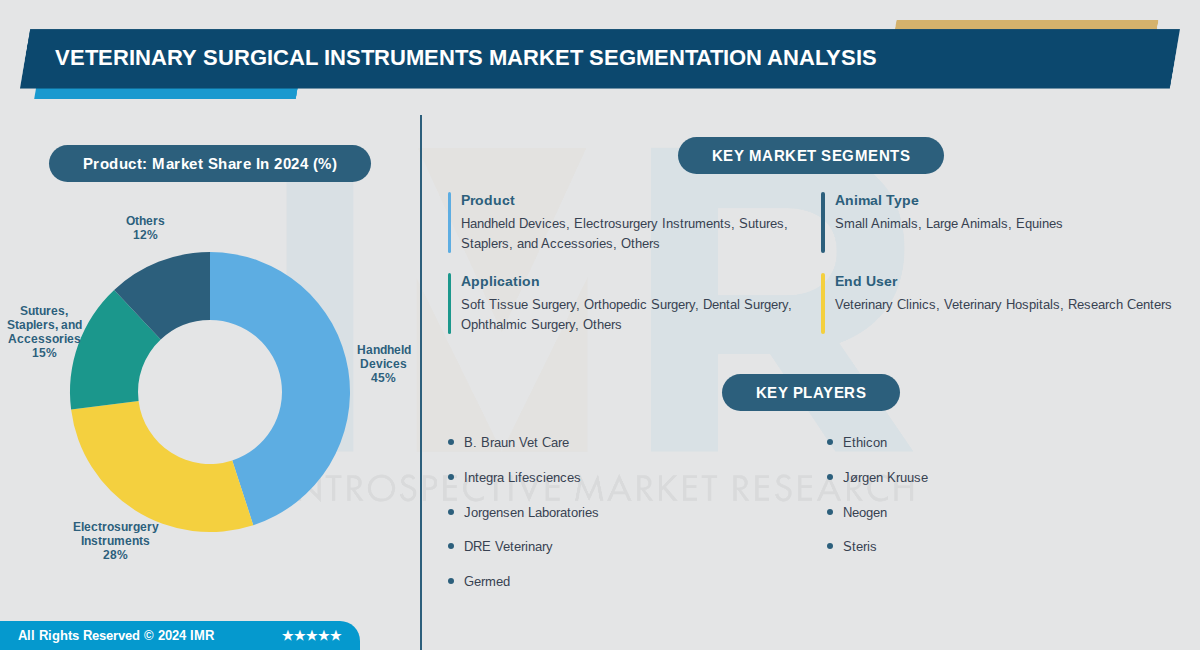
Veterinary Surgical Instruments Market is Segmented on the basis of By Product, By Animal Type, By Application
By Product, Handheld Devices segment is expected to dominate the market during the forecast period
- Handheld devices dominate due to their essential role in precision cutting, grasping, and dissecting across all veterinary surgeries, making them indispensable for daily procedures.
- High volume of routine surgeries like spay/neuter and wound repairs in companion animals drives demand, with veterinarians preferring durable, reusable stainless steel tools.
By Animal Type, Small Animals segment is expected to dominate the market during the forecast period
- Small animals lead due to surging pet ownership of dogs and cats, particularly in North America and Europe, increasing elective surgeries like dental and orthopedic.
- Higher pet insurance penetration and owner willingness to spend on companion animal healthcare significantly boosts instrument demand compared to livestock.
By Application, Soft Tissue Surgery segment is expected to dominate the market during the forecast period
- Soft tissue surgery dominates from high prevalence of injuries, tumors, and organ issues in pets, requiring frequent wound repair and mass excision procedures.
- Advancements in minimally invasive techniques and rising pet adoption globally amplify demand for specialized soft tissue instruments in routine clinic settings.
By End User, Veterinary Clinics segment is expected to dominate the market during the forecast period
- Veterinary clinics lead as primary sites for high-volume routine procedures like spaying, neutering, dental cleanings, and minor orthopedics.
- Expansion of clinic networks, pet owner awareness, and specialized equipment like iM3 dental tools drive their outsized market share.
Veterinary Surgical Instruments Market Regional Insights:
North America is Expected to Dominate the Market Over the Forecast Period
- North America dominates the veterinary surgical instruments market due to high pet ownership rates and substantial investments in animal healthcare, particularly in the U.S., Canada, and Mexico. The U.S. market alone was valued at USD 625.2 million in 2024, reflecting strong demand driven by companion animal adoption. This regional leadership is supported by a mature market structure that prioritizes advanced veterinary care.
- The region benefits from well-established infrastructure, including advanced veterinary hospitals and specialty clinics, alongside favorable regulations and high pet insurance penetration. Rising animal healthcare expenditures and a growing number of veterinary practitioners further bolster market growth. These factors create a robust ecosystem for surgical instrument adoption and innovation.
- Major players like Symmetry Surgical Inc. have expanded through acquisitions such as Bovie Medical in 2018 to enhance electrosurgical offerings. Key companies operate extensively in the U.S., driving product development and market penetration. Recent developments focus on cutting-edge technologies tailored to North American veterinary needs.
Active Key Players in the Veterinary Surgical Instruments Market:
- B. Braun Vet Care (Germany)
- Ethicon (USA)
- Integra Lifesciences (USA)
- Jørgen Kruuse (Denmark)
- Jorgensen Laboratories (USA)
- Neogen (USA)
- DRE Veterinary (USA)
- Steris (USA)
- Germed (USA)
- Sklar (USA)
- IM3 (Italy)
- World Precision Instruments (USA)
- Medtronic (Ireland)
- Arthrex, Inc. (USA)
- Avante Animal Health (USA)
- Vimian: Movora (Sweden)
- Surgical Holdings (UK)
- Other Active Players
|
Veterinary Surgical Instruments Market |
|||
|
Base Year: |
2024 |
Forecast Period: |
2024-2035 |
|
Historical Data: |
2017 to 2024 |
Market Size in 2024: |
USD 1.6 Billion |
|
Forecast Period 2024-2035 CAGR: |
4.3 % |
Market Size in 2035: |
USD 2.5 Billion |
|
Segments Covered: |
By Product |
|
|
|
By Animal Type |
|
||
|
By Application |
|
||
|
By End User |
|
||
|
By Region |
|
||
|
Key Market Drivers: |
|
||
|
Key Market Restraints: |
|
||
|
Key Opportunities: |
|
||
|
Companies Covered in the report: |
|
||
Chapter 1: Introduction
1.1 Scope and Coverage
Chapter 2: Executive Summary
Chapter 3: Market Landscape
3.1 Market Dynamics and Opportunity Analysis
3.1.1 Growth Drivers
3.1.2 Limiting Factors
3.1.3 Growth Opportunities
3.1.4 Challenges and Risks
3.2 Market Trend Analysis
3.3 Industry Ecosystem
3.4 Industry Value Chain Mapping
3.5 Strategic PESTLE Overview
3.6 Porter's Five Forces Framework
3.7 Regulatory Framework
3.8 Pricing Trend Analysis
3.9 Intellectual Property Review
3.10 Technology Evolution
3.11 Import-Export Analysis
3.12 Consumer Behavior Analysis
3.13 Investment Pocket Analysis
3.14 Go-To Market Strategy
Chapter 4: Veterinary Surgical Instruments Market by Product (2017-2035)
4.1 Veterinary Surgical Instruments Market Snapshot and Growth Engine
4.2 Market Overview
4.3 Handheld Devices
4.3.1 Introduction and Market Overview
4.3.2 Historic and Forecasted Market Size in Value USD and Volume Units
4.3.3 Key Market Trends, Growth Factors, and Opportunities
4.3.4 Geographic Segmentation Analysis
4.4 Electrosurgery Instruments
4.5 Sutures
4.6 Staplers
4.7 and Accessories
4.8 Others
Chapter 5: Veterinary Surgical Instruments Market by Animal Type (2017-2035)
5.1 Veterinary Surgical Instruments Market Snapshot and Growth Engine
5.2 Market Overview
5.3 Small Animals
5.3.1 Introduction and Market Overview
5.3.2 Historic and Forecasted Market Size in Value USD and Volume Units
5.3.3 Key Market Trends, Growth Factors, and Opportunities
5.3.4 Geographic Segmentation Analysis
5.4 Large Animals
5.5 Equines
Chapter 6: Veterinary Surgical Instruments Market by Application (2017-2035)
6.1 Veterinary Surgical Instruments Market Snapshot and Growth Engine
6.2 Market Overview
6.3 Soft Tissue Surgery
6.3.1 Introduction and Market Overview
6.3.2 Historic and Forecasted Market Size in Value USD and Volume Units
6.3.3 Key Market Trends, Growth Factors, and Opportunities
6.3.4 Geographic Segmentation Analysis
6.4 Orthopedic Surgery
6.5 Dental Surgery
6.6 Ophthalmic Surgery
6.7 Others
Chapter 7: Veterinary Surgical Instruments Market by End User (2017-2035)
7.1 Veterinary Surgical Instruments Market Snapshot and Growth Engine
7.2 Market Overview
7.3 Veterinary Clinics
7.3.1 Introduction and Market Overview
7.3.2 Historic and Forecasted Market Size in Value USD and Volume Units
7.3.3 Key Market Trends, Growth Factors, and Opportunities
7.3.4 Geographic Segmentation Analysis
7.4 Veterinary Hospitals
7.5 Research Centers
Chapter 8: Company Profiles and Competitive Analysis
8.1 Competitive Landscape
8.1.1 Competitive Benchmarking
8.1.2 Veterinary Surgical Instruments Market Share by Manufacturer/Service Provider (2024)
8.1.3 Industry BCG Matrix
8.1.4 Partnerships, Mergers & Acquisitions
8.2 B. BRAUN VET CARE
8.2.1 Company Overview
8.2.2 Key Executives
8.2.3 Company Snapshot
8.2.4 Role of the Company in the Market
8.2.5 Sustainability and Social Responsibility
8.2.6 Operating Business Segments
8.2.7 Product Portfolio
8.2.8 Business Performance
8.2.9 Recent News & Developments
8.2.10 SWOT Analysis
8.3 ETHICON
8.4 INTEGRA LIFESCIENCES
8.5 JØRGEN KRUUSE
8.6 JORGENSEN LABORATORIES
8.7 NEOGEN
8.8 DRE VETERINARY
8.9 STERIS
8.10 GERMED
8.11 SKLAR
8.12 IM3
8.13 WORLD PRECISION INSTRUMENTS
8.14 MEDTRONIC
8.15 ARTHREX
8.16 INC.
8.17 AVANTE ANIMAL HEALTH
8.18 VIMIAN: MOVORA
8.19 SURGICAL HOLDINGS
Chapter 9: Global Veterinary Surgical Instruments Market By Region
9.1 Overview
9.2. North America Veterinary Surgical Instruments Market
9.2.1 Key Market Trends, Growth Factors and Opportunities
9.2.2 Top Key Companies
9.2.3 Historic and Forecasted Market Size by Segments
9.2.4 Historic and Forecast Market Size by Country
9.3. Eastern Europe Veterinary Surgical Instruments Market
9.3.1 Key Market Trends, Growth Factors and Opportunities
9.3.2 Top Key Companies
9.3.3 Historic and Forecasted Market Size by Segments
9.3.4 Historic and Forecast Market Size by Country
9.4. Western Europe Veterinary Surgical Instruments Market
9.4.1 Key Market Trends, Growth Factors and Opportunities
9.4.2 Top Key Companies
9.4.3 Historic and Forecasted Market Size by Segments
9.4.4 Historic and Forecast Market Size by Country
9.5. Asia Pacific Veterinary Surgical Instruments Market
9.5.1 Key Market Trends, Growth Factors and Opportunities
9.5.2 Top Key Companies
9.5.3 Historic and Forecasted Market Size by Segments
9.5.4 Historic and Forecast Market Size by Country
9.6. Middle East & Africa Veterinary Surgical Instruments Market
9.6.1 Key Market Trends, Growth Factors and Opportunities
9.6.2 Top Key Companies
9.6.3 Historic and Forecasted Market Size by Segments
9.6.4 Historic and Forecast Market Size by Country
9.7. South America Veterinary Surgical Instruments Market
9.7.1 Key Market Trends, Growth Factors and Opportunities
9.7.2 Top Key Companies
9.7.3 Historic and Forecasted Market Size by Segments
9.7.4 Historic and Forecast Market Size by Country
Chapter 10: Analyst Viewpoint and Conclusion
Chapter 11: Research Methodology
11.1 Research Process
11.2 Primary Research
11.3 Secondary Research
Chapter 12: Case Study
Chapter 13: Appendix
13.1 Sources
13.2 List of Tables and Figures
13.3 Short Forms and Citations
13.4 Assumption and Conversion
13.5 Disclaimer
|
Veterinary Surgical Instruments Market |
|||
|
Base Year: |
2024 |
Forecast Period: |
2024-2035 |
|
Historical Data: |
2017 to 2024 |
Market Size in 2024: |
USD 1.6 Billion |
|
Forecast Period 2024-2035 CAGR: |
4.3 % |
Market Size in 2035: |
USD 2.5 Billion |
|
Segments Covered: |
By Product |
|
|
|
By Animal Type |
|
||
|
By Application |
|
||
|
By End User |
|
||
|
By Region |
|
||
|
Key Market Drivers: |
|
||
|
Key Market Restraints: |
|
||
|
Key Opportunities: |
|
||
|
Companies Covered in the report: |
|
||


