




Vagus Nerve Stimulators Market Synopsis:
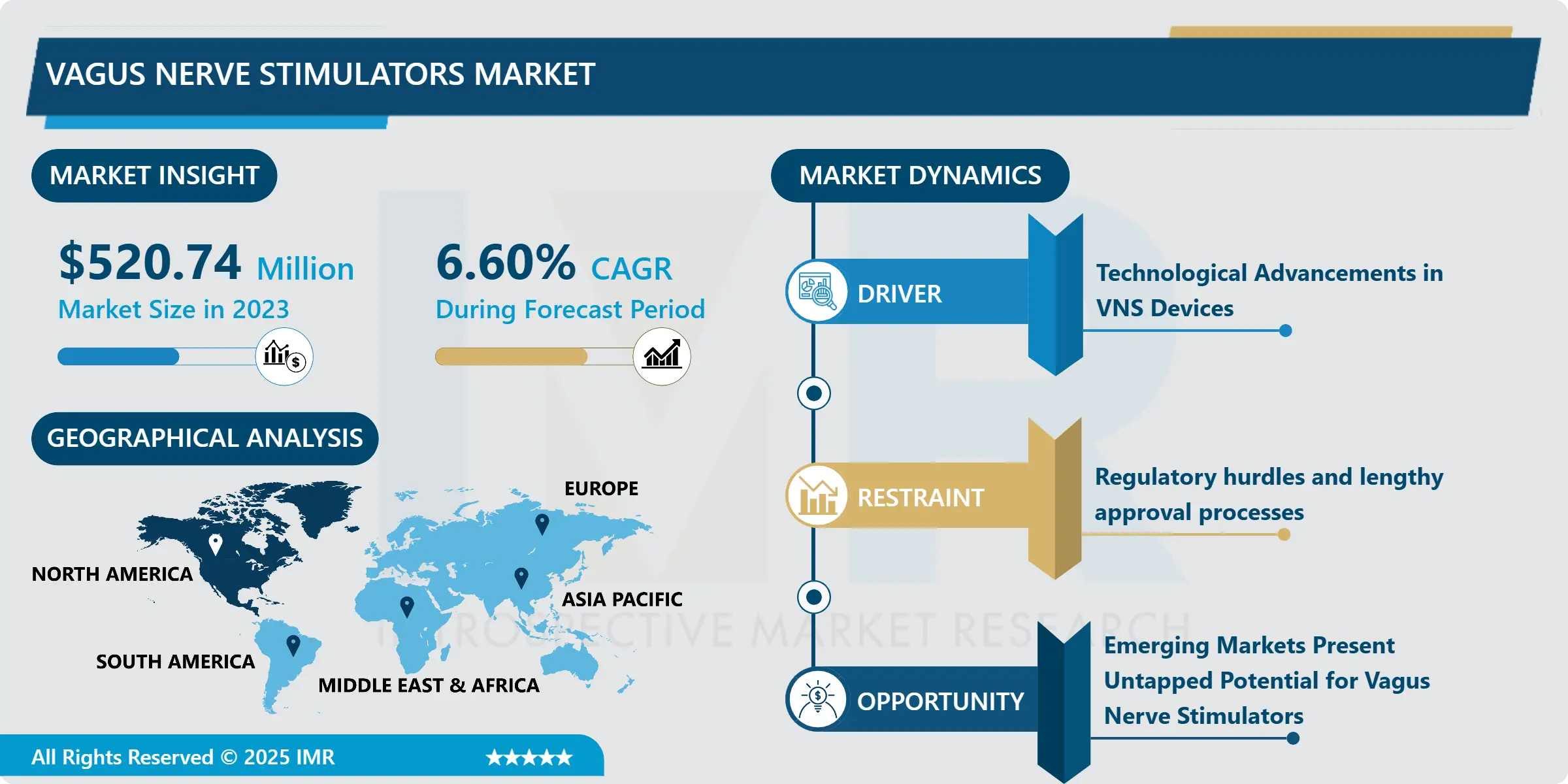
Vagus Nerve Stimulators Market Size Was Valued at USD 520.74 Million in 2023, and is Projected to Reach USD 925.63 Million by 2032, Growing at a CAGR of 6.60% from 2024-2032.
Vagus Nerve Stimulators (VNS) Market is the term used to describe the global market for medical devices that employ the use of electrical impulses to stimulate the vagus nerve – a part of the parasympathetic nervous system. These devices are particularly used for the management of neurological and psychiatric disorders including epilepsy, treatment resistant depression, chronic headaches and other moods disorders. The market for VNS has expanded mainly owing to the growing case of such diseases, the growing need for less or noninvasive treatments, and the improving technology used in the modulating the nerves.
This report covers the Vagus Nerve Stimulators (VNS) market and its growth opportunities, based on current trends such as the rise in the incidence of neurological and psychiatric disorders, establish demand for non-invasive treatment and progress in neuromodulation technologies. Vagus nerve stimulation is a CONFIRMED method for dealing with conditions like epilepsy, treatment resistant depression, and chronic migraines. Since pharmacotherapy and surgery are often invasive and palliative measures, VNS has been identified as an effective and relatively safe non-pharmacological intervention for treating a variety of various symptoms. The possibilities for using cortical stimulation for the vagus nerve in the treatment of a variety of conditions can be principally expanded to include Alzheimer’s disease, Parkinson’s disease, and other mood disorders. In addition, improvements in VNS technology evidenced by increase implant size, battery life, non invasive models that can be used in home settings are greatly increasing the market size and has indeed transformed VNS as an accessible route for a larger population of patients.
Despite the fact that the use of VNS is expensive, and there is a likelihood that some patients may require surgical implantation, researchers anticipate that the prognosis of this device will improve because of the high prospect of effectiveness in treating chronic illnesses that often present a limited number of treatment options. Nevertheless, inherent growth in headache alternative therapies, increasing consciousness among the global populace regarding neurological disorders, and enhanced scientific research concerning the potential of VNS for a range of psychiatric and neurological diseases are strong drivers that strengthen the market’s development. Also, growing healthcare expenditures and a particular emphasis on European and rapidly developing countries contribute to making invasive VNS devices available for a vast number of patients. These actions signify that as the market reaches maturity key players are seeking ways to advance the use of VNS for new clinical applications in treatment. The increasing preference for VNS as a treatment choice especially in North America, Europe, expanding healthcare industry in Asia-Pacific and Latin America can be viewed as major opportunities for the manufacturers in the forward looking years.
Vagus Nerve Stimulators Market Trend Analysis:
Technological Advancements in VNS Devices
- The development of new kinds of VNS equipment is already having a very noticeable positive impact on the subject, enhancing the efficiency, simplicity, and desirability of the devices. One of the main new technologies is thus the establishment of non-invasive VNS equipment which enables patients to receive treatments with out having to undergo surgery. these external devices sends electrical impulses to the vagus nerve through electrode placements usually on the neck thus a more secure and less invasive than the internal VNS. It is being preferred for ailments that may require the use of drugs but patients prefer to avoid taking them more so if there are non-invasive procedures for the same illnesses such as chronic migraines, depression, and anxiety.
- Besides the nonpharmacological and noninvasive approaches, implantable VNS instruments are improving the methods to be specific, secure, and efficient. The current generation of implants is significantly smaller, more efficient, and comes with batteries with longer service life meaning that replacement is not very frequent. Different models also offer programming options for stimulation profiles, enabling clinicians to tailor parameters of stimulation to specific patient’s requirements and thus enhance effectiveness of treatment and reduce side effects.
- The main trends include the establishment of wireless connection and remote monitoring in VNS devices. Such features help doctors monitor the patient’s reactions to the therapy, provide change remotely and present a quadruple interactive treatment plan. Further, the intervention of AI and machine learning has been introduced to expand the precise responsiveness and the resulting stimulation patterns to help achieve an enhanced advancer treatment. Combinedly these technological advancements are refining the accuracy, efficacy and comfort of Vagus Nerve Stimulation, promoting the growth of market and providing the opportunities to treat a diversified range of neurological and even psychological disorders.
Emerging Markets Present Untapped Potential for Vagus Nerve Stimulators
- New concurrent markets have exceptional potential for growth in the Vagus Nerve Stimulators (VNS) market due to growing health care sector and awareness of neurological and psychiatric disorders. Asia-Pacific, Latin America and the Middle East & Africa are still developing relatively fast economically and have the world’s population, so medical technology and the demand for the VNS type of treatment is also becoming increasingly accessible. With development of healthcare systems across these regions, the importance of scaling up efforts for managing advances diseases including epilepsy, depression, chronic migraines and other neurological complications gains importance. Port devices like VNS devices that have shown great efficiency in managing these conditions are gradually being embraced as proper treatment tools. The growing population of such disorders along with an availability to better healthcare services is the reason which compel the VNS manufacturers to enter these new niches.
- Moreover, the VNS devices launched are non-invasive, and their profitability is relatively low in the expense of treatment in emerging nations, which may not afford complicated treatments. As more people in developing areas such as the Asia-Pacific and Latin American move into the middle class, there is a greater readiness to invest in new and better medical technologies.
- There is a considerable spending by governments of several emerging countries on developing health infrastructure and revolving improved access to healthcare services, which should go a long way in popularising the use of neuromodulation therapies such as VNS among others. This untapped market potential of the emerging markets is there waiting for companies who can decipher the local regulatory framework policies and indulge in the task of forming distribution channels and providing affordable solutions that fit in these regions. This along with the increase in healthcare consciousness makes the emerging markets the growth generators of VNS industry in the years to come.
Vagus Nerve Stimulators Market Segment Analysis:
Vagus Nerve Stimulators Market Segmented on the basis of type, application, end user, and region.
By Type, Non-invasive Vagus Nerve Stimulator segment is expected to dominate the market during the forecast period
- This report identifies that Non-invasive Vagus Nerve Stimulator segment is expected to lead the Vagus Nerve Stimulators (VNS) market in the coming years with the help of the following factors. Electrical stimulation devices for the vagus nerve, which do not require invasive surgery (as opposed to implantable VNS devices) include a number of advantages over those: Such include reduced risk than surgical practice, simple to perform and the ability to be conducted at home. Such factors contribute to make non invasive VNS preferable to a patient who opposes surgery or who is seeking an affordable less invasive procedure.
- With an increase in the popularity of noninvasive treatment, including chronic migraine, treatment-resistant depression, and various anxiety disorders, noninvasive VNS devices are also gradually being integrated into clinical and home applications. There is increased patient awareness of neurological and psychiatric disorders, he added, and also increasing global trends towards less invasive treatments from electrodes, which is stimulating interest in non-invasive VNS. Moreover, new smart technologies explored and employed with devices like smart mobile applications enabling patients to monitor the devices or adjust their settings from a distance adds to the non-invasive frontier’s growing allure. This coupled with lower treatment cost compared to implantable segmented power the non-invasive VNS segment that is poised for growth and dominance in the future years.
By Application, Epilepsy segment expected to held the largest share
- Among all the products it offers, the company estimates that the Epilepsy segment will dominate the market for Vagus Nerve Stimulators (VNS) in the forecast period. VNS is another neurostimulation procedure whose most important application, and still the most widespread, is epilepsies, particularly drug-resistant epilepsy. In patients who fail to respond to conventional anti-seizure medications VNS has been found useful in decreasing the frequency and severity of the seizures. The epidemiology of epilepsy is on the rise globally and there are still a third of patients who fail to get well by conventional treatments; this makes VNS a valuable intervention.
- In addition, with emerging clinical data on the beneficial effects of VNS in epilepsy, including frequent reduction in seizure episodes and improvement in quality of life of the patients, the acceptable practice of VNS for epilepsy is likely to expand. VNS has emerged as the first choice in many areas for the treatment of refractory epilepsy which in a way has placed it strategically in the market. The epilepsy application will continue to be the biggest and the most mature segment in the VNS market as understanding of VNS therapy increases with technological advancement and as more people are diagnosed with epilepsy, the need for both implantable and non-invasive devices to treat it will remain high.
Vagus Nerve Stimulators Market Regional Insights:
North America is Expected to Dominate the Market Over the Forecast period
- With these aspects under consideration, it is estimated that North America will continue to lead the Vagus Nerve Stimulators (VNS) market throughout the given forecast period due to availability of advanced health care facilities, greater demand for latest technologies in the medical industry and sound health reimbursement policies. Specifically, the US persists as a dominant market for market growth on account of its leadership in neuromodulation therapies and, in particular, VNS. This country has a high burden rate of neurological and psychiatric disorders including epilepsy, treatment resistant depression, and chronic migraines, all conditions that qualify patient for VNS therapy. Based on this reason, VNS devices market is likely to experience sustainable demand due to availability of improved treatment techniques and increased patient awareness. Also, another factor that has made Vagus Nerve Stimulation more acceptable across the world is the accessibility of the regulation.
- For instance, a case of North America, especially the FDA has approved VNS devices for other uses besides epilepsy. Existence of industry key participants, and ongoing development of VNS technology also provide impetus to North America thereby boosting the market. Canada also offers ample opportunity for growth because of the continuously growing healthcare spending and the increasing popularity of implantable therapies. Since a growing number of healthcare organizations such as hospitals, clinics, and various healthcare providers are including VNS in their treatment portfolio, North America is expected to remain dominant in the global VNS market during the forecast period.
Active Key Players in the Vagus Nerve Stimulators Market:
- Autonomic Technologies, Inc. (United States)
- Boston Scientific Corporation (United States)
- Brigham and Women's Hospital (United States)
- Cala Health (United States)
- Cerebral Therapeutics (United States)
- Cyberonics (now part of LivaNova) (United States)
- Innovative Neurological Devices (United States)
- Inspire Medical Systems (United States)
- LivaNova (United Kingdom)
- Medtronic (United States)
- Nevro Corporation (United States)
- Nexstim (Finland)
- Sanofi (France)
- Soterix Medical (United States)
- Spring Health (United States)
- St. Jude Medical (now part of Abbott) (United States)
- Theranica Bio-Electronics (Israel)
- TMS Neuro Solutions (United States)
- Other Active Players
|
Vagus Nerve Stimulators Market |
|||
|
Base Year: |
2023 |
Forecast Period: |
2024-2032 |
|
Historical Data: |
2017 to 2023 |
Market Size in 2023: |
USD 520.74 Million |
|
Forecast Period 2024-32 CAGR: |
6.60 % |
Market Size in 2032: |
USD 925.63 Million |
|
Segments Covered: |
By Type |
|
|
|
By Application |
|
||
|
By Region |
|
||
|
Key Market Drivers: |
|
||
|
Key Market Restraints: |
|
||
|
Key Opportunities: |
|
||
|
Companies Covered in the report: |
|
||
Chapter 1: Introduction
1.1 Scope and Coverage
Chapter 2:Executive Summary
Chapter 3: Market Landscape
3.1 Industry Dynamics and Opportunity Analysis
3.1.1 Growth Drivers
3.1.2 Limiting Factors
3.1.3 Growth Opportunities
3.1.4 Challenges and Risks
3.2 Market Trend Analysis
3.3 Strategic Pestle Overview
3.4 Porter's Five Forces Analysis
3.5 Industry Value Chain Mapping
3.6 Regulatory Framework
3.7 Princing Trend Analysis
3.8 Patent Analysis
3.9 Technology Evolution
3.10 Investment Pockets
3.11 Import-Export Analysis
Chapter 4: Vagus Nerve Stimulators Market by Type
4.1 Vagus Nerve Stimulators Market Snapshot and Growth Engine
4.2 Vagus Nerve Stimulators Market Overview
4.3 Implantable Vagus Nerve Stimulators
4.3.1 Introduction and Market Overview
4.3.2 Historic and Forecasted Market Size in Value USD and Volume Units (2017-2032F)
4.3.3 Implantable Vagus Nerve Stimulators: Geographic Segmentation Analysis
4.4 Non-invasive Vagus Nerve Stimulators
4.4.1 Introduction and Market Overview
4.4.2 Historic and Forecasted Market Size in Value USD and Volume Units (2017-2032F)
4.4.3 Non-invasive Vagus Nerve Stimulators: Geographic Segmentation Analysis
Chapter 5: Vagus Nerve Stimulators Market by Application
5.1 Vagus Nerve Stimulators Market Snapshot and Growth Engine
5.2 Vagus Nerve Stimulators Market Overview
5.3 Epilepsy Depression
5.3.1 Introduction and Market Overview
5.3.2 Historic and Forecasted Market Size in Value USD and Volume Units (2017-2032F)
5.3.3 Epilepsy Depression: Geographic Segmentation Analysis
5.4 Treatment-Resistant Depression
5.4.1 Introduction and Market Overview
5.4.2 Historic and Forecasted Market Size in Value USD and Volume Units (2017-2032F)
5.4.3 Treatment-Resistant Depression: Geographic Segmentation Analysis
5.5 Chronic Migraines & Headaches
5.5.1 Introduction and Market Overview
5.5.2 Historic and Forecasted Market Size in Value USD and Volume Units (2017-2032F)
5.5.3 Chronic Migraines & Headaches: Geographic Segmentation Analysis
Chapter 6: Vagus Nerve Stimulators Market by End User
6.1 Vagus Nerve Stimulators Market Snapshot and Growth Engine
6.2 Vagus Nerve Stimulators Market Overview
6.3 Hospitals and Healthcare Institutions
6.3.1 Introduction and Market Overview
6.3.2 Historic and Forecasted Market Size in Value USD and Volume Units (2017-2032F)
6.3.3 Hospitals and Healthcare Institutions: Geographic Segmentation Analysis
6.4 Clinics and Neurological Centers
6.4.1 Introduction and Market Overview
6.4.2 Historic and Forecasted Market Size in Value USD and Volume Units (2017-2032F)
6.4.3 Clinics and Neurological Centers: Geographic Segmentation Analysis
6.5 Homecare Settings)
6.5.1 Introduction and Market Overview
6.5.2 Historic and Forecasted Market Size in Value USD and Volume Units (2017-2032F)
6.5.3 Homecare Settings) : Geographic Segmentation Analysis
Chapter 7: Company Profiles and Competitive Analysis
7.1 Competitive Landscape
7.1.1 Competitive Benchmarking
7.1.2 Vagus Nerve Stimulators Market Share by Manufacturer (2023)
7.1.3 Concentration Ratio(CR5)
7.1.4 Heat Map Analysis
7.1.5 Mergers and Acquisitions
7.2 AUTONOMIC TECHNOLOGIES INC. (UNITED STATES)
7.2.1 Company Overview
7.2.2 Key Executives
7.2.3 Company Snapshot
7.2.4 Operating Business Segments
7.2.5 Product Portfolio
7.2.6 Business Performance
7.2.7 Key Strategic Moves and Recent Developments
7.3 BOSTON SCIENTIFIC CORPORATION (UNITED STATES)
7.4 BRIGHAM AND WOMEN'S HOSPITAL (UNITED STATES)
7.5 CALA HEALTH (UNITED STATES)
7.6 CEREBRAL THERAPEUTICS (UNITED STATES)
7.7 CYBERONICS (NOW PART OF LIVANOVA) (UNITED STATES)
7.8 INNOVATIVE NEUROLOGICAL DEVICES (UNITED STATES)
7.9 INSPIRE MEDICAL SYSTEMS (UNITED STATES)
7.10 LIVANOVA (UNITED KINGDOM)
7.11 MEDTRONIC (UNITED STATES)
7.12 NEVRO CORPORATION (UNITED STATES)
7.13 OTHER ACTIVE PLAYERS
Chapter 8: Global Vagus Nerve Stimulators Market By Region
8.1 Overview
8.2. North America Vagus Nerve Stimulators Market
8.2.1 Historic and Forecasted Market Size by Segments
8.2.2 Historic and Forecasted Market Size By Type
8.2.2.1 Implantable Vagus Nerve Stimulators
8.2.2.2 Non-invasive Vagus Nerve Stimulators
8.2.3 Historic and Forecasted Market Size By Application
8.2.3.1 Epilepsy Depression
8.2.3.2 Treatment-Resistant Depression
8.2.3.3 Chronic Migraines & Headaches
8.2.4 Historic and Forecasted Market Size By End User
8.2.4.1 Hospitals and Healthcare Institutions
8.2.4.2 Clinics and Neurological Centers
8.2.4.3 Homecare Settings)
8.2.5 Historic and Forecast Market Size by Country
8.2.5.1 US
8.2.5.2 Canada
8.2.5.3 Mexico
8.3. Eastern Europe Vagus Nerve Stimulators Market
8.3.1 Historic and Forecasted Market Size by Segments
8.3.2 Historic and Forecasted Market Size By Type
8.3.2.1 Implantable Vagus Nerve Stimulators
8.3.2.2 Non-invasive Vagus Nerve Stimulators
8.3.3 Historic and Forecasted Market Size By Application
8.3.3.1 Epilepsy Depression
8.3.3.2 Treatment-Resistant Depression
8.3.3.3 Chronic Migraines & Headaches
8.3.4 Historic and Forecasted Market Size By End User
8.3.4.1 Hospitals and Healthcare Institutions
8.3.4.2 Clinics and Neurological Centers
8.3.4.3 Homecare Settings)
8.3.5 Historic and Forecast Market Size by Country
8.3.5.1 Bulgaria
8.3.5.2 The Czech Republic
8.3.5.3 Hungary
8.3.5.4 Poland
8.3.5.5 Romania
8.3.5.6 Rest of Eastern Europe
8.4. Western Europe Vagus Nerve Stimulators Market
8.4.1 Historic and Forecasted Market Size by Segments
8.4.2 Historic and Forecasted Market Size By Type
8.4.2.1 Implantable Vagus Nerve Stimulators
8.4.2.2 Non-invasive Vagus Nerve Stimulators
8.4.3 Historic and Forecasted Market Size By Application
8.4.3.1 Epilepsy Depression
8.4.3.2 Treatment-Resistant Depression
8.4.3.3 Chronic Migraines & Headaches
8.4.4 Historic and Forecasted Market Size By End User
8.4.4.1 Hospitals and Healthcare Institutions
8.4.4.2 Clinics and Neurological Centers
8.4.4.3 Homecare Settings)
8.4.5 Historic and Forecast Market Size by Country
8.4.5.1 Germany
8.4.5.2 UK
8.4.5.3 France
8.4.5.4 Netherlands
8.4.5.5 Italy
8.4.5.6 Russia
8.4.5.7 Spain
8.4.5.8 Rest of Western Europe
8.5. Asia Pacific Vagus Nerve Stimulators Market
8.5.1 Historic and Forecasted Market Size by Segments
8.5.2 Historic and Forecasted Market Size By Type
8.5.2.1 Implantable Vagus Nerve Stimulators
8.5.2.2 Non-invasive Vagus Nerve Stimulators
8.5.3 Historic and Forecasted Market Size By Application
8.5.3.1 Epilepsy Depression
8.5.3.2 Treatment-Resistant Depression
8.5.3.3 Chronic Migraines & Headaches
8.5.4 Historic and Forecasted Market Size By End User
8.5.4.1 Hospitals and Healthcare Institutions
8.5.4.2 Clinics and Neurological Centers
8.5.4.3 Homecare Settings)
8.5.5 Historic and Forecast Market Size by Country
8.5.5.1 China
8.5.5.2 India
8.5.5.3 Japan
8.5.5.4 South Korea
8.5.5.5 Malaysia
8.5.5.6 Thailand
8.5.5.7 Vietnam
8.5.5.8 The Philippines
8.5.5.9 Australia
8.5.5.10 New Zealand
8.5.5.11 Rest of APAC
8.6. Middle East & Africa Vagus Nerve Stimulators Market
8.6.1 Historic and Forecasted Market Size by Segments
8.6.2 Historic and Forecasted Market Size By Type
8.6.2.1 Implantable Vagus Nerve Stimulators
8.6.2.2 Non-invasive Vagus Nerve Stimulators
8.6.3 Historic and Forecasted Market Size By Application
8.6.3.1 Epilepsy Depression
8.6.3.2 Treatment-Resistant Depression
8.6.3.3 Chronic Migraines & Headaches
8.6.4 Historic and Forecasted Market Size By End User
8.6.4.1 Hospitals and Healthcare Institutions
8.6.4.2 Clinics and Neurological Centers
8.6.4.3 Homecare Settings)
8.6.5 Historic and Forecast Market Size by Country
8.6.5.1 Turkey
8.6.5.2 Bahrain
8.6.5.3 Kuwait
8.6.5.4 Saudi Arabia
8.6.5.5 Qatar
8.6.5.6 UAE
8.6.5.7 Israel
8.6.5.8 South Africa
8.7. South America Vagus Nerve Stimulators Market
8.7.1 Historic and Forecasted Market Size by Segments
8.7.2 Historic and Forecasted Market Size By Type
8.7.2.1 Implantable Vagus Nerve Stimulators
8.7.2.2 Non-invasive Vagus Nerve Stimulators
8.7.3 Historic and Forecasted Market Size By Application
8.7.3.1 Epilepsy Depression
8.7.3.2 Treatment-Resistant Depression
8.7.3.3 Chronic Migraines & Headaches
8.7.4 Historic and Forecasted Market Size By End User
8.7.4.1 Hospitals and Healthcare Institutions
8.7.4.2 Clinics and Neurological Centers
8.7.4.3 Homecare Settings)
8.7.5 Historic and Forecast Market Size by Country
8.7.5.1 Brazil
8.7.5.2 Argentina
8.7.5.3 Rest of SA
Chapter 9 Analyst Viewpoint and Conclusion
9.1 Recommendations and Concluding Analysis
9.2 Potential Market Strategies
Chapter 10 Research Methodology
10.1 Research Process
10.2 Primary Research
10.3 Secondary Research
|
Vagus Nerve Stimulators Market |
|||
|
Base Year: |
2023 |
Forecast Period: |
2024-2032 |
|
Historical Data: |
2017 to 2023 |
Market Size in 2023: |
USD 520.74 Million |
|
Forecast Period 2024-32 CAGR: |
6.60 % |
Market Size in 2032: |
USD 925.63 Million |
|
Segments Covered: |
By Type |
|
|
|
By Application |
|
||
|
By Region |
|
||
|
Key Market Drivers: |
|
||
|
Key Market Restraints: |
|
||
|
Key Opportunities: |
|
||
|
Companies Covered in the report: |
|
||


