




Urine Collection Devices Market Synopsis:
Urine Collection Devices Market Size Was Valued at USD 3.1 Billion in 2023, and is Projected to Reach USD 5.19 Billion by 2032, Growing at a CAGR of 5.9% From 2024-2032.
The urine collection devices industry refers to the varied products used in catching, preserving and transporting of urine samples for analysis and for general medical use. These devices find their use in clinical, diagnostic, and home care applications for sampling, analysis, and monitoring and managing patient with disorders like urinary incontinence, kidney ailments or who are unable to move around.
The market for urine collection devices has been growing year after year, due to increased incidence of urinary disorders, an aging population, and new and improved diagnostic research. Global development of healthcare systems and changes in its focus on prevention and individual medicine are also the driving forces for the market growth. Importantly, thanks to the patients’ preference for home healthcare solutions and convenience, demand has surged for urine collection devices of at-home standing, as well as continuous catheter applications.
These devices are used in the hospital as well as clinical context to help in scenario where urine samples are collected and reassessed on a regular bases for recurrent diagnosis or tracking of certain health states. This aspect is very relevant, especially in chronic disease management where routine urine test is critical in evaluation of patient’s status. Urine collection devices are also necessary in caring for the disabled or handicapped persons who have limitation of mobility and who need to be clean and comfortable most of the time with less help from someone else. Additionally, significant developments in the technology of the devices and the material used in these devices has helped increase compliance from patients and minimize infection related issues hence increasing the market usage of the artificial intelligence-based devices.
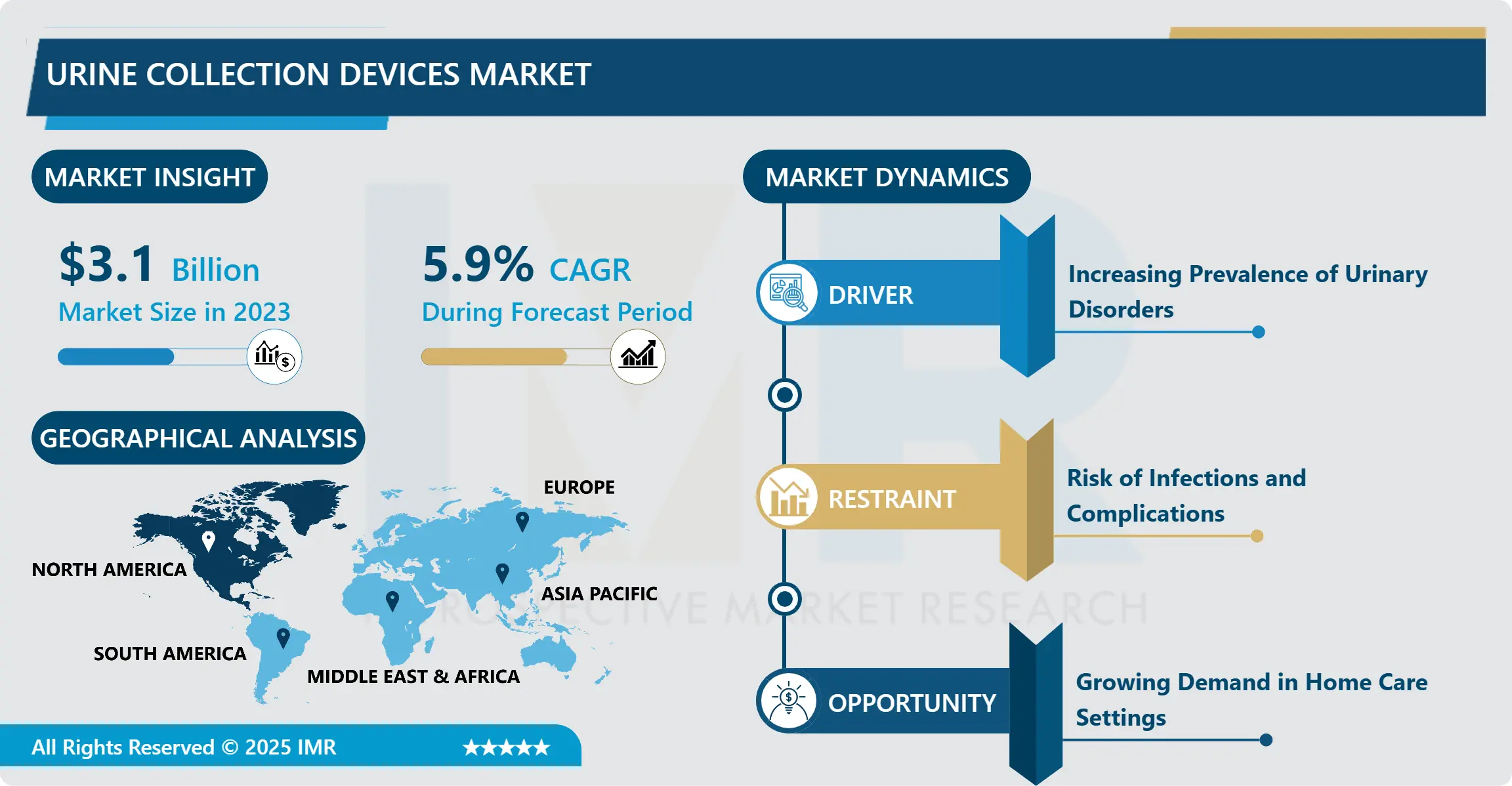
Urine Collection Devices Market Trend Analysis:
Increasing Use of Disposable Urine Collection Devices
-
Due to the rising concern of HAIs and patient protection, there is a rising shift towards disposable urine collection devices. Hygienically disposable apparatuses for example catheters for one use, bags for urine and other bodily fluids manage to reduce chances of cross contamination. These products are slowly finding their way into use in hospitals, clinics and even home care providers in an effort to reduce the risks of infections for patients and care givers. Disposable also eliminate the need to sterilize devices and this makes it easier for the medical persons and the systems to run efficiently.
- This trend also fits in well with the current trend of singleness of usage of the health care instruments in general with an intention to gain better health of the patient as well as to implement stringent standards for infection control as well. Entertainment with the help of regulating bodies demanding better sanitation some disposable urine collection devices are increasingly available in the market. To meet this need, manufacturers are designing products that are easy to use and safe to use; products made of natural materials in order to eliminate the use of disposable products which are over the years pollutive.
Growing Demand in Home Care Settings
-
Due to rapid development of chronic diseases and the continually rising elderly population, the market for the homecare urine collection devices has huge growth space. Remote health monitoring has thus emerged as a highly prized feature and patients are keen on obtaining easy access solutions not requiring frequent visits to the hospital. The services involve basic tools like urine collectors, catheters, sample containers, etc which are very useful for the patients suffering from incontinence or kidney disorders, patients with mobility issues or any kind of pathology that requires a patient to undergo catheterization while comfortably receiving care in the comfort of their own homes.
- This shift towards home care solutions is particularly promising in developed economy that has the underlying healthcare infrastructure to support home based patient care. Also, the COVID-19 pandemic boosted the utilization of home healthcare devices such as urine collection systems to show the importance of monitoring and diagnostic devices from the comfort of one’s home. From such innovations, it is clear that the market could grow and extend overall metered-dose service, as well as improve the quality of life of patients through portable, user-friendly and hygienic home-use urine collection devices.
Urine Collection Devices Market Segment Analysis:
Urine Collection Devices Market Segmented on the basis of product type, Usage, end user, Region.
By Product Type, Urine Sample Containers segment is expected to dominate the market during the forecast period
-
The global urine collection devices market comprises an extensive range of product types, all representing solutions to particular requirements in healthcare and home care settings. Urine sample containers are familiar paraphernalia in laboratories and clinics as diagnostic tools, whereas urinary catheters and urine bags are essential medical devices in patients with urinary incontinence or retention. The Urine meters, used commonly at hospitals, enable the exact evaluation of the urine volume which is important in the cases of seriously ill patients. On the other hand, urine collection kits are comfortable and convenient both in clinics and in home conditions, which provided patients with the possibility to provide clean samples.
- This characteristic makes these products easily applicable in various sanitarium units. These devices are essential in hospital and particularly diagnostic laboratories for correct sampling and patient management. Emerging technologies, including better anti-leakage technology in urine bags, and the use of biocompatible materials in developing catheters, is leading to better patient safety and comfort which translates to demand across each segment.
By End User, Diagnostic Laboratories segment is expected to hold the largest share
-
The key markets for urine collection devices are care centers, hospitals, clinics, laboratory services, home care service providers, and research organizations, and academic institutions. These devices are widely employed in Intensive Care Unit and emergency care wards, operations theatres, and gastrointestinal wards, where catheters and urine bags are used often. It is clear that diagnostic laboratories need appropriate urine sample containers since the quality of collected samples directly affects their diagnostic value.
- You can choose the type of home care setting which is an emerging segment due to increased population and increased home-based healthcare service. These devices are also widely used by research and academic institutes for clinical as well as research purposes especially in urological as well as in nephrological fields. The three end user segments have varying requirements for the urine collection devices, thus staking out competitive market.
Urine Collection Devices Market Regional Insights:
North America is Expected to Dominate the Market Over the Forecast period
-
The geographical region of North America holds maximum markets share Products in the urine collection devices market because of better healthcare facilities and higher instances of urinary disorders. By having an ageing population, and more people using high-tech medical technologies, the region also takes the lead in this market. Moreover, favouring circumstances concerning with regulatory and marked reimbursement functions in USA has facilitated the application of high quality urine collection device in healthcare industries especially for elderly and chronically ill patients.
- Since patient safety and infection control are of great concern in the healthcare facilities in North America, they have embraced the use of disposables and enhanced urine collection products. Business across this region dedicate huge capital in research to increase product efficiency and safety to conform with health care body regulatory standards and continue being competitive.
Active Key Players in the Urine Collection Devices Market:
- Cardinal Health (U.S.)
- Teleflex Incorporated (U.S.)
- B. Braun Melsungen AG (Germany)
- Coloplast A/S (Denmark)
- Medline Industries (U.S.)
- Hollister Incorporated (U.S.)
- BD (U.S.)
- ConvaTec Group PLC (U.K.)
- McKesson Corporation (U.S.)
- Thermo Fisher Scientific (U.S.)
- Teleflex Medical (U.S.)
- Domtar Corporation (Canada)
- Other Active Players
Key Industry Developments in the Urine Collection Devices Market:
-
In July 2024, Mexple, an India-based startup, launched its innovative UroMen and UroWomen urine collection kits. These are designed for male and female incontinence. These new kits aim to revolutionize patient care with their advanced design, comfort, and functionality, addressing the need for superior home medical products.
|
Urine Collection Devices Market |
|||
|
Base Year: |
2023 |
Forecast Period: |
2024-2032 |
|
Historical Data: |
2017 to 2023 |
Market Size in 2023: |
USD 3.1 Billion |
|
Forecast Period 2024-32 CAGR: |
5.9% |
Market Size in 2032: |
USD 5.19 Billion |
|
Segments Covered: |
By Product Type |
|
|
|
By Usage |
|
||
|
By End User |
|
||
|
By Region |
|
||
|
Key Market Drivers: |
|
||
|
Key Market Restraints: |
|
||
|
Key Opportunities: |
|
||
|
Companies Covered in the report: |
|
||
Chapter 1: Introduction
1.1 Scope and Coverage
Chapter 2:Executive Summary
Chapter 3: Market Landscape
3.1 Market Dynamics
3.1.1 Drivers
3.1.2 Restraints
3.1.3 Opportunities
3.1.4 Challenges
3.2 Market Trend Analysis
3.3 PESTLE Analysis
3.4 Porter's Five Forces Analysis
3.5 Industry Value Chain Analysis
3.6 Ecosystem
3.7 Regulatory Landscape
3.8 Price Trend Analysis
3.9 Patent Analysis
3.10 Technology Evolution
3.11 Investment Pockets
3.12 Import-Export Analysis
Chapter 4: Urine Collection Devices Market by Product Type
4.1 Urine Collection Devices Market Snapshot and Growth Engine
4.2 Urine Collection Devices Market Overview
4.3 Urine Sample Containers
4.3.1 Introduction and Market Overview
4.3.2 Historic and Forecasted Market Size in Value USD and Volume Units (2017-2032F)
4.3.3 Key Market Trends, Growth Factors and Opportunities
4.3.4 Urine Sample Containers: Geographic Segmentation Analysis
4.4 Urinary Catheters
4.4.1 Introduction and Market Overview
4.4.2 Historic and Forecasted Market Size in Value USD and Volume Units (2017-2032F)
4.4.3 Key Market Trends, Growth Factors and Opportunities
4.4.4 Urinary Catheters: Geographic Segmentation Analysis
4.5 Urine Collection Bags
4.5.1 Introduction and Market Overview
4.5.2 Historic and Forecasted Market Size in Value USD and Volume Units (2017-2032F)
4.5.3 Key Market Trends, Growth Factors and Opportunities
4.5.4 Urine Collection Bags: Geographic Segmentation Analysis
4.6 Urine Meters
4.6.1 Introduction and Market Overview
4.6.2 Historic and Forecasted Market Size in Value USD and Volume Units (2017-2032F)
4.6.3 Key Market Trends, Growth Factors and Opportunities
4.6.4 Urine Meters: Geographic Segmentation Analysis
4.7 Urine Collection Kits
4.7.1 Introduction and Market Overview
4.7.2 Historic and Forecasted Market Size in Value USD and Volume Units (2017-2032F)
4.7.3 Key Market Trends, Growth Factors and Opportunities
4.7.4 Urine Collection Kits: Geographic Segmentation Analysis
Chapter 5: Urine Collection Devices Market by Usage
5.1 Urine Collection Devices Market Snapshot and Growth Engine
5.2 Urine Collection Devices Market Overview
5.3 Disposable
5.3.1 Introduction and Market Overview
5.3.2 Historic and Forecasted Market Size in Value USD and Volume Units (2017-2032F)
5.3.3 Key Market Trends, Growth Factors and Opportunities
5.3.4 Disposable: Geographic Segmentation Analysis
5.4 Reusable
5.4.1 Introduction and Market Overview
5.4.2 Historic and Forecasted Market Size in Value USD and Volume Units (2017-2032F)
5.4.3 Key Market Trends, Growth Factors and Opportunities
5.4.4 Reusable: Geographic Segmentation Analysis
Chapter 6: Urine Collection Devices Market by End User
6.1 Urine Collection Devices Market Snapshot and Growth Engine
6.2 Urine Collection Devices Market Overview
6.3 Hospitals
6.3.1 Introduction and Market Overview
6.3.2 Historic and Forecasted Market Size in Value USD and Volume Units (2017-2032F)
6.3.3 Key Market Trends, Growth Factors and Opportunities
6.3.4 Hospitals: Geographic Segmentation Analysis
6.4 Clinics
6.4.1 Introduction and Market Overview
6.4.2 Historic and Forecasted Market Size in Value USD and Volume Units (2017-2032F)
6.4.3 Key Market Trends, Growth Factors and Opportunities
6.4.4 Clinics: Geographic Segmentation Analysis
6.5 Diagnostic Laboratories
6.5.1 Introduction and Market Overview
6.5.2 Historic and Forecasted Market Size in Value USD and Volume Units (2017-2032F)
6.5.3 Key Market Trends, Growth Factors and Opportunities
6.5.4 Diagnostic Laboratories: Geographic Segmentation Analysis
6.6 Home Care Settings
6.6.1 Introduction and Market Overview
6.6.2 Historic and Forecasted Market Size in Value USD and Volume Units (2017-2032F)
6.6.3 Key Market Trends, Growth Factors and Opportunities
6.6.4 Home Care Settings: Geographic Segmentation Analysis
6.7 Research and Academic Institutes)
6.7.1 Introduction and Market Overview
6.7.2 Historic and Forecasted Market Size in Value USD and Volume Units (2017-2032F)
6.7.3 Key Market Trends, Growth Factors and Opportunities
6.7.4 Research and Academic Institutes) : Geographic Segmentation Analysis
Chapter 7: Company Profiles and Competitive Analysis
7.1 Competitive Landscape
7.1.1 Competitive Benchmarking
7.1.2 Urine Collection Devices Market Share by Manufacturer (2023)
7.1.3 Industry BCG Matrix
7.1.4 Heat Map Analysis
7.1.5 Mergers and Acquisitions
7.2 CARDINAL HEALTH (U.S.)
7.2.1 Company Overview
7.2.2 Key Executives
7.2.3 Company Snapshot
7.2.4 Role of the Company in the Market
7.2.5 Sustainability and Social Responsibility
7.2.6 Operating Business Segments
7.2.7 Product Portfolio
7.2.8 Business Performance
7.2.9 Key Strategic Moves and Recent Developments
7.2.10 SWOT Analysis
7.3 TELEFLEX INCORPORATED (U.S.)
7.4 B. BRAUN MELSUNGEN AG (GERMANY)
7.5 COLOPLAST A/S (DENMARK)
7.6 MEDLINE INDUSTRIES (U.S.)
7.7 HOLLISTER INCORPORATED (U.S.)
7.8 BD (U.S.)
7.9 CONVATEC GROUP PLC (U.K.)
7.10 OTHER ACTIVE PLAYERS
Chapter 8: Global Urine Collection Devices Market By Region
8.1 Overview
8.2. North America Urine Collection Devices Market
8.2.1 Key Market Trends, Growth Factors and Opportunities
8.2.2 Top Key Companies
8.2.3 Historic and Forecasted Market Size by Segments
8.2.4 Historic and Forecasted Market Size By Product Type
8.2.4.1 Urine Sample Containers
8.2.4.2 Urinary Catheters
8.2.4.3 Urine Collection Bags
8.2.4.4 Urine Meters
8.2.4.5 Urine Collection Kits
8.2.5 Historic and Forecasted Market Size By Usage
8.2.5.1 Disposable
8.2.5.2 Reusable
8.2.6 Historic and Forecasted Market Size By End User
8.2.6.1 Hospitals
8.2.6.2 Clinics
8.2.6.3 Diagnostic Laboratories
8.2.6.4 Home Care Settings
8.2.6.5 Research and Academic Institutes)
8.2.7 Historic and Forecast Market Size by Country
8.2.7.1 US
8.2.7.2 Canada
8.2.7.3 Mexico
8.3. Eastern Europe Urine Collection Devices Market
8.3.1 Key Market Trends, Growth Factors and Opportunities
8.3.2 Top Key Companies
8.3.3 Historic and Forecasted Market Size by Segments
8.3.4 Historic and Forecasted Market Size By Product Type
8.3.4.1 Urine Sample Containers
8.3.4.2 Urinary Catheters
8.3.4.3 Urine Collection Bags
8.3.4.4 Urine Meters
8.3.4.5 Urine Collection Kits
8.3.5 Historic and Forecasted Market Size By Usage
8.3.5.1 Disposable
8.3.5.2 Reusable
8.3.6 Historic and Forecasted Market Size By End User
8.3.6.1 Hospitals
8.3.6.2 Clinics
8.3.6.3 Diagnostic Laboratories
8.3.6.4 Home Care Settings
8.3.6.5 Research and Academic Institutes)
8.3.7 Historic and Forecast Market Size by Country
8.3.7.1 Russia
8.3.7.2 Bulgaria
8.3.7.3 The Czech Republic
8.3.7.4 Hungary
8.3.7.5 Poland
8.3.7.6 Romania
8.3.7.7 Rest of Eastern Europe
8.4. Western Europe Urine Collection Devices Market
8.4.1 Key Market Trends, Growth Factors and Opportunities
8.4.2 Top Key Companies
8.4.3 Historic and Forecasted Market Size by Segments
8.4.4 Historic and Forecasted Market Size By Product Type
8.4.4.1 Urine Sample Containers
8.4.4.2 Urinary Catheters
8.4.4.3 Urine Collection Bags
8.4.4.4 Urine Meters
8.4.4.5 Urine Collection Kits
8.4.5 Historic and Forecasted Market Size By Usage
8.4.5.1 Disposable
8.4.5.2 Reusable
8.4.6 Historic and Forecasted Market Size By End User
8.4.6.1 Hospitals
8.4.6.2 Clinics
8.4.6.3 Diagnostic Laboratories
8.4.6.4 Home Care Settings
8.4.6.5 Research and Academic Institutes)
8.4.7 Historic and Forecast Market Size by Country
8.4.7.1 Germany
8.4.7.2 UK
8.4.7.3 France
8.4.7.4 The Netherlands
8.4.7.5 Italy
8.4.7.6 Spain
8.4.7.7 Rest of Western Europe
8.5. Asia Pacific Urine Collection Devices Market
8.5.1 Key Market Trends, Growth Factors and Opportunities
8.5.2 Top Key Companies
8.5.3 Historic and Forecasted Market Size by Segments
8.5.4 Historic and Forecasted Market Size By Product Type
8.5.4.1 Urine Sample Containers
8.5.4.2 Urinary Catheters
8.5.4.3 Urine Collection Bags
8.5.4.4 Urine Meters
8.5.4.5 Urine Collection Kits
8.5.5 Historic and Forecasted Market Size By Usage
8.5.5.1 Disposable
8.5.5.2 Reusable
8.5.6 Historic and Forecasted Market Size By End User
8.5.6.1 Hospitals
8.5.6.2 Clinics
8.5.6.3 Diagnostic Laboratories
8.5.6.4 Home Care Settings
8.5.6.5 Research and Academic Institutes)
8.5.7 Historic and Forecast Market Size by Country
8.5.7.1 China
8.5.7.2 India
8.5.7.3 Japan
8.5.7.4 South Korea
8.5.7.5 Malaysia
8.5.7.6 Thailand
8.5.7.7 Vietnam
8.5.7.8 The Philippines
8.5.7.9 Australia
8.5.7.10 New Zealand
8.5.7.11 Rest of APAC
8.6. Middle East & Africa Urine Collection Devices Market
8.6.1 Key Market Trends, Growth Factors and Opportunities
8.6.2 Top Key Companies
8.6.3 Historic and Forecasted Market Size by Segments
8.6.4 Historic and Forecasted Market Size By Product Type
8.6.4.1 Urine Sample Containers
8.6.4.2 Urinary Catheters
8.6.4.3 Urine Collection Bags
8.6.4.4 Urine Meters
8.6.4.5 Urine Collection Kits
8.6.5 Historic and Forecasted Market Size By Usage
8.6.5.1 Disposable
8.6.5.2 Reusable
8.6.6 Historic and Forecasted Market Size By End User
8.6.6.1 Hospitals
8.6.6.2 Clinics
8.6.6.3 Diagnostic Laboratories
8.6.6.4 Home Care Settings
8.6.6.5 Research and Academic Institutes)
8.6.7 Historic and Forecast Market Size by Country
8.6.7.1 Turkiye
8.6.7.2 Bahrain
8.6.7.3 Kuwait
8.6.7.4 Saudi Arabia
8.6.7.5 Qatar
8.6.7.6 UAE
8.6.7.7 Israel
8.6.7.8 South Africa
8.7. South America Urine Collection Devices Market
8.7.1 Key Market Trends, Growth Factors and Opportunities
8.7.2 Top Key Companies
8.7.3 Historic and Forecasted Market Size by Segments
8.7.4 Historic and Forecasted Market Size By Product Type
8.7.4.1 Urine Sample Containers
8.7.4.2 Urinary Catheters
8.7.4.3 Urine Collection Bags
8.7.4.4 Urine Meters
8.7.4.5 Urine Collection Kits
8.7.5 Historic and Forecasted Market Size By Usage
8.7.5.1 Disposable
8.7.5.2 Reusable
8.7.6 Historic and Forecasted Market Size By End User
8.7.6.1 Hospitals
8.7.6.2 Clinics
8.7.6.3 Diagnostic Laboratories
8.7.6.4 Home Care Settings
8.7.6.5 Research and Academic Institutes)
8.7.7 Historic and Forecast Market Size by Country
8.7.7.1 Brazil
8.7.7.2 Argentina
8.7.7.3 Rest of SA
Chapter 9 Analyst Viewpoint and Conclusion
9.1 Recommendations and Concluding Analysis
9.2 Potential Market Strategies
Chapter 10 Research Methodology
10.1 Research Process
10.2 Primary Research
10.3 Secondary Research
|
Urine Collection Devices Market |
|||
|
Base Year: |
2023 |
Forecast Period: |
2024-2032 |
|
Historical Data: |
2017 to 2023 |
Market Size in 2023: |
USD 3.1 Billion |
|
Forecast Period 2024-32 CAGR: |
5.9% |
Market Size in 2032: |
USD 5.19 Billion |
|
Segments Covered: |
By Product Type |
|
|
|
By Usage |
|
||
|
By End User |
|
||
|
By Region |
|
||
|
Key Market Drivers: |
|
||
|
Key Market Restraints: |
|
||
|
Key Opportunities: |
|
||
|
Companies Covered in the report: |
|
||


