




Tylosin Market Synopsis:
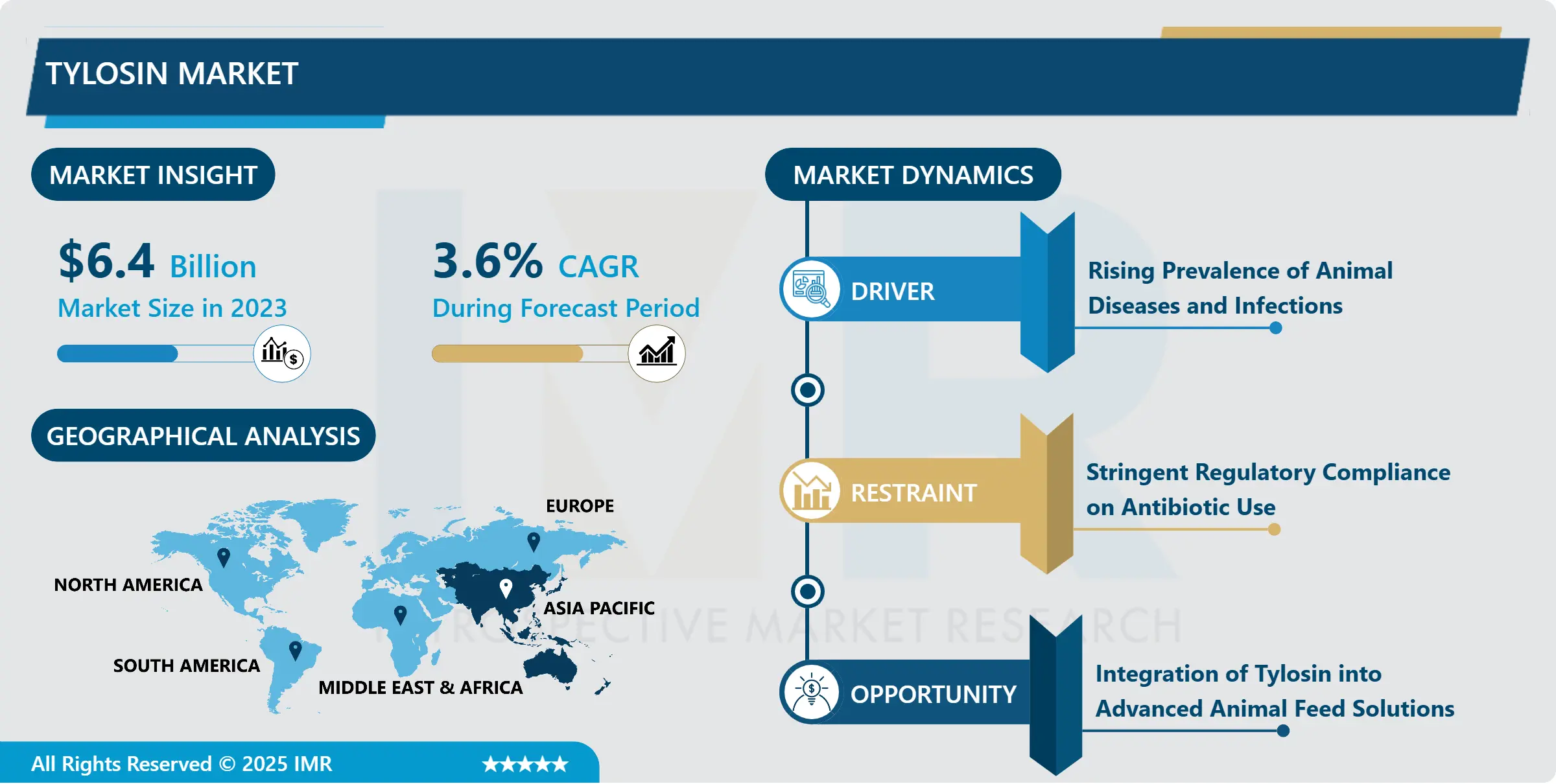
Tylosin Market Size Was Valued at USD 6.40 Billion in 2023, and is Projected to Reach USD 8.79 Billion by 2032, Growing at a CAGR of 3.60% From 2024-2032.
The Tylosin market defines the worldwide market place which involves the manufacture, selling, and use of Tylosin that is commonly used as a veterinary antibiotic. It is used in the treatment of bacterial infections in animals, and is commonly added to feed and medicated animal feedstuffs. Tylosin has a role in increasing growth and the general health of animal species especially in poultry, swine and cattle livestock.
The main factors that have led to growth of Tylosin include; increasing demand of animal protein through consumption and productivity of livestock. As world population expands, need for animal products increases, on the same note the need for efficient animal health solutions improves. Also, the awareness that animal also need some form of welfare and healthy has put pressure on the development of better antibiotics such as Tylosin to enhance the health of the stock to productive levels.
There is better management of diseases and infections together with the growth of diseases affecting animals. Since diseases affect productivity in animals once they have been infected, there is always emphasis on increasing animal health through immunization and treatment. This has led to higher uptake of Tylosin in veterinarian uses for managing of disease, minimizing mortality, and maximize production of meat.
Tylosin Market Trend Analysis:
Shifting towards a more sustainable and responsible use of antibiotics in animal farming
-
These trends are symptomatic of a transition towards correct usage of Tylosin in the sector of animal farming and animal husbandry. Given the increase in the rate at which diseases are developing resistance to commonly used antibiotics, there is huge pressure to have the use of Tylosin and any other antibiotic in animal industries controlled. Monopolies and global regulatory authorities have stepped up a gear to put in place regulation measures to dictate how antibiotic is used and hence affecting this market.
- In the same year, the use of Tylosin in animal feed additives as a growth promoter and disease preventive measure in feed formulation for animals is strongly encouraged. Tylosin is readily available in premix formulation and as customized animal feed solutions, due to the controlled and efficient administration of the formulation that both farmers as well as veterinarians appreciate.
Consumption of veterinary antibiotics
-
As the world’s population is gradually rising Continually, the global demand for meat products, especially amongst the rapidly growing people of the developing region of Asia pacific region. They state that there will be an increase in demand for the Tylosin market because livestock farming will also need to increase due to the consumption of veterinary antibiotics such as Tylosin. In addition, this area is a major producer of poultry and swine food products for which Tylosin is essential in providing animal health and producing quality food products.
- The third transformative opportunity relates to expanding use of veterinary medicine especially in the developing world. with a progress in veterinary medicine and its availability people will require more antibiotics, such as Tylosin, as they are useful in combating infections. Perhaps this creates new opportunities for the market development, although it is likely to appear in areas with the least developed veterinary service.
Tylosin Market Segment Analysis:
Tylosin Market is Segmented on the basis of Product Type, Application, End User, and Region.
By Product Type, Tylosin Tartrate segment is expected to dominate the market during the forecast period
-
The tylosin can either be in the form of Tylosin Tartrate, Tylosin Phosphate and even other forms. The tartrate salt of tylosin is most popular in veterinary practice because of solubility and ready absorption in the animal body. Tylosin Phosphate on the other hand is normally administered in formulations for incorporation into feeds, primarily owing to stability and longer shelf life. Others may be various compounds or blends which are designed for the use in those specific species of livestock.
By Application, Animal Feed segment expected to held the largest share
-
The Tylosin market is segmented into some of its principal uses in the market such as feed additive for animal feeds, antibiotics, and veterinary drugs. Tylosin is commonly added in feed of mice, poultry and swine for growth promotion and prevention of diseases. In agriculture, it is used in antibiotics that tends to treat bacterial infections in animals for improvement of health in the middle of the herds. Veterinary products comprise various forms that comprise Tylosin for treating diseases in cattle, poultry and other livestock to keep them healthy and productive.
Tylosin Market Regional Insights:
Asia Pacific is Expected to Dominate the Market Over the Forecast period
-
The Asia-Pacific region is the largest market for Tylosin in the overall market due to the increasing need for livestock products, increased use of technology in animal husbandry practices. Since countries such as China, India and Thailand have big poultry, cattle and swine sectors they are considered potential markets where there is a need for antibiotics such as Tylosin to enhance animal health and productivity. In addition, it is believed that with the rate at which these countries is urbanizing and the recent improvements in the quality of veterinary health in the countries, the demand of products like Tylosin will increase in future years.
- Currently, the entire region is on the right track of enhancing its food security and increasing protein production, hence a good market for Tylosin in Asia Pacific. Tylosin is increasingly important in managing diseases affecting livestock due to a growing concern in animal welfare, and as an intervention in disease management, which has a significant place in agriculture in the region.
Active Key Players in the Tylosin Market
-
Boehringer Ingelheim (Germany)
- Elanco (USA)
- Huvepharma (Bulgaria)
- Huvepharma (Bulgaria)
- Kyorin Pharmaceutical (Japan)
- Merck Animal Health (USA)
- MSD Animal Health (USA)
- Novartis Animal Health (Switzerland)
- Vetoquinol (France)
- Zoetis (USA)
- Other Active Players.
|
Global Tylosin Market |
|||
|
Base Year: |
2023 |
Forecast Period: |
2024-2032 |
|
Historical Data: |
2017 to 2023 |
Market Size in 2023: |
USD 6.40 Billion |
|
Forecast Period 2024-32 CAGR: |
3.60% |
Market Size in 2032: |
USD 8.79 Billion |
|
Segments Covered: |
By Product Type |
|
|
|
By Animal Type |
|
||
|
By Application |
|
||
|
By Region |
|
||
|
Key Market Drivers: |
|
||
|
Key Market Restraints: |
|
||
|
Key Opportunities: |
|
||
|
Companies Covered in the report: |
|
||
Chapter 1: Introduction
1.1 Scope and Coverage
Chapter 2:Executive Summary
Chapter 3: Market Landscape
3.1 Market Dynamics
3.1.1 Drivers
3.1.2 Restraints
3.1.3 Opportunities
3.1.4 Challenges
3.2 Market Trend Analysis
3.3 PESTLE Analysis
3.4 Porter's Five Forces Analysis
3.5 Industry Value Chain Analysis
3.6 Ecosystem
3.7 Regulatory Landscape
3.8 Price Trend Analysis
3.9 Patent Analysis
3.10 Technology Evolution
3.11 Investment Pockets
3.12 Import-Export Analysis
Chapter 4: Tylosin Market by Type
4.1 Tylosin Market Snapshot and Growth Engine
4.2 Tylosin Market Overview
4.3 UVA LED
4.3.1 Introduction and Market Overview
4.3.2 Historic and Forecasted Market Size in Value USD and Volume Units (2017-2032F)
4.3.3 Key Market Trends, Growth Factors and Opportunities
4.3.4 UVA LED: Geographic Segmentation Analysis
4.4 UVB LED
4.4.1 Introduction and Market Overview
4.4.2 Historic and Forecasted Market Size in Value USD and Volume Units (2017-2032F)
4.4.3 Key Market Trends, Growth Factors and Opportunities
4.4.4 UVB LED: Geographic Segmentation Analysis
4.5 UVC LED
4.5.1 Introduction and Market Overview
4.5.2 Historic and Forecasted Market Size in Value USD and Volume Units (2017-2032F)
4.5.3 Key Market Trends, Growth Factors and Opportunities
4.5.4 UVC LED: Geographic Segmentation Analysis
Chapter 5: Tylosin Market by Application
5.1 Tylosin Market Snapshot and Growth Engine
5.2 Tylosin Market Overview
5.3 Water Purification
5.3.1 Introduction and Market Overview
5.3.2 Historic and Forecasted Market Size in Value USD and Volume Units (2017-2032F)
5.3.3 Key Market Trends, Growth Factors and Opportunities
5.3.4 Water Purification: Geographic Segmentation Analysis
5.4 Curing
5.4.1 Introduction and Market Overview
5.4.2 Historic and Forecasted Market Size in Value USD and Volume Units (2017-2032F)
5.4.3 Key Market Trends, Growth Factors and Opportunities
5.4.4 Curing: Geographic Segmentation Analysis
5.5 Disinfection
5.5.1 Introduction and Market Overview
5.5.2 Historic and Forecasted Market Size in Value USD and Volume Units (2017-2032F)
5.5.3 Key Market Trends, Growth Factors and Opportunities
5.5.4 Disinfection: Geographic Segmentation Analysis
5.6 Healthcare & Medicine
5.6.1 Introduction and Market Overview
5.6.2 Historic and Forecasted Market Size in Value USD and Volume Units (2017-2032F)
5.6.3 Key Market Trends, Growth Factors and Opportunities
5.6.4 Healthcare & Medicine: Geographic Segmentation Analysis
5.7 Printing
5.7.1 Introduction and Market Overview
5.7.2 Historic and Forecasted Market Size in Value USD and Volume Units (2017-2032F)
5.7.3 Key Market Trends, Growth Factors and Opportunities
5.7.4 Printing: Geographic Segmentation Analysis
5.8 Forensics
5.8.1 Introduction and Market Overview
5.8.2 Historic and Forecasted Market Size in Value USD and Volume Units (2017-2032F)
5.8.3 Key Market Trends, Growth Factors and Opportunities
5.8.4 Forensics: Geographic Segmentation Analysis
5.9 Others
5.9.1 Introduction and Market Overview
5.9.2 Historic and Forecasted Market Size in Value USD and Volume Units (2017-2032F)
5.9.3 Key Market Trends, Growth Factors and Opportunities
5.9.4 Others: Geographic Segmentation Analysis
Chapter 6: Tylosin Market by End User
6.1 Tylosin Market Snapshot and Growth Engine
6.2 Tylosin Market Overview
6.3 Industrial
6.3.1 Introduction and Market Overview
6.3.2 Historic and Forecasted Market Size in Value USD and Volume Units (2017-2032F)
6.3.3 Key Market Trends, Growth Factors and Opportunities
6.3.4 Industrial: Geographic Segmentation Analysis
6.4 Commercial
6.4.1 Introduction and Market Overview
6.4.2 Historic and Forecasted Market Size in Value USD and Volume Units (2017-2032F)
6.4.3 Key Market Trends, Growth Factors and Opportunities
6.4.4 Commercial: Geographic Segmentation Analysis
6.5 Residential
6.5.1 Introduction and Market Overview
6.5.2 Historic and Forecasted Market Size in Value USD and Volume Units (2017-2032F)
6.5.3 Key Market Trends, Growth Factors and Opportunities
6.5.4 Residential: Geographic Segmentation Analysis
Chapter 7: Company Profiles and Competitive Analysis
7.1 Competitive Landscape
7.1.1 Competitive Benchmarking
7.1.2 Tylosin Market Share by Manufacturer (2023)
7.1.3 Industry BCG Matrix
7.1.4 Heat Map Analysis
7.1.5 Mergers and Acquisitions
7.2 ZOETIS (USA)
7.2.1 Company Overview
7.2.2 Key Executives
7.2.3 Company Snapshot
7.2.4 Role of the Company in the Market
7.2.5 Sustainability and Social Responsibility
7.2.6 Operating Business Segments
7.2.7 Product Portfolio
7.2.8 Business Performance
7.2.9 Key Strategic Moves and Recent Developments
7.2.10 SWOT Analysis
7.3 MERCK ANIMAL HEALTH (USA)
7.4 BOEHRINGER INGELHEIM (GERMANY)
7.5 ELANCO (USA)
7.6 VETOQUINOL (FRANCE)
7.7 HUVEPHARMA (BULGARIA)
7.8 MSD ANIMAL HEALTH (USA)
7.9 KYORIN PHARMACEUTICAL (JAPAN)
7.10 NOVARTIS ANIMAL HEALTH (SWITZERLAND)
7.11 HUVEPHARMA (BULGARIA)
7.12 OTHER ACTIVE PLAYERS
Chapter 8: Global Tylosin Market By Region
8.1 Overview
8.2. North America Tylosin Market
8.2.1 Key Market Trends, Growth Factors and Opportunities
8.2.2 Top Key Companies
8.2.3 Historic and Forecasted Market Size by Segments
8.2.4 Historic and Forecasted Market Size By Type
8.2.4.1 UVA LED
8.2.4.2 UVB LED
8.2.4.3 UVC LED
8.2.5 Historic and Forecasted Market Size By Application
8.2.5.1 Water Purification
8.2.5.2 Curing
8.2.5.3 Disinfection
8.2.5.4 Healthcare & Medicine
8.2.5.5 Printing
8.2.5.6 Forensics
8.2.5.7 Others
8.2.6 Historic and Forecasted Market Size By End User
8.2.6.1 Industrial
8.2.6.2 Commercial
8.2.6.3 Residential
8.2.7 Historic and Forecast Market Size by Country
8.2.7.1 US
8.2.7.2 Canada
8.2.7.3 Mexico
8.3. Eastern Europe Tylosin Market
8.3.1 Key Market Trends, Growth Factors and Opportunities
8.3.2 Top Key Companies
8.3.3 Historic and Forecasted Market Size by Segments
8.3.4 Historic and Forecasted Market Size By Type
8.3.4.1 UVA LED
8.3.4.2 UVB LED
8.3.4.3 UVC LED
8.3.5 Historic and Forecasted Market Size By Application
8.3.5.1 Water Purification
8.3.5.2 Curing
8.3.5.3 Disinfection
8.3.5.4 Healthcare & Medicine
8.3.5.5 Printing
8.3.5.6 Forensics
8.3.5.7 Others
8.3.6 Historic and Forecasted Market Size By End User
8.3.6.1 Industrial
8.3.6.2 Commercial
8.3.6.3 Residential
8.3.7 Historic and Forecast Market Size by Country
8.3.7.1 Russia
8.3.7.2 Bulgaria
8.3.7.3 The Czech Republic
8.3.7.4 Hungary
8.3.7.5 Poland
8.3.7.6 Romania
8.3.7.7 Rest of Eastern Europe
8.4. Western Europe Tylosin Market
8.4.1 Key Market Trends, Growth Factors and Opportunities
8.4.2 Top Key Companies
8.4.3 Historic and Forecasted Market Size by Segments
8.4.4 Historic and Forecasted Market Size By Type
8.4.4.1 UVA LED
8.4.4.2 UVB LED
8.4.4.3 UVC LED
8.4.5 Historic and Forecasted Market Size By Application
8.4.5.1 Water Purification
8.4.5.2 Curing
8.4.5.3 Disinfection
8.4.5.4 Healthcare & Medicine
8.4.5.5 Printing
8.4.5.6 Forensics
8.4.5.7 Others
8.4.6 Historic and Forecasted Market Size By End User
8.4.6.1 Industrial
8.4.6.2 Commercial
8.4.6.3 Residential
8.4.7 Historic and Forecast Market Size by Country
8.4.7.1 Germany
8.4.7.2 UK
8.4.7.3 France
8.4.7.4 The Netherlands
8.4.7.5 Italy
8.4.7.6 Spain
8.4.7.7 Rest of Western Europe
8.5. Asia Pacific Tylosin Market
8.5.1 Key Market Trends, Growth Factors and Opportunities
8.5.2 Top Key Companies
8.5.3 Historic and Forecasted Market Size by Segments
8.5.4 Historic and Forecasted Market Size By Type
8.5.4.1 UVA LED
8.5.4.2 UVB LED
8.5.4.3 UVC LED
8.5.5 Historic and Forecasted Market Size By Application
8.5.5.1 Water Purification
8.5.5.2 Curing
8.5.5.3 Disinfection
8.5.5.4 Healthcare & Medicine
8.5.5.5 Printing
8.5.5.6 Forensics
8.5.5.7 Others
8.5.6 Historic and Forecasted Market Size By End User
8.5.6.1 Industrial
8.5.6.2 Commercial
8.5.6.3 Residential
8.5.7 Historic and Forecast Market Size by Country
8.5.7.1 China
8.5.7.2 India
8.5.7.3 Japan
8.5.7.4 South Korea
8.5.7.5 Malaysia
8.5.7.6 Thailand
8.5.7.7 Vietnam
8.5.7.8 The Philippines
8.5.7.9 Australia
8.5.7.10 New Zealand
8.5.7.11 Rest of APAC
8.6. Middle East & Africa Tylosin Market
8.6.1 Key Market Trends, Growth Factors and Opportunities
8.6.2 Top Key Companies
8.6.3 Historic and Forecasted Market Size by Segments
8.6.4 Historic and Forecasted Market Size By Type
8.6.4.1 UVA LED
8.6.4.2 UVB LED
8.6.4.3 UVC LED
8.6.5 Historic and Forecasted Market Size By Application
8.6.5.1 Water Purification
8.6.5.2 Curing
8.6.5.3 Disinfection
8.6.5.4 Healthcare & Medicine
8.6.5.5 Printing
8.6.5.6 Forensics
8.6.5.7 Others
8.6.6 Historic and Forecasted Market Size By End User
8.6.6.1 Industrial
8.6.6.2 Commercial
8.6.6.3 Residential
8.6.7 Historic and Forecast Market Size by Country
8.6.7.1 Turkiye
8.6.7.2 Bahrain
8.6.7.3 Kuwait
8.6.7.4 Saudi Arabia
8.6.7.5 Qatar
8.6.7.6 UAE
8.6.7.7 Israel
8.6.7.8 South Africa
8.7. South America Tylosin Market
8.7.1 Key Market Trends, Growth Factors and Opportunities
8.7.2 Top Key Companies
8.7.3 Historic and Forecasted Market Size by Segments
8.7.4 Historic and Forecasted Market Size By Type
8.7.4.1 UVA LED
8.7.4.2 UVB LED
8.7.4.3 UVC LED
8.7.5 Historic and Forecasted Market Size By Application
8.7.5.1 Water Purification
8.7.5.2 Curing
8.7.5.3 Disinfection
8.7.5.4 Healthcare & Medicine
8.7.5.5 Printing
8.7.5.6 Forensics
8.7.5.7 Others
8.7.6 Historic and Forecasted Market Size By End User
8.7.6.1 Industrial
8.7.6.2 Commercial
8.7.6.3 Residential
8.7.7 Historic and Forecast Market Size by Country
8.7.7.1 Brazil
8.7.7.2 Argentina
8.7.7.3 Rest of SA
Chapter 9 Analyst Viewpoint and Conclusion
9.1 Recommendations and Concluding Analysis
9.2 Potential Market Strategies
Chapter 10 Research Methodology
10.1 Research Process
10.2 Primary Research
10.3 Secondary Research
|
Global Tylosin Market |
|||
|
Base Year: |
2023 |
Forecast Period: |
2024-2032 |
|
Historical Data: |
2017 to 2023 |
Market Size in 2023: |
USD 6.40 Billion |
|
Forecast Period 2024-32 CAGR: |
3.60% |
Market Size in 2032: |
USD 8.79 Billion |
|
Segments Covered: |
By Product Type |
|
|
|
By Animal Type |
|
||
|
By Application |
|
||
|
By Region |
|
||
|
Key Market Drivers: |
|
||
|
Key Market Restraints: |
|
||
|
Key Opportunities: |
|
||
|
Companies Covered in the report: |
|
||


