




Predictive Maintenance For Manufacturing Market Synopsis:
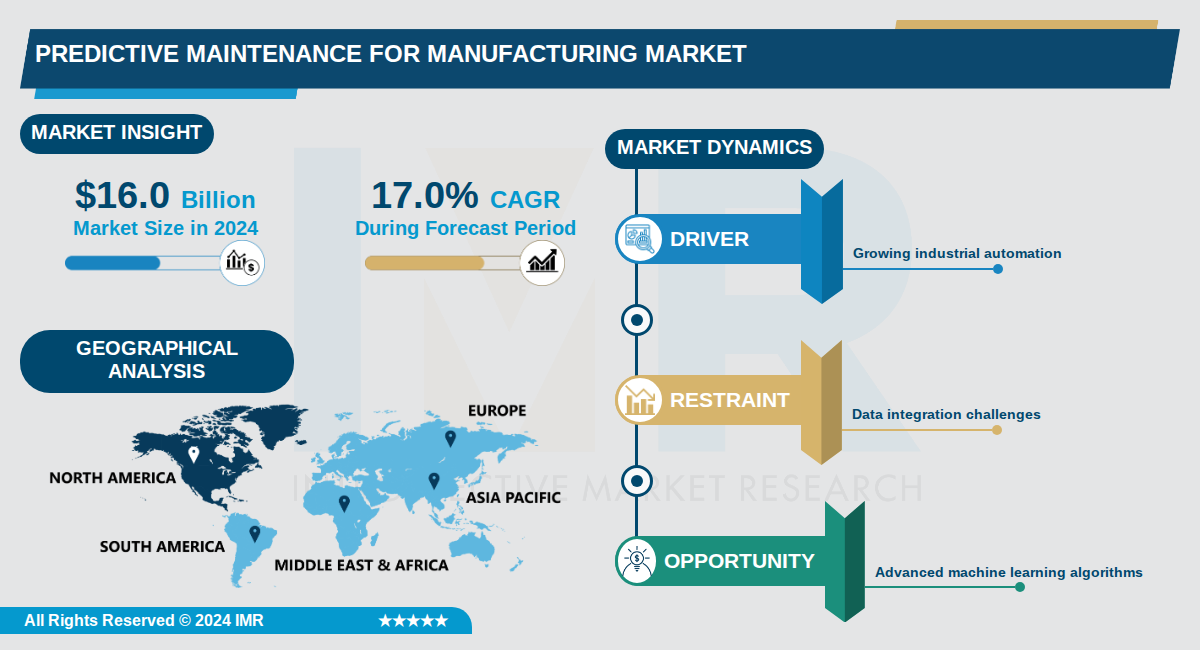
Predictive Maintenance For Manufacturing Market Size Was Valued at USD 16.0 Billion in 2024, and is Projected to Reach USD 91.0 Billion by 2035, Growing at a CAGR of 17.0% From 2024-2035.
The Predictive Maintenance for Manufacturing Market, a critical segment of the broader predictive maintenance industry, is valued at $16.0 billion in 2024 and is projected to reach $91.0 billion by 2035, growing at a compound annual growth rate (CAGR) of 17.0%.[user-provided data]
Predictive maintenance (PdM) leverages technologies such as IoT sensors, AI, machine learning, predictive analytics, and digital twins to monitor equipment health in real-time, predict failures, and enable proactive repairs, minimizing unplanned downtime that costs manufacturers nearly $50 billion annually.
Manufacturing holds the largest market share in PdM due to its heavy reliance on machinery like robots, pumps, and compressors, with Industry 4.0 integration accelerating adoption for optimized asset performance and cost efficiency across regions, particularly in Asia Pacific.
Predictive Maintenance For Manufacturing Market Trend Analysis:
Rising Integration of AI
- The growing adoption of artificial intelligence in predictive maintenance analyzes vast amounts of data from sensors in real-time to detect patterns and predict equipment failures more accurately. In July 2024, Guidewheel introduced Scout, an AI-powered product that helps manufacturers predict maintenance needs and detect early warning signals before machine downtime occurs. This integration is bolstering market growth, with ensemble machine-learning pipelines achieving 85-95% precision in predicting bearing, pump, and motor failures 30-60 days in advance.
- Advanced machine learning algorithms now predict equipment failures 6-12 months ahead with accuracy rates above 85%, while IoT-powered systems exceed 90% accuracy when properly implemented. Generative AI copilots embedded in maintenance suites provide technicians with contextual repair steps, parts lists, and safety checks via natural-language queries. Companies like General Electric use these AI solutions in U.S. power plants to optimize maintenance schedules and enhance operational efficiency.
- AI-driven predictive maintenance is gaining popularity in North America due to high adoption of IoT and AI, with the market expected to lead globally through 2035. In Europe, surging demand for AI-integrated solutions in logistics sectors of Germany, France, and the UK is driving growth, supported by government investments in defense maintenance systems.
Growing Use of IoT Sensors
- The increasing usage of Internet of Things sensors is transforming predictive maintenance by providing continuous data on environmental conditions, equipment performance, and operational parameters for early anomaly detection. Manufacturing giants like Honeywell and Siemens deploy IoT sensors across machinery to monitor temperature, vibrations, and pressure, ensuring timely interventions. This trend is driving data-driven strategies, with the North American market thriving on advanced IoT infrastructure.
- Siemens uses predictive maintenance with sensors and analytics on assembly lines to predict machine failures and schedule proactive maintenance, avoiding production stoppages. Ford implements similar IoT-based systems in automotive production to identify issues before they escalate, reducing unplanned downtime by 70-90%. The energy sector is surging with IoT for monitoring turbines and transformers at a 34.6% CAGR through 2031.
Shift to Proactive Maintenance Culture
- Companies are moving from reactive to proactive maintenance, using regular checks and monitoring to find problems early, resulting in 30-50% fewer machine failures and lower maintenance costs. Predictive analytics in manufacturing target motors, conveyors, and robotic cells, with plants reporting 10-40% maintenance cost reductions. This cultural shift is fueled by explosive market growth from £7.85 billion in 2022 at a 29.5% CAGR through 2030.
- Large enterprises benefit from cost-cutting by reducing extra charges on breakdowns, while small and medium enterprises in China and Japan see growing demand for these solutions. Predictive maintenance software monitors failure possibilities to maximize output with limited resources, especially in competitive manufacturing striving for efficiency.
Predictive Maintenance For Manufacturing Market Segment Analysis:
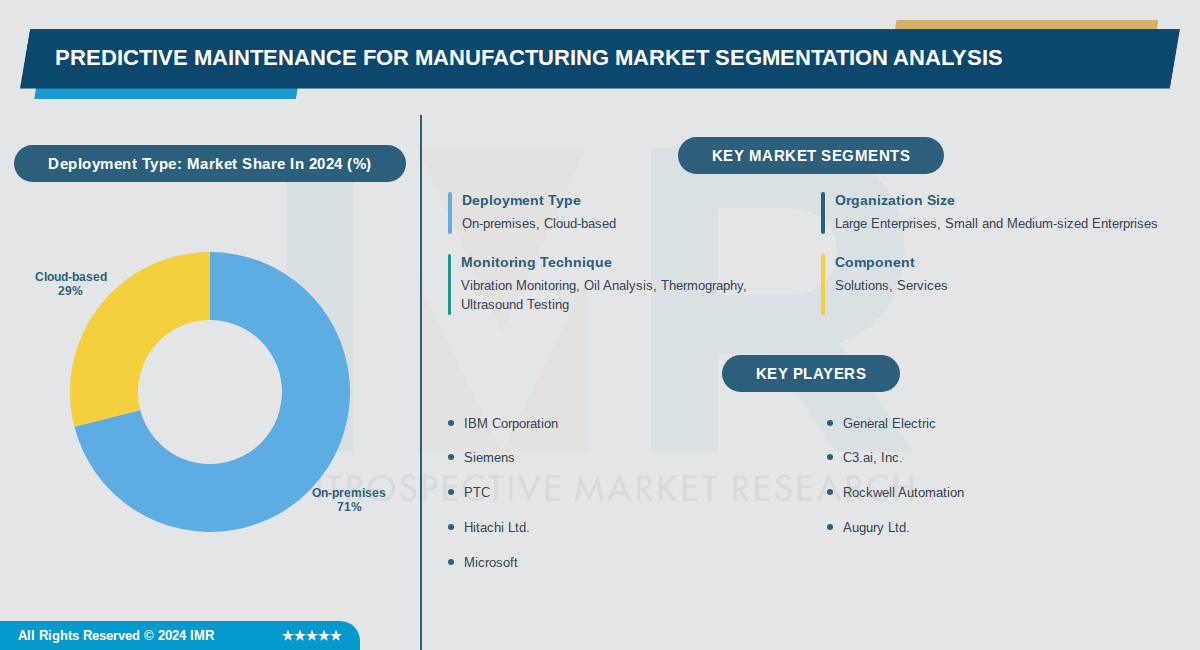
Predictive Maintenance For Manufacturing Market is Segmented on the basis of By Deployment Type, By Organization Size, By Monitoring Technique
By Deployment Type, On-premises segment is expected to dominate the market during the forecast period
- On-premises dominates due to manufacturing firms' stringent data security and privacy requirements for sensitive operational data.
- Legacy infrastructure integration and regulatory compliance in heavy manufacturing favor on-premises solutions over cloud.
By Organization Size, Large Enterprises segment is expected to dominate the market during the forecast period
- Large enterprises lead as they manage complex, high-value assets where downtime costs millions, necessitating advanced PdM.
- Companies like Siemens and GE integrate PdM into digital transformation, achieving 59.24% share through scale and investment.
By Monitoring Technique, Vibration Monitoring segment is expected to dominate the market during the forecast period
- Vibration monitoring dominates in manufacturing for detecting imbalances and misalignments in rotating machinery like motors and pumps.
- Over 28% share driven by its non-invasive nature and high accuracy in predicting failures in assembly lines and CNC machines.
By Component, Solutions segment is expected to dominate the market during the forecast period
- Solutions lead with 83% share as they provide core AI/ML analytics and software for failure prediction in manufacturing equipment.
- Manufacturing adopts integrated solution platforms from vendors like IBM for real-time insights and automation.
Predictive Maintenance For Manufacturing Market Regional Insights:
North America is Expected to Dominate the Market Over the Forecast Period
- North America holds the largest market share in the predictive maintenance market due to its robust industrial sector and high adoption rate of advanced technologies including IoT, machine learning, and big data analytics. The United States and Canada have heavily invested in research and development activities, with companies in these countries leveraging AI, IoT, ML, and deep learning technologies to gain competitive advantages. The region's presence of major market players and continuous technological advancements further strengthen its dominance.
- North America benefits from established infrastructure and strong government support for industrial innovation. The region is at the forefront of adopting remote monitoring facilities and business automation processes. The presence of well-developed supply chains, skilled workforce, and significant capital investment in Industry 4.0 technologies creates a favorable environment for predictive maintenance solution deployment across manufacturing sectors.
- The North American market is characterized by active participation from major industry players who are continuously developing and deploying advanced predictive maintenance solutions. Companies in the region are investing heavily in AI and IoT integration, while governments support research initiatives and technology development. This ecosystem of innovation and competition drives market growth and establishes North America as the leading region through 2035.
Active Key Players in the Predictive Maintenance For Manufacturing Market:
- IBM Corporation (USA)
- General Electric (USA)
- Siemens (Germany)
- C3.ai, Inc. (USA)
- PTC (USA)
- Rockwell Automation (USA)
- Hitachi Ltd. (Japan)
- Augury Ltd. (USA)
- Microsoft (USA)
- Google (USA)
- SAP (Germany)
- Schneider Electric (France)
- Oracle (USA)
- Software AG (Germany)
- TIBCO Software (USA)
- Bosch (Germany)
- UpKeep (USA)
- Factory AI (USA)
- Nanoprecise (Canada)
- Other Active Players
|
Predictive Maintenance For Manufacturing Market |
|||
|
Base Year: |
2024 |
Forecast Period: |
2024-2035 |
|
Historical Data: |
2017 to 2024 |
Market Size in 2024: |
USD 16.0 Billion |
|
Forecast Period 2024-2035 CAGR: |
17.0 % |
Market Size in 2035: |
USD 91.0 Billion |
|
Segments Covered: |
By Deployment Type |
|
|
|
By Organization Size |
|
||
|
By Monitoring Technique |
|
||
|
By Component |
|
||
|
By Region |
|
||
|
Key Market Drivers: |
|
||
|
Key Market Restraints: |
|
||
|
Key Opportunities: |
|
||
|
Companies Covered in the report: |
|
||
Chapter 1: Introduction
1.1 Scope and Coverage
Chapter 2: Executive Summary
Chapter 3: Market Landscape
3.1 Market Dynamics and Opportunity Analysis
3.1.1 Growth Drivers
3.1.2 Limiting Factors
3.1.3 Growth Opportunities
3.1.4 Challenges and Risks
3.2 Market Trend Analysis
3.3 Industry Ecosystem
3.4 Industry Value Chain Mapping
3.5 Strategic PESTLE Overview
3.6 Porter's Five Forces Framework
3.7 Regulatory Framework
3.8 Pricing Trend Analysis
3.9 Intellectual Property Review
3.10 Technology Evolution
3.11 Import-Export Analysis
3.12 Consumer Behavior Analysis
3.13 Investment Pocket Analysis
3.14 Go-To Market Strategy
Chapter 4: Predictive Maintenance For Manufacturing Market by Deployment Type (2017-2035)
4.1 Predictive Maintenance For Manufacturing Market Snapshot and Growth Engine
4.2 Market Overview
4.3 On-premises
4.3.1 Introduction and Market Overview
4.3.2 Historic and Forecasted Market Size in Value USD and Volume Units
4.3.3 Key Market Trends, Growth Factors, and Opportunities
4.3.4 Geographic Segmentation Analysis
4.4 Cloud-based
Chapter 5: Predictive Maintenance For Manufacturing Market by Organization Size (2017-2035)
5.1 Predictive Maintenance For Manufacturing Market Snapshot and Growth Engine
5.2 Market Overview
5.3 Large Enterprises
5.3.1 Introduction and Market Overview
5.3.2 Historic and Forecasted Market Size in Value USD and Volume Units
5.3.3 Key Market Trends, Growth Factors, and Opportunities
5.3.4 Geographic Segmentation Analysis
5.4 Small and Medium-sized Enterprises
Chapter 6: Predictive Maintenance For Manufacturing Market by Monitoring Technique (2017-2035)
6.1 Predictive Maintenance For Manufacturing Market Snapshot and Growth Engine
6.2 Market Overview
6.3 Vibration Monitoring
6.3.1 Introduction and Market Overview
6.3.2 Historic and Forecasted Market Size in Value USD and Volume Units
6.3.3 Key Market Trends, Growth Factors, and Opportunities
6.3.4 Geographic Segmentation Analysis
6.4 Oil Analysis
6.5 Thermography
6.6 Ultrasound Testing
Chapter 7: Predictive Maintenance For Manufacturing Market by Component (2017-2035)
7.1 Predictive Maintenance For Manufacturing Market Snapshot and Growth Engine
7.2 Market Overview
7.3 Solutions
7.3.1 Introduction and Market Overview
7.3.2 Historic and Forecasted Market Size in Value USD and Volume Units
7.3.3 Key Market Trends, Growth Factors, and Opportunities
7.3.4 Geographic Segmentation Analysis
7.4 Services
Chapter 8: Company Profiles and Competitive Analysis
8.1 Competitive Landscape
8.1.1 Competitive Benchmarking
8.1.2 Predictive Maintenance For Manufacturing Market Share by Manufacturer/Service Provider (2024)
8.1.3 Industry BCG Matrix
8.1.4 Partnerships, Mergers & Acquisitions
8.2 IBM CORPORATION
8.2.1 Company Overview
8.2.2 Key Executives
8.2.3 Company Snapshot
8.2.4 Role of the Company in the Market
8.2.5 Sustainability and Social Responsibility
8.2.6 Operating Business Segments
8.2.7 Product Portfolio
8.2.8 Business Performance
8.2.9 Recent News & Developments
8.2.10 SWOT Analysis
8.3 GENERAL ELECTRIC
8.4 SIEMENS
8.5 C3.AI
8.6 INC.
8.7 PTC
8.8 ROCKWELL AUTOMATION
8.9 HITACHI LTD.
8.10 AUGURY LTD.
8.11 MICROSOFT
8.12 GOOGLE
8.13 SAP
8.14 SCHNEIDER ELECTRIC
8.15 ORACLE
8.16 SOFTWARE AG
8.17 TIBCO SOFTWARE
8.18 BOSCH
8.19 UPKEEP
8.20 FACTORY AI
8.21 NANOPRECISE
Chapter 9: Global Predictive Maintenance For Manufacturing Market By Region
9.1 Overview
9.2. North America Predictive Maintenance For Manufacturing Market
9.2.1 Key Market Trends, Growth Factors and Opportunities
9.2.2 Top Key Companies
9.2.3 Historic and Forecasted Market Size by Segments
9.2.4 Historic and Forecast Market Size by Country
9.3. Eastern Europe Predictive Maintenance For Manufacturing Market
9.3.1 Key Market Trends, Growth Factors and Opportunities
9.3.2 Top Key Companies
9.3.3 Historic and Forecasted Market Size by Segments
9.3.4 Historic and Forecast Market Size by Country
9.4. Western Europe Predictive Maintenance For Manufacturing Market
9.4.1 Key Market Trends, Growth Factors and Opportunities
9.4.2 Top Key Companies
9.4.3 Historic and Forecasted Market Size by Segments
9.4.4 Historic and Forecast Market Size by Country
9.5. Asia Pacific Predictive Maintenance For Manufacturing Market
9.5.1 Key Market Trends, Growth Factors and Opportunities
9.5.2 Top Key Companies
9.5.3 Historic and Forecasted Market Size by Segments
9.5.4 Historic and Forecast Market Size by Country
9.6. Middle East & Africa Predictive Maintenance For Manufacturing Market
9.6.1 Key Market Trends, Growth Factors and Opportunities
9.6.2 Top Key Companies
9.6.3 Historic and Forecasted Market Size by Segments
9.6.4 Historic and Forecast Market Size by Country
9.7. South America Predictive Maintenance For Manufacturing Market
9.7.1 Key Market Trends, Growth Factors and Opportunities
9.7.2 Top Key Companies
9.7.3 Historic and Forecasted Market Size by Segments
9.7.4 Historic and Forecast Market Size by Country
Chapter 10: Analyst Viewpoint and Conclusion
Chapter 11: Research Methodology
11.1 Research Process
11.2 Primary Research
11.3 Secondary Research
Chapter 12: Case Study
Chapter 13: Appendix
13.1 Sources
13.2 List of Tables and Figures
13.3 Short Forms and Citations
13.4 Assumption and Conversion
13.5 Disclaimer
|
Predictive Maintenance For Manufacturing Market |
|||
|
Base Year: |
2024 |
Forecast Period: |
2024-2035 |
|
Historical Data: |
2017 to 2024 |
Market Size in 2024: |
USD 16.0 Billion |
|
Forecast Period 2024-2035 CAGR: |
17.0 % |
Market Size in 2035: |
USD 91.0 Billion |
|
Segments Covered: |
By Deployment Type |
|
|
|
By Organization Size |
|
||
|
By Monitoring Technique |
|
||
|
By Component |
|
||
|
By Region |
|
||
|
Key Market Drivers: |
|
||
|
Key Market Restraints: |
|
||
|
Key Opportunities: |
|
||
|
Companies Covered in the report: |
|
||


