




Network Automation Market Synopsis:
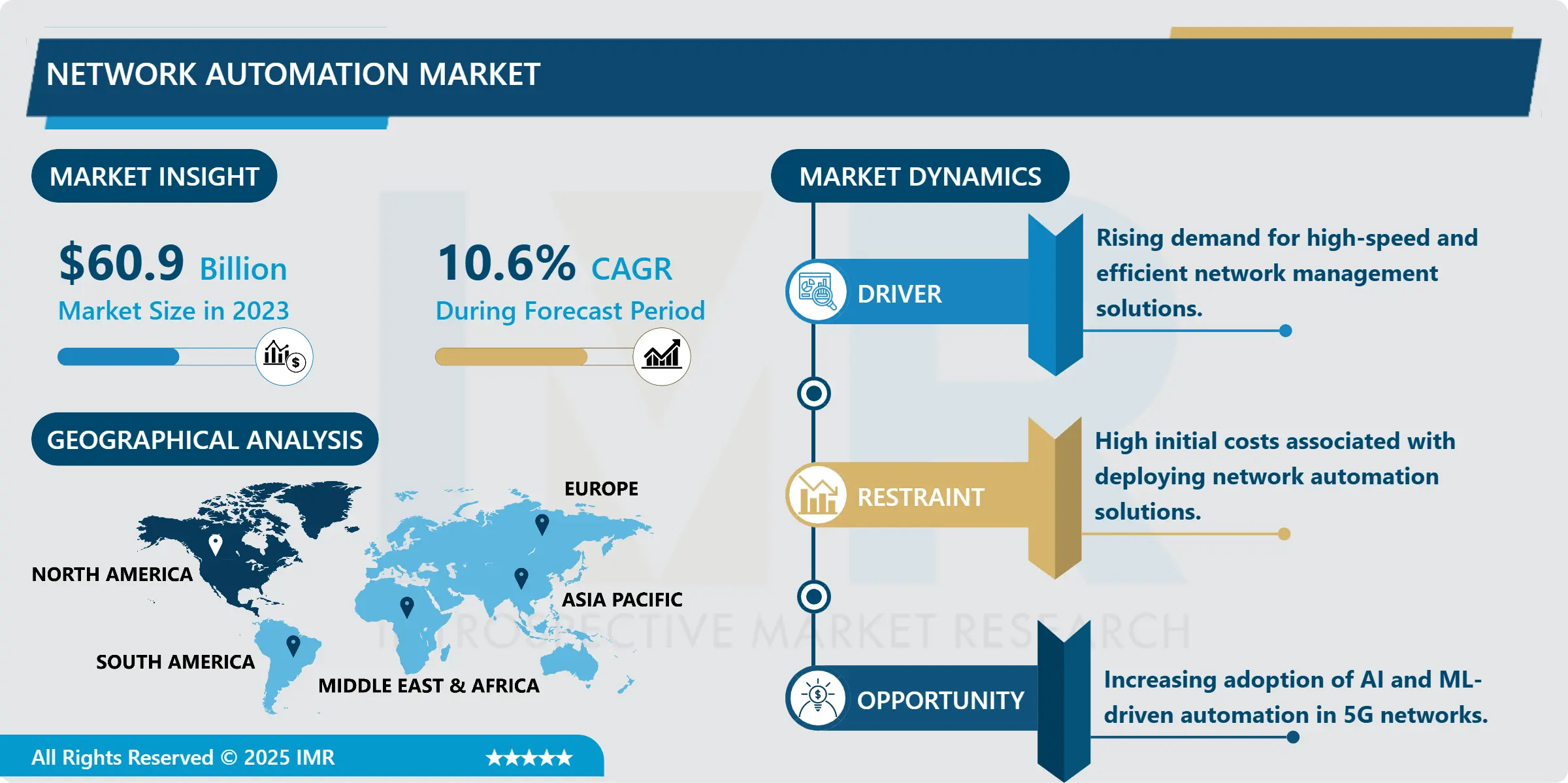
Network Automation Market Size Was Valued at USD 60.9 Billion in 2023, and is Projected to Reach USD 150.80 Billion by 2032, Growing at a CAGR of 10.6 % From 2024-2032.
Network Automation Market specifically relates to the management of tools and software that creates, deploys, and tests both physical and virtual network resources. It increases operational efficiency, decreases the level of manual interference, and increases its capacity, which is important for industries that work with large and diverse networks.
The network automation market is growing at a fast pace because of the need for faster networks, growing cloud service adoption and the convergence of connected devices. Due to increased enterprise networking and the need to integrate more applications, there is a great need to minimize latency and errors relating to the networks. 5G deployment together with SDN and the NFV concepts have embraced NS solutions to reinforce the dynamics of the communication networks.
The increasing use of both hybrid and multi-cloud environments has resulted in high and rising demand for sophisticated automation solutions for complex heterogeneous networks. Many industries like IT, Telecommunication, Banking, and Health care etc are using these solutions to have a better and secure top-notch network solution. The advancements of artificial intelligence and machine learning in network automation fuel the growth of the market more through capabilities of prediction and self-healing, skills needed for the next-gen networks.
Network Automation Market Trend Analysis:
AI-Driven Network Automation
-
AI-Driven Network Automation is emerging as a key market driver in the Network Automation Market, revolutionizing how networks are managed, optimized, and scaled. By integrating artificial intelligence and machine learning, organizations can achieve predictive analytics, real-time decision-making, and autonomous troubleshooting, significantly reducing manual intervention and operational costs. This shift enables more agile, resilient, and self-healing networks capable of adapting to dynamic demands and threats.
- AI's role in anomaly detection, traffic forecasting, and policy enforcement also enhances security and service reliability, which are critical in increasingly complex and hybrid IT environments. As enterprises accelerate digital transformation and adopt cloud-native architectures, AI-driven automation becomes essential for maintaining performance and ensuring business continuity. This growing dependence on AI technologies is fueling demand and investment in advanced network automation solutions across telecom, IT, and enterprise sectors worldwide.
Growing Adoption of 5G and IoT
-
The growing adoption of 5G and the Internet of Things (IoT) presents a significant market opportunity for the Network Automation Market. As 5G networks roll out globally, they enable ultra-low latency and high-speed connectivity, driving the proliferation of IoT devices across industries such as healthcare, manufacturing, and transportation. This surge in connected devices and data traffic increases the complexity of network infrastructure, making manual management unsustainable. Network automation becomes essential to ensure scalability, real-time responsiveness, and efficient resource utilization.
- Automated networks can dynamically adapt to changing conditions, optimize performance, and reduce operational costs. Furthermore, as enterprises embrace edge computing and smart technologies, the demand for intelligent, self-healing networks grows. Vendors offering AI-driven automation solutions are well-positioned to capitalize on this trend, making the convergence of 5G and IoT a powerful catalyst for network automation adoption and market expansion.
Network Automation Market Segment Analysis:
Network Automation Market is Segmented on the basis of Network Type, Service Type, Deployment, and Region.
By Network Type, Physical segment is expected to dominate the market during the forecast period
-
The Physical segment is projected to dominate the network automation industry over the coming years, holding the largest market share. This segment focuses on automating physical network infrastructure, including hardware such as routers, switches, and firewalls. Its growth is being fueled by the ongoing expansion of broadband services and the increasing need to upgrade and modernize physical networks, particularly in developing regions and emerging markets.
- In many cases, these new installations coexist with legacy systems, requiring hybrid solutions that integrate traditional physical equipment with virtualized network functions. This blend drives the continued relevance of physical automation. Moreover, service providers and enterprises are investing in advanced physical network automation tools to enhance operational efficiency, reduce downtime, and simplify complex network management tasks, all of which further contribute to the growing demand in this segment.
By Service Type, the Network Automation Tools segment expected to hold the largest share
-
The rapid evolution of network infrastructure and the increasing complexity of IT environments have made network automation tools a key player in streamlining operations. These tools cover network configuration, troubleshooting, and optimization, making it easier for enterprises to manage expansive, dynamic networks. As organizations continue to adopt cloud-native and software-defined solutions, they seek to maximize operational efficiency while minimizing costs.
- Automation solutions are particularly appealing to businesses that need to respond quickly to network changes and scale operations without compromising performance or security. The demand for automation tools is expected to continue rising, as companies increasingly recognize their value in reducing manual tasks, improving accuracy, and ensuring more reliable network performance. This shift towards automation is transforming network management practices across industries, reinforcing its market dominance.
Network Automation Market Regional Insights:
North America is Expected to Dominate the Market Over the Forecast period
-
North America is expected to be the largest consumer of network automation during the forecast period owing to the developed technological environment and earlier adoption of the automation market in this region. Some of the leading technology providers are based in the region and the industries that are most sensitive to network performance issues including Information technology, Telecommunications, and finance industries.
- The market leader in this region is the United States owing to the significantly high investments made on 5G and cloud infrastructure. Also, the increasing use of Artificial Intelligence and Machine Learning in handling network management tools has in equal measure supported this market. Canada is also coming into its own as the primary supplier for automation technologies, especially important in today’s cellular market and business IT where critical systems are being implemented for both scalability and security. As depicted, North America continues to be well positioned due to its strong innovation focus and an active and growing digital environment.
Active Key Players in the Network Automation Market:
- Anuta Networks (USA)
- Arista Networks (USA)
- Cisco Systems, Inc. (USA)
- Extreme Networks (USA)
- Fujitsu Limited (Japan)
- Hewlett Packard Enterprise (HPE) (USA)
- Huawei Technologies Co., Ltd. (China)
- IBM Corporation (USA)
- Juniper Networks (USA)
- Micro Focus International plc (UK)
- NetBrain Technologies, Inc. (USA)
- Palo Alto Networks, Inc. (USA)
- SolarWinds Worldwide, LLC (USA)
- VMware, Inc. (USA)
- Zoho Corporation (India), and Other Active Player
|
Global Network Automation Market |
|||
|
Base Year: |
2023 |
Forecast Period: |
2024-2032 |
|
Historical Data: |
2017 to 2023 |
Market Size in 2023: |
USD 60.9 Billion |
|
Forecast Period 2024-32 CAGR: |
10.6 % |
Market Size in 2032: |
USD 150.80 Billion |
|
Segments Covered: |
By Network Type |
|
|
|
By Service Type |
|
||
|
By Deployment Type |
|
||
|
By Region |
|
||
|
Key Market Drivers: |
|
||
|
Key Market Restraints: |
|
||
|
Key Opportunities: |
|
||
|
Companies Covered in the report: |
|
||
Chapter 1: Introduction
1.1 Scope and Coverage
Chapter 2:Executive Summary
Chapter 3: Market Landscape
3.1 Market Dynamics
3.1.1 Drivers
3.1.2 Restraints
3.1.3 Opportunities
3.1.4 Challenges
3.2 Market Trend Analysis
3.3 PESTLE Analysis
3.4 Porter's Five Forces Analysis
3.5 Industry Value Chain Analysis
3.6 Ecosystem
3.7 Regulatory Landscape
3.8 Price Trend Analysis
3.9 Patent Analysis
3.10 Technology Evolution
3.11 Investment Pockets
3.12 Import-Export Analysis
Chapter 4: Network Automation Market by Network Type
4.1 Network Automation Market Snapshot and Growth Engine
4.2 Network Automation Market Overview
4.3 Physical Virtual Hybrid
4.3.1 Introduction and Market Overview
4.3.2 Historic and Forecasted Market Size in Value USD and Volume Units (2017-2032F)
4.3.3 Key Market Trends, Growth Factors and Opportunities
4.3.4 Physical Virtual Hybrid: Geographic Segmentation Analysis
Chapter 5: Network Automation Market by Service Type
5.1 Network Automation Market Snapshot and Growth Engine
5.2 Network Automation Market Overview
5.3 Network Automation Tools SD-WAN and Network Virtualization Intent-based Networking
5.3.1 Introduction and Market Overview
5.3.2 Historic and Forecasted Market Size in Value USD and Volume Units (2017-2032F)
5.3.3 Key Market Trends, Growth Factors and Opportunities
5.3.4 Network Automation Tools SD-WAN and Network Virtualization Intent-based Networking: Geographic Segmentation Analysis
Chapter 6: Network Automation Market by Deployment Type
6.1 Network Automation Market Snapshot and Growth Engine
6.2 Network Automation Market Overview
6.3 Cloud On-Premise
6.3.1 Introduction and Market Overview
6.3.2 Historic and Forecasted Market Size in Value USD and Volume Units (2017-2032F)
6.3.3 Key Market Trends, Growth Factors and Opportunities
6.3.4 Cloud On-Premise: Geographic Segmentation Analysis
Chapter 7: Company Profiles and Competitive Analysis
7.1 Competitive Landscape
7.1.1 Competitive Benchmarking
7.1.2 Network Automation Market Share by Manufacturer (2023)
7.1.3 Industry BCG Matrix
7.1.4 Heat Map Analysis
7.1.5 Mergers and Acquisitions
7.2 ANUTA NETWORKS (USA)
7.2.1 Company Overview
7.2.2 Key Executives
7.2.3 Company Snapshot
7.2.4 Role of the Company in the Market
7.2.5 Sustainability and Social Responsibility
7.2.6 Operating Business Segments
7.2.7 Product Portfolio
7.2.8 Business Performance
7.2.9 Key Strategic Moves and Recent Developments
7.2.10 SWOT Analysis
7.3 ARISTA NETWORKS (USA)
7.4 CISCO SYSTEMS INC. (USA)
7.5 EXTREME NETWORKS (USA)
7.6 FUJITSU LIMITED (JAPAN)
7.7 HEWLETT PACKARD ENTERPRISE (HPE) (USA)
7.8 HUAWEI TECHNOLOGIES CO. LTD. (CHINA)
7.9 IBM CORPORATION (USA)
7.10 JUNIPER NETWORKS (USA)
7.11 MICRO FOCUS INTERNATIONAL PLC (UK)
7.12 NETBRAIN TECHNOLOGIES INC. (USA)
7.13 PALO ALTO NETWORKS INC. (USA)
7.14 SOLARWINDS WORLDWIDE LLC (USA)
7.15 VMWARE INC. (USA)
7.16 ZOHO CORPORATION (INDIA)
7.17 OTHER ACTIVE PLAYERS
Chapter 8: Global Network Automation Market By Region
8.1 Overview
8.2. North America Network Automation Market
8.2.1 Key Market Trends, Growth Factors and Opportunities
8.2.2 Top Key Companies
8.2.3 Historic and Forecasted Market Size by Segments
8.2.4 Historic and Forecasted Market Size By Network Type
8.2.4.1 Physical Virtual Hybrid
8.2.5 Historic and Forecasted Market Size By Service Type
8.2.5.1 Network Automation Tools SD-WAN and Network Virtualization Intent-based Networking
8.2.6 Historic and Forecasted Market Size By Deployment Type
8.2.6.1 Cloud On-Premise
8.2.7 Historic and Forecast Market Size by Country
8.2.7.1 US
8.2.7.2 Canada
8.2.7.3 Mexico
8.3. Eastern Europe Network Automation Market
8.3.1 Key Market Trends, Growth Factors and Opportunities
8.3.2 Top Key Companies
8.3.3 Historic and Forecasted Market Size by Segments
8.3.4 Historic and Forecasted Market Size By Network Type
8.3.4.1 Physical Virtual Hybrid
8.3.5 Historic and Forecasted Market Size By Service Type
8.3.5.1 Network Automation Tools SD-WAN and Network Virtualization Intent-based Networking
8.3.6 Historic and Forecasted Market Size By Deployment Type
8.3.6.1 Cloud On-Premise
8.3.7 Historic and Forecast Market Size by Country
8.3.7.1 Russia
8.3.7.2 Bulgaria
8.3.7.3 The Czech Republic
8.3.7.4 Hungary
8.3.7.5 Poland
8.3.7.6 Romania
8.3.7.7 Rest of Eastern Europe
8.4. Western Europe Network Automation Market
8.4.1 Key Market Trends, Growth Factors and Opportunities
8.4.2 Top Key Companies
8.4.3 Historic and Forecasted Market Size by Segments
8.4.4 Historic and Forecasted Market Size By Network Type
8.4.4.1 Physical Virtual Hybrid
8.4.5 Historic and Forecasted Market Size By Service Type
8.4.5.1 Network Automation Tools SD-WAN and Network Virtualization Intent-based Networking
8.4.6 Historic and Forecasted Market Size By Deployment Type
8.4.6.1 Cloud On-Premise
8.4.7 Historic and Forecast Market Size by Country
8.4.7.1 Germany
8.4.7.2 UK
8.4.7.3 France
8.4.7.4 The Netherlands
8.4.7.5 Italy
8.4.7.6 Spain
8.4.7.7 Rest of Western Europe
8.5. Asia Pacific Network Automation Market
8.5.1 Key Market Trends, Growth Factors and Opportunities
8.5.2 Top Key Companies
8.5.3 Historic and Forecasted Market Size by Segments
8.5.4 Historic and Forecasted Market Size By Network Type
8.5.4.1 Physical Virtual Hybrid
8.5.5 Historic and Forecasted Market Size By Service Type
8.5.5.1 Network Automation Tools SD-WAN and Network Virtualization Intent-based Networking
8.5.6 Historic and Forecasted Market Size By Deployment Type
8.5.6.1 Cloud On-Premise
8.5.7 Historic and Forecast Market Size by Country
8.5.7.1 China
8.5.7.2 India
8.5.7.3 Japan
8.5.7.4 South Korea
8.5.7.5 Malaysia
8.5.7.6 Thailand
8.5.7.7 Vietnam
8.5.7.8 The Philippines
8.5.7.9 Australia
8.5.7.10 New Zealand
8.5.7.11 Rest of APAC
8.6. Middle East & Africa Network Automation Market
8.6.1 Key Market Trends, Growth Factors and Opportunities
8.6.2 Top Key Companies
8.6.3 Historic and Forecasted Market Size by Segments
8.6.4 Historic and Forecasted Market Size By Network Type
8.6.4.1 Physical Virtual Hybrid
8.6.5 Historic and Forecasted Market Size By Service Type
8.6.5.1 Network Automation Tools SD-WAN and Network Virtualization Intent-based Networking
8.6.6 Historic and Forecasted Market Size By Deployment Type
8.6.6.1 Cloud On-Premise
8.6.7 Historic and Forecast Market Size by Country
8.6.7.1 Turkiye
8.6.7.2 Bahrain
8.6.7.3 Kuwait
8.6.7.4 Saudi Arabia
8.6.7.5 Qatar
8.6.7.6 UAE
8.6.7.7 Israel
8.6.7.8 South Africa
8.7. South America Network Automation Market
8.7.1 Key Market Trends, Growth Factors and Opportunities
8.7.2 Top Key Companies
8.7.3 Historic and Forecasted Market Size by Segments
8.7.4 Historic and Forecasted Market Size By Network Type
8.7.4.1 Physical Virtual Hybrid
8.7.5 Historic and Forecasted Market Size By Service Type
8.7.5.1 Network Automation Tools SD-WAN and Network Virtualization Intent-based Networking
8.7.6 Historic and Forecasted Market Size By Deployment Type
8.7.6.1 Cloud On-Premise
8.7.7 Historic and Forecast Market Size by Country
8.7.7.1 Brazil
8.7.7.2 Argentina
8.7.7.3 Rest of SA
Chapter 9 Analyst Viewpoint and Conclusion
9.1 Recommendations and Concluding Analysis
9.2 Potential Market Strategies
Chapter 10 Research Methodology
10.1 Research Process
10.2 Primary Research
10.3 Secondary Research
|
Global Network Automation Market |
|||
|
Base Year: |
2023 |
Forecast Period: |
2024-2032 |
|
Historical Data: |
2017 to 2023 |
Market Size in 2023: |
USD 60.9 Billion |
|
Forecast Period 2024-32 CAGR: |
10.6 % |
Market Size in 2032: |
USD 150.80 Billion |
|
Segments Covered: |
By Network Type |
|
|
|
By Service Type |
|
||
|
By Deployment Type |
|
||
|
By Region |
|
||
|
Key Market Drivers: |
|
||
|
Key Market Restraints: |
|
||
|
Key Opportunities: |
|
||
|
Companies Covered in the report: |
|
||


