




Nanobodies Market Synopsis:
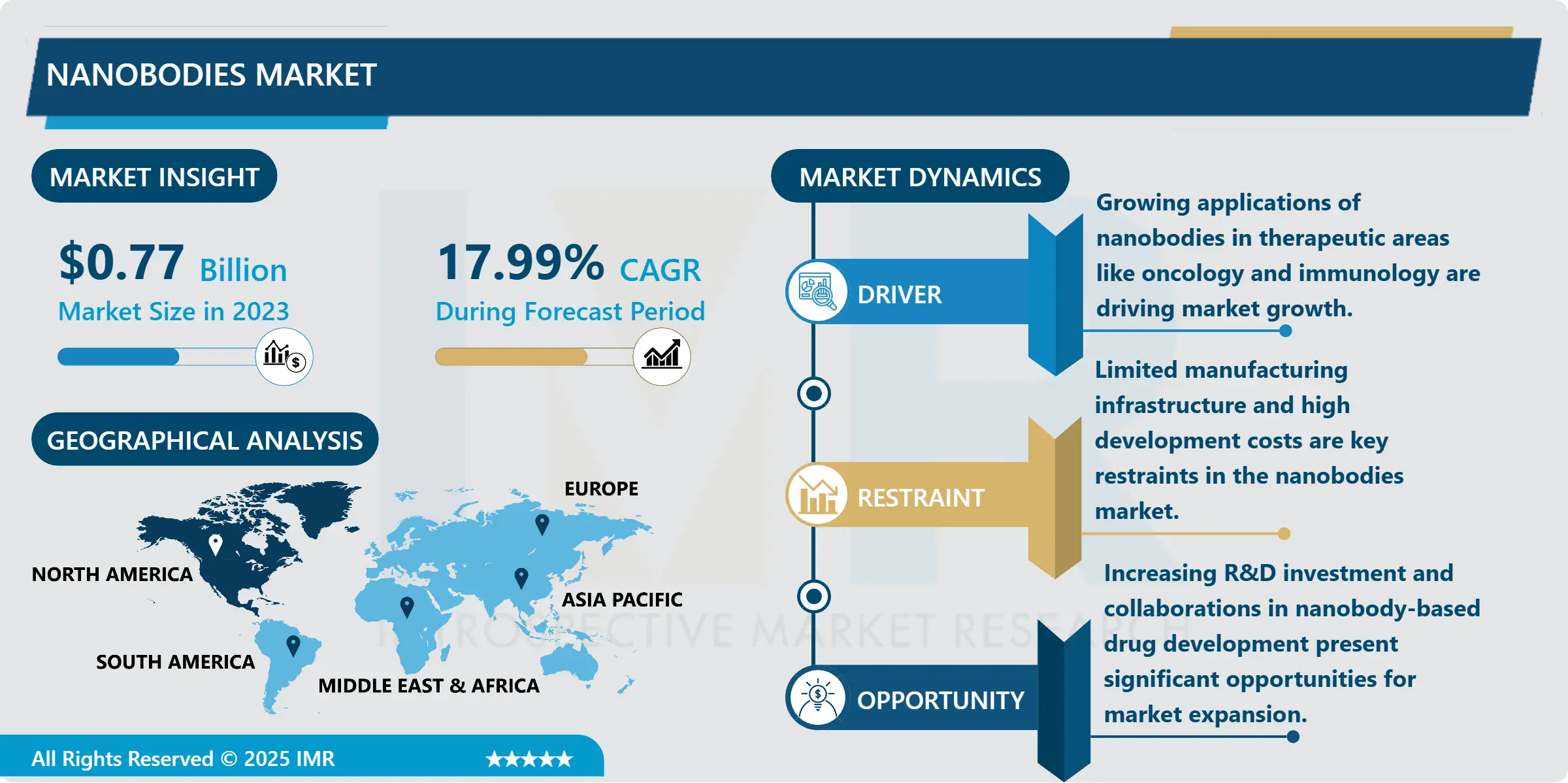
Nanobodies Market Size Was Valued at USD 0.77 Billion in 2023, and is Projected to Reach USD 2.99 Billion by 2032, Growing at a CAGR of 17.99% From 2024-2032.
It can be observed that the market for nanobodies is growing rapidly because of the properties of nanobodies and its multiple uses in the several fields especially in therapeutics and diagnostics. Single-domain antibodies are a product of the immune system of camelids and a number of benefits are associated with their use as compared to conventional antibodies such as smaller size, inherent stability, and better tissue penetration. These features make nanobodies appealing for applications in many fields including targeted delivery of therapeutic agents, imaging and as therapeutic agents in the treatment of diseases such as cancer and autoimmunity. With the progression of studies on the working of the nanobody technology there is an evident growth trajectory seen in the market since it offers an effective positional advantage due to the development of new and innovative biopharmaceutical and diagnostics tools.
North America continues to be an important segment in the nanobodies market due to well-developed biotechnology industry, high R &D investments and leading pharmaceutical companies. This is in light of a strong and stable legal environment which fosters new products development within the region especially those that have to with nanobody application. In addition, the increasing incidence of chronic diseases and the trending shift towards precision or medicine, both create a demand for efficacious and targeted medication, improving the market environment further. Europe is also showing signs of becoming another big market for nanobodies, rising research work from universities and other research organizations, as well as collaborations in between and with industry players.
However, there are number of threats that might affect future prospects of nanobodies market at large Some of them include the following; The complexity of development of nanobody based therapies and the costs that are involved in the production of these may limit market access. Also, the procedures for registration of new biopharmaceuticals requires considerable time and may be cumbersome thus might slow down the time to market new products. However, the complexities in the structure and functions of nanobodies are yet to be resolved to achieve desired objectives fully, but ongoing biomanufacturing processes extending the number of clinical trials in nanobodies is likely to overcome these hurdles in the near future in order to put into operation most nanobodies diagnostic or therapeutic applications worldwide.
Nanobodies Market Trend Analysis:
Growing Focus on Targeted Therapies
-
Another major push in the nanobodies market currently is the focus on specific methodologies when addressing a variety of diseases, including cancer. In this regard, the use of nanobodies these attributes as small size, high affinity, and specificity for antigens make nanobodies ideal candidates for designing targeted therapies. The rising trend is evident in an increase in the number of clinical trials related to nanobodies for treatment with the view of improving the efficiency compared to existing treatments and reducing side effects. This trend continues to increase as healthcare organizations focus more on practising PP, or the idea of tailoring treatment for individual patient characteristics.
Advancements in Diagnostic Applications
-
The second new direction concerns the enhancement of nanobodies’ usage in diagnostics, as for example in creation of improved diagnostic imaging and biosensors. They can be used to develop methods that give reasonably good sensitivity and, therefore, detect low concentrations of biomarkers in biological matrices. This trend is especially true in a number of such fields as early detection of diseases, and their subsequent monitoring when timeliness is a critical factor. It is estimated that when integrated into point- of-care assessment instruments and imaging systems, nanobodies are expected to improve diagnostic services and will open up new opportunities for nanobodies in health care other than therapeutic applications.
Nanobodies Market Segment Analysis:
Nanobodies Market is Segmented on the basis of Type, Application, Diagnostic, End User,m and Region.
By Type, Multi-Specific segment is expected to dominate the market during the forecast period
-
The market segment by type of nanobodies is mono-specific which targets only specific antigens, application of which involves neutralization of viruses, and multi-specific antibodies that can bind to multiple related antigens. Mono-specific nanobodies are single-targeted and are very effective in therapies and diagnostic procedures that demand selective targeting and interaction, such as in cancer treatment, or pathogen recognition. Whereas monospecific nanobodies are specific for a single epitope, multi-specific nanobodies can occupy multiple antigens at the same time therefore showing greater effectiveness and functionality for uses like combination therapy since different biomarkers and pathways often translate to better treatment. Such a double classification allows researchers and developers to choose the right type of nanobody depending on their specific applications, which will promote the development and growth of the nanobodies market.
By End User, Research Laboratories segment expected to held the largest share
-
The nanobodies market based on end user category comprises pharma and biotech firms, research facilities, and other is experiencing a higher growth potential owing to the above benefits which is coupled with conspicuous advantages including small size, high selectivity and stability. Leading industry players include pharmaceutical and biotechnology industries as the industry advances, along with the rising need for novel treatments in immuno-oncology and diseases causing by pathogens. Research laboratories also have their functions; specifically concerned with the discovery and experimental use of nanobodies in diagnostics and treatment. Other end users such as academic institution and contract research organization also participate in development and commercialization of nanobody.
Nanobodies Market Regional Insights:
North America is Expected to Dominate the Market Over the Forecast
-
North America would continue to dominate the nanobodies market throughout the forecasting period in view of the availability of well equipped biotechnology research centres, sound healthcare facilities, and a well developed pharmaceuticals sector. Current active research on therapeutic nanobodies especially in handling cancers, autoimmune diseases, and viridic infections put the region in a vantage point in determining the growth in the market. Besides, growth in the investment for research and development, strategic policies and standards of government support, and university-industry partnerships strengthen the North America market of nanobodies.
Active Key Players in the Nanobodies Market:
- Merck KGaA (Germany)
- Sanofi (France)
- GenScript (China)
- Novartis International AG (Switzerland)
- Taisho Pharmaceutical Holdings Co., Ltd. (Japan)
- Sino Biological, Inc. (China)
- GeneMedi (China)
- Biocytogen (China)
- Abnova Corporation (Taiwan)
- NanoTag Biotechnologies (Germany)
- Avillion LLP (UK)
- Capra Science (Sweden)
- Numab Therapeutics (Switzerland)
- CUSABIO TECHNOLOGY LLC (China)
- Proteintech Group, Inc. (USA)
- GT Biopharma, Inc. (USA)
- Confo Therapeutics (Belgium)
- R&D Systems, Inc. (USA)
- Abcepta Biotech Ltd. Co. (USA)
- Other Active Players
|
Global Nanobodies Market |
|||
|
Base Year: |
2023 |
Forecast Period: |
2024-2032 |
|
Historical Data: |
2017 to 2023 |
Market Size in 2023: |
USD 0.77 Billion |
|
Forecast Period 2024-32 CAGR: |
17.99% |
Market Size in 2032: |
USD 2.99 Billion |
|
Segments Covered: |
By Type |
|
|
|
By Application |
|
||
|
By End User |
|
||
|
By Region |
|
||
|
Key Market Drivers: |
|
||
|
Key Market Restraints: |
|
||
|
Key Opportunities: |
|
||
|
Companies Covered in the report: |
|
||
Chapter 1: Introduction
1.1 Scope and Coverage
Chapter 2:Executive Summary
Chapter 3: Market Landscape
3.1 Market Dynamics
3.1.1 Drivers
3.1.2 Restraints
3.1.3 Opportunities
3.1.4 Challenges
3.2 Market Trend Analysis
3.3 PESTLE Analysis
3.4 Porter's Five Forces Analysis
3.5 Industry Value Chain Analysis
3.6 Ecosystem
3.7 Regulatory Landscape
3.8 Price Trend Analysis
3.9 Patent Analysis
3.10 Technology Evolution
3.11 Investment Pockets
3.12 Import-Export Analysis
Chapter 4: Nanobodies Market by Type
4.1 Nanobodies Market Snapshot and Growth Engine
4.2 Nanobodies Market Overview
4.3 Mono-Specific
4.3.1 Introduction and Market Overview
4.3.2 Historic and Forecasted Market Size in Value USD and Volume Units (2017-2032F)
4.3.3 Key Market Trends, Growth Factors and Opportunities
4.3.4 Mono-Specific: Geographic Segmentation Analysis
4.4 and Multi-Specific
4.4.1 Introduction and Market Overview
4.4.2 Historic and Forecasted Market Size in Value USD and Volume Units (2017-2032F)
4.4.3 Key Market Trends, Growth Factors and Opportunities
4.4.4 and Multi-Specific: Geographic Segmentation Analysis
Chapter 5: Nanobodies Market by Application
5.1 Nanobodies Market Snapshot and Growth Engine
5.2 Nanobodies Market Overview
5.3 Therapeutic (Cancer
5.3.1 Introduction and Market Overview
5.3.2 Historic and Forecasted Market Size in Value USD and Volume Units (2017-2032F)
5.3.3 Key Market Trends, Growth Factors and Opportunities
5.3.4 Therapeutic (Cancer: Geographic Segmentation Analysis
5.4 Neurodegenerative Diseases
5.4.1 Introduction and Market Overview
5.4.2 Historic and Forecasted Market Size in Value USD and Volume Units (2017-2032F)
5.4.3 Key Market Trends, Growth Factors and Opportunities
5.4.4 Neurodegenerative Diseases: Geographic Segmentation Analysis
5.5 Infectious Diseases
5.5.1 Introduction and Market Overview
5.5.2 Historic and Forecasted Market Size in Value USD and Volume Units (2017-2032F)
5.5.3 Key Market Trends, Growth Factors and Opportunities
5.5.4 Infectious Diseases: Geographic Segmentation Analysis
5.6 and Others
5.6.1 Introduction and Market Overview
5.6.2 Historic and Forecasted Market Size in Value USD and Volume Units (2017-2032F)
5.6.3 Key Market Trends, Growth Factors and Opportunities
5.6.4 and Others: Geographic Segmentation Analysis
Chapter 6: Nanobodies Market by Diagnostic
6.1 Nanobodies Market Snapshot and Growth Engine
6.2 Nanobodies Market Overview
6.3 Detection Of Proteins and Microorganisms
6.3.1 Introduction and Market Overview
6.3.2 Historic and Forecasted Market Size in Value USD and Volume Units (2017-2032F)
6.3.3 Key Market Trends, Growth Factors and Opportunities
6.3.4 Detection Of Proteins and Microorganisms: Geographic Segmentation Analysis
6.4 Detection Of Small Molecules
6.4.1 Introduction and Market Overview
6.4.2 Historic and Forecasted Market Size in Value USD and Volume Units (2017-2032F)
6.4.3 Key Market Trends, Growth Factors and Opportunities
6.4.4 Detection Of Small Molecules: Geographic Segmentation Analysis
6.5 and Imaging)
6.5.1 Introduction and Market Overview
6.5.2 Historic and Forecasted Market Size in Value USD and Volume Units (2017-2032F)
6.5.3 Key Market Trends, Growth Factors and Opportunities
6.5.4 and Imaging): Geographic Segmentation Analysis
6.6 Research
6.6.1 Introduction and Market Overview
6.6.2 Historic and Forecasted Market Size in Value USD and Volume Units (2017-2032F)
6.6.3 Key Market Trends, Growth Factors and Opportunities
6.6.4 Research: Geographic Segmentation Analysis
Chapter 7: Nanobodies Market by End User
7.1 Nanobodies Market Snapshot and Growth Engine
7.2 Nanobodies Market Overview
7.3 Pharmaceutical & Biotechnology Companies
7.3.1 Introduction and Market Overview
7.3.2 Historic and Forecasted Market Size in Value USD and Volume Units (2017-2032F)
7.3.3 Key Market Trends, Growth Factors and Opportunities
7.3.4 Pharmaceutical & Biotechnology Companies: Geographic Segmentation Analysis
7.4 Research Laboratories
7.4.1 Introduction and Market Overview
7.4.2 Historic and Forecasted Market Size in Value USD and Volume Units (2017-2032F)
7.4.3 Key Market Trends, Growth Factors and Opportunities
7.4.4 Research Laboratories: Geographic Segmentation Analysis
7.5 and Others
7.5.1 Introduction and Market Overview
7.5.2 Historic and Forecasted Market Size in Value USD and Volume Units (2017-2032F)
7.5.3 Key Market Trends, Growth Factors and Opportunities
7.5.4 and Others: Geographic Segmentation Analysis
Chapter 8: Company Profiles and Competitive Analysis
8.1 Competitive Landscape
8.1.1 Competitive Benchmarking
8.1.2 Nanobodies Market Share by Manufacturer (2023)
8.1.3 Industry BCG Matrix
8.1.4 Heat Map Analysis
8.1.5 Mergers and Acquisitions
8.2 MERCK KGAA (GERMANY)
8.2.1 Company Overview
8.2.2 Key Executives
8.2.3 Company Snapshot
8.2.4 Role of the Company in the Market
8.2.5 Sustainability and Social Responsibility
8.2.6 Operating Business Segments
8.2.7 Product Portfolio
8.2.8 Business Performance
8.2.9 Key Strategic Moves and Recent Developments
8.2.10 SWOT Analysis
8.3 SANOFI (FRANCE)
8.4 GENSCRIPT (CHINA)
8.5 NOVARTIS INTERNATIONAL AG (SWITZERLAND)
8.6 TAISHO PHARMACEUTICAL HOLDINGS CO. LTD. (JAPAN)
8.7 SINO BIOLOGICAL INC. (CHINA)
8.8 GENEMEDI (CHINA)
8.9 BIOCYTOGEN (CHINA)
8.10 ABNOVA CORPORATION (TAIWAN)
8.11 NANOTAG BIOTECHNOLOGIES (GERMANY)
8.12 AVILLION LLP (UK)
8.13 CAPRA SCIENCE (SWEDEN)
8.14 NUMAB THERAPEUTICS (SWITZERLAND)
8.15 CUSABIO TECHNOLOGY LLC (CHINA)
8.16 PROTEINTECH GROUP INC. (USA)
8.17 GT BIOPHARMA INC. (USA)
8.18 CONFO THERAPEUTICS (BELGIUM)
8.19 R&D SYSTEMS INC. (USA)
8.20 ABCEPTA BIOTECH LTD. CO. (USA)
8.21 OTHER ACTIVE PLAYERS
Chapter 9: Global Nanobodies Market By Region
9.1 Overview
9.2. North America Nanobodies Market
9.2.1 Key Market Trends, Growth Factors and Opportunities
9.2.2 Top Key Companies
9.2.3 Historic and Forecasted Market Size by Segments
9.2.4 Historic and Forecasted Market Size By Type
9.2.4.1 Mono-Specific
9.2.4.2 and Multi-Specific
9.2.5 Historic and Forecasted Market Size By Application
9.2.5.1 Therapeutic (Cancer
9.2.5.2 Neurodegenerative Diseases
9.2.5.3 Infectious Diseases
9.2.5.4 and Others
9.2.6 Historic and Forecasted Market Size By Diagnostic
9.2.6.1 Detection Of Proteins and Microorganisms
9.2.6.2 Detection Of Small Molecules
9.2.6.3 and Imaging)
9.2.6.4 Research
9.2.7 Historic and Forecasted Market Size By End User
9.2.7.1 Pharmaceutical & Biotechnology Companies
9.2.7.2 Research Laboratories
9.2.7.3 and Others
9.2.8 Historic and Forecast Market Size by Country
9.2.8.1 US
9.2.8.2 Canada
9.2.8.3 Mexico
9.3. Eastern Europe Nanobodies Market
9.3.1 Key Market Trends, Growth Factors and Opportunities
9.3.2 Top Key Companies
9.3.3 Historic and Forecasted Market Size by Segments
9.3.4 Historic and Forecasted Market Size By Type
9.3.4.1 Mono-Specific
9.3.4.2 and Multi-Specific
9.3.5 Historic and Forecasted Market Size By Application
9.3.5.1 Therapeutic (Cancer
9.3.5.2 Neurodegenerative Diseases
9.3.5.3 Infectious Diseases
9.3.5.4 and Others
9.3.6 Historic and Forecasted Market Size By Diagnostic
9.3.6.1 Detection Of Proteins and Microorganisms
9.3.6.2 Detection Of Small Molecules
9.3.6.3 and Imaging)
9.3.6.4 Research
9.3.7 Historic and Forecasted Market Size By End User
9.3.7.1 Pharmaceutical & Biotechnology Companies
9.3.7.2 Research Laboratories
9.3.7.3 and Others
9.3.8 Historic and Forecast Market Size by Country
9.3.8.1 Russia
9.3.8.2 Bulgaria
9.3.8.3 The Czech Republic
9.3.8.4 Hungary
9.3.8.5 Poland
9.3.8.6 Romania
9.3.8.7 Rest of Eastern Europe
9.4. Western Europe Nanobodies Market
9.4.1 Key Market Trends, Growth Factors and Opportunities
9.4.2 Top Key Companies
9.4.3 Historic and Forecasted Market Size by Segments
9.4.4 Historic and Forecasted Market Size By Type
9.4.4.1 Mono-Specific
9.4.4.2 and Multi-Specific
9.4.5 Historic and Forecasted Market Size By Application
9.4.5.1 Therapeutic (Cancer
9.4.5.2 Neurodegenerative Diseases
9.4.5.3 Infectious Diseases
9.4.5.4 and Others
9.4.6 Historic and Forecasted Market Size By Diagnostic
9.4.6.1 Detection Of Proteins and Microorganisms
9.4.6.2 Detection Of Small Molecules
9.4.6.3 and Imaging)
9.4.6.4 Research
9.4.7 Historic and Forecasted Market Size By End User
9.4.7.1 Pharmaceutical & Biotechnology Companies
9.4.7.2 Research Laboratories
9.4.7.3 and Others
9.4.8 Historic and Forecast Market Size by Country
9.4.8.1 Germany
9.4.8.2 UK
9.4.8.3 France
9.4.8.4 The Netherlands
9.4.8.5 Italy
9.4.8.6 Spain
9.4.8.7 Rest of Western Europe
9.5. Asia Pacific Nanobodies Market
9.5.1 Key Market Trends, Growth Factors and Opportunities
9.5.2 Top Key Companies
9.5.3 Historic and Forecasted Market Size by Segments
9.5.4 Historic and Forecasted Market Size By Type
9.5.4.1 Mono-Specific
9.5.4.2 and Multi-Specific
9.5.5 Historic and Forecasted Market Size By Application
9.5.5.1 Therapeutic (Cancer
9.5.5.2 Neurodegenerative Diseases
9.5.5.3 Infectious Diseases
9.5.5.4 and Others
9.5.6 Historic and Forecasted Market Size By Diagnostic
9.5.6.1 Detection Of Proteins and Microorganisms
9.5.6.2 Detection Of Small Molecules
9.5.6.3 and Imaging)
9.5.6.4 Research
9.5.7 Historic and Forecasted Market Size By End User
9.5.7.1 Pharmaceutical & Biotechnology Companies
9.5.7.2 Research Laboratories
9.5.7.3 and Others
9.5.8 Historic and Forecast Market Size by Country
9.5.8.1 China
9.5.8.2 India
9.5.8.3 Japan
9.5.8.4 South Korea
9.5.8.5 Malaysia
9.5.8.6 Thailand
9.5.8.7 Vietnam
9.5.8.8 The Philippines
9.5.8.9 Australia
9.5.8.10 New Zealand
9.5.8.11 Rest of APAC
9.6. Middle East & Africa Nanobodies Market
9.6.1 Key Market Trends, Growth Factors and Opportunities
9.6.2 Top Key Companies
9.6.3 Historic and Forecasted Market Size by Segments
9.6.4 Historic and Forecasted Market Size By Type
9.6.4.1 Mono-Specific
9.6.4.2 and Multi-Specific
9.6.5 Historic and Forecasted Market Size By Application
9.6.5.1 Therapeutic (Cancer
9.6.5.2 Neurodegenerative Diseases
9.6.5.3 Infectious Diseases
9.6.5.4 and Others
9.6.6 Historic and Forecasted Market Size By Diagnostic
9.6.6.1 Detection Of Proteins and Microorganisms
9.6.6.2 Detection Of Small Molecules
9.6.6.3 and Imaging)
9.6.6.4 Research
9.6.7 Historic and Forecasted Market Size By End User
9.6.7.1 Pharmaceutical & Biotechnology Companies
9.6.7.2 Research Laboratories
9.6.7.3 and Others
9.6.8 Historic and Forecast Market Size by Country
9.6.8.1 Turkiye
9.6.8.2 Bahrain
9.6.8.3 Kuwait
9.6.8.4 Saudi Arabia
9.6.8.5 Qatar
9.6.8.6 UAE
9.6.8.7 Israel
9.6.8.8 South Africa
9.7. South America Nanobodies Market
9.7.1 Key Market Trends, Growth Factors and Opportunities
9.7.2 Top Key Companies
9.7.3 Historic and Forecasted Market Size by Segments
9.7.4 Historic and Forecasted Market Size By Type
9.7.4.1 Mono-Specific
9.7.4.2 and Multi-Specific
9.7.5 Historic and Forecasted Market Size By Application
9.7.5.1 Therapeutic (Cancer
9.7.5.2 Neurodegenerative Diseases
9.7.5.3 Infectious Diseases
9.7.5.4 and Others
9.7.6 Historic and Forecasted Market Size By Diagnostic
9.7.6.1 Detection Of Proteins and Microorganisms
9.7.6.2 Detection Of Small Molecules
9.7.6.3 and Imaging)
9.7.6.4 Research
9.7.7 Historic and Forecasted Market Size By End User
9.7.7.1 Pharmaceutical & Biotechnology Companies
9.7.7.2 Research Laboratories
9.7.7.3 and Others
9.7.8 Historic and Forecast Market Size by Country
9.7.8.1 Brazil
9.7.8.2 Argentina
9.7.8.3 Rest of SA
Chapter 10 Analyst Viewpoint and Conclusion
10.1 Recommendations and Concluding Analysis
10.2 Potential Market Strategies
Chapter 11 Research Methodology
11.1 Research Process
11.2 Primary Research
11.3 Secondary Research
|
Global Nanobodies Market |
|||
|
Base Year: |
2023 |
Forecast Period: |
2024-2032 |
|
Historical Data: |
2017 to 2023 |
Market Size in 2023: |
USD 0.77 Billion |
|
Forecast Period 2024-32 CAGR: |
17.99% |
Market Size in 2032: |
USD 2.99 Billion |
|
Segments Covered: |
By Type |
|
|
|
By Application |
|
||
|
By End User |
|
||
|
By Region |
|
||
|
Key Market Drivers: |
|
||
|
Key Market Restraints: |
|
||
|
Key Opportunities: |
|
||
|
Companies Covered in the report: |
|
||


