




Molecular Biology Enzymes Market Synopsis:
Molecular Biology Enzymes Market Size Was Valued at USD 20.0 Billion in 2024, and is Projected to Reach USD 57.0 Billion by 2035, Growing at a CAGR of 10.0% From 2024-2035.
The Molecular Biology Enzymes Market, valued at $20.0 billion in 2024, is projected to reach $57.0 billion by 2035, growing at a compound annual growth rate (CAGR) of 10.0%. This expansion reflects the critical role of enzymes as biological catalysts in DNA manipulation, protein production, and diagnostic techniques within life sciences research.
North America dominates the market with approximately 49% revenue share in 2024, driven by robust biotechnology infrastructure, high investments in R&D, and prevalence of chronic diseases. Meanwhile, Asia-Pacific is poised for the fastest growth, fueled by expanding biotech sectors, government support for genomics, and rising healthcare expenditures in countries like China and India.
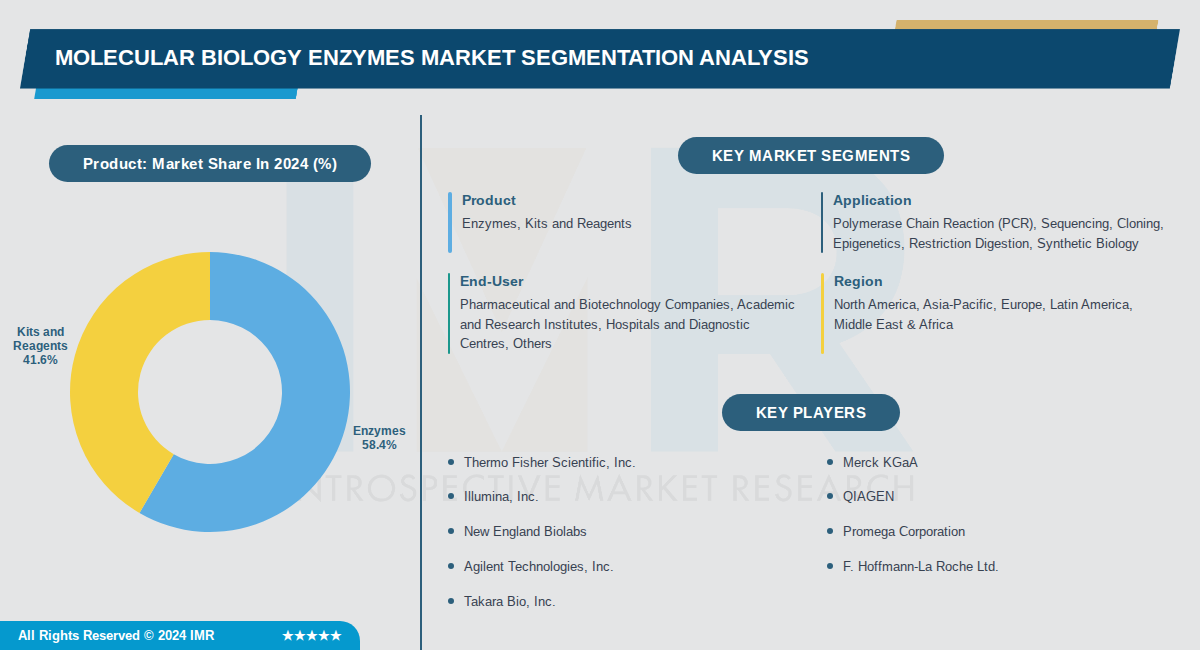
Key segments include enzymes and kits, with PCR applications leading revenue generation and synthetic biology showing rapid growth potential. End-users such as research institutes hold the largest share, while hospitals are expected to expand quickly due to increasing molecular diagnostics adoption.
.png)
Molecular Biology Enzymes Market Trend Analysis:
Rise of Ultra-High-Fidelity Enzymes
- Enzymes segment advances at a 12.05% CAGR, outpacing kits and reagents, due to demand for ultra-high-fidelity polymerases that halve error rates in sequencing. Single-amino-acid tweaks by companies like New England Biolabs enable precise CRISPR specificity, supporting complex genomic workflows. Machine-learning-aided evolution tailors catalytic optima to new sequencing chemistries, driving double-digit growth in the enzymes slice.
- This trend fuels single-cell multi-omics applications in North America and EU research hubs, with +1.2% market impact projected long-term. Promega's low-stutter STR kits exemplify stable demand in forensics, while pharma innovators partner with CROs for single-cell RNA-seq using these advanced enzymes. Premium pricing for such engineered enzymes cements their leadership over commoditized reagents.
Surge in CRISPR Workflow Enzymes
- CRISPR workflows represent the fastest-growing niche, powered by engineered Cas12a variants from vendors like Thermo Fisher for allele-specific edits in gene therapy. Market expansion ties to biopharmaceutical manufacturing of gene therapies and vaccines, where enzymes enable cloning and protein expression. Proliferating multi-omic studies boost epigenetics assays, creating demand for integrated CRISPR-specific nuclease bundles.
- Pharma and biotech firms, holding 37.3% revenue share, drive this via R&D in clinical studies, with CROs accelerating bulk purchases for CRISPR screening. Startups leverage AI-driven protein design to launch niche editing enzymes, shortening R&D cycles amid venture funding. Broad patent portfolios from leaders like Promega tip competitive bids with freedom-to-operate assurances.
- Global investments amplify this, with Asia Pacific's China and India ramping biopharma industries reliant on CRISPR enzymes for chronic disease diagnostics.
Expansion into Emerging Biopharma Markets
- Asia Pacific leads fastest growth via healthcare infrastructure investments in China, India, Japan, and South Korea, constructing biopharma industries demanding enzymes for molecular diagnostics. Booming development counters chronic and infectious diseases, with governmental R&D funds spurring PCR and sequencing enzyme use. Market reaches USD 19.05 billion in 2026, targeting USD 41.14 billion by 2034 at 10.11% CAGR.
- Latin America and Africa offer untapped potential through rising personalized medicine awareness and biotech sector investments. European leaders like Germany and UK invest in genomic sequencing, but APAC's diverse patient base accelerates enzyme adoption in hospitals and CROs. New England Biolabs targets these regions with sustainability-oriented consumables for gene cloning and library prep.
Molecular Biology Enzymes Market Segment Analysis:
Molecular Biology Enzymes Market is Segmented on the basis of By Product, By Application, By End-User
By Product, Enzymes segment is expected to dominate the market during the forecast period
- Enzymes dominate due to their indispensable role in core molecular biology workflows such as PCR, sequencing, cloning, and gene expression analysis.
- High demand for specialized enzymes in drug discovery, genomics research, and diagnostics drives their leading market position with consistent revenue share above 58%.
By Application, Polymerase Chain Reaction (PCR) segment is expected to dominate the market during the forecast period
- PCR leads due to its widespread use in research, diagnostics, and clinical laboratories for amplification tasks essential in nearly all molecular workflows.
- Rising prevalence of infectious diseases, genetic testing, and routine lab protocols solidify PCR's over 34% share across global markets.
By End-User, Pharmaceutical and Biotechnology Companies segment is expected to dominate the market during the forecast period
- Pharma and biotech companies dominate through extensive use in drug discovery, development, validation, gene editing, and biologics manufacturing.
- Substantial R&D budgets and focus on personalized medicine, NGS, and CRISPR technologies drive their 41.8% revenue leadership.
By Region, North America segment is expected to dominate the market during the forecast period
- North America leads due to strong investments in life sciences, established biotech/pharma industries, and advanced research infrastructure.
- High adoption of genomic technologies, government funding, and presence of leading enzyme manufacturers reinforce its over 38% dominant share.
Molecular Biology Enzymes Market Regional Insights:
North America Dominates the Molecular Biology Enzymes Market with Largest Market Share
- North America held the largest market share of 46% in 2024, with a market size of USD 8.6 billion. The United States is the primary driver due to its world-leading research institutions, robust biotech and pharmaceutical industries, and strong government funding from organizations like the National Institutes of Health. The region benefits from early adoption of cutting-edge technologies such as next-generation sequencing and CRISPR gene editing.
- The region's dominance is supported by well-established life sciences infrastructure, efficient regulatory frameworks, and extensive academic research capabilities. North America maintains a large number of clinical trials and molecular diagnostics initiatives that consistently drive enzyme demand. High awareness of personalized medicine and substantial private and public investments in genomics further strengthen the region's leadership position.
- North America is projected to maintain its dominant position through the forecast period (2025-2034) with a steady CAGR of approximately 6.54%. While the region faces challenges such as high production costs and supply chain issues for high-purity enzymes, its mature market infrastructure and continued innovation ensure sustained growth and market leadership over the next decade.
Active Key Players in the Molecular Biology Enzymes Market:
- Thermo Fisher Scientific, Inc. (USA)
- Merck KGaA (Germany)
- Illumina, Inc. (USA)
- QIAGEN (Netherlands)
- New England Biolabs (USA)
- Promega Corporation (USA)
- Agilent Technologies, Inc. (USA)
- F. Hoffmann-La Roche Ltd. (Switzerland)
- Takara Bio, Inc. (Japan)
- Bio-Rad Laboratories, Inc. (USA)
- Bio Basic (Canada)
- Jena Bioscience (Germany)
- Zymo Research Corporation (USA)
- Integrated DNA Technologies, Inc. (USA)
- LGC Biosearch Technologies (UK)
- Aldevron (USA)
- NZYTech, Lda. (Portugal)
- Lucigen Corporation (USA)
- Other Active Players
|
Molecular Biology Enzymes Market |
|||
|
Base Year: |
2024 |
Forecast Period: |
2024-2035 |
|
Historical Data: |
2017 to 2024 |
Market Size in 2024: |
USD 20.0 Billion |
|
Forecast Period 2024-2035 CAGR: |
10.0 % |
Market Size in 2035: |
USD 57.0 Billion |
|
Segments Covered: |
By Product |
|
|
|
By Application |
|
||
|
By End-User |
|
||
|
By Region |
|
||
|
By Region |
|
||
|
Key Market Drivers: |
|
||
|
Key Market Restraints: |
|
||
|
Key Opportunities: |
|
||
|
Companies Covered in the report: |
|
||
Chapter 1: Introduction
1.1 Scope and Coverage
Chapter 2: Executive Summary
Chapter 3: Market Landscape
3.1 Market Dynamics and Opportunity Analysis
3.1.1 Growth Drivers
3.1.2 Limiting Factors
3.1.3 Growth Opportunities
3.1.4 Challenges and Risks
3.2 Market Trend Analysis
3.3 Industry Ecosystem
3.4 Industry Value Chain Mapping
3.5 Strategic PESTLE Overview
3.6 Porter's Five Forces Framework
3.7 Regulatory Framework
3.8 Pricing Trend Analysis
3.9 Intellectual Property Review
3.10 Technology Evolution
3.11 Import-Export Analysis
3.12 Consumer Behavior Analysis
3.13 Investment Pocket Analysis
3.14 Go-To Market Strategy
Chapter 4: Molecular Biology Enzymes Market by Product (2017-2035)
4.1 Molecular Biology Enzymes Market Snapshot and Growth Engine
4.2 Market Overview
4.3 Enzymes
4.3.1 Introduction and Market Overview
4.3.2 Historic and Forecasted Market Size in Value USD and Volume Units
4.3.3 Key Market Trends, Growth Factors, and Opportunities
4.3.4 Geographic Segmentation Analysis
4.4 Kits and Reagents
Chapter 5: Molecular Biology Enzymes Market by Application (2017-2035)
5.1 Molecular Biology Enzymes Market Snapshot and Growth Engine
5.2 Market Overview
5.3 Polymerase Chain Reaction (PCR)
5.3.1 Introduction and Market Overview
5.3.2 Historic and Forecasted Market Size in Value USD and Volume Units
5.3.3 Key Market Trends, Growth Factors, and Opportunities
5.3.4 Geographic Segmentation Analysis
5.4 Sequencing
5.5 Cloning
5.6 Epigenetics
5.7 Restriction Digestion
5.8 Synthetic Biology
Chapter 6: Molecular Biology Enzymes Market by End-User (2017-2035)
6.1 Molecular Biology Enzymes Market Snapshot and Growth Engine
6.2 Market Overview
6.3 Pharmaceutical and Biotechnology Companies
6.3.1 Introduction and Market Overview
6.3.2 Historic and Forecasted Market Size in Value USD and Volume Units
6.3.3 Key Market Trends, Growth Factors, and Opportunities
6.3.4 Geographic Segmentation Analysis
6.4 Academic and Research Institutes
6.5 Hospitals and Diagnostic Centres
6.6 Others
Chapter 7: Molecular Biology Enzymes Market by Region (2017-2035)
7.1 Molecular Biology Enzymes Market Snapshot and Growth Engine
7.2 Market Overview
7.3 North America
7.3.1 Introduction and Market Overview
7.3.2 Historic and Forecasted Market Size in Value USD and Volume Units
7.3.3 Key Market Trends, Growth Factors, and Opportunities
7.3.4 Geographic Segmentation Analysis
7.4 Asia-Pacific
7.5 Europe
7.6 Latin America
7.7 Middle East & Africa
Chapter 8: Company Profiles and Competitive Analysis
8.1 Competitive Landscape
8.1.1 Competitive Benchmarking
8.1.2 Molecular Biology Enzymes Market Share by Manufacturer/Service Provider (2024)
8.1.3 Industry BCG Matrix
8.1.4 Partnerships, Mergers & Acquisitions
8.2 THERMO FISHER SCIENTIFIC
8.2.1 Company Overview
8.2.2 Key Executives
8.2.3 Company Snapshot
8.2.4 Role of the Company in the Market
8.2.5 Sustainability and Social Responsibility
8.2.6 Operating Business Segments
8.2.7 Product Portfolio
8.2.8 Business Performance
8.2.9 Recent News & Developments
8.2.10 SWOT Analysis
8.3 INC.
8.4 MERCK KGAA
8.5 ILLUMINA
8.6 INC.
8.7 QIAGEN
8.8 NEW ENGLAND BIOLABS
8.9 PROMEGA CORPORATION
8.10 AGILENT TECHNOLOGIES
8.11 INC.
8.12 F. HOFFMANN-LA ROCHE LTD.
8.13 TAKARA BIO
8.14 INC.
8.15 BIO-RAD LABORATORIES
8.16 INC.
8.17 BIO BASIC
8.18 JENA BIOSCIENCE
8.19 ZYMO RESEARCH CORPORATION
8.20 INTEGRATED DNA TECHNOLOGIES
8.21 INC.
8.22 LGC BIOSEARCH TECHNOLOGIES
8.23 ALDEVRON
8.24 NZYTECH
8.25 LDA.
8.26 LUCIGEN CORPORATION
Chapter 9: Global Molecular Biology Enzymes Market By Region
9.1 Overview
9.2. North America Molecular Biology Enzymes Market
9.2.1 Key Market Trends, Growth Factors and Opportunities
9.2.2 Top Key Companies
9.2.3 Historic and Forecasted Market Size by Segments
9.2.4 Historic and Forecast Market Size by Country
9.3. Eastern Europe Molecular Biology Enzymes Market
9.3.1 Key Market Trends, Growth Factors and Opportunities
9.3.2 Top Key Companies
9.3.3 Historic and Forecasted Market Size by Segments
9.3.4 Historic and Forecast Market Size by Country
9.4. Western Europe Molecular Biology Enzymes Market
9.4.1 Key Market Trends, Growth Factors and Opportunities
9.4.2 Top Key Companies
9.4.3 Historic and Forecasted Market Size by Segments
9.4.4 Historic and Forecast Market Size by Country
9.5. Asia Pacific Molecular Biology Enzymes Market
9.5.1 Key Market Trends, Growth Factors and Opportunities
9.5.2 Top Key Companies
9.5.3 Historic and Forecasted Market Size by Segments
9.5.4 Historic and Forecast Market Size by Country
9.6. Middle East & Africa Molecular Biology Enzymes Market
9.6.1 Key Market Trends, Growth Factors and Opportunities
9.6.2 Top Key Companies
9.6.3 Historic and Forecasted Market Size by Segments
9.6.4 Historic and Forecast Market Size by Country
9.7. South America Molecular Biology Enzymes Market
9.7.1 Key Market Trends, Growth Factors and Opportunities
9.7.2 Top Key Companies
9.7.3 Historic and Forecasted Market Size by Segments
9.7.4 Historic and Forecast Market Size by Country
Chapter 10: Analyst Viewpoint and Conclusion
Chapter 11: Research Methodology
11.1 Research Process
11.2 Primary Research
11.3 Secondary Research
Chapter 12: Case Study
Chapter 13: Appendix
13.1 Sources
13.2 List of Tables and Figures
13.3 Short Forms and Citations
13.4 Assumption and Conversion
13.5 Disclaimer
|
Molecular Biology Enzymes Market |
|||
|
Base Year: |
2024 |
Forecast Period: |
2024-2035 |
|
Historical Data: |
2017 to 2024 |
Market Size in 2024: |
USD 20.0 Billion |
|
Forecast Period 2024-2035 CAGR: |
10.0 % |
Market Size in 2035: |
USD 57.0 Billion |
|
Segments Covered: |
By Product |
|
|
|
By Application |
|
||
|
By End-User |
|
||
|
By Region |
|
||
|
By Region |
|
||
|
Key Market Drivers: |
|
||
|
Key Market Restraints: |
|
||
|
Key Opportunities: |
|
||
|
Companies Covered in the report: |
|
||


