




Mobile Ticketing Market Synopsis:
Mobile Ticketing Market Size Was Valued at USD 2.23 Billion in 2023, and is Projected to Reach USD 8.07 Billion by 2032, Growing at a CAGR of 15.36% From 2024-2032.
Mobile ticketing market means the use of mobile devices including smart phones, iPad and others for purchasing, storing and using tickets for events or transport or anything. It encompasses solutions in ticketing unprecedented and linked to the digital environment where users can manage their tickets electronically, gain advantages such as convenience, accessibility, and low possibility of fraud. Different segments are available in the market like arrangement tickets for events, tickets for public transport, and tickets for parking violations which can be conducted through applications on smartphones or digital wallets. Mobile ticketing service is becoming prevalent because of its efficiency in ticketing, the improvements in customer experience and the possibility of its conjunction with further digital services.
The current mobile ticketing business is growing rapidly due to the customer’s preference for smartphones’ convenience and availability of high-speed data in most areas. This trend was more observed in the transport, film and theatres, and sports industries since people have their tickets in their mobile devices. There are effects in favour of market participants and the public by cutting the time of transactions, increasing security and the smoothness of the whole process. Moreover, the possibility of widely applying ideas of using tickets as the means of mobile payments contributes to the enhancing of safety and simplicity of transactions that is the key to the success of the market. The sustained rollout of digital solutions across the different segments of the market is expected to catalyze further expansion of the mobile ticketing market through improving customer relations and operational efficiency. With time and technology advancement, mobile ticketing solutions will be a normal part of peoples’ everyday event going activities and offer substantial benefits over conventional event tickets.
The use of mobile ticketing is being propelled by NFC, QR codes and the blockchain in enhancing ticket security and minimizing on the aspect of fraud. All these innovations are especially important in large events and public transport since it can be challenging to control the availability nor influence the number of people at an event let alone prevent counterfeit tickets. The recent outbreak of the COVID-19 pandemic has also pushed the uptake of mobile ticketing solution as a safer means to avoid physical papers in compliance to set health measures. Hence, there is growing capital expenditure on the enhancement of mobile ticketing platforms to address the shifting preferences among consumers. The market is also highly saturated with players like Eventbrite, Ticketmaster, and Fandango, and the current solutions are only being developed to expand into the market further. Taking future into consideration, there are enormous opportunities in the mobile ticketing market which is further going to help by continuous technological advancements and changed consumer behavior.
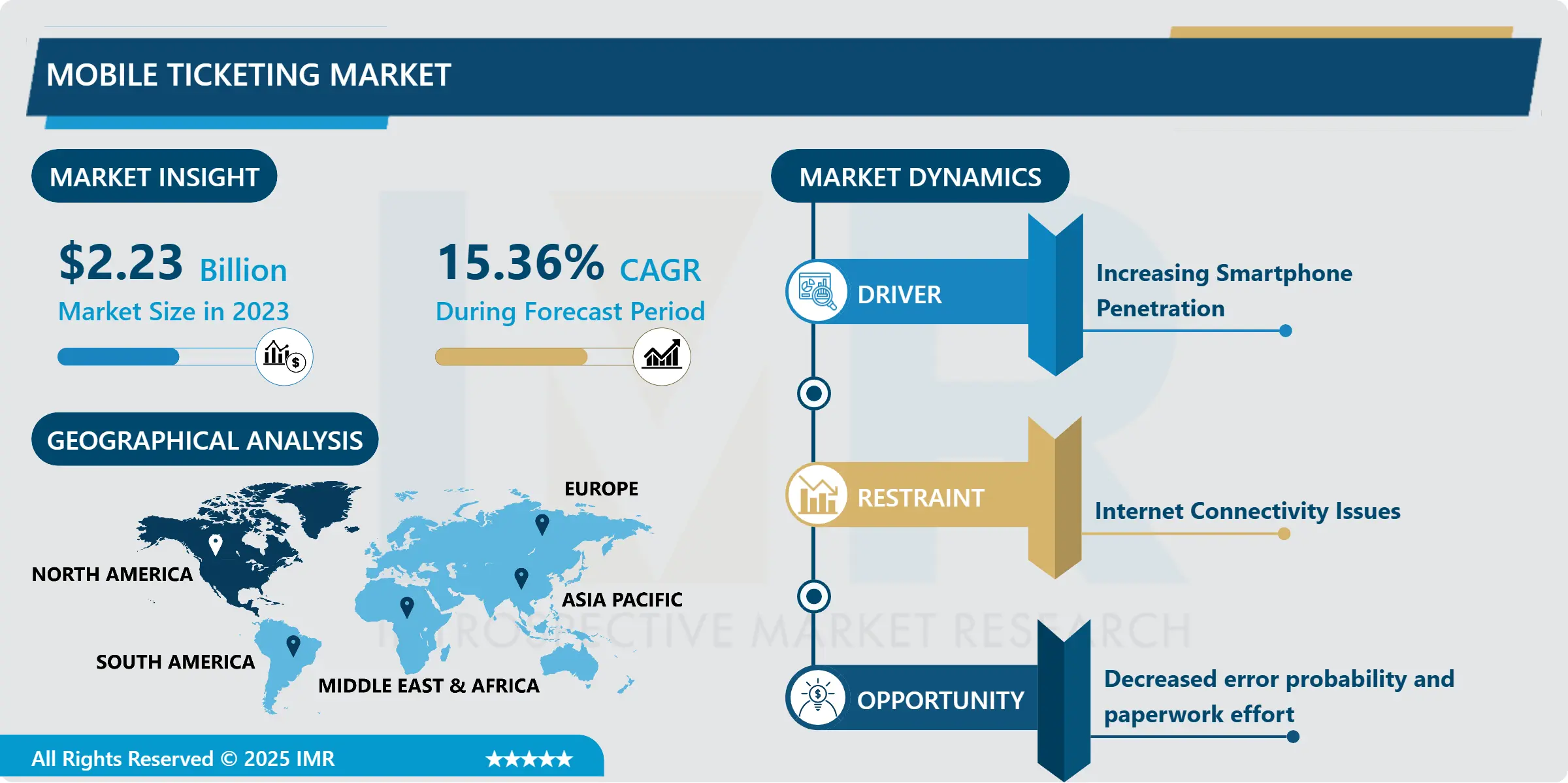
Mobile Ticketing Market Trend Analysis:
Evolution and Trends in the Mobile Ticketing Market
- Mobile ticketing is a convenient and safest way to purchase, preserve and use tickets for events, traveling and entertainment. This is due to heightened awareness of the need of solutions that are faster and better given the prevailing clientele for digital and cashless options. The procedures of utilizing the mobile devices together with NFC and QR code scanning facilitate the process and increase efficiency where entry to an event or a bus is concerned. On convenience to the consumer these advancements are substantial while on the side of the total cost of operation to the business these make significant impact on the traditional costs of issuing physical tickets. In addition, the adoption of mobile ticketing integration with other services is possible, such as in loyalty programmes, whereby users can gather points and be provided with other advantages to increase use.
- With the growth of the market industry, there have been progressive improvements in the use of mobile ticketing platforms with factors like biometric authentication and digital payment options which further decrease fraudulency and increase customer confidence. Further, smart city implementation and modifications in public transportation systems are driving the mobile ticketing solution market. Such measures are intended to enhance accessibility of urban roads and allow optimizing work of transport networks. When introduced into such systems, mobile ticketing not only makes the ticketing process easier but also contributes positively to the cause of environmental conservation by avoiding the use of so many papers. Therefore, the forecast for the mobile ticketing market is positive, as is the need for changing the ticketing process by increasing the use of new technologies aimed at improving the convenience and efficiency of ticketing.
Growth in the Mobile Ticketing Market
- The rising mobile internet traffic, particularly usage of smartphones in the global market, is one of the main factors propelling the mobile ticketing business. This broad access enables consumers to directly purchase, store and manage tickets onto the mobile devices which eliminates the physical paper ticket. It is against this backdrop that, growth in the use of digital ticketing is being enhanced by changing customer needs where they require fast and easy access to information as well as fast transactions. This trend is especially common in entertainment and travel segments because the use of the mobile ticketing system also ensures safe pay for tickets to various events, concerts, sporting events, and transportation services.
- Incorporating different hi-tech solutions like Near Field Communication (NFC) and QR codes in mobile tickets are strategic in the ticketing process. These technologies enhance safety and also facilitate fast, contactless purchasing of tickets so that users can use the products faster. This not only brings a better experience for users, but also minimises the cases of fraud and brings automation and effectiveness to many event management companies and service providers involved in the chain. As these technologies find more application, they are said to fuel more growth in the mobile ticketing market creating new revenue sources and customers.
Mobile Ticketing Market Segment Analysis:
Mobile Ticketing Market is Segmented on the basis of Type, Technology, Application, and Region.
By Type, SMS Ticketing segment is expected to dominate the market during the forecast period
- Mobile messaging ticketing can therefore be described as the technique through which tickets for an event, transport or any entertainments are sent by way of a text message to a particular phone. This method is very preferred because of this convenience; since it enables the users to receive, store, and manage tickets on their mobile devices. This is disδεnt by removing physical tick365ts that can be lost or stolon, this simplifies entry for the user. Be it a music show, watching a game or using public transport, need of physical tickets is completely eliminated in this case with sms ticketing. More people own mobile phones than traveling tickets, while text messages can be easily accessed making SMS ticketing a good solution for the organizers as well as the attendants. It allows for quick accessibility and acquisition of tickets hence allowing event or transporting services without waiting.
- The use of SMS ticketing is beneficial in an event especially for the organizers and the attendees. As for the organizers, it makes the process of ticket distribution easier, also decreases expenses connected to physical ticketing, and decreases the probability of fake tickets. From the attendee’s side it presents a comfortable, fast and secure way to receive tickets directly on the users’ mobile phones. In addition to improving the quality of the attendee experience by removing the lines and ticket printing on paper This technology is also more environmentally friendly as compared to paper ticketing. The many advantages of using SMS ticketing include the fact that the process is popular and efficient for many kinds and types of events and transport services.
By Application, Travel Tickets segment expected to held the largest share
- In the context of ticketing, travel tickets mean those for services in the province of transport like by buses, trains, and aeroplanes. These tickets are today being self-served in the form of mobile applications or through SMS. This shift has help save the environment as compared to the use of tickets which can be easily lost or stolen and allows the management of tickets through the mobile device. Digital travel tickets give the user an opportunity to buy his tickets as well as have his tickets in physical form thus making travelling much easier. While it also improves the customer experience and saves paper, it also improves efficiency for the transportation providers.
- Open tickets are nowadays especially famous because they are more convenient and easy to use. Customers can schedule their trips easier, get updates at any instance and they have easy access to the tickets they need at the time of entry or time of boarding. This technology removes handling of tickets and thus negates delayed times and poor experience to customers. To the transportation providers, health passports offer ticketing convenience and a reduction of expenses ordinarily incurred in physical ticketing. Moreover, changes toward digitization of solutions also in the realm of ticketing are also beneficial as they reduce the number of tickets printed and the problem related to their distribution in terms of the environment.
Mobile Ticketing Market Regional Insights:
North America is Expected to Dominate the Market Over the Forecast period
- Mobile ticketing in North America, especially in the United States of America and Canada is spurred by high smart phone usage, strong internet connection, and well developed public transport systems. Large cities such as New York City, Chicago and Los Angeles have adopted the innovative mobile ticketing technology, through which citizens can purchase their tickets and validate them through the internet in their smart phones. The growing use of mobile ticketing in these cities is coupled with the standard applications provided by the transit authorities of the respective cities: easy-to- navigate platforms for ticket purchase, schedules, or real-time information. Mobile payments including the Apple Pay or Google wallet have added to the market’s growth by making it easier for users to pay for transit fares. These developments of technology and friendly applications have contributed positively to the adoption of mobile ticketing as a feature of everyday transport in North America.
- Ease and accessibility of mobile ticketing is not limited to public transportation, but covers other forms of transport like commuter rail and regional buses within this region. mobile solutions are presented as being more environmentally friendly as well as more efficient than paper tickets and the traditional approach to implementing ticketing systems. Also, the need for a contactless means of payment has greatly influenced the use of mobility ticketing given the current circumstances occasioned by coronavirus. Therefore, applying mobile ticketing is a safer and more effective model for travelling in cities where citizens are asked to maintain social distance and hygiene standards to reduce the spread of illnesses. The process of incorporating mobile tickets into the journey adds to the successful tendencies of the North American urban transport system’s digitalization process as well as to making it more convenient.
Active Key Players in the Mobile Ticketing Market:
- Masabi (UK)
- Smart Card IT Solutions (India)
- Scheidt & Bachmann (Germany)
- Xminnov (China)
- Zendesk (US)
- Softjourn (US)
- Coast to Coast Tickets (US)
- Alliance Tickets (US)
- Helpshift (US)
- CGI Group (Canada)
- Proxima (UK)
- Airbag (France)
- RazorGator (US)
- Ace Ticket WorldWide (US), and Other Active Players
|
Global Mobile Ticketing Market |
|||
|
Base Year: |
2023 |
Forecast Period: |
2024-2032 |
|
Historical Data: |
2017 to 2023 |
Market Size in 2023: |
USD 2.23 Billion |
|
Forecast Period 2024-32 CAGR: |
15.36% |
Market Size in 2032: |
USD 8.07 Billion |
|
|
By Type |
|
|
|
By Technology |
|
||
|
By Application |
|
||
|
By Region |
|
||
|
Key Market Drivers: |
|
||
|
Key Market Restraints: |
|
||
|
Key Opportunities: |
|
||
|
Companies Covered in the report: |
|
||
Chapter 1: Introduction
1.1 Scope and Coverage
Chapter 2:Executive Summary
Chapter 3: Market Landscape
3.1 Market Dynamics
3.1.1 Drivers
3.1.2 Restraints
3.1.3 Opportunities
3.1.4 Challenges
3.2 Market Trend Analysis
3.3 PESTLE Analysis
3.4 Porter's Five Forces Analysis
3.5 Industry Value Chain Analysis
3.6 Ecosystem
3.7 Regulatory Landscape
3.8 Price Trend Analysis
3.9 Patent Analysis
3.10 Technology Evolution
3.11 Investment Pockets
3.12 Import-Export Analysis
Chapter 4: Mobile Ticketing Market by Type
4.1 Mobile Ticketing Market Snapshot and Growth Engine
4.2 Mobile Ticketing Market Overview
4.3 SMS Ticketing and Mobile Applications
4.3.1 Introduction and Market Overview
4.3.2 Historic and Forecasted Market Size in Value USD and Volume Units (2017-2032F)
4.3.3 Key Market Trends, Growth Factors and Opportunities
4.3.4 SMS Ticketing and Mobile Applications: Geographic Segmentation Analysis
Chapter 5: Mobile Ticketing Market by Technology
5.1 Mobile Ticketing Market Snapshot and Growth Engine
5.2 Mobile Ticketing Market Overview
5.3 OCR
5.3.1 Introduction and Market Overview
5.3.2 Historic and Forecasted Market Size in Value USD and Volume Units (2017-2032F)
5.3.3 Key Market Trends, Growth Factors and Opportunities
5.3.4 OCR: Geographic Segmentation Analysis
5.4 2D Bar Code and NFC
5.4.1 Introduction and Market Overview
5.4.2 Historic and Forecasted Market Size in Value USD and Volume Units (2017-2032F)
5.4.3 Key Market Trends, Growth Factors and Opportunities
5.4.4 2D Bar Code and NFC: Geographic Segmentation Analysis
Chapter 6: Mobile Ticketing Market by Application
6.1 Mobile Ticketing Market Snapshot and Growth Engine
6.2 Mobile Ticketing Market Overview
6.3 Travel Tickets and Entertainment Tickets
6.3.1 Introduction and Market Overview
6.3.2 Historic and Forecasted Market Size in Value USD and Volume Units (2017-2032F)
6.3.3 Key Market Trends, Growth Factors and Opportunities
6.3.4 Travel Tickets and Entertainment Tickets: Geographic Segmentation Analysis
Chapter 7: Company Profiles and Competitive Analysis
7.1 Competitive Landscape
7.1.1 Competitive Benchmarking
7.1.2 Mobile Ticketing Market Share by Manufacturer (2023)
7.1.3 Industry BCG Matrix
7.1.4 Heat Map Analysis
7.1.5 Mergers and Acquisitions
7.2 MASABI (UK)
7.2.1 Company Overview
7.2.2 Key Executives
7.2.3 Company Snapshot
7.2.4 Role of the Company in the Market
7.2.5 Sustainability and Social Responsibility
7.2.6 Operating Business Segments
7.2.7 Product Portfolio
7.2.8 Business Performance
7.2.9 Key Strategic Moves and Recent Developments
7.2.10 SWOT Analysis
7.3 SMART CARD IT SOLUTIONS (INDIA)
7.4 SCHEIDT & BACHMANN (GERMANY)
7.5 XMINNOV (CHINA)
7.6 ZENDESK (US)
7.7 SOFTJOURN (US)
7.8 COAST TO COAST TICKETS (US)
7.9 ALLIANCE TICKETS (US)
7.10 HELPSHIFT (US)
7.11 CGI GROUP (CANADA)
7.12 PROXIMA (UK)
7.13 AIRBAG (FRANCE)
7.14 RAZORGATOR (US)
7.15 ACE TICKET WORLDWIDE (US)
7.16 OTHER ACTIVE PLAYERS
Chapter 8: Global Mobile Ticketing Market By Region
8.1 Overview
8.2. North America Mobile Ticketing Market
8.2.1 Key Market Trends, Growth Factors and Opportunities
8.2.2 Top Key Companies
8.2.3 Historic and Forecasted Market Size by Segments
8.2.4 Historic and Forecasted Market Size By Type
8.2.4.1 SMS Ticketing and Mobile Applications
8.2.5 Historic and Forecasted Market Size By Technology
8.2.5.1 OCR
8.2.5.2 2D Bar Code and NFC
8.2.6 Historic and Forecasted Market Size By Application
8.2.6.1 Travel Tickets and Entertainment Tickets
8.2.7 Historic and Forecast Market Size by Country
8.2.7.1 US
8.2.7.2 Canada
8.2.7.3 Mexico
8.3. Eastern Europe Mobile Ticketing Market
8.3.1 Key Market Trends, Growth Factors and Opportunities
8.3.2 Top Key Companies
8.3.3 Historic and Forecasted Market Size by Segments
8.3.4 Historic and Forecasted Market Size By Type
8.3.4.1 SMS Ticketing and Mobile Applications
8.3.5 Historic and Forecasted Market Size By Technology
8.3.5.1 OCR
8.3.5.2 2D Bar Code and NFC
8.3.6 Historic and Forecasted Market Size By Application
8.3.6.1 Travel Tickets and Entertainment Tickets
8.3.7 Historic and Forecast Market Size by Country
8.3.7.1 Russia
8.3.7.2 Bulgaria
8.3.7.3 The Czech Republic
8.3.7.4 Hungary
8.3.7.5 Poland
8.3.7.6 Romania
8.3.7.7 Rest of Eastern Europe
8.4. Western Europe Mobile Ticketing Market
8.4.1 Key Market Trends, Growth Factors and Opportunities
8.4.2 Top Key Companies
8.4.3 Historic and Forecasted Market Size by Segments
8.4.4 Historic and Forecasted Market Size By Type
8.4.4.1 SMS Ticketing and Mobile Applications
8.4.5 Historic and Forecasted Market Size By Technology
8.4.5.1 OCR
8.4.5.2 2D Bar Code and NFC
8.4.6 Historic and Forecasted Market Size By Application
8.4.6.1 Travel Tickets and Entertainment Tickets
8.4.7 Historic and Forecast Market Size by Country
8.4.7.1 Germany
8.4.7.2 UK
8.4.7.3 France
8.4.7.4 The Netherlands
8.4.7.5 Italy
8.4.7.6 Spain
8.4.7.7 Rest of Western Europe
8.5. Asia Pacific Mobile Ticketing Market
8.5.1 Key Market Trends, Growth Factors and Opportunities
8.5.2 Top Key Companies
8.5.3 Historic and Forecasted Market Size by Segments
8.5.4 Historic and Forecasted Market Size By Type
8.5.4.1 SMS Ticketing and Mobile Applications
8.5.5 Historic and Forecasted Market Size By Technology
8.5.5.1 OCR
8.5.5.2 2D Bar Code and NFC
8.5.6 Historic and Forecasted Market Size By Application
8.5.6.1 Travel Tickets and Entertainment Tickets
8.5.7 Historic and Forecast Market Size by Country
8.5.7.1 China
8.5.7.2 India
8.5.7.3 Japan
8.5.7.4 South Korea
8.5.7.5 Malaysia
8.5.7.6 Thailand
8.5.7.7 Vietnam
8.5.7.8 The Philippines
8.5.7.9 Australia
8.5.7.10 New Zealand
8.5.7.11 Rest of APAC
8.6. Middle East & Africa Mobile Ticketing Market
8.6.1 Key Market Trends, Growth Factors and Opportunities
8.6.2 Top Key Companies
8.6.3 Historic and Forecasted Market Size by Segments
8.6.4 Historic and Forecasted Market Size By Type
8.6.4.1 SMS Ticketing and Mobile Applications
8.6.5 Historic and Forecasted Market Size By Technology
8.6.5.1 OCR
8.6.5.2 2D Bar Code and NFC
8.6.6 Historic and Forecasted Market Size By Application
8.6.6.1 Travel Tickets and Entertainment Tickets
8.6.7 Historic and Forecast Market Size by Country
8.6.7.1 Turkiye
8.6.7.2 Bahrain
8.6.7.3 Kuwait
8.6.7.4 Saudi Arabia
8.6.7.5 Qatar
8.6.7.6 UAE
8.6.7.7 Israel
8.6.7.8 South Africa
8.7. South America Mobile Ticketing Market
8.7.1 Key Market Trends, Growth Factors and Opportunities
8.7.2 Top Key Companies
8.7.3 Historic and Forecasted Market Size by Segments
8.7.4 Historic and Forecasted Market Size By Type
8.7.4.1 SMS Ticketing and Mobile Applications
8.7.5 Historic and Forecasted Market Size By Technology
8.7.5.1 OCR
8.7.5.2 2D Bar Code and NFC
8.7.6 Historic and Forecasted Market Size By Application
8.7.6.1 Travel Tickets and Entertainment Tickets
8.7.7 Historic and Forecast Market Size by Country
8.7.7.1 Brazil
8.7.7.2 Argentina
8.7.7.3 Rest of SA
Chapter 9 Analyst Viewpoint and Conclusion
9.1 Recommendations and Concluding Analysis
9.2 Potential Market Strategies
Chapter 10 Research Methodology
10.1 Research Process
10.2 Primary Research
10.3 Secondary Research
|
Global Mobile Ticketing Market |
|||
|
Base Year: |
2023 |
Forecast Period: |
2024-2032 |
|
Historical Data: |
2017 to 2023 |
Market Size in 2023: |
USD 2.23 Billion |
|
Forecast Period 2024-32 CAGR: |
15.36% |
Market Size in 2032: |
USD 8.07 Billion |
|
|
By Type |
|
|
|
By Technology |
|
||
|
By Application |
|
||
|
By Region |
|
||
|
Key Market Drivers: |
|
||
|
Key Market Restraints: |
|
||
|
Key Opportunities: |
|
||
|
Companies Covered in the report: |
|
||


