




Loyalty Management Market Synopsis
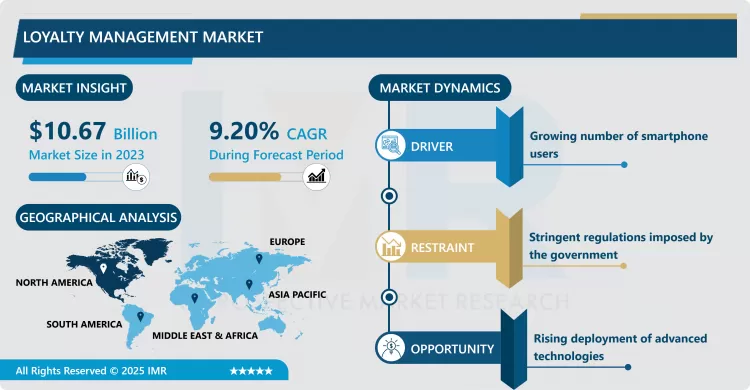
Loyalty Management Market Size Was Valued at USD 10.67 Billion in 2023, and is Projected to Reach USD 23.56 Billion by 2032, Growing at a CAGR of 9.20% From 2024-2032.
Loyalty management is a business approach used in maintaining and enforcing dependable relationships with various stakeholders and consumers. It is a strategy that works on trying to entice customers to buy products within future by offering them offers they used in the past.
The Loyalty Management Market is a relatively new but promising field in the sphere of the customer relationship management market, which is primarily aimed at the customer loyalty management. It covers a broad range of solutions that are related to the practices like loyalty programs, and customer rewards; and those tools that help in improving customer experience & engagement. To help CBU and other companies stand out in a crowded market, loyalty management solutions are being enhanced with analytic tools and the use of artificial intelligence to segment consumers and offer precise, personalized incentives. Not only does this aid greatly in bettering the customer retention ratios of a company but also helps them devise all-encompassing marketing techniques by analyzing the track record of customer behavior.
The Loyalty Management Market globally is expected to register high growth due to the growing trends of digital and mobility, which supports the easy and quick access of the loyalty management for the consumers. The use of e-commerce and online sales has also progressed the need for loyalty management solutions since companies want to deliver the best experiences. Regionally, North America and Europe contribute majority of the market revenue due to the well-developed retail and financial systems, however, the Asia-Pacific region has the most potential considering the continuously growing middle class as well as increasing mobile penetration. Finally, there is a growing interest in combining the application of blockchain technology into loyalty programs and involving gamification aspects in the process where companies are focused on creating truly innovative and captivating concepts for clientele.

Loyalty Management Market Trend Analysis:
Technological Advancements in Loyalty Management
- There is the need to tap into the loyalty aspect, which is why organizations are using retention strategies to employ reward, discounts and incentive programs. These programmes make use of some of the modern technologies like artificial intelligence, data analytics to keep record of customer behaviour, spending pattern and their preferred products to help the businesses devise and execute promotions programme. This further extended with the help of growth of digital channels and mobile applications which allows consumer to engage in loyalty programs and win real-time rewards effortlessly. The use of social media besides gamification in loyalty programs is also emerging as the customer satisfaction is being improved. Furthermore, customer retention has also been made easier through better omnichannel strategies that enables organizations to deliver a consistent brand image across all channels.
- The competitive pressures are increasing further across industries and to combat them, organizations are spending a lot of money on leased loyalty management solutions to remain as unique selling proposition for the customers. This has led to emergence of many more of different loyalty management platforms and tools that cover various elements of loyalty management to include rewards management, program automation, analysis and reporting among others. Organizations are also seeking alternatives like subscriptions for loyalty and influence the market to increase value propositions. The COVID-19 pandemic has also encouraged business organisations to deepened utilisation of timely strategies such as the use of loyalty programme. In this way, the market is expected to deepen the intensified investments in technology and digitization trends, which will help the market foster the growth and development of the loyalty management solutions demand in the future.
Rising Customer Acquisition Costs and Focus on Loyalty Programs:
- While expenditures on acquiring new customers remain high, retaining these clients is already seen as a primary way to improve the buyer’s experience, with the use of loyalty programs being a key priority. In sever sectors such as retail, banking, and telecommunications, products which provide such programs indicate that it is possible for organisations to differentiate themselves from other competitors and to establish sustainable relationships with customers. Loyalty may also help businesses not only to maintain consumers but also to make them purchase more through rebates as well as special privileges suited to individual preferences. The incorporation of the contemporary technologies such as the artificial intelligence, machine learning and big data analysis into these programs is a perfect way for organisations to gain comprehensive information on customers’ behaviours, their choices and their demography. This makes it easy for them to give the customers more relevant and targeted rewards which in turn enhance the satisfaction rates. Digitalized offers not only increase the chances of customer loyalty but also order frequency that helps to create a barrier to the competitors and establish a sustainable competitive advantage in the marked.
- The increasing focus on digital and especially mobile first loyalty programs is another chance for companies to reach tech-oriented consumers and those who expect no hitches in the flexibility of their experiences. Mobile loyalty programs, specifically, are easy to use for tracking personal bonuses/rewards as well as active promotions ensuring continuous communication with clients. The digital nature of customer acquisition also means that businesses can continuously gather information on the customers’ attitudes and behaviours, thereby improving their tactics, adjusting their offerings and marketing highly specific campaigns. Additionally, it also improves clients’ satisfaction, and therefore aids businesses in fighting high churn rates when targeting clients through digital platforms.
Loyalty Management Market Segment Analysis:
Loyalty Management Market Segmented on the basis of Component, Deployment Type, By Organization Size, Vertical, Type of Offering, and Region
By Component, Software segment is expected to dominate the market during the forecast period
- The subcomponent Software envisages software that allows for the management of customer programs and customer engagement platforms. The above-mentioned tools offer diverse capabilities including capturing of customer activities; monitoring of rewards and customers’ information. ‘They provide an insight into the kind of customers, their purchasing patterns hence businesses can develop or marketing strategies or strategies for rewarding loyal customers. It also contributes to the effective development of loyalty programs that would correspond to customer needs, needs of a particular customer in particular, which contributes to improving customer satisfaction and customer retention. Since they provide valuable information pertaining to customer relationships and preferences, such solutions are indispensable to enhancing customer relations and building and securing customer loyalty.
- There are multiple types of software solutions for managing loyalty which are meant to facilitate the processes of creating and managing a loyalty program. They assist companies to undertake other processes such as tracking of rewards, messaging, and reporting. This not only saves time and eliminates mistakes coming from having to do it manually. These thoughts assist companies in decision making about the loyalty strategies, for instance, improving the customer segments or changing the levels of rewards in order to correspond to the customer’s behavior and taste. Finally, all these tools become important in enhancing customer loyalty, which is an essential for enterprises and companies in order to record sustainable business.
By Type of Offering, Loyalty Management segment expected to held the largest share
- Loyalty management can be defined as the process that include conceptualization, planning, implementation and monitoring of loyalty programs. Measurement: It is a process of partitioning customers using their behaviors, inclinations, and past consumption pattern in organizing the program in reference to well-defined organizational goals. This segmentation assists in the identification of customer who are a good source of revenue and thus rewarding them in order to retain them. Another factor about loyalty management is how the types of incentives such as points on a card, discount, or specific deals are properly controlled to meet the expectations of loyalty program customers and at the same time serve the best interest of the franchisor. Through systematic performances measurement & monitoring by tracking number of participants, number of participants redeems the offered incentives and level of satisfaction among the participants, it is easier for the business entities to fine-tune the programs to attain the intended goals & objectives.
- It is in loyalty management solutions that companies get tools for assessing the performance of their loyalty programs. There is tracking of KPIs to determine if the program has been effective In achieving the objectives set out before it. This entails extraction of customer behavior data to determine which of them are most responsive, which rewards are most attractive or perhaps to identify which areas require changes to the program. Analyzing this data shall help the businesses to make the right decisions with regard to the loyalty program – about new additions, changes in the reward system as well as shifts in the marketing strategies. The key objective of loyalty management in therefore in creating value for customers, and to sustain those relationships in the interest of the business.
Loyalty Management Market Regional Insights:
North America is Expected to Dominate the Market Over the Forecast period
- The Loyalty Management Market of North America is well-established; there is ample concentration of market players in terms of loyalty management solution providers and widespread implementation across industries, including retail, hospitality, and financial. Consumer spending power is high attack mainly region has a developed e-commerce market fulfill consumer demand and needs for loyalty solution that are tailored to suit the customer. Businesses across the area use big data analytics to optimize outcomes for customer satisfaction, loyalty, and uptake while preventing competitors from eliminating their market share. This has resulted into increased focus on one to one communication through direct marketing, reward customization and targeted and tactical promotional activities with a view to influencing customer behavior and creating long term customer relationships.
- Significant competitors in the North American market are investing towards ensuring that they develop new solutions that serve new consumer expectations. Loyalty programs are using AI, machine learning and big data for loyalty programs to enhance the suite of solutions aimed at offering targeted promotions. This increases customer interactions while at the same time affords businesses the ability to understand customer behavior more effectively and adapt their strategies to match this knowledge to improve the customer experience where necessary. Therefore, the North American Loyalty Management Market remains at the cutting edge of development while leading the Loyalty Management market’s overall growth.

Active Key Players in the Loyalty Management Market:
- Epsilon Data Management, LLC. (U.S.)
- Oracle (U.S.)
- BOND BRAND LOYALTY INC. (Canada)
- Brierley+Partners (U.S.)
- Merkle Inc. (U.S.)
- Yotpo Ltd. (U.S.)
- Comarch SA. (Poland)
- ICF International Inc. (U.S.)
- Maritz Motivation Inc. (U.S.)
- Cheetah Digital (U.S.)
- Sailplay (U.S.)
- Jakala (Italy)
- AnnexCloud (U.S.)
- Apex Loyalty (U.S.)
- Five Stars Loyalty, Inc. (U.S.)
- Zinrelo (U.S.)
- Punchh, Inc. (U.S.)
- Other Active Players
Key Industry Development in the Loyalty Management Market:
- In August 2024, Network International, a leading provider of digital payment solutions in the Middle East and Africa, announces a strategic partnership with Epsilon, a global advertising and marketing company and leader in creating customer loyalty programs. This collaboration aims to revolutionize loyalty solutions across the region by combining Network International's robust payment infrastructure with Epsilon's innovative loyalty management expertise.
- In August 2024, Capillary Technologies, a global leader in loyalty management and customer engagement solutions, is thrilled to announce its partnership with Loyalty TV, the premier audio and video platform for loyalty professionals worldwide. This collaboration marks a significant step forward in providing cutting-edge insights and technology to enhance customer loyalty programs.
- In January 2023, Blue Ocean Contact Centers announced a new customer engagement platform to improve loyalty program management for its clients. The platform is designed to help businesses enhance their loyalty programs.
|
Loyalty Management Market |
|||
|
Base Year: |
2023 |
Forecast Period: |
2024-2032 |
|
Historical Data: |
2017 to 2023 |
Market Size in 2023: |
USD 10.67 Billion |
|
Forecast Period 2024-32 CAGR: |
9.20% |
Market Size in 2032: |
USD 23.56 Billion |
|
|
By Component |
|
|
|
By Deployment Type |
|
||
|
By Organization Size |
|
||
|
By Vertical |
|
||
|
By Type of Offering |
|
||
|
By Region |
|
||
|
Key Market Drivers: |
|
||
|
Key Market Restraints: |
|
||
|
Key Opportunities: |
|
||
|
Companies Covered in the report: |
|
||
1.1 Scope and Coverage
Chapter 2:Executive Summary
Chapter 3: Market Landscape
3.1 Market Dynamics
3.1.1 Drivers
3.1.2 Restraints
3.1.3 Opportunities
3.1.4 Challenges
3.2 Market Trend Analysis
3.3 PESTLE Analysis
3.4 Porter's Five Forces Analysis
3.5 Industry Value Chain Analysis
3.6 Ecosystem
3.7 Regulatory Landscape
3.8 Price Trend Analysis
3.9 Patent Analysis
3.10 Technology Evolution
3.11 Investment Pockets
3.12 Import-Export Analysis
Chapter 4: Loyalty Management Market by Component (2018-2032)
4.1 Loyalty Management Market Snapshot and Growth Engine
4.2 Market Overview
4.3 Software
4.3.1 Introduction and Market Overview
4.3.2 Historic and Forecasted Market Size in Value USD and Volume Units
4.3.3 Key Market Trends, Growth Factors, and Opportunities
4.3.4 Geographic Segmentation Analysis
4.4 Services
4.5 Solutions
Chapter 5: Loyalty Management Market by Deployment Type (2018-2032)
5.1 Loyalty Management Market Snapshot and Growth Engine
5.2 Market Overview
5.3 On-Premises
5.3.1 Introduction and Market Overview
5.3.2 Historic and Forecasted Market Size in Value USD and Volume Units
5.3.3 Key Market Trends, Growth Factors, and Opportunities
5.3.4 Geographic Segmentation Analysis
5.4 On-Demand
Chapter 6: Loyalty Management Market by Organization Size (2018-2032)
6.1 Loyalty Management Market Snapshot and Growth Engine
6.2 Market Overview
6.3 Large Enterprise
6.3.1 Introduction and Market Overview
6.3.2 Historic and Forecasted Market Size in Value USD and Volume Units
6.3.3 Key Market Trends, Growth Factors, and Opportunities
6.3.4 Geographic Segmentation Analysis
6.4 Small and Medium-Sized Enterprise
Chapter 7: Loyalty Management Market by Vertical (2018-2032)
7.1 Loyalty Management Market Snapshot and Growth Engine
7.2 Market Overview
7.3 Banking Financial Services and Insurance
7.3.1 Introduction and Market Overview
7.3.2 Historic and Forecasted Market Size in Value USD and Volume Units
7.3.3 Key Market Trends, Growth Factors, and Opportunities
7.3.4 Geographic Segmentation Analysis
7.4 Retail and Consumer Goods
7.5 Healthcare and Life Sciences
7.6 Travel and Hospitality
7.7 IT and Telecommunication
7.8 Media and Entertainment
7.9 Manufacturing
7.10 Others
Chapter 8: Loyalty Management Market by Type of Offering (2018-2032)
8.1 Loyalty Management Market Snapshot and Growth Engine
8.2 Market Overview
8.3 Loyalty Management
8.3.1 Introduction and Market Overview
8.3.2 Historic and Forecasted Market Size in Value USD and Volume Units
8.3.3 Key Market Trends, Growth Factors, and Opportunities
8.3.4 Geographic Segmentation Analysis
8.4 Technology Capabilities Platform
8.5 Analytics and Measurement
8.6 Services Delivery Capabilities
8.7 Loyalty Strategy Design
8.8 Loyalty Marketing
Chapter 9: Company Profiles and Competitive Analysis
9.1 Competitive Landscape
9.1.1 Competitive Benchmarking
9.1.2 Loyalty Management Market Share by Manufacturer (2024)
9.1.3 Industry BCG Matrix
9.1.4 Heat Map Analysis
9.1.5 Mergers and Acquisitions
9.2 EPSILON DATA MANAGEMENT LLC. (U.S.)
9.2.1 Company Overview
9.2.2 Key Executives
9.2.3 Company Snapshot
9.2.4 Role of the Company in the Market
9.2.5 Sustainability and Social Responsibility
9.2.6 Operating Business Segments
9.2.7 Product Portfolio
9.2.8 Business Performance
9.2.9 Key Strategic Moves and Recent Developments
9.2.10 SWOT Analysis
9.3 ORACLE (U.S.) BOND BRAND LOYALTY INC. (CANADA)
9.4 BRIERLEY+PARTNERS (U.S.)
9.5 MERKLE INC. (U.S.)
9.6 YOTPO LTD. (U.S.)
9.7 COMARCH SA. (POLAND)
9.8 ICF INTERNATIONAL INC. (U.S.)
9.9 MARITZ MOTIVATION INC. (U.S.)
9.10 CHEETAH DIGITAL (U.S.)
9.11 SAILPLAY (U.S.)
9.12 JAKALA (ITALY)
9.13 ANNEXCLOUD (U.S.)
9.14 APEX LOYALTY (U.S.)
9.15 FIVE STARS LOYALTY INC. (U.S.)
9.16 ZINRELO (U.S.)
9.17 PUNCHH INC. (U.S.)OTHER ACTIVE PLAYERS
Chapter 10: Global Loyalty Management Market By Region
10.1 Overview
10.2. North America Loyalty Management Market
10.2.1 Key Market Trends, Growth Factors and Opportunities
10.2.2 Top Key Companies
10.2.3 Historic and Forecasted Market Size by Segments
10.2.4 Historic and Forecasted Market Size by Component
10.2.4.1 Software
10.2.4.2 Services
10.2.4.3 Solutions
10.2.5 Historic and Forecasted Market Size by Deployment Type
10.2.5.1 On-Premises
10.2.5.2 On-Demand
10.2.6 Historic and Forecasted Market Size by Organization Size
10.2.6.1 Large Enterprise
10.2.6.2 Small and Medium-Sized Enterprise
10.2.7 Historic and Forecasted Market Size by Vertical
10.2.7.1 Banking Financial Services and Insurance
10.2.7.2 Retail and Consumer Goods
10.2.7.3 Healthcare and Life Sciences
10.2.7.4 Travel and Hospitality
10.2.7.5 IT and Telecommunication
10.2.7.6 Media and Entertainment
10.2.7.7 Manufacturing
10.2.7.8 Others
10.2.8 Historic and Forecasted Market Size by Type of Offering
10.2.8.1 Loyalty Management
10.2.8.2 Technology Capabilities Platform
10.2.8.3 Analytics and Measurement
10.2.8.4 Services Delivery Capabilities
10.2.8.5 Loyalty Strategy Design
10.2.8.6 Loyalty Marketing
10.2.9 Historic and Forecast Market Size by Country
10.2.9.1 US
10.2.9.2 Canada
10.2.9.3 Mexico
10.3. Eastern Europe Loyalty Management Market
10.3.1 Key Market Trends, Growth Factors and Opportunities
10.3.2 Top Key Companies
10.3.3 Historic and Forecasted Market Size by Segments
10.3.4 Historic and Forecasted Market Size by Component
10.3.4.1 Software
10.3.4.2 Services
10.3.4.3 Solutions
10.3.5 Historic and Forecasted Market Size by Deployment Type
10.3.5.1 On-Premises
10.3.5.2 On-Demand
10.3.6 Historic and Forecasted Market Size by Organization Size
10.3.6.1 Large Enterprise
10.3.6.2 Small and Medium-Sized Enterprise
10.3.7 Historic and Forecasted Market Size by Vertical
10.3.7.1 Banking Financial Services and Insurance
10.3.7.2 Retail and Consumer Goods
10.3.7.3 Healthcare and Life Sciences
10.3.7.4 Travel and Hospitality
10.3.7.5 IT and Telecommunication
10.3.7.6 Media and Entertainment
10.3.7.7 Manufacturing
10.3.7.8 Others
10.3.8 Historic and Forecasted Market Size by Type of Offering
10.3.8.1 Loyalty Management
10.3.8.2 Technology Capabilities Platform
10.3.8.3 Analytics and Measurement
10.3.8.4 Services Delivery Capabilities
10.3.8.5 Loyalty Strategy Design
10.3.8.6 Loyalty Marketing
10.3.9 Historic and Forecast Market Size by Country
10.3.9.1 Russia
10.3.9.2 Bulgaria
10.3.9.3 The Czech Republic
10.3.9.4 Hungary
10.3.9.5 Poland
10.3.9.6 Romania
10.3.9.7 Rest of Eastern Europe
10.4. Western Europe Loyalty Management Market
10.4.1 Key Market Trends, Growth Factors and Opportunities
10.4.2 Top Key Companies
10.4.3 Historic and Forecasted Market Size by Segments
10.4.4 Historic and Forecasted Market Size by Component
10.4.4.1 Software
10.4.4.2 Services
10.4.4.3 Solutions
10.4.5 Historic and Forecasted Market Size by Deployment Type
10.4.5.1 On-Premises
10.4.5.2 On-Demand
10.4.6 Historic and Forecasted Market Size by Organization Size
10.4.6.1 Large Enterprise
10.4.6.2 Small and Medium-Sized Enterprise
10.4.7 Historic and Forecasted Market Size by Vertical
10.4.7.1 Banking Financial Services and Insurance
10.4.7.2 Retail and Consumer Goods
10.4.7.3 Healthcare and Life Sciences
10.4.7.4 Travel and Hospitality
10.4.7.5 IT and Telecommunication
10.4.7.6 Media and Entertainment
10.4.7.7 Manufacturing
10.4.7.8 Others
10.4.8 Historic and Forecasted Market Size by Type of Offering
10.4.8.1 Loyalty Management
10.4.8.2 Technology Capabilities Platform
10.4.8.3 Analytics and Measurement
10.4.8.4 Services Delivery Capabilities
10.4.8.5 Loyalty Strategy Design
10.4.8.6 Loyalty Marketing
10.4.9 Historic and Forecast Market Size by Country
10.4.9.1 Germany
10.4.9.2 UK
10.4.9.3 France
10.4.9.4 The Netherlands
10.4.9.5 Italy
10.4.9.6 Spain
10.4.9.7 Rest of Western Europe
10.5. Asia Pacific Loyalty Management Market
10.5.1 Key Market Trends, Growth Factors and Opportunities
10.5.2 Top Key Companies
10.5.3 Historic and Forecasted Market Size by Segments
10.5.4 Historic and Forecasted Market Size by Component
10.5.4.1 Software
10.5.4.2 Services
10.5.4.3 Solutions
10.5.5 Historic and Forecasted Market Size by Deployment Type
10.5.5.1 On-Premises
10.5.5.2 On-Demand
10.5.6 Historic and Forecasted Market Size by Organization Size
10.5.6.1 Large Enterprise
10.5.6.2 Small and Medium-Sized Enterprise
10.5.7 Historic and Forecasted Market Size by Vertical
10.5.7.1 Banking Financial Services and Insurance
10.5.7.2 Retail and Consumer Goods
10.5.7.3 Healthcare and Life Sciences
10.5.7.4 Travel and Hospitality
10.5.7.5 IT and Telecommunication
10.5.7.6 Media and Entertainment
10.5.7.7 Manufacturing
10.5.7.8 Others
10.5.8 Historic and Forecasted Market Size by Type of Offering
10.5.8.1 Loyalty Management
10.5.8.2 Technology Capabilities Platform
10.5.8.3 Analytics and Measurement
10.5.8.4 Services Delivery Capabilities
10.5.8.5 Loyalty Strategy Design
10.5.8.6 Loyalty Marketing
10.5.9 Historic and Forecast Market Size by Country
10.5.9.1 China
10.5.9.2 India
10.5.9.3 Japan
10.5.9.4 South Korea
10.5.9.5 Malaysia
10.5.9.6 Thailand
10.5.9.7 Vietnam
10.5.9.8 The Philippines
10.5.9.9 Australia
10.5.9.10 New Zealand
10.5.9.11 Rest of APAC
10.6. Middle East & Africa Loyalty Management Market
10.6.1 Key Market Trends, Growth Factors and Opportunities
10.6.2 Top Key Companies
10.6.3 Historic and Forecasted Market Size by Segments
10.6.4 Historic and Forecasted Market Size by Component
10.6.4.1 Software
10.6.4.2 Services
10.6.4.3 Solutions
10.6.5 Historic and Forecasted Market Size by Deployment Type
10.6.5.1 On-Premises
10.6.5.2 On-Demand
10.6.6 Historic and Forecasted Market Size by Organization Size
10.6.6.1 Large Enterprise
10.6.6.2 Small and Medium-Sized Enterprise
10.6.7 Historic and Forecasted Market Size by Vertical
10.6.7.1 Banking Financial Services and Insurance
10.6.7.2 Retail and Consumer Goods
10.6.7.3 Healthcare and Life Sciences
10.6.7.4 Travel and Hospitality
10.6.7.5 IT and Telecommunication
10.6.7.6 Media and Entertainment
10.6.7.7 Manufacturing
10.6.7.8 Others
10.6.8 Historic and Forecasted Market Size by Type of Offering
10.6.8.1 Loyalty Management
10.6.8.2 Technology Capabilities Platform
10.6.8.3 Analytics and Measurement
10.6.8.4 Services Delivery Capabilities
10.6.8.5 Loyalty Strategy Design
10.6.8.6 Loyalty Marketing
10.6.9 Historic and Forecast Market Size by Country
10.6.9.1 Turkiye
10.6.9.2 Bahrain
10.6.9.3 Kuwait
10.6.9.4 Saudi Arabia
10.6.9.5 Qatar
10.6.9.6 UAE
10.6.9.7 Israel
10.6.9.8 South Africa
10.7. South America Loyalty Management Market
10.7.1 Key Market Trends, Growth Factors and Opportunities
10.7.2 Top Key Companies
10.7.3 Historic and Forecasted Market Size by Segments
10.7.4 Historic and Forecasted Market Size by Component
10.7.4.1 Software
10.7.4.2 Services
10.7.4.3 Solutions
10.7.5 Historic and Forecasted Market Size by Deployment Type
10.7.5.1 On-Premises
10.7.5.2 On-Demand
10.7.6 Historic and Forecasted Market Size by Organization Size
10.7.6.1 Large Enterprise
10.7.6.2 Small and Medium-Sized Enterprise
10.7.7 Historic and Forecasted Market Size by Vertical
10.7.7.1 Banking Financial Services and Insurance
10.7.7.2 Retail and Consumer Goods
10.7.7.3 Healthcare and Life Sciences
10.7.7.4 Travel and Hospitality
10.7.7.5 IT and Telecommunication
10.7.7.6 Media and Entertainment
10.7.7.7 Manufacturing
10.7.7.8 Others
10.7.8 Historic and Forecasted Market Size by Type of Offering
10.7.8.1 Loyalty Management
10.7.8.2 Technology Capabilities Platform
10.7.8.3 Analytics and Measurement
10.7.8.4 Services Delivery Capabilities
10.7.8.5 Loyalty Strategy Design
10.7.8.6 Loyalty Marketing
10.7.9 Historic and Forecast Market Size by Country
10.7.9.1 Brazil
10.7.9.2 Argentina
10.7.9.3 Rest of SA
Chapter 11 Analyst Viewpoint and Conclusion
11.1 Recommendations and Concluding Analysis
11.2 Potential Market Strategies
Chapter 12 Research Methodology
12.1 Research Process
12.2 Primary Research
12.3 Secondary Research
|
Loyalty Management Market |
|||
|
Base Year: |
2023 |
Forecast Period: |
2024-2032 |
|
Historical Data: |
2017 to 2023 |
Market Size in 2023: |
USD 10.67 Billion |
|
Forecast Period 2024-32 CAGR: |
9.20% |
Market Size in 2032: |
USD 23.56 Billion |
|
|
By Component |
|
|
|
By Deployment Type |
|
||
|
By Organization Size |
|
||
|
By Vertical |
|
||
|
By Type of Offering |
|
||
|
By Region |
|
||
|
Key Market Drivers: |
|
||
|
Key Market Restraints: |
|
||
|
Key Opportunities: |
|
||
|
Companies Covered in the report: |
|
||
Frequently Asked Questions :
The forecast period in the Market research report is 2024-2032.
Epsilon Data Management, LLC. (U.S.), Oracle (U.S.) BOND BRAND LOYALTY INC. (Canada), Brierley+Partners (U.S.), Merkle Inc. (U.S.), Yotpo Ltd. (U.S.), Comarch SA. (Poland), ICF International Inc. (U.S.), Maritz Motivation Inc. (U.S.), Cheetah Digital (U.S.), Sailplay (U.S.), Jakala (Italy), AnnexCloud (U.S.), Apex Loyalty (U.S.), Five Stars Loyalty, Inc. (U.S.), Zinrelo (U.S.), Punchh, Inc. (U.S.), and Other Active Players.
The Loyalty Management Market is segmented into By Component, By Deployment Type, By Organization Size, By Vertical, By Type of Offering and region. By Component, the market is categorized into (Software, Services, Solutions), By Deployment Type, the market is categorized into (On-Premises and On-Demand), By Organization Size, the market is categorized into (Large Enterprise and Small and Medium-Sized Enterprise), By Vertical, the market is categorized into (Banking Financial Services and Insurance, Retail and Consumer Goods, Healthcare and Life Sciences, Travel and Hospitality, IT and Telecommunication, Media and Entertainment, Manufacturing and Others), By Type of Offering Capacity, the market is categorized into (Loyalty Management, Technology Capabilities Platform, Analytics and Measurement, Services Delivery Capabilities, Loyalty Strategy Design and Loyalty Marketing. By region, it is analyzed across North America (U.S.; Canada; Mexico), Eastern Europe (Bulgaria; The Czech Republic; Hungary; Poland; Romania; Rest of Eastern Europe), Western Europe (Germany; UK; France; Netherlands; Italy; Russia; Spain; Rest of Western Europe), Asia-Pacific (China; India; Japan; Southeast Asia, etc.), South America (Brazil; Argentina, etc.), Middle East & Africa (Saudi Arabia; South Africa, etc.).
Loyalty management is a strategy business use to establish and uphold trust with their stakeholders and customers. It is a strategy that focuses on rewarding customers for previous purchases and luring them in with incentives to continue being loyal customers in the future.
Loyalty Management Market Size Was Valued at USD 10.67 Billion in 2023, and is Projected to Reach USD 23.56 Billion by 2032, Growing at a CAGR of 9.20% From 2024-2032.


