




Industrial Belt Scale Market Synopsis:
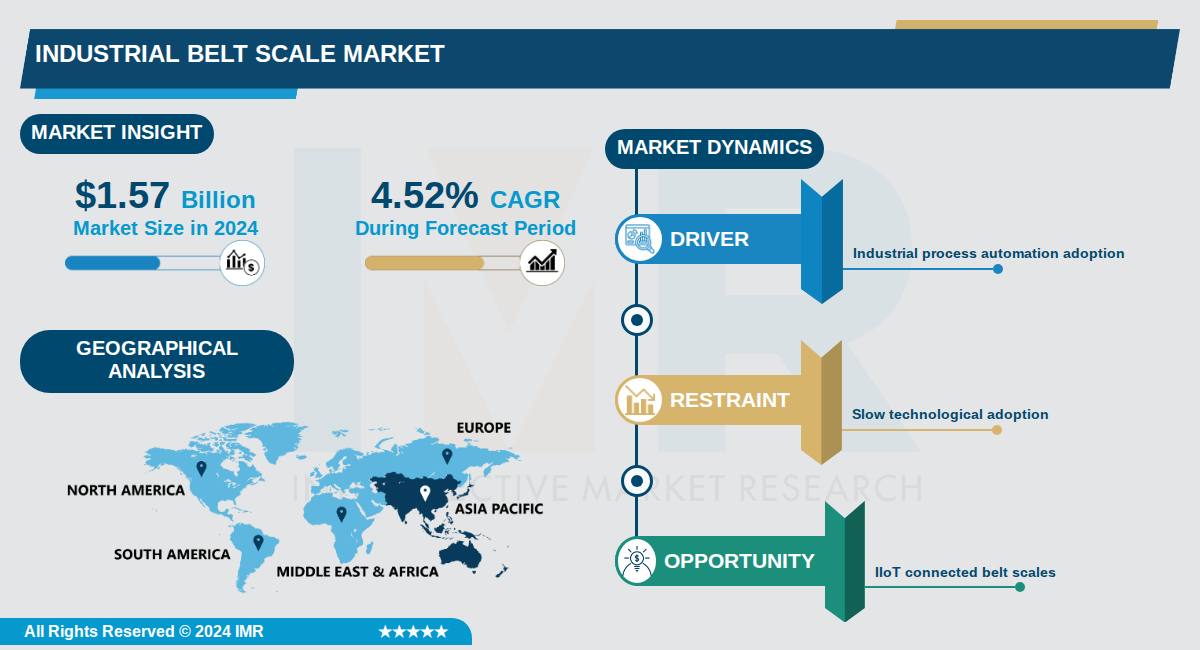
Industrial Belt Scale Market Size Was Valued at USD 1.57 Billion in 2024, and is Projected to Reach USD 2.44 Billion by 2035, Growing at a CAGR of 4.52% From 2024-2035.
The global industrial belt scale market, valued at USD 1.57 billion in 2024, is projected to reach USD 2.44 billion by 2035, growing at a compound annual growth rate (CAGR) of 4.52% from 2026 to 2035. These devices, utilizing rollers, speed sensors, and electronic components, enable real-time measurement of total weight and material flow rates on conveyor belts, serving critical roles in bulk materials handling across various sectors.
Key market segments show robust performance, with the multi-idler type expected to grow at a 5.5% CAGR, electronic load-cell technology holding 52.3% share in 2025, and conveyor belts of 500-1200 mm width capturing 45.8% market share. Mining dominates end-user applications at 35.8% share, while logistics & warehousing is poised for the fastest growth at 5.7% CAGR; process control leads applications at 42.3%.
Regional dynamics highlight expansion in the Middle East & Africa due to rising industrial activity, IoT/AI integration, Industry 4.0 adoption, and regulatory support for safety standards. North America and Europe also drive growth through automation demands in mining, agriculture, and manufacturing, bolstered by IIoT technologies for enhanced accuracy and real-time insights.
Industrial Belt Scale Market Trend Analysis:
Integration with IoT and Predictive Maintenance
- Belt scales are increasingly integrated into industrial IoT ecosystems by companies like Siemens AG and Mettler-Toledo International Inc., enabling real-time material flow monitoring and remote diagnostics that reduce downtime by up to 30% in mining operations. This shift allows centralized control rooms to predict failures using AI-driven analytics, as seen in Rice Lake Weighing Systems' latest models which connect to Industry 4.0 platforms. Wireless protocols further support this by providing mobile app compatibility for field technicians, streamlining setup in high-volume sectors like cement production.
- In the Asia-Pacific region, particularly China and India, IoT-enabled belt scales from Schenck Process are fueling a 7.5% CAGR in the belt weighing system market through 2034, with installations in new infrastructure projects optimizing resource allocation. Predictive maintenance features have helped Thayer Scale customers in coal handling cut maintenance costs by 25%, demonstrating how these systems enhance process transparency. Modular IoT designs also adapt to varying belt speeds, making them scalable for emerging markets.
- North American leaders like Belt-Way Scales Inc. are pioneering cloud-based analytics in their products, projecting the single idler segment to reach US$787.7 million by 2030 at a 3.1% CAGR, driven by energy-efficient diagnostics in biomass operations.
Rise of Smart Sensor and AI-Driven Precision Weighing
- Smart sensor integration is transforming belt scales, with Kistler-Morse and Avery Weigh-Tronix deploying AI-powered diagnostics that achieve accuracy rates above 99% in aggregate handling, surpassing traditional systems. These advancements support high-precision weighing in steel production, where real-time data from sensors like those in multi-idler configurations prevents yield losses estimated at 5-10% in unregulated setups. Energy-efficient designs reduce power consumption by 20%, aligning with global sustainability goals.
- In mining, which accounts for over 45% of demand, Siemens Global's AI-enhanced systems provide continuous ore weighing for regulatory compliance, boosting operational efficiency in quarries across Indonesia. The flat belt segment's rapid growth, led by Weightron Bilanciai Ltd, incorporates these sensors for versatile applications in bulk terminals, expanding logistics integration.
- Europe's stringent emissions regulations are accelerating adoption, with Schenck Process reporting a 15% uptick in AI belt scale installations for power generation, enabling precise coal flow monitoring.
Expansion in Asia-Pacific Mining and Infrastructure
- Asia-Pacific is the fastest-growing region at over 7% CAGR, driven by China's rapid industrialization and India's infrastructure boom, where belt scales from Rice Lake Weighing Systems monitor aggregates in mega-projects valued at billions. Mining expansions in Indonesia have installed over 5,000 units since 2024, supporting a market jump from USD 1.56 billion in 2026 to USD 2.78 billion by 2034. Government incentives for automation in cement sectors further propel this trend.
- Multi-idler systems dominate heavy-load mining in the region, with Thayer Scale securing contracts for 20% more capacity in quarries, ensuring uninterrupted material flow amid rising coal demand.
Industrial Belt Scale Market Segment Analysis:
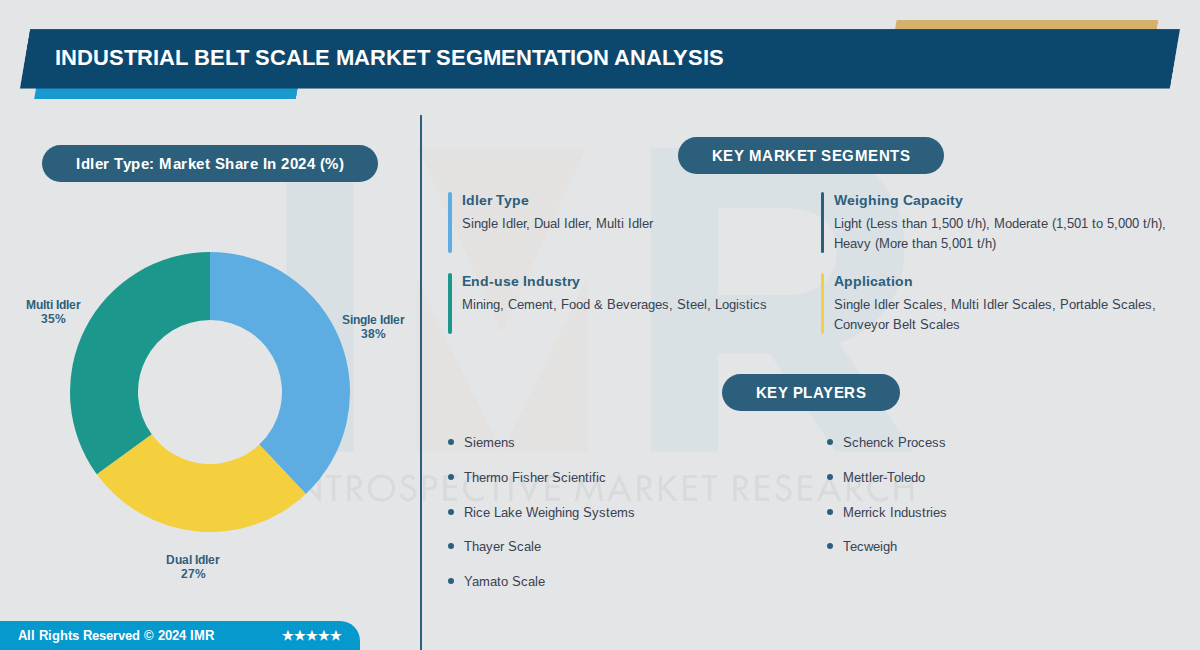
Industrial Belt Scale Market is Segmented on the basis of By Idler Type, By Weighing Capacity, By End-use Industry
By Idler Type, Single Idler segment is expected to dominate the market during the forecast period
- Multi Idler scales dominate due to their superior accuracy and precision in measuring weight and flow rates across diverse bulk materials and conveyor belt sizes.
- Advancements in sensor technology and automation have enhanced multi-idler capabilities, making them essential for modern industrial weighing solutions.
By Weighing Capacity, Moderate (1,501 to 5,000 t/h) segment is expected to dominate the market during the forecast period
- Moderate capacity belt scales lead due to their versatility in industries like cement, logistics, and aggregates, balancing speed, accuracy, and load-handling.
- They are ideal for continuous operations in mid-sized processing units requiring high throughput and reliable weight data.
By End-use Industry, Mining segment is expected to dominate the market during the forecast period
- Mining dominates as belt scales enable accurate measurement of bulk materials on conveyors, supporting inventory control and logistics in high-volume operations.
- Stringent regulations and expansion in mining activities demand precise weighing for compliance and efficiency.
By Application, Multi Idler Scales segment is expected to dominate the market during the forecast period
- Multi Idler Scales lead due to their high precision and adaptability to various conveyor systems and material types in heavy industries.
- They provide reliable performance in demanding environments, driving adoption for continuous bulk material handling.
Industrial Belt Scale Market Regional Insights:
Asia Pacific is Expected to Dominate the Market Over the Forecast Period
- Asia Pacific dominates the industrial belt scale market with the largest share of 45.3% in 2025 and is projected to grow at a CAGR of 6.5% from 2026 to 2035. Key countries like China, India, and Japan drive this leadership due to massive industrial expansion in mining, cement, and manufacturing sectors. The region's rapid industrialization creates high demand for precise bulk material handling solutions.
- Robust infrastructure development, coupled with heavy investments in automation and Industry 4.0 initiatives, fuels market growth across Asia Pacific. Countries such as China and India are expanding logistics, supply chains, and manufacturing hubs, necessitating advanced weighing technologies for efficiency. Government programs promoting industrial digitalization further accelerate adoption of smart belt scales.
- Major players are partnering with local distributors in Asia Pacific to penetrate markets, supported by recent developments in IoT-integrated systems. China leads in procurement for coal and cement, while India sees fast growth from steel and power projects; Australia contributes through high-value mining operations. These trends highlight ongoing innovations and expansions by key manufacturers in the region.
Active Key Players in the Industrial Belt Scale Market:
- Siemens (Germany)
- Schenck Process (Germany)
- Thermo Fisher Scientific (USA)
- Mettler-Toledo (Switzerland)
- Rice Lake Weighing Systems (USA)
- Merrick Industries (USA)
- Thayer Scale (USA)
- Tecweigh (USA)
- Yamato Scale (Japan)
- Minebea Intec (Japan)
- Bizerba (Germany)
- Kanawha Scales & Systems (USA)
- Belt-Way Scales (USA)
- Avery Weigh-Tronix (USA)
- FLSmidth (Denmark)
- Saimo Technology (China)
- Ishida Co., Ltd. (Japan)
- Precia Molen (France)
- Other Active Players
|
Industrial Belt Scale Market |
|||
|
Base Year: |
2024 |
Forecast Period: |
2024-2035 |
|
Historical Data: |
2017 to 2024 |
Market Size in 2024: |
USD 1.57 Billion |
|
Forecast Period 2024-2035 CAGR: |
4.52 % |
Market Size in 2035: |
USD 2.44 Billion |
|
Segments Covered: |
By Idler Type |
|
|
|
By Weighing Capacity |
|
||
|
By End-use Industry |
|
||
|
By Application |
|
||
|
By Region |
|
||
|
Key Market Drivers: |
|
||
|
Key Market Restraints: |
|
||
|
Key Opportunities: |
|
||
|
Companies Covered in the report: |
|
||
Chapter 1: Introduction
1.1 Scope and Coverage
Chapter 2: Executive Summary
Chapter 3: Market Landscape
3.1 Market Dynamics and Opportunity Analysis
3.1.1 Growth Drivers
3.1.2 Limiting Factors
3.1.3 Growth Opportunities
3.1.4 Challenges and Risks
3.2 Market Trend Analysis
3.3 Industry Ecosystem
3.4 Industry Value Chain Mapping
3.5 Strategic PESTLE Overview
3.6 Porter's Five Forces Framework
3.7 Regulatory Framework
3.8 Pricing Trend Analysis
3.9 Intellectual Property Review
3.10 Technology Evolution
3.11 Import-Export Analysis
3.12 Consumer Behavior Analysis
3.13 Investment Pocket Analysis
3.14 Go-To Market Strategy
Chapter 4: Industrial Belt Scale Market by Idler Type (2017-2035)
4.1 Industrial Belt Scale Market Snapshot and Growth Engine
4.2 Market Overview
4.3 Single Idler
4.3.1 Introduction and Market Overview
4.3.2 Historic and Forecasted Market Size in Value USD and Volume Units
4.3.3 Key Market Trends, Growth Factors, and Opportunities
4.3.4 Geographic Segmentation Analysis
4.4 Dual Idler
4.5 Multi Idler
Chapter 5: Industrial Belt Scale Market by Weighing Capacity (2017-2035)
5.1 Industrial Belt Scale Market Snapshot and Growth Engine
5.2 Market Overview
5.3 Light (Less than 1
5.3.1 Introduction and Market Overview
5.3.2 Historic and Forecasted Market Size in Value USD and Volume Units
5.3.3 Key Market Trends, Growth Factors, and Opportunities
5.3.4 Geographic Segmentation Analysis
5.4 500 t/h)
5.5 Moderate (1
5.6 501 to 5
5.7 000 t/h)
5.8 Heavy (More than 5
5.9 001 t/h)
Chapter 6: Industrial Belt Scale Market by End-use Industry (2017-2035)
6.1 Industrial Belt Scale Market Snapshot and Growth Engine
6.2 Market Overview
6.3 Mining
6.3.1 Introduction and Market Overview
6.3.2 Historic and Forecasted Market Size in Value USD and Volume Units
6.3.3 Key Market Trends, Growth Factors, and Opportunities
6.3.4 Geographic Segmentation Analysis
6.4 Cement
6.5 Food & Beverages
6.6 Steel
6.7 Logistics
Chapter 7: Industrial Belt Scale Market by Application (2017-2035)
7.1 Industrial Belt Scale Market Snapshot and Growth Engine
7.2 Market Overview
7.3 Single Idler Scales
7.3.1 Introduction and Market Overview
7.3.2 Historic and Forecasted Market Size in Value USD and Volume Units
7.3.3 Key Market Trends, Growth Factors, and Opportunities
7.3.4 Geographic Segmentation Analysis
7.4 Multi Idler Scales
7.5 Portable Scales
7.6 Conveyor Belt Scales
Chapter 8: Company Profiles and Competitive Analysis
8.1 Competitive Landscape
8.1.1 Competitive Benchmarking
8.1.2 Industrial Belt Scale Market Share by Manufacturer/Service Provider (2024)
8.1.3 Industry BCG Matrix
8.1.4 Partnerships, Mergers & Acquisitions
8.2 SIEMENS
8.2.1 Company Overview
8.2.2 Key Executives
8.2.3 Company Snapshot
8.2.4 Role of the Company in the Market
8.2.5 Sustainability and Social Responsibility
8.2.6 Operating Business Segments
8.2.7 Product Portfolio
8.2.8 Business Performance
8.2.9 Recent News & Developments
8.2.10 SWOT Analysis
8.3 SCHENCK PROCESS
8.4 THERMO FISHER SCIENTIFIC
8.5 METTLER-TOLEDO
8.6 RICE LAKE WEIGHING SYSTEMS
8.7 MERRICK INDUSTRIES
8.8 THAYER SCALE
8.9 TECWEIGH
8.10 YAMATO SCALE
8.11 MINEBEA INTEC
8.12 BIZERBA
8.13 KANAWHA SCALES & SYSTEMS
8.14 BELT-WAY SCALES
8.15 AVERY WEIGH-TRONIX
8.16 FLSMIDTH
8.17 SAIMO TECHNOLOGY
8.18 ISHIDA CO.
8.19 LTD.
8.20 PRECIA MOLEN
Chapter 9: Global Industrial Belt Scale Market By Region
9.1 Overview
9.2. North America Industrial Belt Scale Market
9.2.1 Key Market Trends, Growth Factors and Opportunities
9.2.2 Top Key Companies
9.2.3 Historic and Forecasted Market Size by Segments
9.2.4 Historic and Forecast Market Size by Country
9.3. Eastern Europe Industrial Belt Scale Market
9.3.1 Key Market Trends, Growth Factors and Opportunities
9.3.2 Top Key Companies
9.3.3 Historic and Forecasted Market Size by Segments
9.3.4 Historic and Forecast Market Size by Country
9.4. Western Europe Industrial Belt Scale Market
9.4.1 Key Market Trends, Growth Factors and Opportunities
9.4.2 Top Key Companies
9.4.3 Historic and Forecasted Market Size by Segments
9.4.4 Historic and Forecast Market Size by Country
9.5. Asia Pacific Industrial Belt Scale Market
9.5.1 Key Market Trends, Growth Factors and Opportunities
9.5.2 Top Key Companies
9.5.3 Historic and Forecasted Market Size by Segments
9.5.4 Historic and Forecast Market Size by Country
9.6. Middle East & Africa Industrial Belt Scale Market
9.6.1 Key Market Trends, Growth Factors and Opportunities
9.6.2 Top Key Companies
9.6.3 Historic and Forecasted Market Size by Segments
9.6.4 Historic and Forecast Market Size by Country
9.7. South America Industrial Belt Scale Market
9.7.1 Key Market Trends, Growth Factors and Opportunities
9.7.2 Top Key Companies
9.7.3 Historic and Forecasted Market Size by Segments
9.7.4 Historic and Forecast Market Size by Country
Chapter 10: Analyst Viewpoint and Conclusion
Chapter 11: Research Methodology
11.1 Research Process
11.2 Primary Research
11.3 Secondary Research
Chapter 12: Case Study
Chapter 13: Appendix
13.1 Sources
13.2 List of Tables and Figures
13.3 Short Forms and Citations
13.4 Assumption and Conversion
13.5 Disclaimer
|
Industrial Belt Scale Market |
|||
|
Base Year: |
2024 |
Forecast Period: |
2024-2035 |
|
Historical Data: |
2017 to 2024 |
Market Size in 2024: |
USD 1.57 Billion |
|
Forecast Period 2024-2035 CAGR: |
4.52 % |
Market Size in 2035: |
USD 2.44 Billion |
|
Segments Covered: |
By Idler Type |
|
|
|
By Weighing Capacity |
|
||
|
By End-use Industry |
|
||
|
By Application |
|
||
|
By Region |
|
||
|
Key Market Drivers: |
|
||
|
Key Market Restraints: |
|
||
|
Key Opportunities: |
|
||
|
Companies Covered in the report: |
|
||


