




Immunohistochemistry Market Synopsis:
Immunohistochemistry Market Size Was Valued at USD 2.32 Billion in 2023, and is Projected to Reach USD 3.82 Billion by 2032, Growing at a CAGR of 5.7% from 2024-2032.
Immunohistochemistry (IHC) is a practical method in the histological laboratory that involves staining of tissues with particular antibodies for the identification of unique antigens in tissues. It is particularly helpful in diagnostic work and subsequent treatment of diseases especially cancer, based on the presence or otherwise of certain biomarkers. The IHC market comprises reagents, software and instruments applied in both research and clinical practice.
The market for immunohistochemistry has expanded at an impressive growth pattern primarily being driven by rising rate of cancer diagnosed and the developments in the diagnostic tools. Increasing interest in research and an increasing focus on individualized treatment are pushing IHC applications forward. Also, the increase in aging people and the increasing incidence of chronic diseases has increased the need for highly accurate diagnoses even higher. The market is growing due to the incorporation of IHC in drug development and companion diagnostics, which make it significant to current pathology.
Moreover, the growth in the IHC market depends on the enablement of technology to improve diagnostic outcomes. Through the adoption of automation, and artificial intelligence the work flow in laboratories undertaking IHC has been enhanced and reduced the ambience of slow turn around time and human interferences. This trend is positively influencing the growth of huge investments from private as well as the public sectors to provide a higher end to IHC solutions for the improvement of patients’ health. Besides, strategic relations between pharma and diagnostics companies are believed to catalyze the creation of new IHC assays, which are also going to fuel the market.
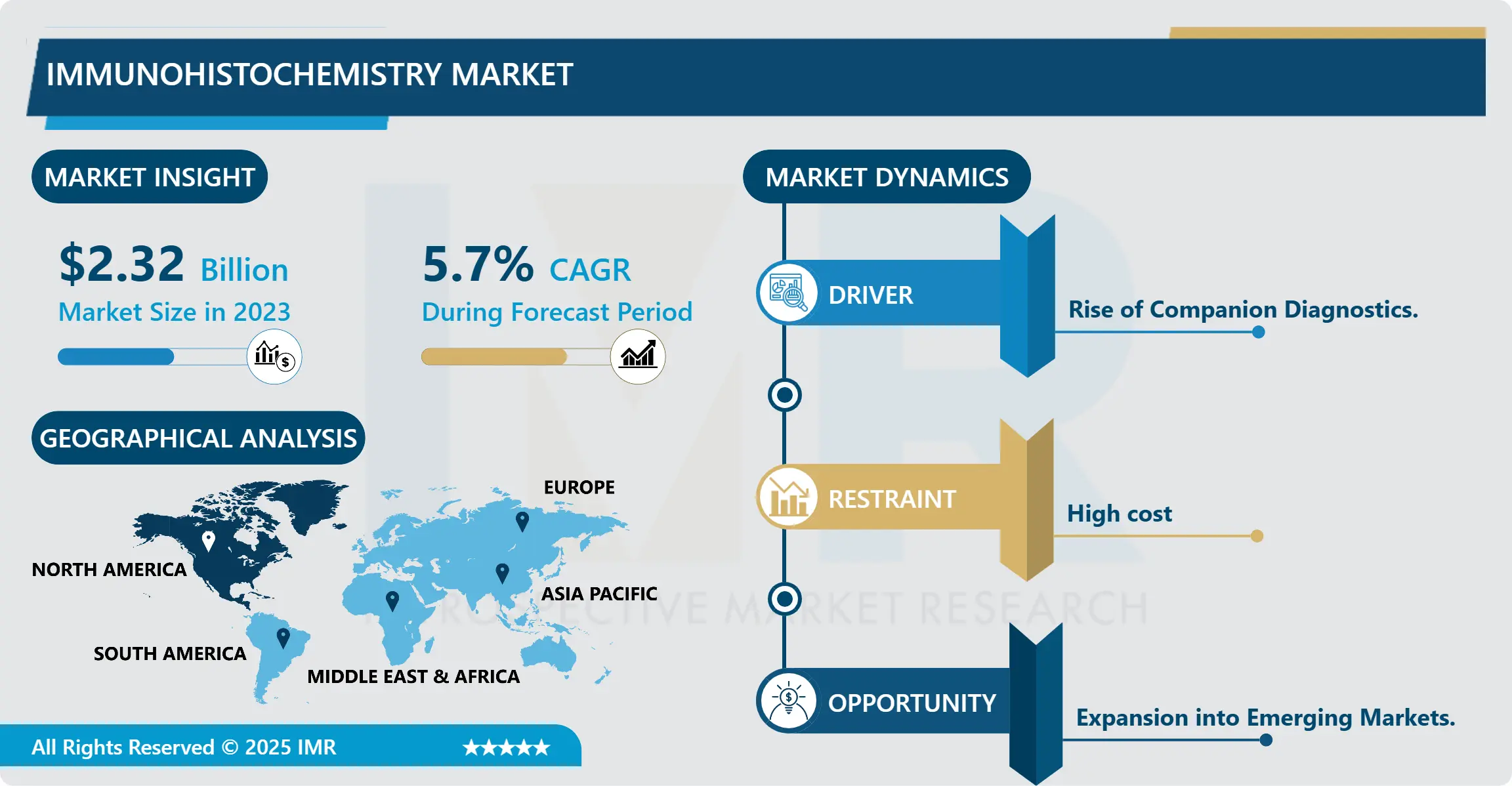
Immunohistochemistry Market Trend Analysis:
Rise of Companion Diagnostics
-
The fact that PD-L1 IHC is a companion diagnostic is changing the direction of the immunohistochemistry market. Over time, companion diagnostic that work with the particular characteristics of the disease are being incorporated in oncology’s practice. The advancement of more targeted therapies demands identification of biomarkers, and IHC is beneficial in visualizing proteins within unidentified sections of tissue samples. With increased calls from the regulatory authorities for the development of companion diagnostics alongside new all therapeutics, the IHC products market is in for significant growth. This trend is not only improving the outcome of treatments for patients but is also helping to grow revenues for providers of IHC technologies.
Expansion into Emerging Markets
-
An increasing demand for outsourced and new healthcare structures in developed markets is viewed as a promising opportunity for the immunohistochemistry market. South Asia and other areas that form part of the Asia-Pacific region and Latin America in particular are spending significantly on their health facilities, measures that are accumulating to improvement of facilities such as laboratories and enhancing patients’ access to sophisticated diagnostic equipment. This shift is to a need to increase the quality of IHC products since healthcare providers are looking for ways to improve diagnosis. These global product markets make it easier for companies that gain entry into the markets to enjoy more opportunities to capture a larger share of the marked than their competitors. Additionally, it can be more easily partnered with local firms to better penetrate and distribute the product, thus quickly moving into these emerging areas.
Immunohistochemistry Market Segment Analysis:
Immunohistochemistry Market is Segmented on the basis of Product, Application, End User, and Region
By Product, Antibodies segment is expected to dominate the market during the forecast period
-
The antibodies segment held the largest share of nearly 40.96% in the year 2022 because antibodies are extensively used for diagnosing diseases and testing new drugs. The upsurge in importance of the monoclonal antibodies and all related product thereof comprising Fc-fusion, antibody fragments, and ADC have rendered it as the leading product usage rate. These antibodies are used in a variety of ways including, pathological anatomy, neuropathological and hematopathological.
By Application, Diagnosties segment expected to held the largest share
-
Further based on application, the global market has been divided into diagnostics and research markets. The diagnostics application segment bought the highest proportions of revenues, of over 69.16%, in 2022 and the same segment is expected to continue its dominance over the market till the end of the expected period. Immunohistochemistry (IHC) tests are particularly suitable for the diagnosis of various chronic diseases including cancer, cardiovascular diseases, infectious diseases, diabetes mellitus, autoimmune diseases, and nephrological diseases. Also, the increasing incidence rate of chronic diseases is expected to enhance the diagnostics segment growth.
Immunohistochemistry Market Regional Insights:
North America is Expected to Dominate the Market Over the Forecast period
-
For the immunohistochemistry in the year 2023, North America market will grow up to 40% of the overall market share. The leadership of the region can be associated with such factors as well-developed healthcare industry, high investment rate in research and development processes, location of leading market participants. The USA has recently experienced an increase in the cases of cancers, thereby creating the need for tests like IHC. Besides, owing to integration of modern technologies and the availability of numerous laboratories, North America has a vast market share. More so, the area’s strong emphasis on patient-specific treatments and companion diagnostic continues to make it a within the leader in the IHC industry.
- The immunohistochemistry product market is mainly fueled by rise in the number of cancer cases and developments in biomarkers. Growth in the number of cases, increased awareness of healthcare professionals about the importance of proper diagnostics and individual approach to treatment also stimulate market growth. However, there are some factors, including high costs of the advanced IHC technologies and scarcity of skilled personnel prevalent in the developing world, which may negatively influence this market growth. However, it can be noted that new research activities and technologies provide an infinite possibility for innovation and an addition to the market.
Active Key Players in the Immunohistochemistry Market:
-
Abcam plc (UK)
- Agilent Technologies (USA)
- Bio-Techne Corporation (USA)
- Cell Signaling Technology (USA)
- Dako (Denmark)
- Fujifilm Wako Pure Chemical Corporation (Japan)
- Johnson & Johnson (USA)
- Leica Biosystems (Germany)
- Merck KGaA (Germany)
- NeoGenomics Laboratories (USA)
- PerkinElmer, Inc. (USA)
- QIAGEN N.V. (Netherlands)
- Roche Diagnostics (Switzerland)
- Sigma-Aldrich (USA)
- Thermo Fisher Scientific (USA)
- Others Active players.
|
Immunohistochemistry Market |
|||
|
Base Year: |
2023 |
Forecast Period: |
2024-2032 |
|
Historical Data: |
2017 to 2023 |
Market Size in 2023: |
USD 2.32 Billion |
|
Forecast Period 2024-32 CAGR: |
5.7% |
Market Size in 2032: |
USD 3.82 Billion |
|
Segments Covered: |
By Product |
Primary Antibodies Secondary Antibodies
Slide Staining System Tissue Microarrays Tissue Processing Systems Slide Scanners Others
Histological stains Blocking Sera and Reagents Chromogenic Substrates Fixation Reagents Stabilizers Organic Solvents Proteolytic Enzymes Diluents
|
|
|
By Application |
|
||
|
By End user |
|
||
|
By Region |
|
||
|
Key Market Drivers: |
|
||
|
Key Market Restraints: |
|
||
|
Key Opportunities: |
|
||
|
Companies Covered in the report: |
|
||
Chapter 1: Introduction
1.1 Scope and Coverage
Chapter 2:Executive Summary
Chapter 3: Market Landscape
3.1 Market Dynamics
3.1.1 Drivers
3.1.2 Restraints
3.1.3 Opportunities
3.1.4 Challenges
3.2 Market Trend Analysis
3.3 PESTLE Analysis
3.4 Porter's Five Forces Analysis
3.5 Industry Value Chain Analysis
3.6 Ecosystem
3.7 Regulatory Landscape
3.8 Price Trend Analysis
3.9 Patent Analysis
3.10 Technology Evolution
3.11 Investment Pockets
3.12 Import-Export Analysis
Chapter 4: Immunohistochemistry Market by Product
4.1 Immunohistochemistry Market Snapshot and Growth Engine
4.2 Immunohistochemistry Market Overview
4.3 Antibodies (Primary Antibodies
4.3.1 Introduction and Market Overview
4.3.2 Historic and Forecasted Market Size in Value USD and Volume Units (2017-2032F)
4.3.3 Key Market Trends, Growth Factors and Opportunities
4.3.4 Antibodies (Primary Antibodies: Geographic Segmentation Analysis
4.4 Secondary Antibodies)) (Equipment (Slide Staining System
4.4.1 Introduction and Market Overview
4.4.2 Historic and Forecasted Market Size in Value USD and Volume Units (2017-2032F)
4.4.3 Key Market Trends, Growth Factors and Opportunities
4.4.4 Secondary Antibodies)) (Equipment (Slide Staining System: Geographic Segmentation Analysis
4.5 Tissue Microarrays
4.5.1 Introduction and Market Overview
4.5.2 Historic and Forecasted Market Size in Value USD and Volume Units (2017-2032F)
4.5.3 Key Market Trends, Growth Factors and Opportunities
4.5.4 Tissue Microarrays: Geographic Segmentation Analysis
4.6 Tissue Processing Systems
4.6.1 Introduction and Market Overview
4.6.2 Historic and Forecasted Market Size in Value USD and Volume Units (2017-2032F)
4.6.3 Key Market Trends, Growth Factors and Opportunities
4.6.4 Tissue Processing Systems: Geographic Segmentation Analysis
4.7 Slide Scanners
4.7.1 Introduction and Market Overview
4.7.2 Historic and Forecasted Market Size in Value USD and Volume Units (2017-2032F)
4.7.3 Key Market Trends, Growth Factors and Opportunities
4.7.4 Slide Scanners: Geographic Segmentation Analysis
4.8 Others)) (Reagents (Histological stains
4.8.1 Introduction and Market Overview
4.8.2 Historic and Forecasted Market Size in Value USD and Volume Units (2017-2032F)
4.8.3 Key Market Trends, Growth Factors and Opportunities
4.8.4 Others)) (Reagents (Histological stains: Geographic Segmentation Analysis
4.9 Blocking Sera and Reagents
4.9.1 Introduction and Market Overview
4.9.2 Historic and Forecasted Market Size in Value USD and Volume Units (2017-2032F)
4.9.3 Key Market Trends, Growth Factors and Opportunities
4.9.4 Blocking Sera and Reagents: Geographic Segmentation Analysis
4.10 Chromogenic Substrates
4.10.1 Introduction and Market Overview
4.10.2 Historic and Forecasted Market Size in Value USD and Volume Units (2017-2032F)
4.10.3 Key Market Trends, Growth Factors and Opportunities
4.10.4 Chromogenic Substrates: Geographic Segmentation Analysis
4.11 Fixation Reagents
4.11.1 Introduction and Market Overview
4.11.2 Historic and Forecasted Market Size in Value USD and Volume Units (2017-2032F)
4.11.3 Key Market Trends, Growth Factors and Opportunities
4.11.4 Fixation Reagents: Geographic Segmentation Analysis
4.12 Stabilizers
4.12.1 Introduction and Market Overview
4.12.2 Historic and Forecasted Market Size in Value USD and Volume Units (2017-2032F)
4.12.3 Key Market Trends, Growth Factors and Opportunities
4.12.4 Stabilizers: Geographic Segmentation Analysis
4.13 Organic Solvents
4.13.1 Introduction and Market Overview
4.13.2 Historic and Forecasted Market Size in Value USD and Volume Units (2017-2032F)
4.13.3 Key Market Trends, Growth Factors and Opportunities
4.13.4 Organic Solvents: Geographic Segmentation Analysis
4.14 Proteolytic Enzymes
4.14.1 Introduction and Market Overview
4.14.2 Historic and Forecasted Market Size in Value USD and Volume Units (2017-2032F)
4.14.3 Key Market Trends, Growth Factors and Opportunities
4.14.4 Proteolytic Enzymes: Geographic Segmentation Analysis
4.15 Diluents)) (Kits )
4.15.1 Introduction and Market Overview
4.15.2 Historic and Forecasted Market Size in Value USD and Volume Units (2017-2032F)
4.15.3 Key Market Trends, Growth Factors and Opportunities
4.15.4 Diluents)) (Kits ): Geographic Segmentation Analysis
Chapter 5: Immunohistochemistry Market by Application
5.1 Immunohistochemistry Market Snapshot and Growth Engine
5.2 Immunohistochemistry Market Overview
5.3 Diagnostics
5.3.1 Introduction and Market Overview
5.3.2 Historic and Forecasted Market Size in Value USD and Volume Units (2017-2032F)
5.3.3 Key Market Trends, Growth Factors and Opportunities
5.3.4 Diagnostics : Geographic Segmentation Analysis
5.4 Cancer
5.4.1 Introduction and Market Overview
5.4.2 Historic and Forecasted Market Size in Value USD and Volume Units (2017-2032F)
5.4.3 Key Market Trends, Growth Factors and Opportunities
5.4.4 Cancer : Geographic Segmentation Analysis
5.5 Infectious Diseases
5.5.1 Introduction and Market Overview
5.5.2 Historic and Forecasted Market Size in Value USD and Volume Units (2017-2032F)
5.5.3 Key Market Trends, Growth Factors and Opportunities
5.5.4 Infectious Diseases : Geographic Segmentation Analysis
5.6 Cardiovascular Diseases Autoimmune Diseases
5.6.1 Introduction and Market Overview
5.6.2 Historic and Forecasted Market Size in Value USD and Volume Units (2017-2032F)
5.6.3 Key Market Trends, Growth Factors and Opportunities
5.6.4 Cardiovascular Diseases Autoimmune Diseases: Geographic Segmentation Analysis
5.7 Diabetes Mellitus
5.7.1 Introduction and Market Overview
5.7.2 Historic and Forecasted Market Size in Value USD and Volume Units (2017-2032F)
5.7.3 Key Market Trends, Growth Factors and Opportunities
5.7.4 Diabetes Mellitus: Geographic Segmentation Analysis
5.8 Nephrological Diseases
5.8.1 Introduction and Market Overview
5.8.2 Historic and Forecasted Market Size in Value USD and Volume Units (2017-2032F)
5.8.3 Key Market Trends, Growth Factors and Opportunities
5.8.4 Nephrological Diseases: Geographic Segmentation Analysis
5.9 Research
5.9.1 Introduction and Market Overview
5.9.2 Historic and Forecasted Market Size in Value USD and Volume Units (2017-2032F)
5.9.3 Key Market Trends, Growth Factors and Opportunities
5.9.4 Research: Geographic Segmentation Analysis
Chapter 6: Immunohistochemistry Market by End User
6.1 Immunohistochemistry Market Snapshot and Growth Engine
6.2 Immunohistochemistry Market Overview
6.3 Hospitals & Diagnostic Laboratories
6.3.1 Introduction and Market Overview
6.3.2 Historic and Forecasted Market Size in Value USD and Volume Units (2017-2032F)
6.3.3 Key Market Trends, Growth Factors and Opportunities
6.3.4 Hospitals & Diagnostic Laboratories: Geographic Segmentation Analysis
6.4 Research Institutes
6.4.1 Introduction and Market Overview
6.4.2 Historic and Forecasted Market Size in Value USD and Volume Units (2017-2032F)
6.4.3 Key Market Trends, Growth Factors and Opportunities
6.4.4 Research Institutes: Geographic Segmentation Analysis
6.5 Others
6.5.1 Introduction and Market Overview
6.5.2 Historic and Forecasted Market Size in Value USD and Volume Units (2017-2032F)
6.5.3 Key Market Trends, Growth Factors and Opportunities
6.5.4 Others: Geographic Segmentation Analysis
Chapter 7: Company Profiles and Competitive Analysis
7.1 Competitive Landscape
7.1.1 Competitive Benchmarking
7.1.2 Immunohistochemistry Market Share by Manufacturer (2023)
7.1.3 Industry BCG Matrix
7.1.4 Heat Map Analysis
7.1.5 Mergers and Acquisitions
7.2 AGILENT TECHNOLOGIES (USA)
7.2.1 Company Overview
7.2.2 Key Executives
7.2.3 Company Snapshot
7.2.4 Role of the Company in the Market
7.2.5 Sustainability and Social Responsibility
7.2.6 Operating Business Segments
7.2.7 Product Portfolio
7.2.8 Business Performance
7.2.9 Key Strategic Moves and Recent Developments
7.2.10 SWOT Analysis
7.3 ROCHE DIAGNOSTICS (SWITZERLAND)
7.4 THERMO FISHER SCIENTIFIC (USA)
7.5 AND MERCK KGAA (GERMANY) ARE AMONG THE LEADING PLAYERS IN THE IMMUNOHISTOCHEMISTRY MARKET
7.6 OTHER ACTIVE PLAYERS
Chapter 8: Global Immunohistochemistry Market By Region
8.1 Overview
8.2. North America Immunohistochemistry Market
8.2.1 Key Market Trends, Growth Factors and Opportunities
8.2.2 Top Key Companies
8.2.3 Historic and Forecasted Market Size by Segments
8.2.4 Historic and Forecasted Market Size By Product
8.2.4.1 Antibodies (Primary Antibodies
8.2.4.2 Secondary Antibodies)) (Equipment (Slide Staining System
8.2.4.3 Tissue Microarrays
8.2.4.4 Tissue Processing Systems
8.2.4.5 Slide Scanners
8.2.4.6 Others)) (Reagents (Histological stains
8.2.4.7 Blocking Sera and Reagents
8.2.4.8 Chromogenic Substrates
8.2.4.9 Fixation Reagents
8.2.4.10 Stabilizers
8.2.4.11 Organic Solvents
8.2.4.12 Proteolytic Enzymes
8.2.4.13 Diluents)) (Kits )
8.2.5 Historic and Forecasted Market Size By Application
8.2.5.1 Diagnostics
8.2.5.2 Cancer
8.2.5.3 Infectious Diseases
8.2.5.4 Cardiovascular Diseases Autoimmune Diseases
8.2.5.5 Diabetes Mellitus
8.2.5.6 Nephrological Diseases
8.2.5.7 Research
8.2.6 Historic and Forecasted Market Size By End User
8.2.6.1 Hospitals & Diagnostic Laboratories
8.2.6.2 Research Institutes
8.2.6.3 Others
8.2.7 Historic and Forecast Market Size by Country
8.2.7.1 US
8.2.7.2 Canada
8.2.7.3 Mexico
8.3. Eastern Europe Immunohistochemistry Market
8.3.1 Key Market Trends, Growth Factors and Opportunities
8.3.2 Top Key Companies
8.3.3 Historic and Forecasted Market Size by Segments
8.3.4 Historic and Forecasted Market Size By Product
8.3.4.1 Antibodies (Primary Antibodies
8.3.4.2 Secondary Antibodies)) (Equipment (Slide Staining System
8.3.4.3 Tissue Microarrays
8.3.4.4 Tissue Processing Systems
8.3.4.5 Slide Scanners
8.3.4.6 Others)) (Reagents (Histological stains
8.3.4.7 Blocking Sera and Reagents
8.3.4.8 Chromogenic Substrates
8.3.4.9 Fixation Reagents
8.3.4.10 Stabilizers
8.3.4.11 Organic Solvents
8.3.4.12 Proteolytic Enzymes
8.3.4.13 Diluents)) (Kits )
8.3.5 Historic and Forecasted Market Size By Application
8.3.5.1 Diagnostics
8.3.5.2 Cancer
8.3.5.3 Infectious Diseases
8.3.5.4 Cardiovascular Diseases Autoimmune Diseases
8.3.5.5 Diabetes Mellitus
8.3.5.6 Nephrological Diseases
8.3.5.7 Research
8.3.6 Historic and Forecasted Market Size By End User
8.3.6.1 Hospitals & Diagnostic Laboratories
8.3.6.2 Research Institutes
8.3.6.3 Others
8.3.7 Historic and Forecast Market Size by Country
8.3.7.1 Russia
8.3.7.2 Bulgaria
8.3.7.3 The Czech Republic
8.3.7.4 Hungary
8.3.7.5 Poland
8.3.7.6 Romania
8.3.7.7 Rest of Eastern Europe
8.4. Western Europe Immunohistochemistry Market
8.4.1 Key Market Trends, Growth Factors and Opportunities
8.4.2 Top Key Companies
8.4.3 Historic and Forecasted Market Size by Segments
8.4.4 Historic and Forecasted Market Size By Product
8.4.4.1 Antibodies (Primary Antibodies
8.4.4.2 Secondary Antibodies)) (Equipment (Slide Staining System
8.4.4.3 Tissue Microarrays
8.4.4.4 Tissue Processing Systems
8.4.4.5 Slide Scanners
8.4.4.6 Others)) (Reagents (Histological stains
8.4.4.7 Blocking Sera and Reagents
8.4.4.8 Chromogenic Substrates
8.4.4.9 Fixation Reagents
8.4.4.10 Stabilizers
8.4.4.11 Organic Solvents
8.4.4.12 Proteolytic Enzymes
8.4.4.13 Diluents)) (Kits )
8.4.5 Historic and Forecasted Market Size By Application
8.4.5.1 Diagnostics
8.4.5.2 Cancer
8.4.5.3 Infectious Diseases
8.4.5.4 Cardiovascular Diseases Autoimmune Diseases
8.4.5.5 Diabetes Mellitus
8.4.5.6 Nephrological Diseases
8.4.5.7 Research
8.4.6 Historic and Forecasted Market Size By End User
8.4.6.1 Hospitals & Diagnostic Laboratories
8.4.6.2 Research Institutes
8.4.6.3 Others
8.4.7 Historic and Forecast Market Size by Country
8.4.7.1 Germany
8.4.7.2 UK
8.4.7.3 France
8.4.7.4 The Netherlands
8.4.7.5 Italy
8.4.7.6 Spain
8.4.7.7 Rest of Western Europe
8.5. Asia Pacific Immunohistochemistry Market
8.5.1 Key Market Trends, Growth Factors and Opportunities
8.5.2 Top Key Companies
8.5.3 Historic and Forecasted Market Size by Segments
8.5.4 Historic and Forecasted Market Size By Product
8.5.4.1 Antibodies (Primary Antibodies
8.5.4.2 Secondary Antibodies)) (Equipment (Slide Staining System
8.5.4.3 Tissue Microarrays
8.5.4.4 Tissue Processing Systems
8.5.4.5 Slide Scanners
8.5.4.6 Others)) (Reagents (Histological stains
8.5.4.7 Blocking Sera and Reagents
8.5.4.8 Chromogenic Substrates
8.5.4.9 Fixation Reagents
8.5.4.10 Stabilizers
8.5.4.11 Organic Solvents
8.5.4.12 Proteolytic Enzymes
8.5.4.13 Diluents)) (Kits )
8.5.5 Historic and Forecasted Market Size By Application
8.5.5.1 Diagnostics
8.5.5.2 Cancer
8.5.5.3 Infectious Diseases
8.5.5.4 Cardiovascular Diseases Autoimmune Diseases
8.5.5.5 Diabetes Mellitus
8.5.5.6 Nephrological Diseases
8.5.5.7 Research
8.5.6 Historic and Forecasted Market Size By End User
8.5.6.1 Hospitals & Diagnostic Laboratories
8.5.6.2 Research Institutes
8.5.6.3 Others
8.5.7 Historic and Forecast Market Size by Country
8.5.7.1 China
8.5.7.2 India
8.5.7.3 Japan
8.5.7.4 South Korea
8.5.7.5 Malaysia
8.5.7.6 Thailand
8.5.7.7 Vietnam
8.5.7.8 The Philippines
8.5.7.9 Australia
8.5.7.10 New Zealand
8.5.7.11 Rest of APAC
8.6. Middle East & Africa Immunohistochemistry Market
8.6.1 Key Market Trends, Growth Factors and Opportunities
8.6.2 Top Key Companies
8.6.3 Historic and Forecasted Market Size by Segments
8.6.4 Historic and Forecasted Market Size By Product
8.6.4.1 Antibodies (Primary Antibodies
8.6.4.2 Secondary Antibodies)) (Equipment (Slide Staining System
8.6.4.3 Tissue Microarrays
8.6.4.4 Tissue Processing Systems
8.6.4.5 Slide Scanners
8.6.4.6 Others)) (Reagents (Histological stains
8.6.4.7 Blocking Sera and Reagents
8.6.4.8 Chromogenic Substrates
8.6.4.9 Fixation Reagents
8.6.4.10 Stabilizers
8.6.4.11 Organic Solvents
8.6.4.12 Proteolytic Enzymes
8.6.4.13 Diluents)) (Kits )
8.6.5 Historic and Forecasted Market Size By Application
8.6.5.1 Diagnostics
8.6.5.2 Cancer
8.6.5.3 Infectious Diseases
8.6.5.4 Cardiovascular Diseases Autoimmune Diseases
8.6.5.5 Diabetes Mellitus
8.6.5.6 Nephrological Diseases
8.6.5.7 Research
8.6.6 Historic and Forecasted Market Size By End User
8.6.6.1 Hospitals & Diagnostic Laboratories
8.6.6.2 Research Institutes
8.6.6.3 Others
8.6.7 Historic and Forecast Market Size by Country
8.6.7.1 Turkiye
8.6.7.2 Bahrain
8.6.7.3 Kuwait
8.6.7.4 Saudi Arabia
8.6.7.5 Qatar
8.6.7.6 UAE
8.6.7.7 Israel
8.6.7.8 South Africa
8.7. South America Immunohistochemistry Market
8.7.1 Key Market Trends, Growth Factors and Opportunities
8.7.2 Top Key Companies
8.7.3 Historic and Forecasted Market Size by Segments
8.7.4 Historic and Forecasted Market Size By Product
8.7.4.1 Antibodies (Primary Antibodies
8.7.4.2 Secondary Antibodies)) (Equipment (Slide Staining System
8.7.4.3 Tissue Microarrays
8.7.4.4 Tissue Processing Systems
8.7.4.5 Slide Scanners
8.7.4.6 Others)) (Reagents (Histological stains
8.7.4.7 Blocking Sera and Reagents
8.7.4.8 Chromogenic Substrates
8.7.4.9 Fixation Reagents
8.7.4.10 Stabilizers
8.7.4.11 Organic Solvents
8.7.4.12 Proteolytic Enzymes
8.7.4.13 Diluents)) (Kits )
8.7.5 Historic and Forecasted Market Size By Application
8.7.5.1 Diagnostics
8.7.5.2 Cancer
8.7.5.3 Infectious Diseases
8.7.5.4 Cardiovascular Diseases Autoimmune Diseases
8.7.5.5 Diabetes Mellitus
8.7.5.6 Nephrological Diseases
8.7.5.7 Research
8.7.6 Historic and Forecasted Market Size By End User
8.7.6.1 Hospitals & Diagnostic Laboratories
8.7.6.2 Research Institutes
8.7.6.3 Others
8.7.7 Historic and Forecast Market Size by Country
8.7.7.1 Brazil
8.7.7.2 Argentina
8.7.7.3 Rest of SA
Chapter 9 Analyst Viewpoint and Conclusion
9.1 Recommendations and Concluding Analysis
9.2 Potential Market Strategies
Chapter 10 Research Methodology
10.1 Research Process
10.2 Primary Research
10.3 Secondary Research
|
Immunohistochemistry Market |
|||
|
Base Year: |
2023 |
Forecast Period: |
2024-2032 |
|
Historical Data: |
2017 to 2023 |
Market Size in 2023: |
USD 2.32 Billion |
|
Forecast Period 2024-32 CAGR: |
5.7% |
Market Size in 2032: |
USD 3.82 Billion |
|
Segments Covered: |
By Product |
Primary Antibodies Secondary Antibodies
Slide Staining System Tissue Microarrays Tissue Processing Systems Slide Scanners Others
Histological stains Blocking Sera and Reagents Chromogenic Substrates Fixation Reagents Stabilizers Organic Solvents Proteolytic Enzymes Diluents
|
|
|
By Application |
|
||
|
By End user |
|
||
|
By Region |
|
||
|
Key Market Drivers: |
|
||
|
Key Market Restraints: |
|
||
|
Key Opportunities: |
|
||
|
Companies Covered in the report: |
|
||


