




Key Human Platelet Lysate Market Highlights:
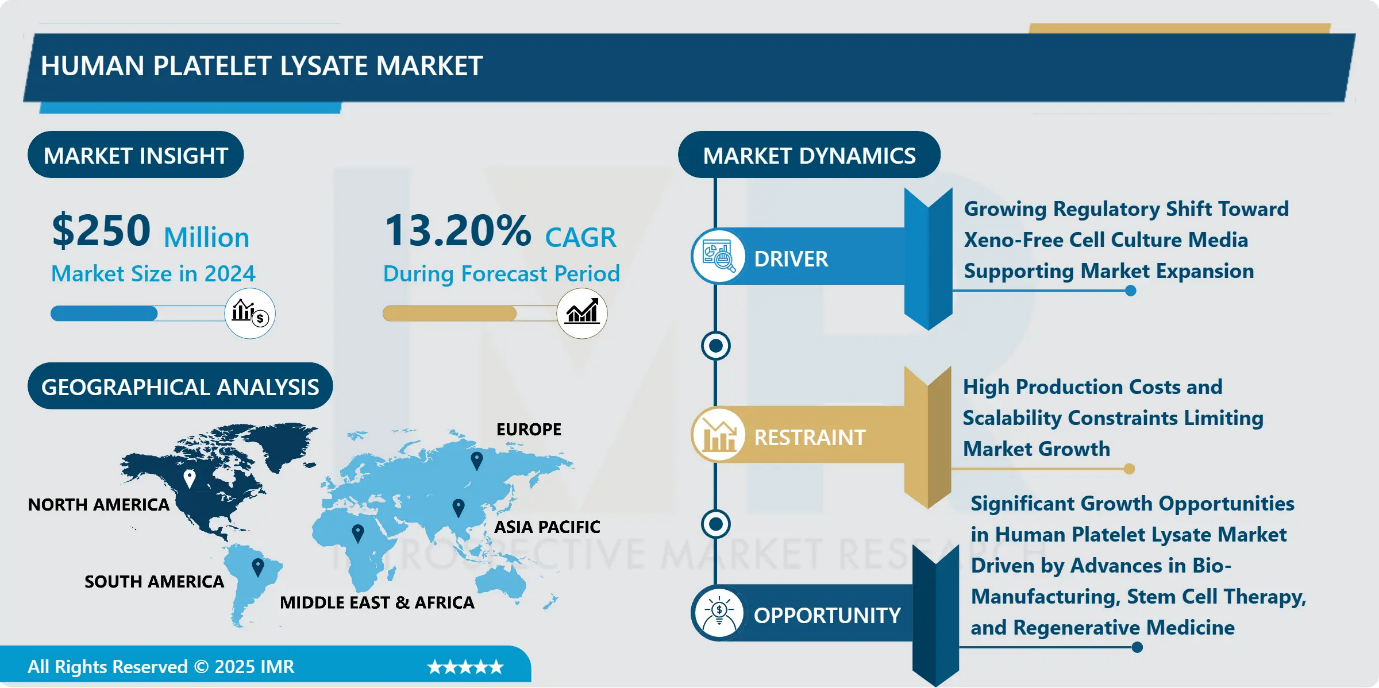
Human Platelet Lysate Market Size Was Valued at USD 250 Million in 2024, and is Projected to Reach USD 977.80 Million by 2035, Growing at a CAGR of 13.2% from 2025-2035.
- Human Platelet Lysate Market Size in 2024: USD 250 Million
- Projected Human Platelet Lysate Market Size by 2035: USD 977.80 Million
- CAGR (2025–2035): 13.20%
- Leading Human Platelet Lysate Market in 2024: North America
- Fastest-Growing Human Platelet Lysate Market: Asia-Pacific
- By Application: The Cell therapy and Regenerative medicine segment is anticipated to lead the Human Platelet Lysate Market by accounting for 38.90% of the Human Platelet Lysate Market share throughout the forecast period.
- By End-User: The Pharmaceutical and biotechnological companies segment is expected to capture 31.09% of the Human Platelet Lysate Market share, thereby maintaining its dominance over the forecast period.
- By Region: North America region is projected to hold 34.20% of the Human Platelet Lysate Market share during the forecast period.
- Active Players: AventaCell BioMedical Corp. (USA), BioIVT (USA), Biological Industries – a Sartorius Company (Germany), Compass Biomedical Inc. (USA), Cook Regentec (USA), Lonza Group Ltd. (Switzerland), and Other Active Players.
Human Platelet Lysate Market Synopsis:
Human Platelet Lysate (HPL) is a human-derived, xeno-free, serum-free supplement extensively used in cell culture to promote the growth, proliferation, and maintenance of various cell types, particularly mesenchymal stem cells (MSCs). HPL is a safer and more ethical alternative to fetal bovine serum (FBS), eliminating the risks of disease transmission, immune reactions, and ethical concerns associated with animal-derived products. The Human Platelet Lysate Market is witnessing rapid expansion due to increasing demand for cell therapy, regenerative medicine, tissue engineering, and advanced biopharmaceutical production. The rise in clinical trials, government support, and investments in regenerative research has further fueled HPL adoption. Standardized, GMP-grade, and pathogen-reduced formulations enable reproducible and safe cell expansion for clinical and research applications. Its ethical profile, safety, scalability, and compatibility with modern bioprocessing requirements make HPL a preferred supplement for researchers, biotech companies, and CDMOs globally, supporting the growth of advanced therapeutics.
Human Platelet Lysate Market Dynamics and Trend Analysis:
Human Platelet Lysate Market Growth Driver
Growing Regulatory Shift Toward Xeno-Free Cell Culture Media Supporting Human Platelet Lysate Market Expansion
- The global human platelet lysate (HPL) Human Platelet Lysate Market grew steadily from 2019 to 2023, mainly due to increasing regulatory preference for xeno-free and serum-free media in clinical-grade cell production. Regulatory authorities such as the FDA, EMA, and PMDA discourage the use of animal-derived supplements like fetal bovine serum because of risks related to contamination, batch inconsistency, zoonotic infections, and immune reactions. This shift is happening because clinical manufacturers must now prove higher safety, traceability, and reproducibility in cell-based products.
- HPL fulfills these requirements by offering a human-derived, standardized, and GMP-compliant solution that improves batch consistency and cell growth performance. For instance, Mill Creek Life Sciences’ PLTMax is used in immune cell therapy trials, while Japan’s RIKEN Center replaced FBS with HPL for iPSC research to meet regulatory standards. Despite cost and supply challenges, adoption continues to rise in stem cell therapy and tissue engineering.
Human Platelet Lysate Market Limiting Factor
High Production Costs and Scalability Constraints Limiting Human Platelet Lysate Market Growth
High production costs are a key challenge for the human platelet lysate (HPL) Human Platelet Lysate Market. Manufacturing HPL involves donor screening, platelet collection, pathogen testing, and controlled processing, making it 3–5 times more expensive than fetal bovine serum (FBS). Each batch often requires platelets from 40–60 donors, creating supply constraints and variability in quality. Compliance with Good Manufacturing Practice (GMP) standards adds another 25–30% to production costs. With the demand for cell and gene therapies growing at around 10% annually, manufacturers face difficulties in scaling up production while maintaining consistency, safety, and affordability, especially in emerging Human Platelet Lysate Markets where cost sensitivity is high.
Human Platelet Lysate Market Expansion Opportunity
Significant Growth Opportunities in Human Platelet Lysate Market Driven by Advances in Bio-Manufacturing, Stem Cell Therapy, and Regenerative Medicine
- The human platelet lysate (HPL) Human Platelet Lysate Market is poised for significant growth as advances in bio-manufacturing improve accessibility and scalability. Innovations in platelet collection, automated processing, and closed-system bioreactors are enabling consistent, high-quality production while reducing costs. Increased investment from governments and private organizations is accelerating the development of cost-efficient, large-scale HPL production. Cell therapy remains the largest application, dominating the Human Platelet Lysate Market due to HPL’s efficiency in supporting stem cell expansion, tissue regeneration, and other regenerative medicine applications.
- Advanced formulations, including heparinized and non-heparinized variants, enhance reproducibility and therapeutic performance, providing a competitive advantage to manufacturers. Expansion into emerging biotechnology Human Platelet Lysate Markets in Asia, along with collaborations between academic institutions and industry players, fosters innovation and the development of novel therapies. These trends collectively create a strong foundation for Human Platelet Lysate Market growth, positioning HPL as a critical component in research, clinical applications, and the broader regenerative medicine sector.
Human Platelet Lysate Market Challenge and Risk
Regulatory Compliance and Quality Standardization
- Stringent regulations and quality control requirements are key challenges for the human platelet lysate (HPL) Human Platelet Lysate Market. In the U.S., the FDA requires compliance with Good Manufacturing Practices (GMP), increasing production costs by approximately 20–30%, while the EMA mandates detailed documentation and GMP adherence, often delaying product approvals by 6–12 months. Complex manufacturing and donor variability can lead to up to 15% batch-to-batch inconsistency, impacting efficacy. Ethical considerations around sourcing human platelets also affect adoption. To overcome these challenges, the industry is increasingly focusing on standardization and quality control, developing guidelines and best practices to ensure consistent, reliable outcomes in stem cell therapy, tissue engineering, and regenerative medicine applications.
Human Platelet Lysate Market Trend
Rising Adoption of Regenerative Medicine Using Human Platelet Lysate as a Key Human Platelet Lysate Market Trend
- The increasing use of regenerative medicine is emerging as a major current trend shaping the Human Platelet Lysate (HPL) Human Platelet Lysate Market. Healthcare providers are steadily shifting toward stem cell–based therapies to treat orthopedic injuries, chronic wounds, autoimmune disorders, and neurodegenerative diseases. This shift is driving the adoption of HPL as a preferred xeno-free cell culture supplement due to its ability to enhance cell growth, safety, and clinical consistency.
- Unlike fetal bovine serum, HPL reduces the risk of immune reactions and contamination, making it more suitable for GMP-grade cell manufacturing. For example, regenerative clinics in Europe and the U.S. now routinely use HPL-expanded mesenchymal stem cells for cartilage and bone repair. Additionally, cell therapy companies such as Pluristem and Athersys integrate HPL into large-scale manufacturing processes to meet regulatory standards. Continuous funding in regenerative medicine is further reinforcing this trend.
Human Platelet Lysate Market Segment Analysis:
Human Platelet Lysate Market is segmented based on Source, Formulation Type, Application, End-Users, and Region
By Application, Cell therapy and Regenerative medicine segment is expected to dominate the Human Platelet Lysate Market with around 38.90% share during the forecast period.
- In 2024, the cell therapy and regenerative medicine segment dominated the human platelet lysate (HPL) Human Platelet Lysate Market, accounting for approximately 38.90% of total revenue. HPL’s high concentration of growth factors and cytokines makes it a preferred choice for mesenchymal stem cell (MSC) and hematopoietic stem cell expansion, moving from research labs to GMP-grade pipelines. Its clinical applications include tissue regeneration, cartilage repair for osteoarthritis, tendon recovery, bone regeneration, and nerve repair. The segment’s rapid adoption is further driven by regulatory mandates for xeno-free media, positioning HPL at the forefront of advanced therapies and expanding its use across hospitals, regenerative medicine clinics, and biopharmaceutical research globally.
By End-User, Pharmaceutical and biotechnological companies are expected to dominate with close to 31.09% Human Platelet Lysate Market share during the forecast period.
- Pharmaceutical and biotechnological companies remained the leading end users in the human platelet lysate (HPL) Market in 2024, contributing nearly 31.09% of total revenue. Their leadership is largely supported by the growing demand for cell-based therapies, biologics, and regenerative medicine products. These companies depend on HPL for the large-scale, GMP-compliant expansion of human cells used in clinical development and commercial manufacturing. With more than 3,000 active cell and gene therapy trials worldwide, the need for consistent, xeno-free culture supplements continues to rise. In addition, partnerships between pharma firms and stem cell technology providers are helping improve production standards and supply stability, further strengthening this segment’s dominant position in the global Human Platelet Lysate Market.
Human Platelet Lysate Market Regional Insights:
North America region is estimated to lead the Human Platelet Lysate Market with around 34.20% share during the forecast period.
- North America holds a dominant position in the global human platelet lysate (HPL) Human Platelet Lysate Market, contributing nearly 32.20% of the overall Human Platelet Lysate Market share. The United States remains the key contributor, supported by strong investments in biomedical research and regenerative medicine. The National Institutes of Health (NIH) allocates over USD 40 billion annually to life science research, which directly supports stem cell and cell therapy studies using HPL. Regulatory oversight by the U.S. FDA ensures safe clinical use and boosts industry confidence. The region also faces a growing burden of chronic diseases, with more than 32 million Americans affected by osteoarthritis, increasing demand for regenerative treatments. Canada adds steady growth through expanding biotech research. Ongoing innovation and active participation of major companies continue to strengthen the region’s leadership.
Human Platelet Lysate Market Active Players:
- AventaCell BioMedical Corp. (USA)
- BioIVT (USA)
- Biological Industries (Germany)
- Compass Biomedical Inc. (USA)
- Cook Regentec (USA)
- Lonza Group Ltd. (Switzerland)
- Macopharma SA (France)
- Merck KGaA (Sigma-Aldrich) (Germany)
- Mill Creek Life Sciences LLC (USA)
- PL BioScience GmbH (Germany)
- PromoCell GmbH (Germany)
- Sartorius AG (Germany)
- STEMCELL Technologies Inc. (Canada)
- Thermo Fisher Scientific Inc. (USA)
- ZenBio Inc. (USA)
- Other Active Players
Key Industry Developments in the Human Platelet Lysate Market:
- In April 2025, PL BioScience GmbH launched ELAREM™ Ultimate-FD PLUS, a gamma-irradiated, GMP-grade human platelet lysate produced in Germany using a patented global manufacturing process.
Processing Technology and Biological Role of Human Platelet Lysate:
- Human Platelet Lysate (HPL) is a biologically active, xeno-free cell culture supplement derived from human blood platelets through controlled freeze–thaw lysis. The process releases a concentrated pool of growth factors, including PDGF, TGF-β, VEGF, EGF, and FGF, which are essential for cell proliferation, adhesion, and differentiation. Unlike fetal bovine serum (FBS), HPL offers superior batch consistency, improved safety, and full compatibility with GMP-compliant manufacturing. It is widely used for the expansion of mesenchymal stem cells (MSCs), immune cells, fibroblasts, and endothelial cells in regenerative medicine, cell therapy, and tissue engineering. HPL is available in heparinized and heparin-free formats, as well as liquid and lyophilized forms, depending on application needs. Its defined human origin, high bioavailability, and reduced immunogenic risk make it a preferred supplement for clinical-grade cell culture systems.
|
Human Platelet Lysate Market |
|||
|
Base Year: |
2024 |
Forecast Period: |
2025-2035 |
|
Historical Data: |
2018 to 2023 |
Market Size in 2024: |
US 250 Mn. |
|
Forecast Period 2025-35 CAGR: |
13.20% |
Market Size in 2035: |
USD 977.80 Mn. |
|
Segments Covered: |
By Source |
|
|
|
By Application |
|
||
|
By Formulation Type |
|
||
|
By End User |
|
||
|
By Region |
|
||
|
Growth Driver: |
|
||
|
Limiting Factor |
|
||
|
Expansion Opportunity |
|
||
|
Challenge and Risk |
|
||
|
Companies Covered in the Report: |
|
||
Chapter 1: Introduction
1.1 Scope and Coverage
Chapter 2:Executive Summary
Chapter 3: Market Landscape
3.1 Market Dynamics and Opportunity Analysis
3.1.1 Growth Drivers
3.1.2 Limiting Factors
3.1.3 Growth Opportunities
3.1.4 Challenges and Risks
3.2 Market Trend Analysis
3.3 Industry Ecosystem
3.4 Industry Value Chain Mapping
3.5 Strategic PESTLE Overview
3.6 Porter's Five Forces Framework
3.7 Regulatory Framework
3.8 Pricing Trend Analysis
3.9 Intellectual Property Review
3.10 Technology Evolution
3.11 Import-Export Analysis
3.12 Consumer Behavior Analysis
3.13 Investment Pocket Analysis
3.14 Go-To Market Strategy
Chapter 4: Human Platelet Lysate Market by Application (2018-2035)
4.1 Human Platelet Lysate Market Snapshot and Growth Engine
4.2 Market Overview
4.3 Cell Therapy and Regenerative Medicine
4.3.1 Introduction and Market Overview
4.3.2 Historic and Forecasted Market Size in Value USD and Volume Units
4.3.3 Key Market Trends, Growth Factors, and Opportunities
4.3.4 Geographic Segmentation Analysis
4.4 Tissue Engineering
4.5 Vaccine and Drug Development
Chapter 5: Human Platelet Lysate Market by End Use (2018-2035)
5.1 Human Platelet Lysate Market Snapshot and Growth Engine
5.2 Market Overview
5.3 Pharmaceutical Companies
5.3.1 Introduction and Market Overview
5.3.2 Historic and Forecasted Market Size in Value USD and Volume Units
5.3.3 Key Market Trends, Growth Factors, and Opportunities
5.3.4 Geographic Segmentation Analysis
5.4 Academic Research Institutes
5.5 Biotechnology Companies
5.6 Contract Research Organizations
Chapter 6: Human Platelet Lysate Market by Source (2018-2035)
6.1 Human Platelet Lysate Market Snapshot and Growth Engine
6.2 Market Overview
6.3 Peripheral Blood
6.3.1 Introduction and Market Overview
6.3.2 Historic and Forecasted Market Size in Value USD and Volume Units
6.3.3 Key Market Trends, Growth Factors, and Opportunities
6.3.4 Geographic Segmentation Analysis
6.4 Umbilical Cord Blood
6.5 Bone Marrow
6.6 Platelet-Rich Plasma
Chapter 7: Human Platelet Lysate Market by Formulation Type (2018-2035)
7.1 Human Platelet Lysate Market Snapshot and Growth Engine
7.2 Market Overview
7.3 Liquid Formulation
7.3.1 Introduction and Market Overview
7.3.2 Historic and Forecasted Market Size in Value USD and Volume Units
7.3.3 Key Market Trends, Growth Factors, and Opportunities
7.3.4 Geographic Segmentation Analysis
7.4 Lyophilized Formulation
7.5 Cell Culture Supplement
Chapter 8: Human Platelet Lysate Market by Source Type (2018-2035)
8.1 Human Platelet Lysate Market Snapshot and Growth Engine
8.2 Market Overview
8.3 Allogeneic
8.3.1 Introduction and Market Overview
8.3.2 Historic and Forecasted Market Size in Value USD and Volume Units
8.3.3 Key Market Trends, Growth Factors, and Opportunities
8.3.4 Geographic Segmentation Analysis
8.4 Autologous
Chapter 9: Human Platelet Lysate Market by End User (2018-2035)
9.1 Human Platelet Lysate Market Snapshot and Growth Engine
9.2 Market Overview
9.3 Biotech & Cell Therapy Companies
9.3.1 Introduction and Market Overview
9.3.2 Historic and Forecasted Market Size in Value USD and Volume Units
9.3.3 Key Market Trends, Growth Factors, and Opportunities
9.3.4 Geographic Segmentation Analysis
9.4 CDMOs
9.5 Academic & Research Institutes
9.6 Hospital-Based Labs
Chapter 10: Company Profiles and Competitive Analysis
10.1 Competitive Landscape
10.1.1 Competitive Benchmarking
10.1.2 Human Platelet Lysate Market Share by Manufacturer/Service Provider(2024)
10.1.3 Industry BCG Matrix
10.1.4 PArtnerships, Mergers & Acquisitions
10.2 AVENTACELL BIOMEDICAL CORP. (USA)
10.2.1 Company Overview
10.2.2 Key Executives
10.2.3 Company Snapshot
10.2.4 Role of the Company in the Market
10.2.5 Sustainability and Social Responsibility
10.2.6 Operating Business Segments
10.2.7 Product Portfolio
10.2.8 Business Performance
10.2.9 Recent News & Developments
10.2.10 SWOT Analysis
10.3 BIOIVT (USA)
10.4 BIOLOGICAL INDUSTRIES – A SARTORIUS COMPANY (GERMANY)
10.5 COMPASS BIOMEDICAL INC. (USA)
10.6 COOK REGENTEC (USA)
10.7 LONZA GROUP LTD. (SWITZERLAND)
10.8 MACOPHARMA SA (FRANCE)
10.9 MERCK KGAA (SIGMA-ALDRICH) (GERMANY)
10.10 MILL CREEK LIFE SCIENCES LLC (USA)
10.11 PL BIOSCIENCE GMBH (GERMANY)
10.12 PROMOCELL GMBH (GERMANY)
10.13 SARTORIUS AG (GERMANY)
10.14 STEMCELL TECHNOLOGIES INC. (CANADA)
10.15 THERMO FISHER SCIENTIFIC INC. (USA)
10.16 ZENBIO INC. (USA)
10.17 OTHER ACTIVE PLAYERS.
Chapter 11: Global Human Platelet Lysate Market By Region
11.1 Overview
11.2. North America Human Platelet Lysate Market
11.2.1 Key Market Trends, Growth Factors and Opportunities
11.2.2 Top Key Companies
11.2.3 Historic and Forecasted Market Size by Segments
11.2.4 Historic and Forecast Market Size by Country
11.2.4.1 US
11.2.4.2 Canada
11.2.4.3 Mexico
11.3. Eastern Europe Human Platelet Lysate Market
11.3.1 Key Market Trends, Growth Factors and Opportunities
11.3.2 Top Key Companies
11.3.3 Historic and Forecasted Market Size by Segments
11.3.4 Historic and Forecast Market Size by Country
11.3.4.1 Russia
11.3.4.2 Bulgaria
11.3.4.3 The Czech Republic
11.3.4.4 Hungary
11.3.4.5 Poland
11.3.4.6 Romania
11.3.4.7 Rest of Eastern Europe
11.4. Western Europe Human Platelet Lysate Market
11.4.1 Key Market Trends, Growth Factors and Opportunities
11.4.2 Top Key Companies
11.4.3 Historic and Forecasted Market Size by Segments
11.4.4 Historic and Forecast Market Size by Country
11.4.4.1 Germany
11.4.4.2 UK
11.4.4.3 France
11.4.4.4 The Netherlands
11.4.4.5 Italy
11.4.4.6 Spain
11.4.4.7 Rest of Western Europe
11.5. Asia Pacific Human Platelet Lysate Market
11.5.1 Key Market Trends, Growth Factors and Opportunities
11.5.2 Top Key Companies
11.5.3 Historic and Forecasted Market Size by Segments
11.5.4 Historic and Forecast Market Size by Country
11.5.4.1 China
11.5.4.2 India
11.5.4.3 Japan
11.5.4.4 South Korea
11.5.4.5 Malaysia
11.5.4.6 Thailand
11.5.4.7 Vietnam
11.5.4.8 The Philippines
11.5.4.9 Australia
11.5.4.10 New Zealand
11.5.4.11 Rest of APAC
11.6. Middle East & Africa Human Platelet Lysate Market
11.6.1 Key Market Trends, Growth Factors and Opportunities
11.6.2 Top Key Companies
11.6.3 Historic and Forecasted Market Size by Segments
11.6.4 Historic and Forecast Market Size by Country
11.6.4.1 Turkiye
11.6.4.2 Bahrain
11.6.4.3 Kuwait
11.6.4.4 Saudi Arabia
11.6.4.5 Qatar
11.6.4.6 UAE
11.6.4.7 Israel
11.6.4.8 South Africa
11.7. South America Human Platelet Lysate Market
11.7.1 Key Market Trends, Growth Factors and Opportunities
11.7.2 Top Key Companies
11.7.3 Historic and Forecasted Market Size by Segments
11.7.4 Historic and Forecast Market Size by Country
11.7.4.1 Brazil
11.7.4.2 Argentina
11.7.4.3 Rest of SA
Chapter 12 Analyst Viewpoint and Conclusion
Chapter 13 Our Thematic Research Methodology
13.1 Research Process
13.2 Primary Research
13.3 Secondary Research
Chapter 14 Case Study
Chapter 15 Appendix
15.1 Sources
15.2 List of Tables and figures
15.3 Short Forms and Citations
15.4 Assumption and Conversion
15.5 Disclaimer
|
Human Platelet Lysate Market |
|||
|
Base Year: |
2024 |
Forecast Period: |
2025-2035 |
|
Historical Data: |
2018 to 2023 |
Market Size in 2024: |
US 250 Mn. |
|
Forecast Period 2025-35 CAGR: |
13.20% |
Market Size in 2035: |
USD 977.80 Mn. |
|
Segments Covered: |
By Source |
|
|
|
By Application |
|
||
|
By Formulation Type |
|
||
|
By End User |
|
||
|
By Region |
|
||
|
Growth Driver: |
|
||
|
Limiting Factor |
|
||
|
Expansion Opportunity |
|
||
|
Challenge and Risk |
|
||
|
Companies Covered in the Report: |
|
||


