




Electrotherapy Market Synopsis:
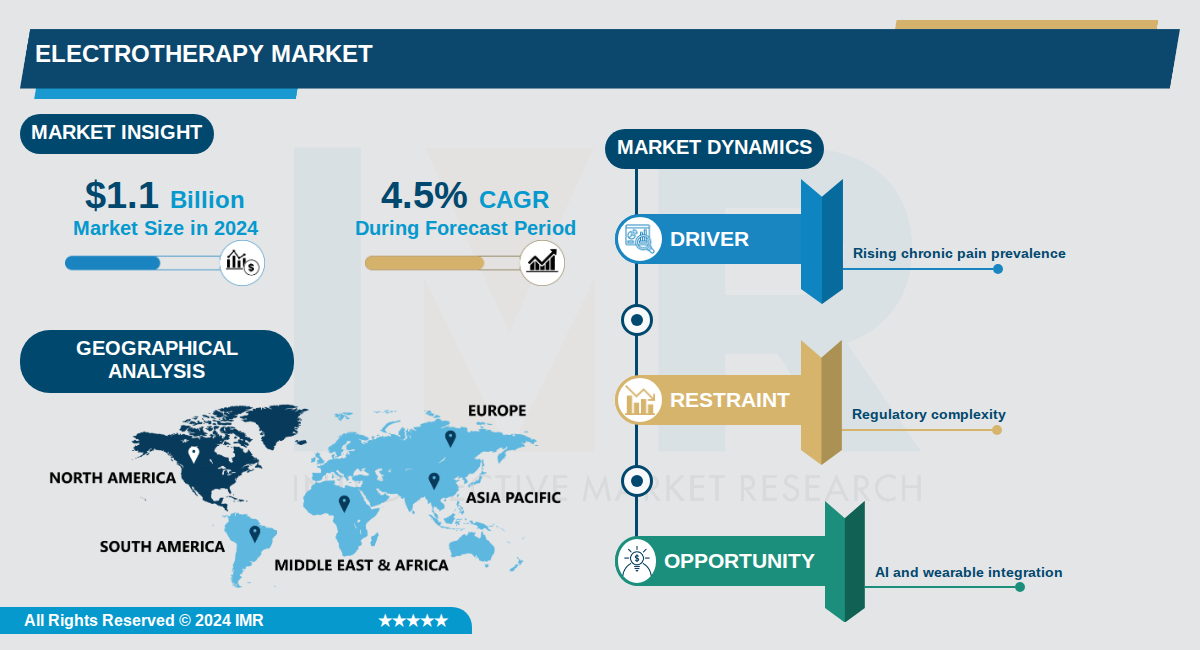
Electrotherapy Market Size Was Valued at USD 1.1 Billion in 2024, and is Projected to Reach USD 1.8 Billion by 2035, Growing at a CAGR of 4.5% From 2024-2035.
The global electrotherapy market, valued at approximately $1.1 billion in 2024, is projected to reach $1.8 billion by 2035, growing at a compound annual growth rate (CAGR) of 4.5%. Electrotherapy utilizes electrical impulses to stimulate nerves and muscles, serving as a key modality in pain management, rehabilitation, and neurological therapies across hospitals, clinics, and home settings.
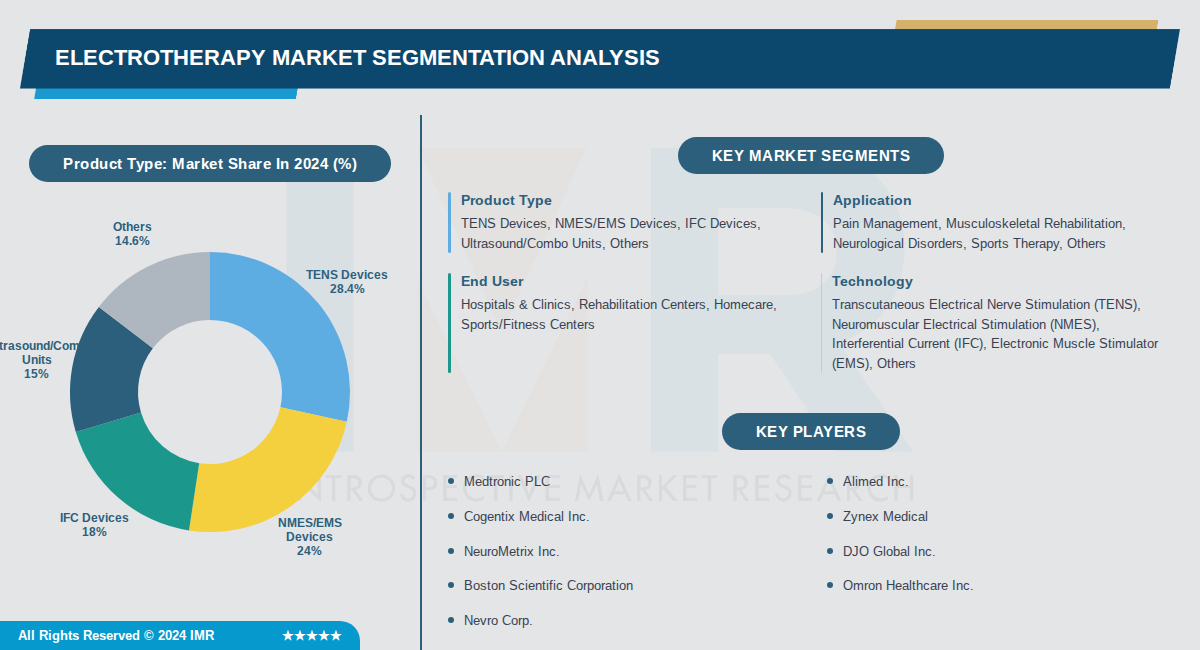
Key market segments include transcutaneous electrical nerve stimulation (TENS) therapy, which holds the largest share due to its effectiveness in pain relief and muscle rehabilitation, and electronic muscle stimulators (EMS). Pain management dominates applications with over 30% market share, followed by neuromuscular dysfunction and musculoskeletal disorders, while hospitals lead end-user adoption.
North America commands the largest regional share, driven by advanced healthcare infrastructure and high adoption in the U.S., while Asia-Pacific is poised for the fastest growth due to expanding healthcare access and rising chronic conditions. Innovations in wearable devices, AI integration, and home-use systems are reshaping the market landscape.
Electrotherapy Market Trend Analysis:
Integration of AI and Wearable Technologies
- In 2025, over 45% of new electrotherapy devices integrated AI algorithms to auto-adjust stimulation intensity based on user feedback and biometric data, improving pain relief consistency and therapeutic outcomes. Companies like Chattanooga from DJO Global and BTL Industries are developing AI-integrated solutions that automatically adapt to patient activity and condition, enhancing convenience in both clinical and homecare settings. This shift enables real-time monitoring and personalized treatment programs through IoT-enabled devices.
- Devices such as Compex Wireless TENS and Omron Pocket Pain Pro offer wearable electrotherapy controlled via mobile apps, allowing patients to adjust intensity, track sessions, and monitor progress remotely. These innovations are redefining patient expectations by providing smarter, connected solutions that boost engagement and effectiveness for non-invasive pain management. Growing consumer interest in home-based solutions further accelerates adoption across rehabilitation centers and physiotherapy clinics.
Expansion of Home-Based Electrotherapy Devices
- The demand for portable, wireless TENS and EMS devices is surging due to patient preference for drug-free pain management at home, avoiding side effects of medications and reducing clinic visits. Technological advancements have made these devices compact and user-friendly, with features like app integration for session tracking, driving their expansion into homecare settings worldwide. Rising telehealth infrastructure supports this trend by enabling remote monitoring and adjustments.
- Rehabilitation centers and physiotherapy clinics are increasingly prescribing home-use devices like those from Omron and Compex for continuous therapy in post-operative recovery and chronic pain conditions such as arthritis and neuropathy. This shift aligns with growing elderly populations and the need for long-term mobility restoration, positioning home-based electrotherapy as a key market growth area. In regions like Asia-Pacific, affordable manufacturing in countries such as China and India boosts accessibility.
Rapid Growth in Rehabilitation Center Adoption
- Rehabilitation centers are projected to witness the fastest growth in the electrotherapy market, fueled by rising focus on post-operative recovery, sports injury management, and physical therapy programs for neurological disorders like stroke and multiple sclerosis. Patients prefer personalized, long-duration sessions in these facilities, supported by portable devices that allow real-time monitoring and improved outcomes. Collaborations with hospitals and expanding investments in specialized rehab facilities accelerate this segment.
- The increasing number of physiotherapy and wellness centers globally, coupled with a surging elderly population requiring neuromuscular re-education, drives adoption of advanced electrotherapy like Magnetic Field Therapy, which grows at a CAGR of 9.15%. In Europe, particularly Germany, strong medical infrastructure and emphasis on evidence-based therapies enhance integration in rehab settings. Portable and connected devices further optimize treatment customization and patient convenience.
Electrotherapy Market Segment Analysis:
Electrotherapy Market is Segmented on the basis of By Product Type, By Application, By End User
By Product Type, TENS Devices segment is expected to dominate the market during the forecast period
- TENS devices lead due to their widespread use in chronic pain management, addressing the rising prevalence of conditions like arthritis and back pain.
- Portable and cost-effective TENS units enable broad adoption in both clinical and homecare settings, supported by over-the-counter availability and telehealth integration.
By Application, Pain Management segment is expected to dominate the market during the forecast period
- Pain management dominates from increasing chronic pain cases including arthritis, back pain, and sports injuries, driving demand for non-invasive therapies.
- High patient volumes and preference for drug-free alternatives position pain management as the primary application across hospitals and homecare.
By End User, Hospitals & Clinics segment is expected to dominate the market during the forecast period
- Hospitals and clinics lead due to advanced infrastructure, high patient inflow, and investment in comprehensive electrotherapy solutions for pain and rehab.
- Integration of AI-enabled devices and strong reimbursement systems in hospitals accelerate adoption for post-surgical and chronic condition treatments.
By Technology, Transcutaneous Electrical Nerve Stimulation (TENS) segment is expected to dominate the market during the forecast period
- TENS technology dominates with its proven efficacy in pain relief, portability, and integration into AI-adjusted wearable devices.
- Over 45% of new devices feature TENS with auto-adjusting algorithms, enhancing consistency and user compliance in diverse settings.
Electrotherapy Market Regional Insights:
North America is Expected to Dominate the Market Over the Forecast Period
- North America dominates the electrotherapy market, holding the largest revenue share of around 42.53% in 2025 and approximately 35% globally. The U.S., Canada, and Mexico are key contributors due to advanced healthcare systems and high prevalence of chronic pain and sports injuries. This leadership stems from early adoption of innovative therapeutic devices and extensive R&D investments.
- The region benefits from well-established healthcare infrastructure, strong regulatory frameworks, and high healthcare spending. Reimbursement frameworks support nonpharmacological pain solutions, accelerating uptake in acute and chronic care. Increasing demand for wearable and home-based electrotherapy solutions further fuels growth amid rising chronic diseases.
- Major players like Medtronic are active, with significant R&D expansions supporting device efficacy and user comfort. Extensive investments by companies enhance market position, while collaborations with digital health platforms optimize remote monitoring. Recent developments include tailored strategies for high-demand U.S. states like California and Texas.
Active Key Players in the Electrotherapy Market:
- Medtronic PLC (Ireland)
- Alimed Inc. (USA)
- Cogentix Medical Inc. (USA)
- Zynex Medical (USA)
- NeuroMetrix Inc. (USA)
- DJO Global Inc. (USA)
- Boston Scientific Corporation (USA)
- Omron Healthcare Inc. (Japan)
- Nevro Corp. (USA)
- BTL Industries (Czech Republic)
- Enraf-Nonius BV (Netherlands)
- EMS Physio Ltd. (UK)
- Abbott Laboratories (USA)
- St. Jude Medical Inc. (USA)
- Cyberonics Inc. (USA)
- BioMedical Life Systems Inc. (USA)
- Chattanooga Group (USA)
- Ito Co. Ltd. (Japan)
- Beurer GmbH (Germany)
- Eme srl (Italy)
- Other Active Players
|
Electrotherapy Market |
|||
|
Base Year: |
2024 |
Forecast Period: |
2024-2035 |
|
Historical Data: |
2017 to 2024 |
Market Size in 2024: |
USD 1.1 Billion |
|
Forecast Period 2024-2035 CAGR: |
4.5 % |
Market Size in 2035: |
USD 1.8 Billion |
|
Segments Covered: |
By Product Type |
|
|
|
By Application |
|
||
|
By End User |
|
||
|
By Technology |
|
||
|
By Region |
|
||
|
Key Market Drivers: |
|
||
|
Key Market Restraints: |
|
||
|
Key Opportunities: |
|
||
|
Companies Covered in the report: |
|
||
Chapter 1: Introduction
1.1 Scope and Coverage
Chapter 2: Executive Summary
Chapter 3: Market Landscape
3.1 Market Dynamics and Opportunity Analysis
3.1.1 Growth Drivers
3.1.2 Limiting Factors
3.1.3 Growth Opportunities
3.1.4 Challenges and Risks
3.2 Market Trend Analysis
3.3 Industry Ecosystem
3.4 Industry Value Chain Mapping
3.5 Strategic PESTLE Overview
3.6 Porter's Five Forces Framework
3.7 Regulatory Framework
3.8 Pricing Trend Analysis
3.9 Intellectual Property Review
3.10 Technology Evolution
3.11 Import-Export Analysis
3.12 Consumer Behavior Analysis
3.13 Investment Pocket Analysis
3.14 Go-To Market Strategy
Chapter 4: Electrotherapy Market by Product Type (2017-2035)
4.1 Electrotherapy Market Snapshot and Growth Engine
4.2 Market Overview
4.3 TENS Devices
4.3.1 Introduction and Market Overview
4.3.2 Historic and Forecasted Market Size in Value USD and Volume Units
4.3.3 Key Market Trends, Growth Factors, and Opportunities
4.3.4 Geographic Segmentation Analysis
4.4 NMES/EMS Devices
4.5 IFC Devices
4.6 Ultrasound/Combo Units
4.7 Others
Chapter 5: Electrotherapy Market by Application (2017-2035)
5.1 Electrotherapy Market Snapshot and Growth Engine
5.2 Market Overview
5.3 Pain Management
5.3.1 Introduction and Market Overview
5.3.2 Historic and Forecasted Market Size in Value USD and Volume Units
5.3.3 Key Market Trends, Growth Factors, and Opportunities
5.3.4 Geographic Segmentation Analysis
5.4 Musculoskeletal Rehabilitation
5.5 Neurological Disorders
5.6 Sports Therapy
5.7 Others
Chapter 6: Electrotherapy Market by End User (2017-2035)
6.1 Electrotherapy Market Snapshot and Growth Engine
6.2 Market Overview
6.3 Hospitals & Clinics
6.3.1 Introduction and Market Overview
6.3.2 Historic and Forecasted Market Size in Value USD and Volume Units
6.3.3 Key Market Trends, Growth Factors, and Opportunities
6.3.4 Geographic Segmentation Analysis
6.4 Rehabilitation Centers
6.5 Homecare
6.6 Sports/Fitness Centers
Chapter 7: Electrotherapy Market by Technology (2017-2035)
7.1 Electrotherapy Market Snapshot and Growth Engine
7.2 Market Overview
7.3 Transcutaneous Electrical Nerve Stimulation (TENS)
7.3.1 Introduction and Market Overview
7.3.2 Historic and Forecasted Market Size in Value USD and Volume Units
7.3.3 Key Market Trends, Growth Factors, and Opportunities
7.3.4 Geographic Segmentation Analysis
7.4 Neuromuscular Electrical Stimulation (NMES)
7.5 Interferential Current (IFC)
7.6 Electronic Muscle Stimulator (EMS)
7.7 Others
Chapter 8: Company Profiles and Competitive Analysis
8.1 Competitive Landscape
8.1.1 Competitive Benchmarking
8.1.2 Electrotherapy Market Share by Manufacturer/Service Provider (2024)
8.1.3 Industry BCG Matrix
8.1.4 Partnerships, Mergers & Acquisitions
8.2 MEDTRONIC PLC
8.2.1 Company Overview
8.2.2 Key Executives
8.2.3 Company Snapshot
8.2.4 Role of the Company in the Market
8.2.5 Sustainability and Social Responsibility
8.2.6 Operating Business Segments
8.2.7 Product Portfolio
8.2.8 Business Performance
8.2.9 Recent News & Developments
8.2.10 SWOT Analysis
8.3 ALIMED INC.
8.4 COGENTIX MEDICAL INC.
8.5 ZYNEX MEDICAL
8.6 NEUROMETRIX INC.
8.7 DJO GLOBAL INC.
8.8 BOSTON SCIENTIFIC CORPORATION
8.9 OMRON HEALTHCARE INC.
8.10 NEVRO CORP.
8.11 BTL INDUSTRIES
8.12 ENRAF-NONIUS BV
8.13 EMS PHYSIO LTD.
8.14 ABBOTT LABORATORIES
8.15 ST. JUDE MEDICAL INC.
8.16 CYBERONICS INC.
8.17 BIOMEDICAL LIFE SYSTEMS INC.
8.18 CHATTANOOGA GROUP
8.19 ITO CO. LTD.
8.20 BEURER GMBH
8.21 EME SRL
Chapter 9: Global Electrotherapy Market By Region
9.1 Overview
9.2. North America Electrotherapy Market
9.2.1 Key Market Trends, Growth Factors and Opportunities
9.2.2 Top Key Companies
9.2.3 Historic and Forecasted Market Size by Segments
9.2.4 Historic and Forecast Market Size by Country
9.3. Eastern Europe Electrotherapy Market
9.3.1 Key Market Trends, Growth Factors and Opportunities
9.3.2 Top Key Companies
9.3.3 Historic and Forecasted Market Size by Segments
9.3.4 Historic and Forecast Market Size by Country
9.4. Western Europe Electrotherapy Market
9.4.1 Key Market Trends, Growth Factors and Opportunities
9.4.2 Top Key Companies
9.4.3 Historic and Forecasted Market Size by Segments
9.4.4 Historic and Forecast Market Size by Country
9.5. Asia Pacific Electrotherapy Market
9.5.1 Key Market Trends, Growth Factors and Opportunities
9.5.2 Top Key Companies
9.5.3 Historic and Forecasted Market Size by Segments
9.5.4 Historic and Forecast Market Size by Country
9.6. Middle East & Africa Electrotherapy Market
9.6.1 Key Market Trends, Growth Factors and Opportunities
9.6.2 Top Key Companies
9.6.3 Historic and Forecasted Market Size by Segments
9.6.4 Historic and Forecast Market Size by Country
9.7. South America Electrotherapy Market
9.7.1 Key Market Trends, Growth Factors and Opportunities
9.7.2 Top Key Companies
9.7.3 Historic and Forecasted Market Size by Segments
9.7.4 Historic and Forecast Market Size by Country
Chapter 10: Analyst Viewpoint and Conclusion
Chapter 11: Research Methodology
11.1 Research Process
11.2 Primary Research
11.3 Secondary Research
Chapter 12: Case Study
Chapter 13: Appendix
13.1 Sources
13.2 List of Tables and Figures
13.3 Short Forms and Citations
13.4 Assumption and Conversion
13.5 Disclaimer
|
Electrotherapy Market |
|||
|
Base Year: |
2024 |
Forecast Period: |
2024-2035 |
|
Historical Data: |
2017 to 2024 |
Market Size in 2024: |
USD 1.1 Billion |
|
Forecast Period 2024-2035 CAGR: |
4.5 % |
Market Size in 2035: |
USD 1.8 Billion |
|
Segments Covered: |
By Product Type |
|
|
|
By Application |
|
||
|
By End User |
|
||
|
By Technology |
|
||
|
By Region |
|
||
|
Key Market Drivers: |
|
||
|
Key Market Restraints: |
|
||
|
Key Opportunities: |
|
||
|
Companies Covered in the report: |
|
||


