




Digital Cell Morphology System Market Synopsis:
Digital Cell Morphology System Market Size Was Valued at USD 2.0 Billion in 2024, and is Projected to Reach USD 3.0 Billion by 2035, Growing at a CAGR of 4.0% From 2024-2035.
The Digital Cell Morphology System market, valued at $2.0 billion in 2024, is projected to reach $3.0 billion by 2035, reflecting a compound annual growth rate (CAGR) of 4.0%. These systems utilize digital image analysis, algorithms, and machine learning to automate cell categorization based on morphology, offering superior accuracy, speed, and reproducibility compared to manual methods.
Primary applications span clinical laboratories, research institutions, and pharmaceutical companies in hematology, cytology, and histology. North America dominates the market due to advanced healthcare infrastructure, while Asia-Pacific is poised for the fastest growth driven by expanding healthcare investments and rising disease prevalence.
Key trends include AI integration for automated cell classification, high-speed image processing, machine learning for predictive diagnostics, cloud-based solutions for remote access, and multi-modal imaging platforms, enhancing diagnostic precision and laboratory efficiency.
.png)
Digital Cell Morphology System Market Trend Analysis:
Integration of AI-Driven Cell Classification
- Leading companies like F. Hoffmann-La Roche AG and Thermo Fisher Scientific Inc. are developing AI-powered image analyzers that automatically categorize cells from digital images, reducing diagnostic time from hours to minutes. These systems use machine learning algorithms to identify subtle morphological changes in blood cells, achieving over 95% accuracy in hematology diagnostics compared to manual methods. This trend addresses global shortages of skilled lab technologists by enabling consistent results across high-volume labs.
- AI integration supports predictive diagnostics, such as early detection of hematological disorders like leukemia, by analyzing patterns in cell morphology data. For instance, Roche's systems incorporate real-time monitoring features that track patient progress during treatment. Market growth from $2.1 billion in 2025 to $3.49 billion by 2030 is partly driven by these AI advancements, with adoption surging in North American labs.
- The trend extends to creating morphology-based biomarkers, allowing for personalized medicine panels that integrate with electronic health records. Thermo Fisher's AI tools have been deployed in over 500 research institutes, improving oncology screening efficiency by 40%.
Adoption of Automated Cell Imaging Systems
- Automated cell imaging systems are replacing manual microscopy, with high-speed image processing algorithms capturing thousands of cells per second for precise morphology analysis. Companies like Beckman Coulter are leading with platforms that standardize results across labs, reducing variability by up to 30%. This shift boosts laboratory efficiency, handling the rising caseload from hematological disorders affecting 1 in 5 patients globally.
- These systems integrate with flow cytometry and hematology analyzers, enabling comprehensive diagnostics in under 10 minutes. In 2025, North America, holding 40% market share, saw widespread adoption in hospitals like Mayo Clinic, driving the market's 11% CAGR. Expansion into Asia-Pacific, especially China and India, is accelerating due to healthcare infrastructure investments exceeding $100 billion annually.
Rise of Remote Diagnostics and Telepathology
- Remote diagnostics platforms allow pathologists to analyze cell morphology images via cloud-based systems, supporting telemedicine in underserved areas. Solutions from Siemens Healthineers enable real-time sharing of high-resolution scans, cutting turnaround times by 50% for rural clinics. This trend is fueled by growing demand for digital pathology, with projections showing Asia-Pacific's market growing at 9.2% CAGR through 2032.
- Integration with laboratory information systems (LIS) facilitates seamless data flow, as seen in Sysmex Corporation's telepathology tools used in 200 European labs. The aging population and rising chronic diseases, impacting 1.5 billion people by 2030, amplify the need for these scalable solutions. Consumables for remote systems are expanding the market by 15% annually.
Digital Cell Morphology System Market Segment Analysis:
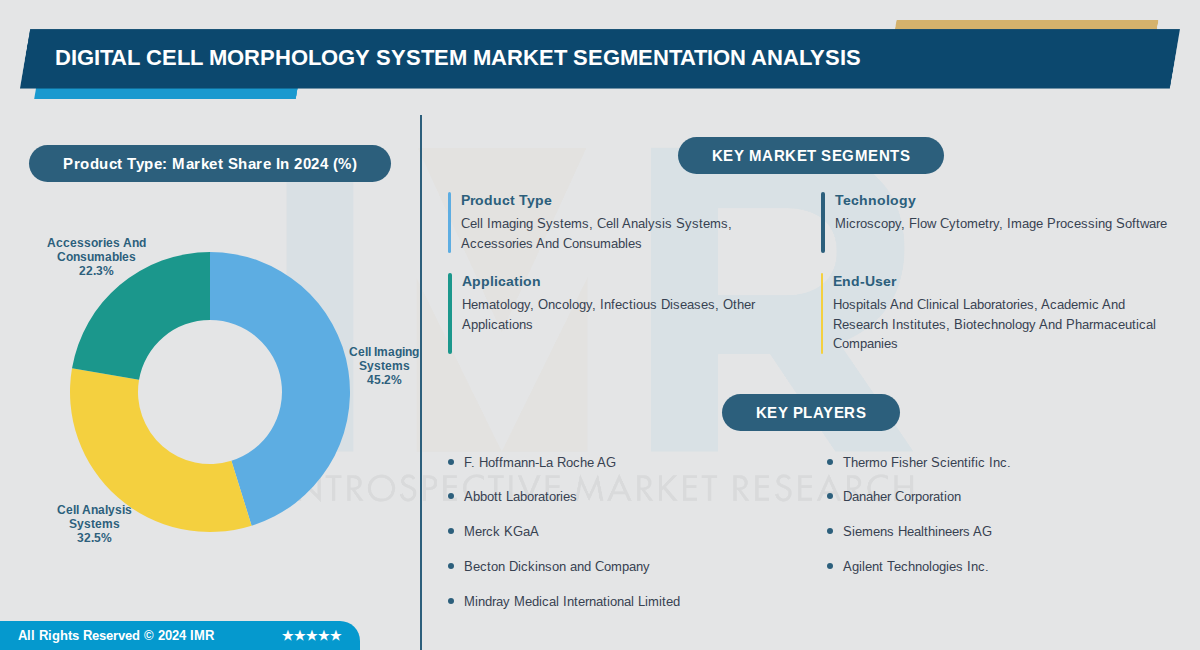
Digital Cell Morphology System Market is Segmented on the basis of By Product Type, By Technology, By Application
By Product Type, Cell Imaging Systems segment is expected to dominate the market during the forecast period
- Cell Imaging Systems dominate due to continuous innovations like high-resolution digital microscopes and automated slide scanners that enhance imaging capabilities and reduce manual intervention in laboratories.
- Rising demand for advanced diagnostic tools in hematology and pathology drives over 70% adoption of imaging systems in high-volume clinical labs for precise cell visualization.
By Technology, Microscopy segment is expected to dominate the market during the forecast period
- Microscopy leads as the foundational technology for detailed cell morphology examination, integrated with AI for automated analysis in routine hematology workflows.
- Over 60% of digital morphology systems in hospitals utilize microscopy due to its high accuracy in identifying abnormal cells in blood smears amid rising hematological disorders.
By Application, Hematology segment is expected to dominate the market during the forecast period
- Hematology dominates driven by escalating prevalence of blood disorders and need for standardized peripheral blood smear analysis in clinical diagnostics.
- More than 75% of systems are deployed in hematology labs due to integration with analyzers for early detection of leukemia and anemias.
By End-User, Hospitals And Clinical Laboratories segment is expected to dominate the market during the forecast period
- Hospitals and clinical labs lead due to high-volume testing needs, laboratory automation demands, and regulatory requirements for efficient workflows.
- These end-users account for nearly 80% of installations, fueled by geriatric population growth and chronic disease diagnostics.
Digital Cell Morphology System Market Regional Insights:
North America is Expected to Dominate the Market Over the Forecast Period
- North America dominates the Digital Cell Morphology System Market due to its advanced healthcare infrastructure and high adoption rates of cutting-edge technologies. The United States leads as the primary contributor, supported by Canada and Mexico, where extensive healthcare networks drive widespread implementation. This region's market leadership is evident from 2024 through 2025 data, positioning it ahead of other global areas.
- Robust research funding, established regulatory frameworks, and strong technological adoption propel North America's dominance. The presence of well-developed healthcare systems facilitates seamless integration of digital cell analysis tools across hospitals and labs. These factors create a mature market environment that supports innovation and rapid deployment of new systems.
- Major players concentrate in North America, leveraging the region's resources for product development and clinical trials. Recent developments include expanded implementations in U.S. healthcare networks and significant investments in digital pathology advancements. Key companies benefit from the area's high chronic disease prevalence, fueling demand for precise diagnostic solutions.
Active Key Players in the Digital Cell Morphology System Market:
- F. Hoffmann-La Roche AG (Switzerland)
- Thermo Fisher Scientific Inc. (USA)
- Abbott Laboratories (USA)
- Danaher Corporation (USA)
- Merck KGaA (Germany)
- Siemens Healthineers AG (Germany)
- Becton Dickinson and Company (USA)
- Agilent Technologies Inc. (USA)
- Mindray Medical International Limited (China)
- Nikon Corporation (Japan)
- Sysmex Corporation (Japan)
- Bio-Rad Laboratories Inc. (USA)
- Horiba ABX SAS (France)
- Leica Microsystems GmbH (Germany)
- Medica Corporation (USA)
- Beckman Coulter (USA)
- CellaVision AB (Sweden)
- IDEXX Laboratories Inc. (USA)
- Scopio Labs Ltd. (Israel)
- Sight Diagnostics (Israel)
- Other Active Players
|
Digital Cell Morphology System Market |
|||
|
Base Year: |
2024 |
Forecast Period: |
2024-2035 |
|
Historical Data: |
2017 to 2024 |
Market Size in 2024: |
USD 2.0 Billion |
|
Forecast Period 2024-2035 CAGR: |
4.0 % |
Market Size in 2035: |
USD 3.0 Billion |
|
Segments Covered: |
By Product Type |
|
|
|
By Technology |
|
||
|
By Application |
|
||
|
By End-User |
|
||
|
By Region |
|
||
|
Key Market Drivers: |
|
||
|
Key Market Restraints: |
|
||
|
Key Opportunities: |
|
||
|
Companies Covered in the report: |
|
||
Chapter 1: Introduction
1.1 Scope and Coverage
Chapter 2: Executive Summary
Chapter 3: Market Landscape
3.1 Market Dynamics and Opportunity Analysis
3.1.1 Growth Drivers
3.1.2 Limiting Factors
3.1.3 Growth Opportunities
3.1.4 Challenges and Risks
3.2 Market Trend Analysis
3.3 Industry Ecosystem
3.4 Industry Value Chain Mapping
3.5 Strategic PESTLE Overview
3.6 Porter's Five Forces Framework
3.7 Regulatory Framework
3.8 Pricing Trend Analysis
3.9 Intellectual Property Review
3.10 Technology Evolution
3.11 Import-Export Analysis
3.12 Consumer Behavior Analysis
3.13 Investment Pocket Analysis
3.14 Go-To Market Strategy
Chapter 4: Digital Cell Morphology System Market by Product Type (2017-2035)
4.1 Digital Cell Morphology System Market Snapshot and Growth Engine
4.2 Market Overview
4.3 Cell Imaging Systems
4.3.1 Introduction and Market Overview
4.3.2 Historic and Forecasted Market Size in Value USD and Volume Units
4.3.3 Key Market Trends, Growth Factors, and Opportunities
4.3.4 Geographic Segmentation Analysis
4.4 Cell Analysis Systems
4.5 Accessories And Consumables
Chapter 5: Digital Cell Morphology System Market by Technology (2017-2035)
5.1 Digital Cell Morphology System Market Snapshot and Growth Engine
5.2 Market Overview
5.3 Microscopy
5.3.1 Introduction and Market Overview
5.3.2 Historic and Forecasted Market Size in Value USD and Volume Units
5.3.3 Key Market Trends, Growth Factors, and Opportunities
5.3.4 Geographic Segmentation Analysis
5.4 Flow Cytometry
5.5 Image Processing Software
Chapter 6: Digital Cell Morphology System Market by Application (2017-2035)
6.1 Digital Cell Morphology System Market Snapshot and Growth Engine
6.2 Market Overview
6.3 Hematology
6.3.1 Introduction and Market Overview
6.3.2 Historic and Forecasted Market Size in Value USD and Volume Units
6.3.3 Key Market Trends, Growth Factors, and Opportunities
6.3.4 Geographic Segmentation Analysis
6.4 Oncology
6.5 Infectious Diseases
6.6 Other Applications
Chapter 7: Digital Cell Morphology System Market by End-User (2017-2035)
7.1 Digital Cell Morphology System Market Snapshot and Growth Engine
7.2 Market Overview
7.3 Hospitals And Clinical Laboratories
7.3.1 Introduction and Market Overview
7.3.2 Historic and Forecasted Market Size in Value USD and Volume Units
7.3.3 Key Market Trends, Growth Factors, and Opportunities
7.3.4 Geographic Segmentation Analysis
7.4 Academic And Research Institutes
7.5 Biotechnology And Pharmaceutical Companies
Chapter 8: Company Profiles and Competitive Analysis
8.1 Competitive Landscape
8.1.1 Competitive Benchmarking
8.1.2 Digital Cell Morphology System Market Share by Manufacturer/Service Provider (2024)
8.1.3 Industry BCG Matrix
8.1.4 Partnerships, Mergers & Acquisitions
8.2 F. HOFFMANN-LA ROCHE AG
8.2.1 Company Overview
8.2.2 Key Executives
8.2.3 Company Snapshot
8.2.4 Role of the Company in the Market
8.2.5 Sustainability and Social Responsibility
8.2.6 Operating Business Segments
8.2.7 Product Portfolio
8.2.8 Business Performance
8.2.9 Recent News & Developments
8.2.10 SWOT Analysis
8.3 THERMO FISHER SCIENTIFIC INC.
8.4 ABBOTT LABORATORIES
8.5 DANAHER CORPORATION
8.6 MERCK KGAA
8.7 SIEMENS HEALTHINEERS AG
8.8 BECTON DICKINSON AND COMPANY
8.9 AGILENT TECHNOLOGIES INC.
8.10 MINDRAY MEDICAL INTERNATIONAL LIMITED
8.11 NIKON CORPORATION
8.12 SYSMEX CORPORATION
8.13 BIO-RAD LABORATORIES INC.
8.14 HORIBA ABX SAS
8.15 LEICA MICROSYSTEMS GMBH
8.16 MEDICA CORPORATION
8.17 BECKMAN COULTER
8.18 CELLAVISION AB
8.19 IDEXX LABORATORIES INC.
8.20 SCOPIO LABS LTD.
8.21 SIGHT DIAGNOSTICS
Chapter 9: Global Digital Cell Morphology System Market By Region
9.1 Overview
9.2. North America Digital Cell Morphology System Market
9.2.1 Key Market Trends, Growth Factors and Opportunities
9.2.2 Top Key Companies
9.2.3 Historic and Forecasted Market Size by Segments
9.2.4 Historic and Forecast Market Size by Country
9.3. Eastern Europe Digital Cell Morphology System Market
9.3.1 Key Market Trends, Growth Factors and Opportunities
9.3.2 Top Key Companies
9.3.3 Historic and Forecasted Market Size by Segments
9.3.4 Historic and Forecast Market Size by Country
9.4. Western Europe Digital Cell Morphology System Market
9.4.1 Key Market Trends, Growth Factors and Opportunities
9.4.2 Top Key Companies
9.4.3 Historic and Forecasted Market Size by Segments
9.4.4 Historic and Forecast Market Size by Country
9.5. Asia Pacific Digital Cell Morphology System Market
9.5.1 Key Market Trends, Growth Factors and Opportunities
9.5.2 Top Key Companies
9.5.3 Historic and Forecasted Market Size by Segments
9.5.4 Historic and Forecast Market Size by Country
9.6. Middle East & Africa Digital Cell Morphology System Market
9.6.1 Key Market Trends, Growth Factors and Opportunities
9.6.2 Top Key Companies
9.6.3 Historic and Forecasted Market Size by Segments
9.6.4 Historic and Forecast Market Size by Country
9.7. South America Digital Cell Morphology System Market
9.7.1 Key Market Trends, Growth Factors and Opportunities
9.7.2 Top Key Companies
9.7.3 Historic and Forecasted Market Size by Segments
9.7.4 Historic and Forecast Market Size by Country
Chapter 10: Analyst Viewpoint and Conclusion
Chapter 11: Research Methodology
11.1 Research Process
11.2 Primary Research
11.3 Secondary Research
Chapter 12: Case Study
Chapter 13: Appendix
13.1 Sources
13.2 List of Tables and Figures
13.3 Short Forms and Citations
13.4 Assumption and Conversion
13.5 Disclaimer
|
Digital Cell Morphology System Market |
|||
|
Base Year: |
2024 |
Forecast Period: |
2024-2035 |
|
Historical Data: |
2017 to 2024 |
Market Size in 2024: |
USD 2.0 Billion |
|
Forecast Period 2024-2035 CAGR: |
4.0 % |
Market Size in 2035: |
USD 3.0 Billion |
|
Segments Covered: |
By Product Type |
|
|
|
By Technology |
|
||
|
By Application |
|
||
|
By End-User |
|
||
|
By Region |
|
||
|
Key Market Drivers: |
|
||
|
Key Market Restraints: |
|
||
|
Key Opportunities: |
|
||
|
Companies Covered in the report: |
|
||


