Dengue Testing Market Synopsis
Dengue Testing Market Size Was Valued at USD 0.63 Billion in 2023, and is Projected to Reach USD 1.08 Billion by 2032, Growing at a CAGR of 6.20% From 2024-2032.
The dengue testing market was defined as the market comprising of activities and products pertaining to the identification of dengue virus in human beings through diagnostic tests. These tests are intended to detect the dengue virus antigen or the host’s antibodies to the virus. Some of the diagnostic techniques are serologic tests, molecular, particular, and Polymerase chain reaction (PCR), Rapid Diagnostic Tests (RDTs) being among the quick diagnostics. The market includes the selling of these testing kits, the provision in hospitals, clinic and laboratories, and the development of enhanced techniques in testing the disease.
The dengue testing market has also emerged as one of the most rapidly developing markets in recent time because of the growing prevalence of dengue fever across the tropical and subtropical climate zones. Dengue fever is an acute infectious disease produced by the dengue virus and transmitted through the Aedes mosquitoes, and the WHO approximates that 3.5 billion people are currently at a high risk for it. The number of dengue incidents has grown quickly, and community demands have emerged for comprehensive and immediate diagnostic methods to identify the virus early so that the illness could be corrected as quickly as possible. Thus, danger for finding new testing methods like molecular diagnostic tests and point-of-care testing devices has risen, so the companies had to create more complex and easy-to-use testing kits.
The market also benefits with the increasing rate of spread of the disease as well as the development of health care facilities especially in dengue tropical region such as SE Asia, Latin America, and Africa. The governments and the health care system are spending more on diagnostic tools to ensure that the disease is not transmitted to many people and eradicate any possible outbreaks. Furthermore, the COVID-19 has highlighted the significance of diagnostics particularly the testing that has boost Research and Development of the infectious diseases testing. Such a factor makes advanced dengue testing solutions a rapidly growing segment in a global healthcare market as all the above factors affect increase the popularity of the disease.
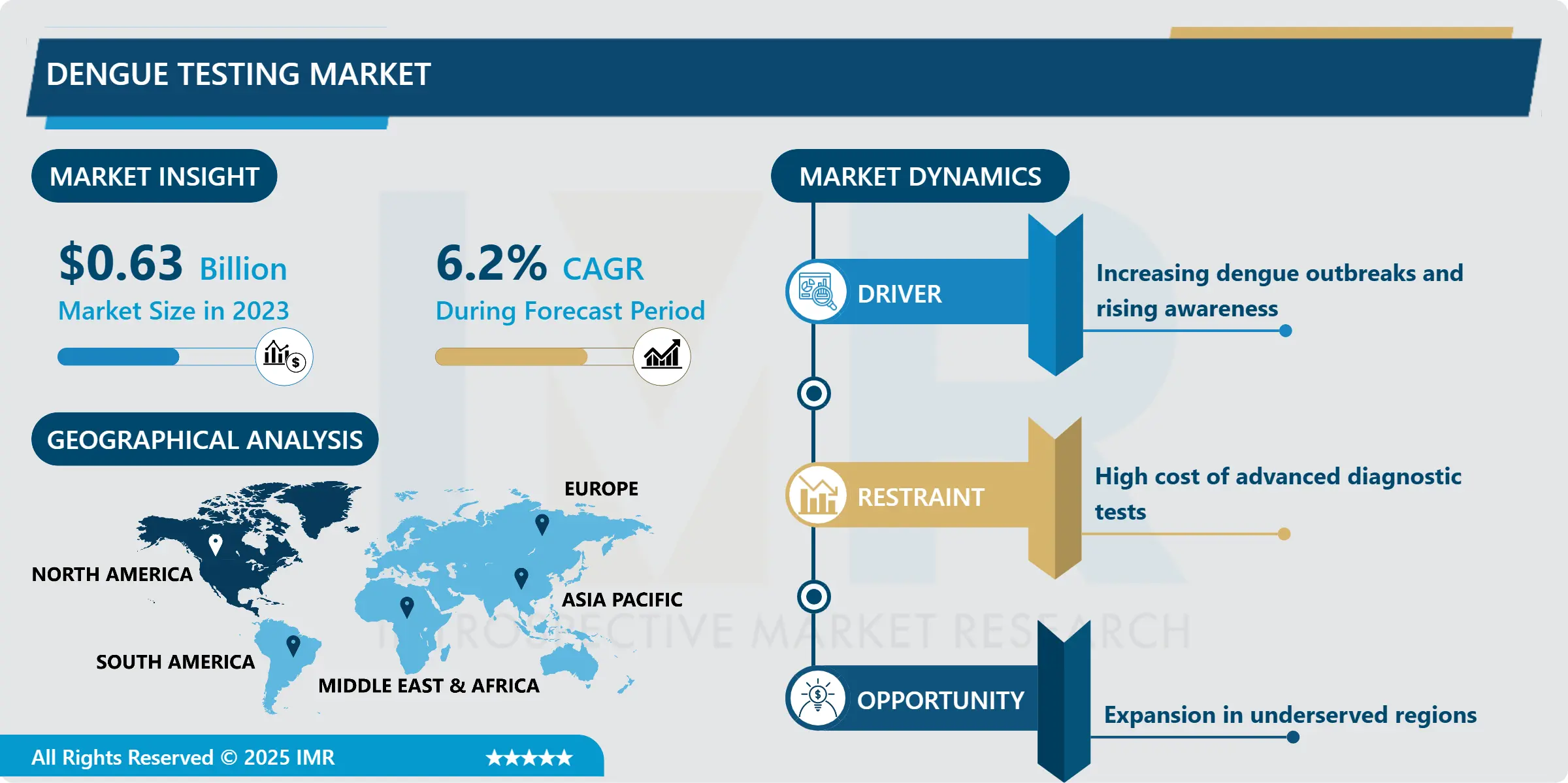
Dengue Testing Market Trend Analysis:
Advancements in Rapid Diagnostic Testing for Dengue
-
The emerging trend able to be identified in the dengue testing market is the shift towards RDTs, the demand for which is high and continuously rising due to their affordances. These tests involve a small amount of blood sample and provide results within 30 minutes which is of paramount important during epidemics because early detection is effective in stopping spread of dengue. The simplicity and efficiency of RDTs are important contributors to the general utility of the diagnostic in the context of many different heath care settings, especially in regions with restricted access to advanced laboratory services. In addition, RDTs are economical, easy to operate, needs less skilled personnel for administration, which makes it more appropriate for regions with poor health facility i.e. limited health facilities.
- Thus, increasing its usage, especially in low-resource settings, manufacturers are working on making RDTs more accurate as indicated by the sensitivity and specificity. Exploding mobile health technologies which can be diagnosed or connected to smartphones for result tracking and analysis also support this trend. The innovations in the mobile diagnostics are increasing the operationality of the dengue testing especially in the developing regions. This change to rapid and mobile diagnostic is poised to drastically alter how dengue is diagnosed setting the stage for better control and management of the disease thereby reducing its impact across the world.
Expansion in Emerging Markets
-
The dengue testing market is poised for strong growth in the growing markets, especially, in the areas of Asia-Pacific, Latin America, and Africa, where infected dengue cases are on the rise. These include increase in outbreaks due to; urbanization, climatic change and increasing population of the mosquitoes that transmit the disease. These regions struggle with timely and accurate diagnostics because of the general lack of healthcare infrastructure, which is the reason behind the large unmet need for better dengue testing services. To this end, all levels of government and private healthcare providers are increasing their spending in health care facility and diagnostic equipment that is necessary to reduce the incidence of dengue.
- Moreover, the prospect of expansion is boosted thanks to increased efficiency in the choice of testing approaches in underdeveloped rural regions supported by local health care legislation. This is equally true because telemedicine and mobile health applications can as well be used to extend diagnostic solutions to such regions at an affordable and easier method. These increasing healthcare investments along with continuous technological developments establish appropriate circumstances for early entrants and leaders within the field to provide innovative testing solutions to fulfil the rising demand in these relatively unexplored markets. This trend will help organizations to grow their market and improve their position in the constantly changing dengue testing market.
Dengue Testing Market Segment Analysis:
Dengue Testing Market Segmented on the basis of test type, end user and region.
By Test Type, ELISA-Based Tests segment is expected to dominate the market during the forecast period
-
The dengue testing market is divided by the type of test: ELISA-based tests are used for the dengue testing most often as they provide a high sensitivity and specificity. The ELISA (Enzyme-Linked Immunosorbent Assay) develop antibodies or antigens in the blood making them quick and efficient in diagnosing dengue in clinical laboratories. These tests are embraced in hospitals and diagnostic laboratories due to efficiency in delivering accurate results in large scale screening. However, they often times involve skilled personnel and laboratory setting which posse a problem in implementation in resource poor environments.
- Rapid diagnostic tests are being used frequently because they give results in a short time of between 15 and 30 minutes. Such tests are especially useful during the epidemic or in the districts where the access to the sophisticated laboratory equipment is impossible. Structural and molecular tests which include RT-PCR form the common positive method in diagnosing the dengue virus as they detect the viral RNA accurately. These tests are useful in the initial stages of the infection but are generally costly, and technological advanced. Other methods are used rarely in the routine diagnostics, they are hemagglutination inhibition and plaque reduction neutralization. Both proctored and exemption testing serve an important purpose, each of which is needed for a variety of reasons in today’s growing diagnostic market due to technological developments.
By end user, hospitals segment expected to held the largest share
-
The dengue testing market has been divided by the end-user segment; among them, the hospitals segment occupies the prime position amongst the users of diagnostic equipment. These tests are important for hospitals to ensure they diagnose patients with dengue like symptoms, especially during a surge in outbreak because of the high turn up. The situations and presence of laboratory facilities in the hospitals can help to use the ELISA and RT-PCR, precise methods. Hospitals are also important in-patient management and therefore timely diagnosis is compulsory to avoid things like dengue haemorrhagic fever or shock syndrome.
- Diagnostic laboratories can also be included here, these are primarily those which provide testing services for dengue fever. Such centres process a high number of samples, and sometimes serve both hospitals and clinics, which do not possess their laboratories. Another group important to the market is composed of academic and research institutions that concentrate on improving diagnostic technologies and analysing disease patterns. Other end-users include clinics and point-of-care testing who offer convenient and fast testing solutions where there is poor access or inadequate infrastructure. The increased demand for point-of-care devices is a result of the development of portable, accurate and fast solutions for diagnostics – particularly in the least developed countries.
Dengue Testing Market Regional Insights:
North America is Expected to Dominate the Market Over the Forecast period
-
The Asia-Pacific (APAC) region is dominating the dengue testing market, owning the largest market share, mainly due to the rising incidence of dengue in emerging countries such as India, Thailand, Indonesia and the Philippines. As located in Asiatic countries, the region contributes more than 70 % of the global dengue cases, and therefore, it becomes the epicentre for dengue infections where demand for diagnostic tools is most urgently needed. Ideally, the constant occurrence of the dengue virus, the increasing population of mosquitoes, and constantly shifting climate have created increased demand for accurate and affordable dengue diagnostics. Consequently, the APAC region remains the largest market for both with laboratory-based diagnostics, tests as well as RDTs critical for effective containment of disease outbreaks.
- The fact that APAC public health authorities have lately shifted to enhance the testing facilities and health care system has also supplemented the dengue diagnostic market. As governments continue to chip in to ensure that health sector improves and diagnostic facilities are made more available, there is a further attempt to make tests cheaper. This is especially common in the rural and remote areas where access to health /care facilities is a luxury. The increasing use of the rapid testing methods such as mobile health solution is expected to increase the market growth of the region thereby strengthening the market position of APAC in the global dengue testing market.
Active Key Players in the Dengue Testing Market:
-
Abbott Laboratories (USA)
- BD (Becton, Dickinson and Company) (USA)
- Bio-Rad Laboratories (USA)
- Cepheid (USA)
- Corgenix Medical (USA)
- Dengue Diagnostics (India)
- Everlywell (USA)
- Hologic Inc. (USA)
- InBios International, Inc. (USA)
- MedMira Inc. (Canada)
- Merck Group (Germany)
- Siemens Healthineers (Germany)
- South East Asian Research Center (India)
- Thermo Fisher Scientific (USA)
- Tecan Group Ltd. (Switzerland)
- Other Active Players
|
Global Dengue Testing Market |
|||
|
Base Year: |
2023 |
Forecast Period: |
2024-2032 |
|
Historical Data: |
2017 to 2023 |
Market Size in 2023: |
USD 0.63 Billion |
|
Forecast Period 2024-32 CAGR: |
6.20 % |
Market Size in 2032: |
USD 1.08 Billion |
|
Segments Covered: |
By Test Type |
|
|
|
By End User |
|
||
|
By Region |
|
||
|
Key Market Drivers: |
|
||
|
Key Market Restraints: |
|
||
|
Key Opportunities: |
|
||
|
Companies Covered in the report: |
|
||
Chapter 1: Introduction
1.1 Scope and Coverage
Chapter 2:Executive Summary
Chapter 3: Market Landscape
3.1 Market Dynamics
3.1.1 Drivers
3.1.2 Restraints
3.1.3 Opportunities
3.1.4 Challenges
3.2 Market Trend Analysis
3.3 PESTLE Analysis
3.4 Porter's Five Forces Analysis
3.5 Industry Value Chain Analysis
3.6 Ecosystem
3.7 Regulatory Landscape
3.8 Price Trend Analysis
3.9 Patent Analysis
3.10 Technology Evolution
3.11 Investment Pockets
3.12 Import-Export Analysis
Chapter 4: Dengue Testing Market by Test Type
4.1 Dengue Testing Market Snapshot and Growth Engine
4.2 Dengue Testing Market Overview
4.3 ELISA-Based Tests
4.3.1 Introduction and Market Overview
4.3.2 Historic and Forecasted Market Size in Value USD and Volume Units (2017-2032F)
4.3.3 Key Market Trends, Growth Factors and Opportunities
4.3.4 ELISA-Based Tests: Geographic Segmentation Analysis
4.4 Rapid Diagnostic Tests (RDTs)
4.4.1 Introduction and Market Overview
4.4.2 Historic and Forecasted Market Size in Value USD and Volume Units (2017-2032F)
4.4.3 Key Market Trends, Growth Factors and Opportunities
4.4.4 Rapid Diagnostic Tests (RDTs): Geographic Segmentation Analysis
4.5 RT-PCR Based Tests
4.5.1 Introduction and Market Overview
4.5.2 Historic and Forecasted Market Size in Value USD and Volume Units (2017-2032F)
4.5.3 Key Market Trends, Growth Factors and Opportunities
4.5.4 RT-PCR Based Tests: Geographic Segmentation Analysis
4.6 Others (Hemagglutination Inhibition
4.6.1 Introduction and Market Overview
4.6.2 Historic and Forecasted Market Size in Value USD and Volume Units (2017-2032F)
4.6.3 Key Market Trends, Growth Factors and Opportunities
4.6.4 Others (Hemagglutination Inhibition: Geographic Segmentation Analysis
4.7 Plaque Reduction Neutralization)
4.7.1 Introduction and Market Overview
4.7.2 Historic and Forecasted Market Size in Value USD and Volume Units (2017-2032F)
4.7.3 Key Market Trends, Growth Factors and Opportunities
4.7.4 Plaque Reduction Neutralization): Geographic Segmentation Analysis
Chapter 5: Dengue Testing Market by End User
5.1 Dengue Testing Market Snapshot and Growth Engine
5.2 Dengue Testing Market Overview
5.3 Hospitals
5.3.1 Introduction and Market Overview
5.3.2 Historic and Forecasted Market Size in Value USD and Volume Units (2017-2032F)
5.3.3 Key Market Trends, Growth Factors and Opportunities
5.3.4 Hospitals: Geographic Segmentation Analysis
5.4 Diagnostic Laboratories
5.4.1 Introduction and Market Overview
5.4.2 Historic and Forecasted Market Size in Value USD and Volume Units (2017-2032F)
5.4.3 Key Market Trends, Growth Factors and Opportunities
5.4.4 Diagnostic Laboratories: Geographic Segmentation Analysis
5.5 Academic & Research Institutes
5.5.1 Introduction and Market Overview
5.5.2 Historic and Forecasted Market Size in Value USD and Volume Units (2017-2032F)
5.5.3 Key Market Trends, Growth Factors and Opportunities
5.5.4 Academic & Research Institutes: Geographic Segmentation Analysis
5.6 Others (Clinics
5.6.1 Introduction and Market Overview
5.6.2 Historic and Forecasted Market Size in Value USD and Volume Units (2017-2032F)
5.6.3 Key Market Trends, Growth Factors and Opportunities
5.6.4 Others (Clinics: Geographic Segmentation Analysis
5.7 Point-of-Care Testing)
5.7.1 Introduction and Market Overview
5.7.2 Historic and Forecasted Market Size in Value USD and Volume Units (2017-2032F)
5.7.3 Key Market Trends, Growth Factors and Opportunities
5.7.4 Point-of-Care Testing): Geographic Segmentation Analysis
Chapter 6: Company Profiles and Competitive Analysis
6.1 Competitive Landscape
6.1.1 Competitive Benchmarking
6.1.2 Dengue Testing Market Share by Manufacturer (2023)
6.1.3 Industry BCG Matrix
6.1.4 Heat Map Analysis
6.1.5 Mergers and Acquisitions
6.2 ABBOTT LABORATORIES (USA)
6.2.1 Company Overview
6.2.2 Key Executives
6.2.3 Company Snapshot
6.2.4 Role of the Company in the Market
6.2.5 Sustainability and Social Responsibility
6.2.6 Operating Business Segments
6.2.7 Product Portfolio
6.2.8 Business Performance
6.2.9 Key Strategic Moves and Recent Developments
6.2.10 SWOT Analysis
6.3 BD (BECTON
6.4 DICKINSON AND COMPANY) (USA)
6.5 BIO-RAD LABORATORIES (USA)
6.6 CEPHEID (USA)
6.7 CORGENIX MEDICAL (USA)
6.8 DENGUE DIAGNOSTICS (INDIA)
6.9 EVERLYWELL (USA)
6.10 HOLOGIC INC. (USA)
6.11 INBIOS INTERNATIONAL INC. (USA)
6.12 MEDMIRA INC. (CANADA)
6.13 MERCK GROUP (GERMANY)
6.14 SIEMENS HEALTHINEERS (GERMANY)
6.15 SOUTH EAST ASIAN RESEARCH CENTER (INDIA)
6.16 THERMO FISHER SCIENTIFIC (USA)
6.17 TECAN GROUP LTD. (SWITZERLAND)
6.18 OTHER ACTIVE PLAYERS
Chapter 7: Global Dengue Testing Market By Region
7.1 Overview
7.2. North America Dengue Testing Market
7.2.1 Key Market Trends, Growth Factors and Opportunities
7.2.2 Top Key Companies
7.2.3 Historic and Forecasted Market Size by Segments
7.2.4 Historic and Forecasted Market Size By Test Type
7.2.4.1 ELISA-Based Tests
7.2.4.2 Rapid Diagnostic Tests (RDTs)
7.2.4.3 RT-PCR Based Tests
7.2.4.4 Others (Hemagglutination Inhibition
7.2.4.5 Plaque Reduction Neutralization)
7.2.5 Historic and Forecasted Market Size By End User
7.2.5.1 Hospitals
7.2.5.2 Diagnostic Laboratories
7.2.5.3 Academic & Research Institutes
7.2.5.4 Others (Clinics
7.2.5.5 Point-of-Care Testing)
7.2.6 Historic and Forecast Market Size by Country
7.2.6.1 US
7.2.6.2 Canada
7.2.6.3 Mexico
7.3. Eastern Europe Dengue Testing Market
7.3.1 Key Market Trends, Growth Factors and Opportunities
7.3.2 Top Key Companies
7.3.3 Historic and Forecasted Market Size by Segments
7.3.4 Historic and Forecasted Market Size By Test Type
7.3.4.1 ELISA-Based Tests
7.3.4.2 Rapid Diagnostic Tests (RDTs)
7.3.4.3 RT-PCR Based Tests
7.3.4.4 Others (Hemagglutination Inhibition
7.3.4.5 Plaque Reduction Neutralization)
7.3.5 Historic and Forecasted Market Size By End User
7.3.5.1 Hospitals
7.3.5.2 Diagnostic Laboratories
7.3.5.3 Academic & Research Institutes
7.3.5.4 Others (Clinics
7.3.5.5 Point-of-Care Testing)
7.3.6 Historic and Forecast Market Size by Country
7.3.6.1 Russia
7.3.6.2 Bulgaria
7.3.6.3 The Czech Republic
7.3.6.4 Hungary
7.3.6.5 Poland
7.3.6.6 Romania
7.3.6.7 Rest of Eastern Europe
7.4. Western Europe Dengue Testing Market
7.4.1 Key Market Trends, Growth Factors and Opportunities
7.4.2 Top Key Companies
7.4.3 Historic and Forecasted Market Size by Segments
7.4.4 Historic and Forecasted Market Size By Test Type
7.4.4.1 ELISA-Based Tests
7.4.4.2 Rapid Diagnostic Tests (RDTs)
7.4.4.3 RT-PCR Based Tests
7.4.4.4 Others (Hemagglutination Inhibition
7.4.4.5 Plaque Reduction Neutralization)
7.4.5 Historic and Forecasted Market Size By End User
7.4.5.1 Hospitals
7.4.5.2 Diagnostic Laboratories
7.4.5.3 Academic & Research Institutes
7.4.5.4 Others (Clinics
7.4.5.5 Point-of-Care Testing)
7.4.6 Historic and Forecast Market Size by Country
7.4.6.1 Germany
7.4.6.2 UK
7.4.6.3 France
7.4.6.4 The Netherlands
7.4.6.5 Italy
7.4.6.6 Spain
7.4.6.7 Rest of Western Europe
7.5. Asia Pacific Dengue Testing Market
7.5.1 Key Market Trends, Growth Factors and Opportunities
7.5.2 Top Key Companies
7.5.3 Historic and Forecasted Market Size by Segments
7.5.4 Historic and Forecasted Market Size By Test Type
7.5.4.1 ELISA-Based Tests
7.5.4.2 Rapid Diagnostic Tests (RDTs)
7.5.4.3 RT-PCR Based Tests
7.5.4.4 Others (Hemagglutination Inhibition
7.5.4.5 Plaque Reduction Neutralization)
7.5.5 Historic and Forecasted Market Size By End User
7.5.5.1 Hospitals
7.5.5.2 Diagnostic Laboratories
7.5.5.3 Academic & Research Institutes
7.5.5.4 Others (Clinics
7.5.5.5 Point-of-Care Testing)
7.5.6 Historic and Forecast Market Size by Country
7.5.6.1 China
7.5.6.2 India
7.5.6.3 Japan
7.5.6.4 South Korea
7.5.6.5 Malaysia
7.5.6.6 Thailand
7.5.6.7 Vietnam
7.5.6.8 The Philippines
7.5.6.9 Australia
7.5.6.10 New Zealand
7.5.6.11 Rest of APAC
7.6. Middle East & Africa Dengue Testing Market
7.6.1 Key Market Trends, Growth Factors and Opportunities
7.6.2 Top Key Companies
7.6.3 Historic and Forecasted Market Size by Segments
7.6.4 Historic and Forecasted Market Size By Test Type
7.6.4.1 ELISA-Based Tests
7.6.4.2 Rapid Diagnostic Tests (RDTs)
7.6.4.3 RT-PCR Based Tests
7.6.4.4 Others (Hemagglutination Inhibition
7.6.4.5 Plaque Reduction Neutralization)
7.6.5 Historic and Forecasted Market Size By End User
7.6.5.1 Hospitals
7.6.5.2 Diagnostic Laboratories
7.6.5.3 Academic & Research Institutes
7.6.5.4 Others (Clinics
7.6.5.5 Point-of-Care Testing)
7.6.6 Historic and Forecast Market Size by Country
7.6.6.1 Turkiye
7.6.6.2 Bahrain
7.6.6.3 Kuwait
7.6.6.4 Saudi Arabia
7.6.6.5 Qatar
7.6.6.6 UAE
7.6.6.7 Israel
7.6.6.8 South Africa
7.7. South America Dengue Testing Market
7.7.1 Key Market Trends, Growth Factors and Opportunities
7.7.2 Top Key Companies
7.7.3 Historic and Forecasted Market Size by Segments
7.7.4 Historic and Forecasted Market Size By Test Type
7.7.4.1 ELISA-Based Tests
7.7.4.2 Rapid Diagnostic Tests (RDTs)
7.7.4.3 RT-PCR Based Tests
7.7.4.4 Others (Hemagglutination Inhibition
7.7.4.5 Plaque Reduction Neutralization)
7.7.5 Historic and Forecasted Market Size By End User
7.7.5.1 Hospitals
7.7.5.2 Diagnostic Laboratories
7.7.5.3 Academic & Research Institutes
7.7.5.4 Others (Clinics
7.7.5.5 Point-of-Care Testing)
7.7.6 Historic and Forecast Market Size by Country
7.7.6.1 Brazil
7.7.6.2 Argentina
7.7.6.3 Rest of SA
Chapter 8 Analyst Viewpoint and Conclusion
8.1 Recommendations and Concluding Analysis
8.2 Potential Market Strategies
Chapter 9 Research Methodology
9.1 Research Process
9.2 Primary Research
9.3 Secondary Research
|
Global Dengue Testing Market |
|||
|
Base Year: |
2023 |
Forecast Period: |
2024-2032 |
|
Historical Data: |
2017 to 2023 |
Market Size in 2023: |
USD 0.63 Billion |
|
Forecast Period 2024-32 CAGR: |
6.20 % |
Market Size in 2032: |
USD 1.08 Billion |
|
Segments Covered: |
By Test Type |
|
|
|
By End User |
|
||
|
By Region |
|
||
|
Key Market Drivers: |
|
||
|
Key Market Restraints: |
|
||
|
Key Opportunities: |
|
||
|
Companies Covered in the report: |
|
||