




Coconut Shell Charcoal Market Synopsis:
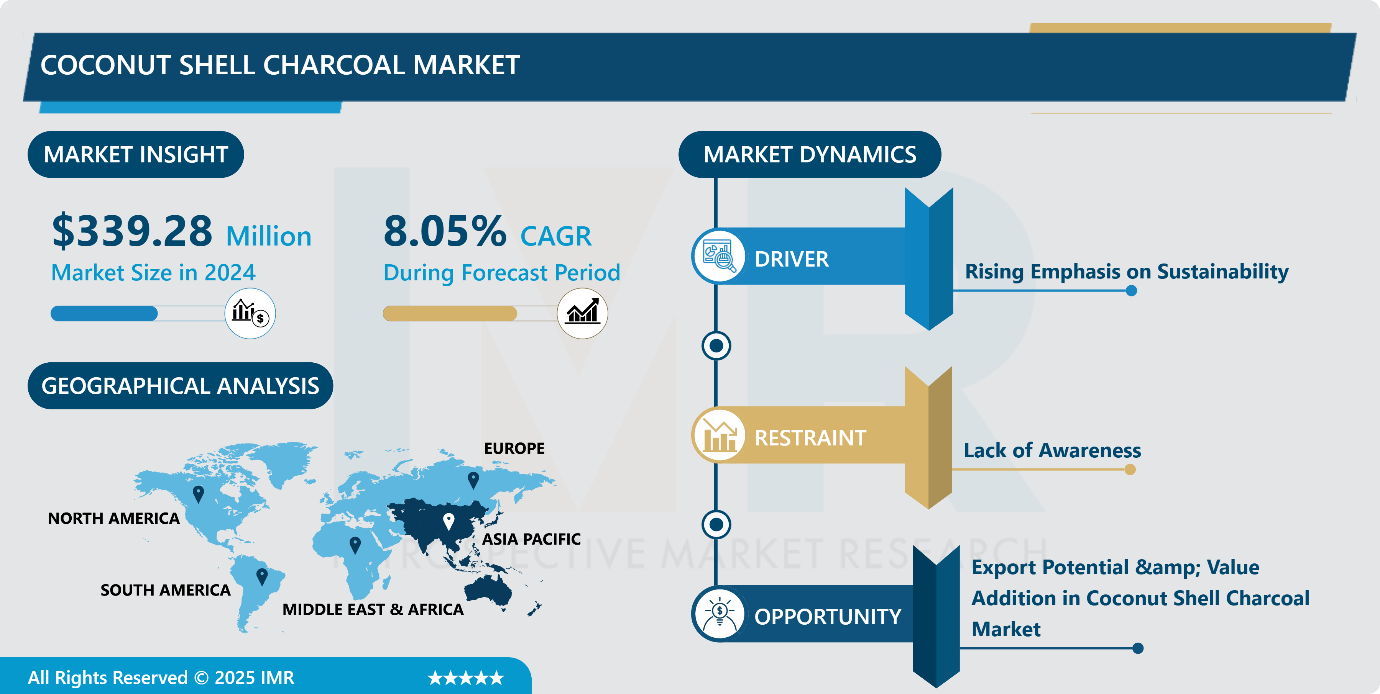
The Coconut Shell Charcoal Market Was Valued at USD 339.28 million in 2024 and is Projected to Reach USD 630.31 million by 2032, Growing at a CAGR of 8.05% from 2025 to 2032.
Shell Charcoal is obtained by burning the shell of fully matured coconuts with a limited supply of air so that they do not burn away to ash but are only carbonized. The manufacture of shell charcoal shows from the coconut shell has become a very important economic and commercial activity.
Coconut shell charcoal market expansion is occurring due to stable coconut production growth and increasing market demand. The worldwide coconut consumption is forecasted to grow until 2026 when it expects to reach 20 million metric tons for a marginal boost from an initial 19.9 million metric tons in 2021. The manufacturing volumes of coconut shell charcoal will steadily grow until 2026 when production is projected to reach 65.4 million metric tons. This projection represents a 0.5% annual increase from 2021 figures.
The coconut processing sector will create substantial market potential for the coconut shell charcoal sector due to increasing coconut supply sources for charcoal manufacturing. The coconut shell charcoal market expansion will be propelled by the leading coconut-producing countries of Indonesia, India, Philippines, and Sri Lanka. The global leader in coconut production during 2023 Indonesia contributed 17.97 million metric tons to its total production which enabled extensive raw material usage for charcoal creation. The market development continues to gain momentum due to worldwide efforts to minimize deforestation and decrease carbon pollution. Stable coconut production output combined with growing consumer preference for sustainable fuels will enable the coconut shell charcoal industry to experience long-term growth throughout the next few years.
Coconut Shell Charcoal Market Growth and Trend Analysis:
Rising Emphasis on Sustainability
- The global coconut shell charcoal market is experiencing significant growth, driven by increasing environmental awareness, expanding applications, and supportive government initiatives. The market demands sustainable alternative fuel sources since both sustainability and reduced carbon footprint measurements have become increasingly important factors. The sustainability goals find perfect alignment through coconut shell charcoal which functions as an environmentally friendly resource that draws both industries and eco-minded consumers. World governments support sustainable practices through the creation of policies which stir up production and use of renewable energy products involving coconut shell charcoal. These programs seek dual achievements of fossil fuels reduction and environmental protection. The coconut shell charcoal market exhibits strong growth prospects because of shifting sustainability patterns combined with market needs and supportive regulatory standards.
- For Instance, in October 2024, the Coconut Development Board reiterated its commitment to sustainable development by offering project-based financial assistance of 25% of the total project cost for green ventures. This support is designed to encourage the adoption of clean technology in the coconut shell charcoal industry, aligning with global environmental goals and the principles of the circular economy. This shift represents a key milestone in the industry's journey towards a more sustainable, eco-friendly future.
Lack of Awareness
- The market demands better awareness regarding coconut shell charcoal applications together with its environmental advantages throughout specific geographical areas. A lack of information about coconut shell charcoal prevents both market sector development and sustainable alternative utilization. The market demands educational programs and targeted advertising to demonstrate coconut shell charcoal advantages to potential users and businesses which will boost market requirements and stimulate growth.
Export Potential & Value Addition in Coconut Shell Charcoal Market
- The coconut shell charcoal market worldwide offers important commercial prospects because of exporting potential combined with value enhancement possibilities. The markets for sustainable products including eco-friendly items lead to high export potential for coconut shell charcoal from countries where this demand exists since industries and consumers actively seek green alternatives. Active carbon and specialty chemicals represent substantial growth potentials among value-added products produced from coconut shell charcoal. Manufacturers generate new revenue streams through these products which simultaneously provide manufacturers with added application capabilities for the market.
Stable Supply of Raw Materials
- The key challenge is sourcing and supply, as maintaining a consistent and reliable supply of coconut shells can be difficult, particularly in regions where coconut production fluctuates due to factors like weather conditions or agricultural cycles. To meet the growing demand, it will be essential to find ways to secure a stable supply of raw materials.
Coconut Shell Charcoal Market Segment Analysis:
Coconut Shell Charcoal Market is segmented based on Type, Application, and Region
By Type, A Grade Segment is Expected to Dominate the Market During the Forecast Period
- In the global coconut shell charcoal market A Grade shell charcoal is emerging as the dominant force in the global coconut shell charcoal market, driven by its superior quality, high fixed carbon content, and diverse industrial applications. The A grade coconut shell charcoal emerges from a controlled limited-oxygen pyrolysis process of mature coconut shells with minimal ash content and superior moisture performance for wide industrial applications.
- The energy sector recognizes A Grade Shell charcoal as a strong market leader because it serves as an advanced renewable biofuel fuel. A Grade Shell charcoal successfully powers barbecue grills and stoves along with industrial furnaces because it provides sustained efficient heat while maintaining high heat content to minimal ash levels. The efficient operation of A Grade shell charcoal combined with rising adoption of sustainable energy solutions makes this fuel a regional leader in different parts of the world.
By Application, Industrial Field Segment Held the Largest Share in the projected period
- The industrial use of coconut shell charcoal has seen significant growth in recent years, driven by its increasing demand in various sectors. Coconut shell charcoal is primarily utilized in industries such as metallurgy, pharmaceuticals, and agriculture due to its high carbon content and porous structure, making it an ideal material for filtration and adsorption processes.
- The role of coconut shell charcoal is particularly dominant in water treatment and purification applications, where it serves as an efficient adsorbent to remove impurities. This trend is bolstered by the growing awareness of the environmental benefits of using coconut shell charcoal over other forms of charcoal, as it is a renewable and eco-friendly resource. As industries increasingly focus on sustainability, the global coconut shell charcoal market is witnessing substantial growth, with sediment-related applications playing a key role in this expansion.
Coconut Shell Charcoal Market Regional Insights:
Asia Pacific is Expected to Dominate the Market Over the Forecast Period
- Asia-Pacific continues to assert its dominance in the global coconut shell charcoal market in 2024. The strategic producers including India, Sri Lanka, Indonesia, and the Philippines from this region are showing expansion in export volumes due to continued global market demand in air purification, water treatment and pharmaceutical industries. Market participation continues to rise because of the competitive advantages and strong manufacturing capabilities alongside the growing international footprints of the region.
- India will maintain its position as one of the most significant exporters in the coconut-shell-activated carbon market during 2024. A 10.7% increase in export volumes matched the market growth during which coconut shell charcoal exports from India grew from 106,051 MT to 117,368 MT in 2024. Export value expansion followed closely with a 22.5% boost from USD 184.3 million to USD 225.7 million. Indian manufacturers demonstrate expanding global market competitiveness through their efficient production facilities in combination with appealing prices.
Coconut Shell Charcoal Market Active Players:
- Bill Klisli (USA)
- Blac Banc Trade Trust (USA)
- Bluegold Global Distribution (USA)
- BMD Materials (Canada)
- Charcoal Xporter (Indonesia)
- Coconut Impex (India)
- Haven Coconut Charcoal Factory (Indonesia)
- Ibrahim (USA)
- JACOID (Indonesia)
- Jift Logistics (USA)
- Kovacic Helga (Austria)
- Majose Essuon Enterprise (USA)
- Ocean Moon Social Enterprise - OMSE (Philippines)
- PT Tatum Nusantara (Indonesia)
- Raga (USA)
- Samudera Sulawesi Sejahtera (Indonesia)
- Thisara Ishan (USA)
- UI Charcoal (Indonesia)
- UICHARCOAL - PT. Gunawan Putra Persada (Indonesia)
- Unibossmart (USA)
- Other Active Players
Key Industry Developments in the Coconut Shell Charcoal Market:
- In September 2024, as part of the ‘Go Green’ initiative, Jacobi Group is investing in the sustainable production of coconut shell charcoal, launching research and development efforts on an improved proprietary charring process while also expanding reactivation facilities in Europe.
- In April 2024, Indonesia's Ministry of Agriculture officially released the exports of moringa leaves, coconut charcoal, and tea during the National Plantation Celebration (SKENA) event. The coconut charcoal produced by PT Cococha Indonesia will be exported to Jordan with a volume of 33 tons valued at USD 48,840.
|
Coconut Shell Charcoal Market |
|||
|
Base Year: |
2024 |
Forecast Period: |
2025-2032 |
|
Historical Data: |
2018 to 2024 |
Market Size in 2024: |
USD 339.28 Mn. |
|
Forecast Period 2025-32 CAGR: |
8.05 % |
Market Size in 2032: |
USD 630.31 Mn. |
|
Segments Covered: |
By Type |
|
|
|
By Application |
|
||
|
By Region |
|
||
|
Growth Driver: |
|
||
|
Limiting Factor |
|
||
|
Expansion Opportunity |
|
||
|
Challenge Barrier |
|
||
|
Companies Covered in the Report: |
|
||
Chapter 1: Introduction
1.1 Scope and Coverage
Chapter 2:Executive Summary
Chapter 3: Market Landscape
3.1 Market Dynamics
3.1.1 Drivers
3.1.2 Restraints
3.1.3 Opportunities
3.1.4 Challenges
3.2 Market Trend Analysis
3.3 PESTLE Analysis
3.4 Porter's Five Forces Analysis
3.5 Industry Value Chain Analysis
3.6 Ecosystem
3.7 Regulatory Landscape
3.8 Price Trend Analysis
3.9 Patent Analysis
3.10 Technology Evolution
3.11 Investment Pockets
3.12 Import-Export Analysis
Chapter 4: Coconut Shell Charcoal Market by Type
4.1 Coconut Shell Charcoal Market Snapshot and Growth Engine
4.2 Coconut Shell Charcoal Market Overview
4.3 A Grade
4.3.1 Introduction and Market Overview
4.3.2 Historic and Forecasted Market Size in Value USD and Volume Units (2017-2032F)
4.3.3 Key Market Trends, Growth Factors and Opportunities
4.3.4 A Grade: Geographic Segmentation Analysis
4.4 B Grade
4.4.1 Introduction and Market Overview
4.4.2 Historic and Forecasted Market Size in Value USD and Volume Units (2017-2032F)
4.4.3 Key Market Trends, Growth Factors and Opportunities
4.4.4 B Grade: Geographic Segmentation Analysis
4.5 and C Grade
4.5.1 Introduction and Market Overview
4.5.2 Historic and Forecasted Market Size in Value USD and Volume Units (2017-2032F)
4.5.3 Key Market Trends, Growth Factors and Opportunities
4.5.4 and C Grade: Geographic Segmentation Analysis
Chapter 5: Coconut Shell Charcoal Market by Application
5.1 Coconut Shell Charcoal Market Snapshot and Growth Engine
5.2 Coconut Shell Charcoal Market Overview
5.3 Industrial Field
5.3.1 Introduction and Market Overview
5.3.2 Historic and Forecasted Market Size in Value USD and Volume Units (2017-2032F)
5.3.3 Key Market Trends, Growth Factors and Opportunities
5.3.4 Industrial Field: Geographic Segmentation Analysis
5.4 Cooking Fuel
5.4.1 Introduction and Market Overview
5.4.2 Historic and Forecasted Market Size in Value USD and Volume Units (2017-2032F)
5.4.3 Key Market Trends, Growth Factors and Opportunities
5.4.4 Cooking Fuel: Geographic Segmentation Analysis
5.5 and Others
5.5.1 Introduction and Market Overview
5.5.2 Historic and Forecasted Market Size in Value USD and Volume Units (2017-2032F)
5.5.3 Key Market Trends, Growth Factors and Opportunities
5.5.4 and Others : Geographic Segmentation Analysis
Chapter 6: Company Profiles and Competitive Analysis
6.1 Competitive Landscape
6.1.1 Competitive Benchmarking
6.1.2 Coconut Shell Charcoal Market Share by Manufacturer (2023)
6.1.3 Industry BCG Matrix
6.1.4 Heat Map Analysis
6.1.5 Mergers and Acquisitions
6.2 BILL KLISLI (USA)
6.2.1 Company Overview
6.2.2 Key Executives
6.2.3 Company Snapshot
6.2.4 Role of the Company in the Market
6.2.5 Sustainability and Social Responsibility
6.2.6 Operating Business Segments
6.2.7 Product Portfolio
6.2.8 Business Performance
6.2.9 Key Strategic Moves and Recent Developments
6.2.10 SWOT Analysis
6.3 BLAC BANC TRADE TRUST (USA)
6.4 BLUEGOLD GLOBAL DISTRIBUTION (USA)
6.5 BMD MATERIALS (CANADA)
6.6 CHARCOAL XPORTER (INDONESIA)
6.7 COCONUT IMPEX (INDIA)
6.8 HAVEN COCONUT CHARCOAL FACTORY (INDONESIA)
6.9 IBRAHIM (USA)
6.10 JACOID (INDONESIA)
6.11 JIFT LOGISTICS (USA)
6.12 KOVACIC HELGA (AUSTRIA)
6.13 MAJOSE ESSUON ENTERPRISE (USA)
6.14 OCEAN MOON SOCIAL ENTERPRISE - OMSE (PHILIPPINES)
6.15 PT TATUM NUSANTARA (INDONESIA)
6.16 RAGA (USA)
6.17 SAMUDERA SULAWESI SEJAHTERA (INDONESIA)
6.18 THISARA ISHAN (USA)
6.19 UI CHARCOAL (INDONESIA)
6.20 UICHARCOAL - PT. GUNAWAN PUTRA PERSADA (INDONESIA)
6.21 UNIBOSSMART (USA)
6.22 OTHER ACTIVE PLAYERS.
Chapter 7: Global Coconut Shell Charcoal Market By Region
7.1 Overview
7.2. North America Coconut Shell Charcoal Market
7.2.1 Key Market Trends, Growth Factors and Opportunities
7.2.2 Top Key Companies
7.2.3 Historic and Forecasted Market Size by Segments
7.2.4 Historic and Forecasted Market Size By Type
7.2.4.1 A Grade
7.2.4.2 B Grade
7.2.4.3 and C Grade
7.2.5 Historic and Forecasted Market Size By Application
7.2.5.1 Industrial Field
7.2.5.2 Cooking Fuel
7.2.5.3 and Others
7.2.6 Historic and Forecast Market Size by Country
7.2.6.1 US
7.2.6.2 Canada
7.2.6.3 Mexico
7.3. Eastern Europe Coconut Shell Charcoal Market
7.3.1 Key Market Trends, Growth Factors and Opportunities
7.3.2 Top Key Companies
7.3.3 Historic and Forecasted Market Size by Segments
7.3.4 Historic and Forecasted Market Size By Type
7.3.4.1 A Grade
7.3.4.2 B Grade
7.3.4.3 and C Grade
7.3.5 Historic and Forecasted Market Size By Application
7.3.5.1 Industrial Field
7.3.5.2 Cooking Fuel
7.3.5.3 and Others
7.3.6 Historic and Forecast Market Size by Country
7.3.6.1 Russia
7.3.6.2 Bulgaria
7.3.6.3 The Czech Republic
7.3.6.4 Hungary
7.3.6.5 Poland
7.3.6.6 Romania
7.3.6.7 Rest of Eastern Europe
7.4. Western Europe Coconut Shell Charcoal Market
7.4.1 Key Market Trends, Growth Factors and Opportunities
7.4.2 Top Key Companies
7.4.3 Historic and Forecasted Market Size by Segments
7.4.4 Historic and Forecasted Market Size By Type
7.4.4.1 A Grade
7.4.4.2 B Grade
7.4.4.3 and C Grade
7.4.5 Historic and Forecasted Market Size By Application
7.4.5.1 Industrial Field
7.4.5.2 Cooking Fuel
7.4.5.3 and Others
7.4.6 Historic and Forecast Market Size by Country
7.4.6.1 Germany
7.4.6.2 UK
7.4.6.3 France
7.4.6.4 The Netherlands
7.4.6.5 Italy
7.4.6.6 Spain
7.4.6.7 Rest of Western Europe
7.5. Asia Pacific Coconut Shell Charcoal Market
7.5.1 Key Market Trends, Growth Factors and Opportunities
7.5.2 Top Key Companies
7.5.3 Historic and Forecasted Market Size by Segments
7.5.4 Historic and Forecasted Market Size By Type
7.5.4.1 A Grade
7.5.4.2 B Grade
7.5.4.3 and C Grade
7.5.5 Historic and Forecasted Market Size By Application
7.5.5.1 Industrial Field
7.5.5.2 Cooking Fuel
7.5.5.3 and Others
7.5.6 Historic and Forecast Market Size by Country
7.5.6.1 China
7.5.6.2 India
7.5.6.3 Japan
7.5.6.4 South Korea
7.5.6.5 Malaysia
7.5.6.6 Thailand
7.5.6.7 Vietnam
7.5.6.8 The Philippines
7.5.6.9 Australia
7.5.6.10 New Zealand
7.5.6.11 Rest of APAC
7.6. Middle East & Africa Coconut Shell Charcoal Market
7.6.1 Key Market Trends, Growth Factors and Opportunities
7.6.2 Top Key Companies
7.6.3 Historic and Forecasted Market Size by Segments
7.6.4 Historic and Forecasted Market Size By Type
7.6.4.1 A Grade
7.6.4.2 B Grade
7.6.4.3 and C Grade
7.6.5 Historic and Forecasted Market Size By Application
7.6.5.1 Industrial Field
7.6.5.2 Cooking Fuel
7.6.5.3 and Others
7.6.6 Historic and Forecast Market Size by Country
7.6.6.1 Turkiye
7.6.6.2 Bahrain
7.6.6.3 Kuwait
7.6.6.4 Saudi Arabia
7.6.6.5 Qatar
7.6.6.6 UAE
7.6.6.7 Israel
7.6.6.8 South Africa
7.7. South America Coconut Shell Charcoal Market
7.7.1 Key Market Trends, Growth Factors and Opportunities
7.7.2 Top Key Companies
7.7.3 Historic and Forecasted Market Size by Segments
7.7.4 Historic and Forecasted Market Size By Type
7.7.4.1 A Grade
7.7.4.2 B Grade
7.7.4.3 and C Grade
7.7.5 Historic and Forecasted Market Size By Application
7.7.5.1 Industrial Field
7.7.5.2 Cooking Fuel
7.7.5.3 and Others
7.7.6 Historic and Forecast Market Size by Country
7.7.6.1 Brazil
7.7.6.2 Argentina
7.7.6.3 Rest of SA
Chapter 8 Analyst Viewpoint and Conclusion
8.1 Recommendations and Concluding Analysis
8.2 Potential Market Strategies
Chapter 9 Research Methodology
9.1 Research Process
9.2 Primary Research
9.3 Secondary Research
|
Coconut Shell Charcoal Market |
|||
|
Base Year: |
2024 |
Forecast Period: |
2025-2032 |
|
Historical Data: |
2018 to 2024 |
Market Size in 2024: |
USD 339.28 Mn. |
|
Forecast Period 2025-32 CAGR: |
8.05 % |
Market Size in 2032: |
USD 630.31 Mn. |
|
Segments Covered: |
By Type |
|
|
|
By Application |
|
||
|
By Region |
|
||
|
Growth Driver: |
|
||
|
Limiting Factor |
|
||
|
Expansion Opportunity |
|
||
|
Challenge Barrier |
|
||
|
Companies Covered in the Report: |
|
||


