




Cloud Services Market Synopsis:
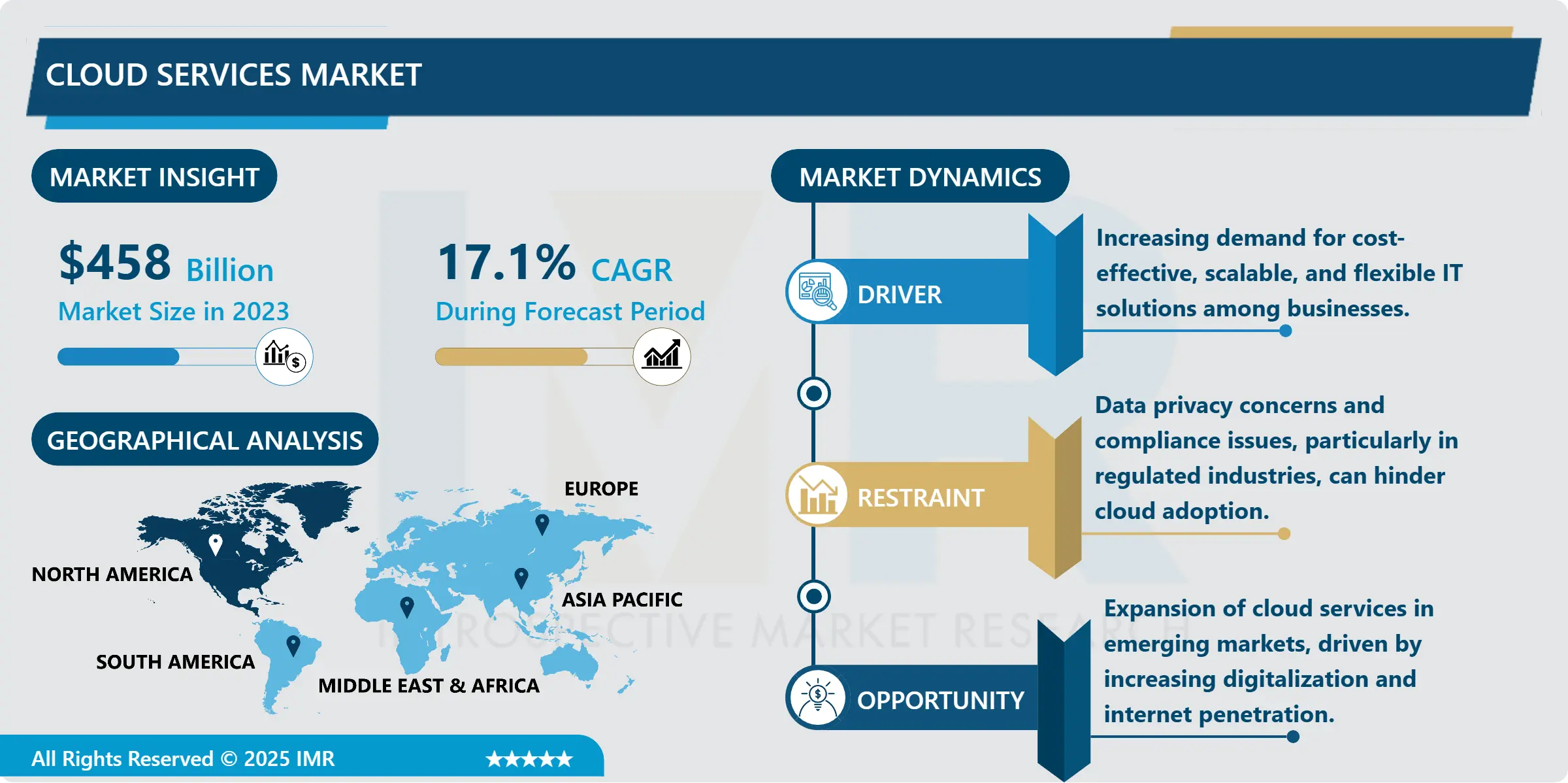
Cloud Services Market Size Was Valued at USD 458 Billion in 2023, and is Projected to Reach USD xx Billion by 2192 Growing at a CAGR of 17.10% From 2024-2032.
The Cloud Services Market describes the availability of computing infrastructure including applications, storage and other computing resources through the internet or ‘the cloud’. These services enable both business consumers and individual consumers to obtain and use resources with limited physical apparatus. Cloud services are categorized into three main types: IaaS (Infrastructure as a Service), PaaS (Platform as a Service) and SaaS (Software as a Service). These services help organisations to grow their operations in more efficient and affordable ways that are only paid for what they need, increase competiveness, and promote innovation, performance and adaptability in different fields.
The current market for cloud services all around the world has been on the rise for the past few years and it has been precipitated by the rise in organizations’ use of digital solutions. Hence, enterprises as leading organizational structures are actively implementing cloud platforms for operational optimization and efficiency, for collaboration, and competitiveness. These include lower cost of ownership, flexibility, better security and within reach technologies such as artificial intelligence, big data analytics, and machine learning. Firms are also streaming their old IT infrastructure to cloud solutions to cut on operational expense and enhance flexibility in operations, hence increasing cloud service adoption.
In recent years, cloud services market is mainly attributed to the growth in demand for solutions related to remote work, especially after the COVID-19 pandemic, which has advanced the opportunities for digitalization. When companies evolve to their new environment, they turn to the cloud to meet organizational needs for versatility, elasticity, and security. Further, the emergence of the cloud-native applications, the microservices, and multi-cloud structures has led to the development of this market. High competitiveness is a distinctive feature of the market, and leading global technology giants are further increasing their cloud offerings to address a larger and steadily increasing market. This is creating demand for further enhancement of cloud solutions and services hence encouraging market expansion.
Cloud Services Market Trend Analysis:
Shift Toward Multi-Cloud Strategies
- One observed shift in the cloud market trends is that businesses are shifting from a single cloud provider model to the multi-cloud model. It has become apparent that organisations are no longer willing to place their reliance on a single cloud service provider. This approach offers the following benefits; it reduces risk, increase performance and one can choose the best service that suits the need. Through the use of multiple cloud platforms, organizations are sometimes assured that they do not lock themselves up with a particular vendor thus have more control over their data and systems. This also enables organization to select specific cloud services from a different supplier which optimizes the organizational functions they can harness.
- The use of multi-cloud approach improves the levels of security and business resilience. Data put on a different cloud and applications on different cloud will make sure that business is not fully compliant with one cloud that may have service outage and issues with security breaches. This approach also helps organizations to develop backup services, and to regain its stability in case of disruptions. Not only that, multi-cloud strategies enable organizations to balance cost and performance and choose the most effective and cheap services for every task. With the advancement of cloud technologies, the multi-cloud models are likely to become even more popular, allowing for better business adaptation, and increased organizational resource reliability.
Expansion of Cloud Services in Emerging Markets
- Another critical unmet opportunity that has been seen from the cloud services market is the increased penetration to the new markets, as this is still a very large market. North America and European countries have led the charge in cloud ROI, but Asia-Pacific, Latin America, and the Middle East and Africa are comparable regions that can lure CSIOs at other firms. These regions have enjoyed considerable investment in digital infrastructure and technology to pave way for organizations to move to cloud environments. As business organizations in these emerging markets come to appreciate the benefits that cloud services can bring to their organizations with regard to efficiency, communication, and innovation, then there should be increased uptake of cloud solutions.
- But new regions have large number of small and medium enterprises SMEs which are now actively participating and thus helping the clouds to grow. SME companies, in particular, may need affordable and easily scalable solutions for IT services, for which cloud services may act as the perfect answer by encapsulating best both cheap pricing for each service and the lack of need for expensive physical infrastructure. While it steadily becomes easier to connect to the Internet, and issues like data protection and governmental rules and regulations are steadily taken care of, the uptake of the cloud will also increase at a corresponding rate in these areas. These factors further show that the markets in emerging economies are a potential segment of growth that cloud service providers can leverage to grow their market based on a rapidly growing client base.
Cloud Services Market Segment Analysis:
Cloud Services Market is Segmented on the basis of Service Type, Deployment Type, End User, and Region.
By Service Type, Infrastructure as a Service (IaaS) segment is expected to dominate the market during the forecast period
- Defined by the delivery of IT infrastructure over the internet, Infrastructure as a Service or IaaS is currently the dominant segment in a cloud services market. IaaS provides ability to users to lease IT equipment’s like server, storage facilities and networks and obtain them only when required, unlike physical buying. Moreover, this kind of infrastructure helps companies to expand or shrink according to customer traffic, thereby, sparing capital expenses and only paying for what they consume. The key players within the IaaS market are several but most popular are Amazon, Web services Microsoft Azure and Google cloud these are comprehensive platforms necessary for enterprises to take advantage of cloud computing for elation storage, disaster back up among others.
- The Platform as a Service (PaaS) segment offers a platform to design, develop, test and implement applications without having to bother about the software or hardware. Most PaaS solutions provide solutions pertaining to application development process such as management of the database, development of frameworks and analytics. This service is particularly useful for organizations that wish to avoid a lot of hassles associated with infrastructure, while engaging the services of an application. Also, the Software as a Service (SaaS) segment provides fully operational software applications over the cloud, thus the application does not require to be downloaded and installed in computers used by businesses. Some of the most consumed SaaS solutions are business email and collaboration services, CRM, and ERP systems with Salesforce, Microsoft Office 365 suite, and Google Workspace. PaaS and SaaS services in particular are highly scalable, flexible and cost efficient for most organizations, whether large or small.
By Deployment Type, Public Cloud segment expected to held the largest share
- The Public Cloud deployment model remains one of the most popular in the cloud services industry. In this model, computing resources including the servers, storage, applications are owned by third party cloud service provider and are rented out to anyone over the internet. Public clouds are inexpensive because they operate on demand and do not require most of the resources to be physically bought for use in an organization. Today, there are so many providers, which provide different services in the field of cloud computing among which are the most significant leaders such as Amazon Web Services, Microsoft Azure, and Google Cloud that offer various services for different industries and businesses.
- On the other hand, the Private Cloud is the deployment model whereby organizational cloud resources are solely dedicated to a single organization. This type of cloud can be located within an organization’s premises or with a third-party service provider, though comes with more flexibility, compatibility and security measures. This model is used by organizations that demand greater data security, privacy laws or have certain business requirements that cannot be met through public cloud. Hybrid Cloud is also a model that is halfway between the public and private clouds, to help organizations take advantage of both of them. Hybrid cloud is an effective solution for sharing benefits of different cloud models: putting important tasks in private clouds and using public clouds for cost-effective scaling. This flexibility makes hybrid clouds appealing especially for firms which seek to get the benefits of cloud but retain control on their data.
Cloud Services Market Regional Insights:
North America is Expected to Dominate the Market Over the Forecast period
- The research also found that North America remained the leading region to show strength in the overall revenues of the cloud services market in 2023. This dominance is primarily due to the region’s strong technology base to prompt the usage of the cloud services. Today’s large CSPs are headquartered in North America, and includes players like AWS, Microsoft Azure, Google Cloud, which attests to the dominance of the region in terms of cloud computing. Further, the businesses in various sectors such as healthcare, financing & retail, and government sectors in North America are deploying more and more digital transformation solutions which in turn increases the demand for cloud services. The IT markets of the developed region helps make this region a suitable area to capture for cloud service providers.
- Accounting to the market research in 2023, the North American market share dominated the global cloud services market. The United States takes the lead globally as the most popular country that has advanced cloud infrastructure due to the availability of the largest technology companies in the country. A fresh internal investigation conducted and the ever-increasing need for cloud services from customers in health, finance, and retail industry sectors is forcing the market to grow this region rapidly. In addition, favourable policies and legal provisions such as incentives on innovation and investment in cloud technologies have continued to develop encouraging foundations. It is through this technological aptitude, continued regulatory backing and the demand from the North American industry that the region leads the world in Cloud services.
Active Key Players in the Cloud Services Market:
- Amazon Web Services (AWS) (USA)
- Alibaba Cloud (China)
- Alphabet (Google Cloud) (USA)
- Apple (USA)
- Cisco Systems (USA)
- Digital Ocean (USA)
- IBM Cloud (USA)
- Microsoft Azure (USA)
- Oracle Cloud (USA)
- Salesforce (USA)
- SAP (Germany)
- Tencent Cloud (China)
- VMware (USA)
- Huawei Cloud (China)
- Rack space Technology (USA), and Other Active Players
|
Global Cloud Services Market |
|||
|
Base Year: |
2023 |
Forecast Period: |
2024-2032 |
|
Historical Data: |
2017 to 2023 |
Market Size in 2023: |
USD 458 Billion |
|
Forecast Period 2024-32 CAGR: |
17.10 % |
Market Size in 2032: |
USD 2192 Billion |
|
Segments Covered: |
By Service Type |
|
|
|
By Deployment Type |
|
||
|
By End User |
|
||
|
By Region |
|
||
|
Key Market Drivers: |
|
||
|
Key Market Restraints: |
|
||
|
Key Opportunities: |
|
||
|
Companies Covered in the report: |
|
||
Chapter 1: Introduction
1.1 Scope and Coverage
Chapter 2:Executive Summary
Chapter 3: Market Landscape
3.1 Market Dynamics
3.1.1 Drivers
3.1.2 Restraints
3.1.3 Opportunities
3.1.4 Challenges
3.2 Market Trend Analysis
3.3 PESTLE Analysis
3.4 Porter's Five Forces Analysis
3.5 Industry Value Chain Analysis
3.6 Ecosystem
3.7 Regulatory Landscape
3.8 Price Trend Analysis
3.9 Patent Analysis
3.10 Technology Evolution
3.11 Investment Pockets
3.12 Import-Export Analysis
Chapter 4: Cloud Services Market by Service Type
4.1 Cloud Services Market Snapshot and Growth Engine
4.2 Cloud Services Market Overview
4.3 Infrastructure as a Service (IaaS)
4.3.1 Introduction and Market Overview
4.3.2 Historic and Forecasted Market Size in Value USD and Volume Units (2017-2032F)
4.3.3 Key Market Trends, Growth Factors and Opportunities
4.3.4 Infrastructure as a Service (IaaS): Geographic Segmentation Analysis
4.4 Platform as a Service (PaaS)
4.4.1 Introduction and Market Overview
4.4.2 Historic and Forecasted Market Size in Value USD and Volume Units (2017-2032F)
4.4.3 Key Market Trends, Growth Factors and Opportunities
4.4.4 Platform as a Service (PaaS): Geographic Segmentation Analysis
4.5 Software as a Service (SaaS)
4.5.1 Introduction and Market Overview
4.5.2 Historic and Forecasted Market Size in Value USD and Volume Units (2017-2032F)
4.5.3 Key Market Trends, Growth Factors and Opportunities
4.5.4 Software as a Service (SaaS) : Geographic Segmentation Analysis
Chapter 5: Cloud Services Market by deployment Type
5.1 Cloud Services Market Snapshot and Growth Engine
5.2 Cloud Services Market Overview
5.3 Public Cloud
5.3.1 Introduction and Market Overview
5.3.2 Historic and Forecasted Market Size in Value USD and Volume Units (2017-2032F)
5.3.3 Key Market Trends, Growth Factors and Opportunities
5.3.4 Public Cloud: Geographic Segmentation Analysis
5.4 Private Cloud
5.4.1 Introduction and Market Overview
5.4.2 Historic and Forecasted Market Size in Value USD and Volume Units (2017-2032F)
5.4.3 Key Market Trends, Growth Factors and Opportunities
5.4.4 Private Cloud: Geographic Segmentation Analysis
5.5 Hybrid Cloud
5.5.1 Introduction and Market Overview
5.5.2 Historic and Forecasted Market Size in Value USD and Volume Units (2017-2032F)
5.5.3 Key Market Trends, Growth Factors and Opportunities
5.5.4 Hybrid Cloud: Geographic Segmentation Analysis
Chapter 6: Cloud Services Market by End User
6.1 Cloud Services Market Snapshot and Growth Engine
6.2 Cloud Services Market Overview
6.3 (BFSI (Banking
6.3.1 Introduction and Market Overview
6.3.2 Historic and Forecasted Market Size in Value USD and Volume Units (2017-2032F)
6.3.3 Key Market Trends, Growth Factors and Opportunities
6.3.4 (BFSI (Banking: Geographic Segmentation Analysis
6.4 Financial Services
6.4.1 Introduction and Market Overview
6.4.2 Historic and Forecasted Market Size in Value USD and Volume Units (2017-2032F)
6.4.3 Key Market Trends, Growth Factors and Opportunities
6.4.4 Financial Services: Geographic Segmentation Analysis
6.5 and Insurance
6.5.1 Introduction and Market Overview
6.5.2 Historic and Forecasted Market Size in Value USD and Volume Units (2017-2032F)
6.5.3 Key Market Trends, Growth Factors and Opportunities
6.5.4 and Insurance: Geographic Segmentation Analysis
6.6 IT & Telecom
6.6.1 Introduction and Market Overview
6.6.2 Historic and Forecasted Market Size in Value USD and Volume Units (2017-2032F)
6.6.3 Key Market Trends, Growth Factors and Opportunities
6.6.4 IT & Telecom: Geographic Segmentation Analysis
6.7 Healthcare
6.7.1 Introduction and Market Overview
6.7.2 Historic and Forecasted Market Size in Value USD and Volume Units (2017-2032F)
6.7.3 Key Market Trends, Growth Factors and Opportunities
6.7.4 Healthcare: Geographic Segmentation Analysis
6.8 Retail
6.8.1 Introduction and Market Overview
6.8.2 Historic and Forecasted Market Size in Value USD and Volume Units (2017-2032F)
6.8.3 Key Market Trends, Growth Factors and Opportunities
6.8.4 Retail: Geographic Segmentation Analysis
6.9 Manufacturing
6.9.1 Introduction and Market Overview
6.9.2 Historic and Forecasted Market Size in Value USD and Volume Units (2017-2032F)
6.9.3 Key Market Trends, Growth Factors and Opportunities
6.9.4 Manufacturing: Geographic Segmentation Analysis
6.10 Government
6.10.1 Introduction and Market Overview
6.10.2 Historic and Forecasted Market Size in Value USD and Volume Units (2017-2032F)
6.10.3 Key Market Trends, Growth Factors and Opportunities
6.10.4 Government: Geographic Segmentation Analysis
6.11 Media & Entertainment
6.11.1 Introduction and Market Overview
6.11.2 Historic and Forecasted Market Size in Value USD and Volume Units (2017-2032F)
6.11.3 Key Market Trends, Growth Factors and Opportunities
6.11.4 Media & Entertainment: Geographic Segmentation Analysis
6.12 Energy & Utilities
6.12.1 Introduction and Market Overview
6.12.2 Historic and Forecasted Market Size in Value USD and Volume Units (2017-2032F)
6.12.3 Key Market Trends, Growth Factors and Opportunities
6.12.4 Energy & Utilities: Geographic Segmentation Analysis
6.13 Education
6.13.1 Introduction and Market Overview
6.13.2 Historic and Forecasted Market Size in Value USD and Volume Units (2017-2032F)
6.13.3 Key Market Trends, Growth Factors and Opportunities
6.13.4 Education: Geographic Segmentation Analysis
6.14 Others
6.14.1 Introduction and Market Overview
6.14.2 Historic and Forecasted Market Size in Value USD and Volume Units (2017-2032F)
6.14.3 Key Market Trends, Growth Factors and Opportunities
6.14.4 Others: Geographic Segmentation Analysis
Chapter 7: Company Profiles and Competitive Analysis
7.1 Competitive Landscape
7.1.1 Competitive Benchmarking
7.1.2 Cloud Services Market Share by Manufacturer (2023)
7.1.3 Industry BCG Matrix
7.1.4 Heat Map Analysis
7.1.5 Mergers and Acquisitions
7.2 AMAZON WEB SERVICES (AWS) (USA)
7.2.1 Company Overview
7.2.2 Key Executives
7.2.3 Company Snapshot
7.2.4 Role of the Company in the Market
7.2.5 Sustainability and Social Responsibility
7.2.6 Operating Business Segments
7.2.7 Product Portfolio
7.2.8 Business Performance
7.2.9 Key Strategic Moves and Recent Developments
7.2.10 SWOT Analysis
7.3 ALIBABA CLOUD (CHINA)
7.4 ALPHABET (GOOGLE CLOUD) (USA)
7.5 APPLE (USA)
7.6 CISCO SYSTEMS (USA)
7.7 DIGITAL OCEAN (USA)
7.8 IBM CLOUD (USA)
7.9 MICROSOFT AZURE (USA)
7.10 ORACLE CLOUD (USA)
7.11 SALESFORCE (USA)
7.12 SAP (GERMANY)
7.13 TENCENT CLOUD (CHINA)
7.14 VMWARE (USA)
7.15 HUAWEI CLOUD (CHINA)
7.16 RACKSPACE TECHNOLOGY (USA)
7.17 OTHER ACTIVE PLAYERS
Chapter 8: Global Cloud Services Market By Region
8.1 Overview
8.2. North America Cloud Services Market
8.2.1 Key Market Trends, Growth Factors and Opportunities
8.2.2 Top Key Companies
8.2.3 Historic and Forecasted Market Size by Segments
8.2.4 Historic and Forecasted Market Size By Service Type
8.2.4.1 Infrastructure as a Service (IaaS)
8.2.4.2 Platform as a Service (PaaS)
8.2.4.3 Software as a Service (SaaS)
8.2.5 Historic and Forecasted Market Size By deployment Type
8.2.5.1 Public Cloud
8.2.5.2 Private Cloud
8.2.5.3 Hybrid Cloud
8.2.6 Historic and Forecasted Market Size By End User
8.2.6.1 (BFSI (Banking
8.2.6.2 Financial Services
8.2.6.3 and Insurance
8.2.6.4 IT & Telecom
8.2.6.5 Healthcare
8.2.6.6 Retail
8.2.6.7 Manufacturing
8.2.6.8 Government
8.2.6.9 Media & Entertainment
8.2.6.10 Energy & Utilities
8.2.6.11 Education
8.2.6.12 Others
8.2.7 Historic and Forecast Market Size by Country
8.2.7.1 US
8.2.7.2 Canada
8.2.7.3 Mexico
8.3. Eastern Europe Cloud Services Market
8.3.1 Key Market Trends, Growth Factors and Opportunities
8.3.2 Top Key Companies
8.3.3 Historic and Forecasted Market Size by Segments
8.3.4 Historic and Forecasted Market Size By Service Type
8.3.4.1 Infrastructure as a Service (IaaS)
8.3.4.2 Platform as a Service (PaaS)
8.3.4.3 Software as a Service (SaaS)
8.3.5 Historic and Forecasted Market Size By deployment Type
8.3.5.1 Public Cloud
8.3.5.2 Private Cloud
8.3.5.3 Hybrid Cloud
8.3.6 Historic and Forecasted Market Size By End User
8.3.6.1 (BFSI (Banking
8.3.6.2 Financial Services
8.3.6.3 and Insurance
8.3.6.4 IT & Telecom
8.3.6.5 Healthcare
8.3.6.6 Retail
8.3.6.7 Manufacturing
8.3.6.8 Government
8.3.6.9 Media & Entertainment
8.3.6.10 Energy & Utilities
8.3.6.11 Education
8.3.6.12 Others
8.3.7 Historic and Forecast Market Size by Country
8.3.7.1 Russia
8.3.7.2 Bulgaria
8.3.7.3 The Czech Republic
8.3.7.4 Hungary
8.3.7.5 Poland
8.3.7.6 Romania
8.3.7.7 Rest of Eastern Europe
8.4. Western Europe Cloud Services Market
8.4.1 Key Market Trends, Growth Factors and Opportunities
8.4.2 Top Key Companies
8.4.3 Historic and Forecasted Market Size by Segments
8.4.4 Historic and Forecasted Market Size By Service Type
8.4.4.1 Infrastructure as a Service (IaaS)
8.4.4.2 Platform as a Service (PaaS)
8.4.4.3 Software as a Service (SaaS)
8.4.5 Historic and Forecasted Market Size By deployment Type
8.4.5.1 Public Cloud
8.4.5.2 Private Cloud
8.4.5.3 Hybrid Cloud
8.4.6 Historic and Forecasted Market Size By End User
8.4.6.1 (BFSI (Banking
8.4.6.2 Financial Services
8.4.6.3 and Insurance
8.4.6.4 IT & Telecom
8.4.6.5 Healthcare
8.4.6.6 Retail
8.4.6.7 Manufacturing
8.4.6.8 Government
8.4.6.9 Media & Entertainment
8.4.6.10 Energy & Utilities
8.4.6.11 Education
8.4.6.12 Others
8.4.7 Historic and Forecast Market Size by Country
8.4.7.1 Germany
8.4.7.2 UK
8.4.7.3 France
8.4.7.4 The Netherlands
8.4.7.5 Italy
8.4.7.6 Spain
8.4.7.7 Rest of Western Europe
8.5. Asia Pacific Cloud Services Market
8.5.1 Key Market Trends, Growth Factors and Opportunities
8.5.2 Top Key Companies
8.5.3 Historic and Forecasted Market Size by Segments
8.5.4 Historic and Forecasted Market Size By Service Type
8.5.4.1 Infrastructure as a Service (IaaS)
8.5.4.2 Platform as a Service (PaaS)
8.5.4.3 Software as a Service (SaaS)
8.5.5 Historic and Forecasted Market Size By deployment Type
8.5.5.1 Public Cloud
8.5.5.2 Private Cloud
8.5.5.3 Hybrid Cloud
8.5.6 Historic and Forecasted Market Size By End User
8.5.6.1 (BFSI (Banking
8.5.6.2 Financial Services
8.5.6.3 and Insurance
8.5.6.4 IT & Telecom
8.5.6.5 Healthcare
8.5.6.6 Retail
8.5.6.7 Manufacturing
8.5.6.8 Government
8.5.6.9 Media & Entertainment
8.5.6.10 Energy & Utilities
8.5.6.11 Education
8.5.6.12 Others
8.5.7 Historic and Forecast Market Size by Country
8.5.7.1 China
8.5.7.2 India
8.5.7.3 Japan
8.5.7.4 South Korea
8.5.7.5 Malaysia
8.5.7.6 Thailand
8.5.7.7 Vietnam
8.5.7.8 The Philippines
8.5.7.9 Australia
8.5.7.10 New Zealand
8.5.7.11 Rest of APAC
8.6. Middle East & Africa Cloud Services Market
8.6.1 Key Market Trends, Growth Factors and Opportunities
8.6.2 Top Key Companies
8.6.3 Historic and Forecasted Market Size by Segments
8.6.4 Historic and Forecasted Market Size By Service Type
8.6.4.1 Infrastructure as a Service (IaaS)
8.6.4.2 Platform as a Service (PaaS)
8.6.4.3 Software as a Service (SaaS)
8.6.5 Historic and Forecasted Market Size By deployment Type
8.6.5.1 Public Cloud
8.6.5.2 Private Cloud
8.6.5.3 Hybrid Cloud
8.6.6 Historic and Forecasted Market Size By End User
8.6.6.1 (BFSI (Banking
8.6.6.2 Financial Services
8.6.6.3 and Insurance
8.6.6.4 IT & Telecom
8.6.6.5 Healthcare
8.6.6.6 Retail
8.6.6.7 Manufacturing
8.6.6.8 Government
8.6.6.9 Media & Entertainment
8.6.6.10 Energy & Utilities
8.6.6.11 Education
8.6.6.12 Others
8.6.7 Historic and Forecast Market Size by Country
8.6.7.1 Turkiye
8.6.7.2 Bahrain
8.6.7.3 Kuwait
8.6.7.4 Saudi Arabia
8.6.7.5 Qatar
8.6.7.6 UAE
8.6.7.7 Israel
8.6.7.8 South Africa
8.7. South America Cloud Services Market
8.7.1 Key Market Trends, Growth Factors and Opportunities
8.7.2 Top Key Companies
8.7.3 Historic and Forecasted Market Size by Segments
8.7.4 Historic and Forecasted Market Size By Service Type
8.7.4.1 Infrastructure as a Service (IaaS)
8.7.4.2 Platform as a Service (PaaS)
8.7.4.3 Software as a Service (SaaS)
8.7.5 Historic and Forecasted Market Size By deployment Type
8.7.5.1 Public Cloud
8.7.5.2 Private Cloud
8.7.5.3 Hybrid Cloud
8.7.6 Historic and Forecasted Market Size By End User
8.7.6.1 (BFSI (Banking
8.7.6.2 Financial Services
8.7.6.3 and Insurance
8.7.6.4 IT & Telecom
8.7.6.5 Healthcare
8.7.6.6 Retail
8.7.6.7 Manufacturing
8.7.6.8 Government
8.7.6.9 Media & Entertainment
8.7.6.10 Energy & Utilities
8.7.6.11 Education
8.7.6.12 Others
8.7.7 Historic and Forecast Market Size by Country
8.7.7.1 Brazil
8.7.7.2 Argentina
8.7.7.3 Rest of SA
Chapter 9 Analyst Viewpoint and Conclusion
9.1 Recommendations and Concluding Analysis
9.2 Potential Market Strategies
Chapter 10 Research Methodology
10.1 Research Process
10.2 Primary Research
10.3 Secondary Research
|
Global Cloud Services Market |
|||
|
Base Year: |
2023 |
Forecast Period: |
2024-2032 |
|
Historical Data: |
2017 to 2023 |
Market Size in 2023: |
USD 458 Billion |
|
Forecast Period 2024-32 CAGR: |
17.10 % |
Market Size in 2032: |
USD 2192 Billion |
|
Segments Covered: |
By Service Type |
|
|
|
By Deployment Type |
|
||
|
By End User |
|
||
|
By Region |
|
||
|
Key Market Drivers: |
|
||
|
Key Market Restraints: |
|
||
|
Key Opportunities: |
|
||
|
Companies Covered in the report: |
|
||


