Cloud Migration Service Market Synopsis:
Cloud Migration Service Market Size Was Valued at USD 10.2 Billion in 2023, and is Projected to Reach USD 67.18 Billion by 2032, Growing at a CAGR of 23.30% From 2024-2032.
Cloud migration services are defined as the act of transferring data, applications and other organizational components from an in-house system to the cloud or from one cloud to another. This implies activities like planning, risk and testing, and actual migration of assets to support business operation and its security, and effectiveness. Cloud migration services frequently involve the engagement of other service providers or cloud ecosystems such as AWS, Microsoft Azure or Google Cloud in dealing with matters related to data migration and cloud resource management that are intricate.
The market of cloud migration services is becoming more vast in the modern world as cloud computing technologies enter the sphere of people’s lives at a high rate, and as the need for companies to remain innovative and competitive in the world of technologies appears to be essential. Businesses in many industries need better solutions for increasing the flexibility, scalability and cost-efficiency of their corporate infrastructure. Cloud migration helps organisations harness the true value of cloud environments eliminating Capex in physical assets and providing a better and well-governed decentralisation of resources alongside flexibility and process adaptability.
Besides, application areas like new work environment, business intelligence, and big data analytics, and disaster recovery are driving the overall growth of this market conveniently. It is therefore seen that as more companies seek to transform their out-dated information technology platforms, migration to cloud is high in demand. In addition, through the pandemic crisis, which affects all spheres of life, the use of cloud solutions grew rapidly as it allowed organizations to retain activity in the cloud environment during the crisis. Thus, the market should maintain its steady growth, backed by cloud service providers who are to launch custom migration services and enhanced tools to ensure smooth switch.
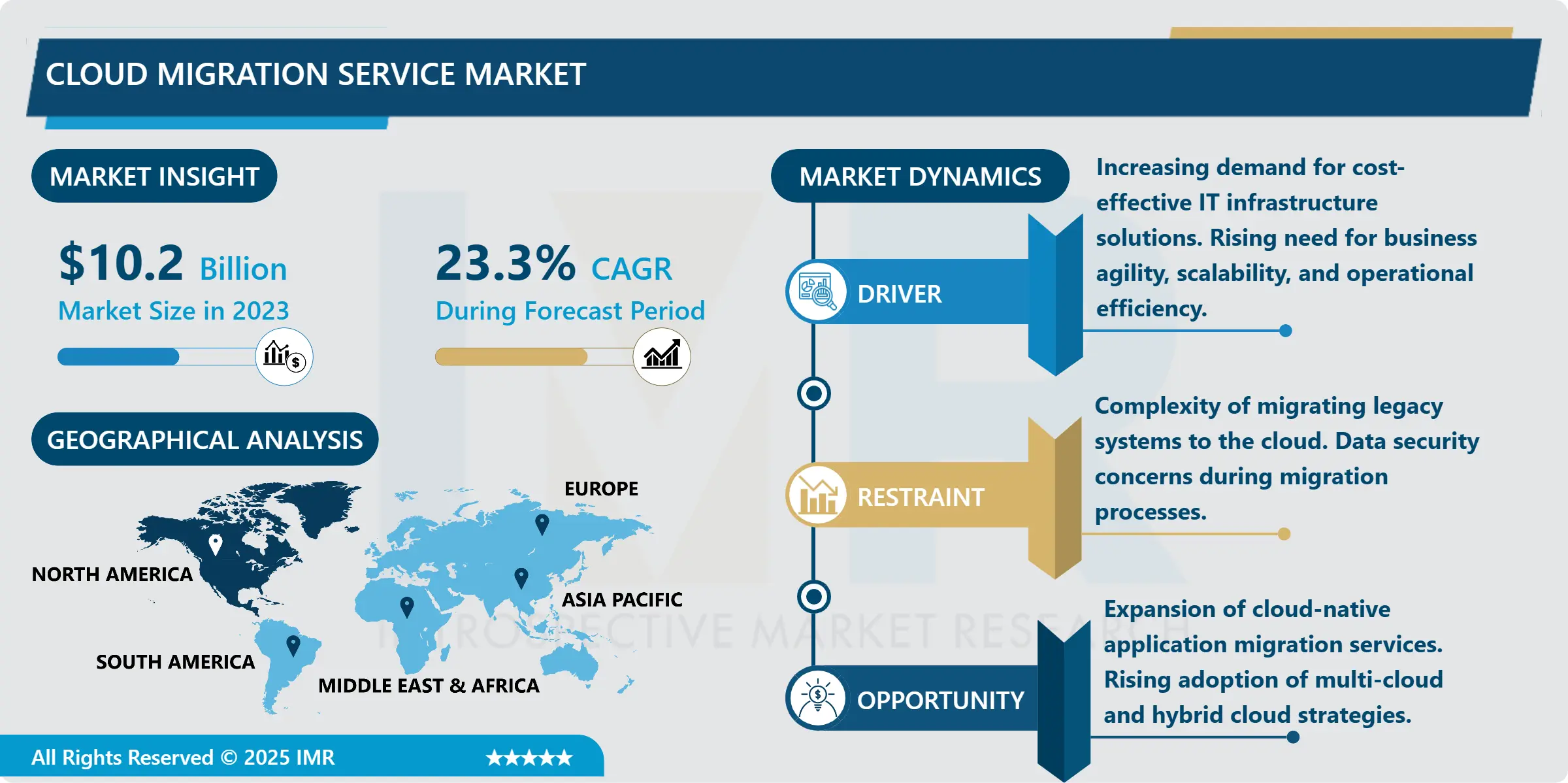
Cloud Migration Service Market Trend Analysis:
Increased Adoption of Multi-Cloud and Hybrid Cloud Strategies
-
The use of multiple cloud solutions and the combination of private and public clouds are among the trends that define the further development of the cloud migration services market. It is becoming more common for organisations to utilise both private and public clouds, as well as employing services from different cloud service providers, in order to have better flexibility, reliability and to avoid becoming locked into one specific provider. This kind of trend allows organizations to get the best of each of the many cloud platforms and conform to any relevant legislation, security, or performance concerns.
-
The multi-cloud approach makes it easier for businesses to leverage on different cloud environments by always placing workloads on the most appropriate platforms depending on the cost, and possible performance and geographic locations. For instance, an organization may opt for AWS for its computing and storage requirement and, at the same time, use the Microsoft Azure for organizational software. This is being accomplished by AI, machine learning, and edge computing which rely upon a diverse and resilient cloud architecture.
Growth in Cloud-Native Application Migration
-
One of the great opportunities in the context of the cloud migration service market is the ever-growing requirement for transitioning the pre-cloud applications to the cloud-native ones. More conventional style of building the enterprise applications is to use the old architectures which need a lot of effort to extend and bring in tune with the current trends. When these applications are deployed in new cloud-native environments like Kubernetes, microservices, and serverless computing, enterprises see better scalability, speed of deployment and better operations without having to spend more.
-
Modern companies are using digital tools in operations and pursuing new applications across industries, and cloud-native options are seeing a rise. This shift is best seen in the financial services, the healthcare sector, the retail sector and manufacturing because it is here that flexibility and innovation determine competitiveness. Concerning this, the service providers are coming up with various tools and methodologies to enable organizations to migrate their applications to the cloud; giving them the chance of using up to date technology in their operations to make them more efficient to their clients.
Cloud Migration Service Market Segment Analysis:
Cloud Migration Service Market is Segmented on the basis of Service Type, Deployment Model, End User, and Region.
By Service Type, Cloud Application Migration segment is expected to dominate the market during the forecast period
-
Accordingly, the Cloud Migration Services market can be broadly categorised into several specific types of services Most of the Cloud Migration Services market segments are regularly growing due to the increasing use of cloud migration solutions. Cloud Application Migration means the relocation of enterprise applications clients, to the cloud so that they run in the cloud environment optimally with additions such as scalability and better performance. Cloud Storage Migration discusses how to transfer massive data from local storage to cloud platform and extend data availability for remote access with higher security and flexibility. Likewise, Cloud DB Migration involves the process of moving databases from physical data centres to the cloud leading to enhanced access and a secure cost-effective DBMS.
-
Other major sections are the Cloud Server Migration, which involves the transition of physical or virtual on-premises server to the cloud to grant companies more flexibility and provide the expenses of the own hardware. Last, the services of Cloud Disaster Recovery make it possible for Companies to store and restore their data in the cloud in the face of a failure or disaster, and thus continue their businesses with minimal interruptions. All these service types are instrumental in effecting an organization’s migration to cloud, to enable it maximize on the benefits of cloud computing depending on the business requirements.
By Deployment Model, Public Cloud segment expected to held the largest share
-
By the degree of utilization, the Cloud Migration Services market is also secondly divided by the deployment model that defines how cloud resources are administered and utilized. Public Cloud refers to outsourcing of computer data and application to external cloud system which is available to the public. This model has a potential of scalability, low cost of operation and flexibility which is why many organizations avoid maintaining on-premises hardware. Through public cloud services, enterprises can easily and efficiently procure their requirements without substantial capital outlay and prominent public cloud solutions’ providers include AWS, Microsoft Azure, and Google Cloud.
-
Private Cloud migration is, therefore, a process where an organization relocates its workloads to a single, separate, and personalized cloud environment it will share with no other organization. However, this model provides better control over the data security, data compliance and data customization for any specific business, especially those that handle special types of data. Hybrid Cloud integrates both private and public clouds where an organization interacts when it transmits workload across both the environments based on a given level of security demand and cost implications. On the other hand, Multi-Cloud relates to service from several clouds from different providers to avoid being limited by one provider and to increase their ability in case of threat or disaster. This approach gives more flexibility to the business needs and makes sure that the workload of the business is communicated to the right cloud for performance, security and cost.
Cloud Migration Service Market Regional Insights:
North America is Expected to Dominate the Market Over the Forecast period
-
North America has the largest market share of the cloud migration services market. This popularity can be explained firstly by the condition that the key cloud services providers like AWS, Azure, Google Cloud are situated in the region, secondly, the region has highly developed IT infrastructure. The migration services need is likewise hastened by the fact that many organisations in the United States of America and Canada are early adopters of cloud technologies. The established and healthy business environment especially in the region’s paramount segments such as; finance, healthcare, and technology sectors have prompted the uptake of cloud services & migration solutions.
-
The U.S. government has spent money on transforming digital services, thus fostering the growth of cloud migration services. In addition, due to the COVID-19 pandemic that forced many companies around the world to adopt the concept of work from home, the adoption of cloud solutions has increased, and many organizations in North America use a hybrid and multi-cloud environment in recent years. As the cloud market keeps expanding North America and especially the United States are set to remain the market leaders in the coming years.
Active Key Players in the Cloud Migration Service Market:
- Accenture (Ireland)
- Amazon Web Services (USA)
- Capgemini (France)
- Cisco Systems (USA)
- Cognizant Technology Solutions (USA)
- DXC Technology (USA)
- Google Cloud (USA)
- HCL Technologies (India)
- IBM (USA)
- Infosys (India)
- Microsoft Azure (USA)
- Oracle (USA)
- Rackspace Technology (USA)
- Tata Consultancy Services (India)
- Wipro (India), and Other Active Players
|
Global Cloud Migration Service Market |
|||
|
Base Year: |
2023 |
Forecast Period: |
2024-2032 |
|
Historical Data: |
2017 to 2023 |
Market Size in 2023: |
USD 10.2 Billion |
|
Forecast Period 2024-32 CAGR: |
23.30% |
Market Size in 2032: |
USD 67.18 Billion |
|
Segments Covered: |
By Service Type |
|
|
|
By Deployment Model |
|
||
|
By End User |
|
||
|
By Region |
|
||
|
Key Market Drivers: |
|
||
|
Key Market Restraints: |
|
||
|
Key Opportunities: |
|
||
|
Companies Covered in the report: |
|
||
Chapter 1: Introduction
1.1 Scope and Coverage
Chapter 2:Executive Summary
Chapter 3: Market Landscape
3.1 Market Dynamics
3.1.1 Drivers
3.1.2 Restraints
3.1.3 Opportunities
3.1.4 Challenges
3.2 Market Trend Analysis
3.3 PESTLE Analysis
3.4 Porter's Five Forces Analysis
3.5 Industry Value Chain Analysis
3.6 Ecosystem
3.7 Regulatory Landscape
3.8 Price Trend Analysis
3.9 Patent Analysis
3.10 Technology Evolution
3.11 Investment Pockets
3.12 Import-Export Analysis
Chapter 4: Cloud Migration Service Market by Service Type
4.1 Cloud Migration Service Market Snapshot and Growth Engine
4.2 Cloud Migration Service Market Overview
4.3 Cloud Application Migration
4.3.1 Introduction and Market Overview
4.3.2 Historic and Forecasted Market Size in Value USD and Volume Units (2017-2032F)
4.3.3 Key Market Trends, Growth Factors and Opportunities
4.3.4 Cloud Application Migration: Geographic Segmentation Analysis
4.4 Cloud Storage Migration
4.4.1 Introduction and Market Overview
4.4.2 Historic and Forecasted Market Size in Value USD and Volume Units (2017-2032F)
4.4.3 Key Market Trends, Growth Factors and Opportunities
4.4.4 Cloud Storage Migration: Geographic Segmentation Analysis
4.5 Cloud Database Migration
4.5.1 Introduction and Market Overview
4.5.2 Historic and Forecasted Market Size in Value USD and Volume Units (2017-2032F)
4.5.3 Key Market Trends, Growth Factors and Opportunities
4.5.4 Cloud Database Migration: Geographic Segmentation Analysis
4.6 Cloud Server Migration
4.6.1 Introduction and Market Overview
4.6.2 Historic and Forecasted Market Size in Value USD and Volume Units (2017-2032F)
4.6.3 Key Market Trends, Growth Factors and Opportunities
4.6.4 Cloud Server Migration: Geographic Segmentation Analysis
4.7 Cloud Disaster Recovery
4.7.1 Introduction and Market Overview
4.7.2 Historic and Forecasted Market Size in Value USD and Volume Units (2017-2032F)
4.7.3 Key Market Trends, Growth Factors and Opportunities
4.7.4 Cloud Disaster Recovery: Geographic Segmentation Analysis
Chapter 5: Cloud Migration Service Market by Deployment Model
5.1 Cloud Migration Service Market Snapshot and Growth Engine
5.2 Cloud Migration Service Market Overview
5.3 Public Cloud
5.3.1 Introduction and Market Overview
5.3.2 Historic and Forecasted Market Size in Value USD and Volume Units (2017-2032F)
5.3.3 Key Market Trends, Growth Factors and Opportunities
5.3.4 Public Cloud: Geographic Segmentation Analysis
5.4 Private Cloud
5.4.1 Introduction and Market Overview
5.4.2 Historic and Forecasted Market Size in Value USD and Volume Units (2017-2032F)
5.4.3 Key Market Trends, Growth Factors and Opportunities
5.4.4 Private Cloud: Geographic Segmentation Analysis
5.5 Hybrid Cloud
5.5.1 Introduction and Market Overview
5.5.2 Historic and Forecasted Market Size in Value USD and Volume Units (2017-2032F)
5.5.3 Key Market Trends, Growth Factors and Opportunities
5.5.4 Hybrid Cloud: Geographic Segmentation Analysis
5.6 Multi-Cloud
5.6.1 Introduction and Market Overview
5.6.2 Historic and Forecasted Market Size in Value USD and Volume Units (2017-2032F)
5.6.3 Key Market Trends, Growth Factors and Opportunities
5.6.4 Multi-Cloud: Geographic Segmentation Analysis
Chapter 6: Cloud Migration Service Market by End User
6.1 Cloud Migration Service Market Snapshot and Growth Engine
6.2 Cloud Migration Service Market Overview
6.3 Small & Medium Businesses
6.3.1 Introduction and Market Overview
6.3.2 Historic and Forecasted Market Size in Value USD and Volume Units (2017-2032F)
6.3.3 Key Market Trends, Growth Factors and Opportunities
6.3.4 Small & Medium Businesses: Geographic Segmentation Analysis
6.4 Large Enterprises
6.4.1 Introduction and Market Overview
6.4.2 Historic and Forecasted Market Size in Value USD and Volume Units (2017-2032F)
6.4.3 Key Market Trends, Growth Factors and Opportunities
6.4.4 Large Enterprises: Geographic Segmentation Analysis
Chapter 7: Company Profiles and Competitive Analysis
7.1 Competitive Landscape
7.1.1 Competitive Benchmarking
7.1.2 Cloud Migration Service Market Share by Manufacturer (2023)
7.1.3 Industry BCG Matrix
7.1.4 Heat Map Analysis
7.1.5 Mergers and Acquisitions
7.2 ACCENTURE (IRELAND)
7.2.1 Company Overview
7.2.2 Key Executives
7.2.3 Company Snapshot
7.2.4 Role of the Company in the Market
7.2.5 Sustainability and Social Responsibility
7.2.6 Operating Business Segments
7.2.7 Product Portfolio
7.2.8 Business Performance
7.2.9 Key Strategic Moves and Recent Developments
7.2.10 SWOT Analysis
7.3 AMAZON WEB SERVICES (USA)
7.4 CAPGEMINI (FRANCE)
7.5 CISCO SYSTEMS (USA)
7.6 COGNIZANT TECHNOLOGY SOLUTIONS (USA)
7.7 DXC TECHNOLOGY (USA)
7.8 GOOGLE CLOUD (USA)
7.9 HCL TECHNOLOGIES (INDIA)
7.10 IBM (USA)
7.11 INFOSYS (INDIA)
7.12 MICROSOFT AZURE (USA)
7.13 ORACLE (USA)
7.14 RACKSPACE TECHNOLOGY (USA)
7.15 TATA CONSULTANCY SERVICES (INDIA)
7.16 WIPRO (INDIA)
7.17 OTHER ACTIVE PLAYERS
Chapter 8: Global Cloud Migration Service Market By Region
8.1 Overview
8.2. North America Cloud Migration Service Market
8.2.1 Key Market Trends, Growth Factors and Opportunities
8.2.2 Top Key Companies
8.2.3 Historic and Forecasted Market Size by Segments
8.2.4 Historic and Forecasted Market Size By Service Type
8.2.4.1 Cloud Application Migration
8.2.4.2 Cloud Storage Migration
8.2.4.3 Cloud Database Migration
8.2.4.4 Cloud Server Migration
8.2.4.5 Cloud Disaster Recovery
8.2.5 Historic and Forecasted Market Size By Deployment Model
8.2.5.1 Public Cloud
8.2.5.2 Private Cloud
8.2.5.3 Hybrid Cloud
8.2.5.4 Multi-Cloud
8.2.6 Historic and Forecasted Market Size By End User
8.2.6.1 Small & Medium Businesses
8.2.6.2 Large Enterprises
8.2.7 Historic and Forecast Market Size by Country
8.2.7.1 US
8.2.7.2 Canada
8.2.7.3 Mexico
8.3. Eastern Europe Cloud Migration Service Market
8.3.1 Key Market Trends, Growth Factors and Opportunities
8.3.2 Top Key Companies
8.3.3 Historic and Forecasted Market Size by Segments
8.3.4 Historic and Forecasted Market Size By Service Type
8.3.4.1 Cloud Application Migration
8.3.4.2 Cloud Storage Migration
8.3.4.3 Cloud Database Migration
8.3.4.4 Cloud Server Migration
8.3.4.5 Cloud Disaster Recovery
8.3.5 Historic and Forecasted Market Size By Deployment Model
8.3.5.1 Public Cloud
8.3.5.2 Private Cloud
8.3.5.3 Hybrid Cloud
8.3.5.4 Multi-Cloud
8.3.6 Historic and Forecasted Market Size By End User
8.3.6.1 Small & Medium Businesses
8.3.6.2 Large Enterprises
8.3.7 Historic and Forecast Market Size by Country
8.3.7.1 Russia
8.3.7.2 Bulgaria
8.3.7.3 The Czech Republic
8.3.7.4 Hungary
8.3.7.5 Poland
8.3.7.6 Romania
8.3.7.7 Rest of Eastern Europe
8.4. Western Europe Cloud Migration Service Market
8.4.1 Key Market Trends, Growth Factors and Opportunities
8.4.2 Top Key Companies
8.4.3 Historic and Forecasted Market Size by Segments
8.4.4 Historic and Forecasted Market Size By Service Type
8.4.4.1 Cloud Application Migration
8.4.4.2 Cloud Storage Migration
8.4.4.3 Cloud Database Migration
8.4.4.4 Cloud Server Migration
8.4.4.5 Cloud Disaster Recovery
8.4.5 Historic and Forecasted Market Size By Deployment Model
8.4.5.1 Public Cloud
8.4.5.2 Private Cloud
8.4.5.3 Hybrid Cloud
8.4.5.4 Multi-Cloud
8.4.6 Historic and Forecasted Market Size By End User
8.4.6.1 Small & Medium Businesses
8.4.6.2 Large Enterprises
8.4.7 Historic and Forecast Market Size by Country
8.4.7.1 Germany
8.4.7.2 UK
8.4.7.3 France
8.4.7.4 The Netherlands
8.4.7.5 Italy
8.4.7.6 Spain
8.4.7.7 Rest of Western Europe
8.5. Asia Pacific Cloud Migration Service Market
8.5.1 Key Market Trends, Growth Factors and Opportunities
8.5.2 Top Key Companies
8.5.3 Historic and Forecasted Market Size by Segments
8.5.4 Historic and Forecasted Market Size By Service Type
8.5.4.1 Cloud Application Migration
8.5.4.2 Cloud Storage Migration
8.5.4.3 Cloud Database Migration
8.5.4.4 Cloud Server Migration
8.5.4.5 Cloud Disaster Recovery
8.5.5 Historic and Forecasted Market Size By Deployment Model
8.5.5.1 Public Cloud
8.5.5.2 Private Cloud
8.5.5.3 Hybrid Cloud
8.5.5.4 Multi-Cloud
8.5.6 Historic and Forecasted Market Size By End User
8.5.6.1 Small & Medium Businesses
8.5.6.2 Large Enterprises
8.5.7 Historic and Forecast Market Size by Country
8.5.7.1 China
8.5.7.2 India
8.5.7.3 Japan
8.5.7.4 South Korea
8.5.7.5 Malaysia
8.5.7.6 Thailand
8.5.7.7 Vietnam
8.5.7.8 The Philippines
8.5.7.9 Australia
8.5.7.10 New Zealand
8.5.7.11 Rest of APAC
8.6. Middle East & Africa Cloud Migration Service Market
8.6.1 Key Market Trends, Growth Factors and Opportunities
8.6.2 Top Key Companies
8.6.3 Historic and Forecasted Market Size by Segments
8.6.4 Historic and Forecasted Market Size By Service Type
8.6.4.1 Cloud Application Migration
8.6.4.2 Cloud Storage Migration
8.6.4.3 Cloud Database Migration
8.6.4.4 Cloud Server Migration
8.6.4.5 Cloud Disaster Recovery
8.6.5 Historic and Forecasted Market Size By Deployment Model
8.6.5.1 Public Cloud
8.6.5.2 Private Cloud
8.6.5.3 Hybrid Cloud
8.6.5.4 Multi-Cloud
8.6.6 Historic and Forecasted Market Size By End User
8.6.6.1 Small & Medium Businesses
8.6.6.2 Large Enterprises
8.6.7 Historic and Forecast Market Size by Country
8.6.7.1 Turkiye
8.6.7.2 Bahrain
8.6.7.3 Kuwait
8.6.7.4 Saudi Arabia
8.6.7.5 Qatar
8.6.7.6 UAE
8.6.7.7 Israel
8.6.7.8 South Africa
8.7. South America Cloud Migration Service Market
8.7.1 Key Market Trends, Growth Factors and Opportunities
8.7.2 Top Key Companies
8.7.3 Historic and Forecasted Market Size by Segments
8.7.4 Historic and Forecasted Market Size By Service Type
8.7.4.1 Cloud Application Migration
8.7.4.2 Cloud Storage Migration
8.7.4.3 Cloud Database Migration
8.7.4.4 Cloud Server Migration
8.7.4.5 Cloud Disaster Recovery
8.7.5 Historic and Forecasted Market Size By Deployment Model
8.7.5.1 Public Cloud
8.7.5.2 Private Cloud
8.7.5.3 Hybrid Cloud
8.7.5.4 Multi-Cloud
8.7.6 Historic and Forecasted Market Size By End User
8.7.6.1 Small & Medium Businesses
8.7.6.2 Large Enterprises
8.7.7 Historic and Forecast Market Size by Country
8.7.7.1 Brazil
8.7.7.2 Argentina
8.7.7.3 Rest of SA
Chapter 9 Analyst Viewpoint and Conclusion
9.1 Recommendations and Concluding Analysis
9.2 Potential Market Strategies
Chapter 10 Research Methodology
10.1 Research Process
10.2 Primary Research
10.3 Secondary Research
|
Global Cloud Migration Service Market |
|||
|
Base Year: |
2023 |
Forecast Period: |
2024-2032 |
|
Historical Data: |
2017 to 2023 |
Market Size in 2023: |
USD 10.2 Billion |
|
Forecast Period 2024-32 CAGR: |
23.30% |
Market Size in 2032: |
USD 67.18 Billion |
|
Segments Covered: |
By Service Type |
|
|
|
By Deployment Model |
|
||
|
By End User |
|
||
|
By Region |
|
||
|
Key Market Drivers: |
|
||
|
Key Market Restraints: |
|
||
|
Key Opportunities: |
|
||
|
Companies Covered in the report: |
|
||