




Blockchain Market Synopsis
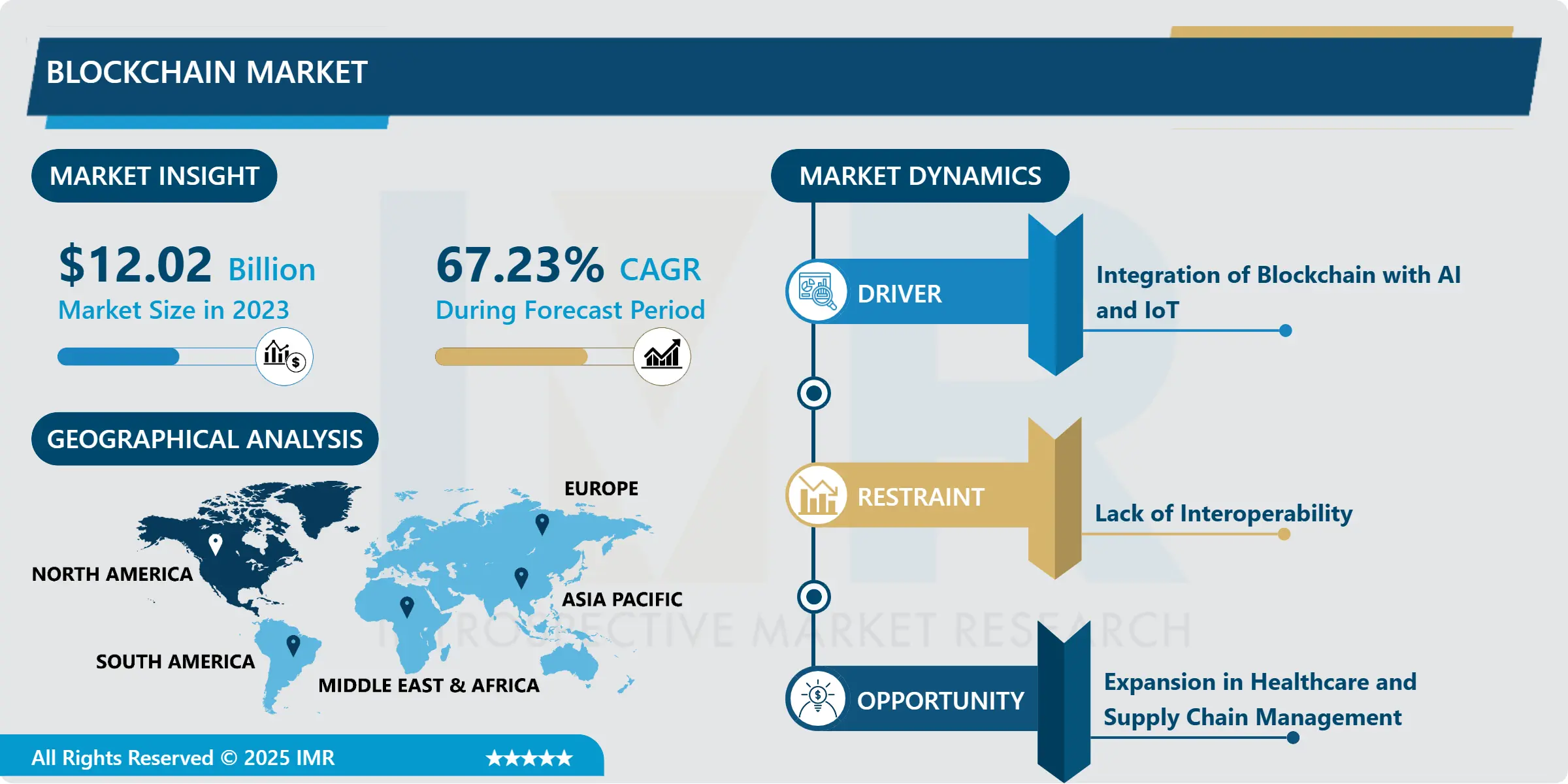
Blockchain Market Size Was Valued at USD 12.02 Billion in 2023, and is Projected to Reach USD 1229.51 Billion by 2032, Growing at a CAGR of 67.23% From 2024-2032.
The blockchain market refers to the global industry centered around blockchain technology, including its development, adoption, and application across sectors like finance, supply chain, healthcare, and more. It covers cryptocurrencies, smart contracts, decentralized applications (dApps), and related services, driving innovation, security, transparency, and efficiency in digital transactions and data management.
The blockchain market has rapidly developed in recent years as this technology demonstrated promising results in various fields of activity. While cryptocurrencies are its most well-known application, blockchain is slowly making its way into industries including finance, healthcare, logistics and others. The global market is mainly motivated by the need for a secure and transparent market, decentralized financial frameworks, and the need for efficiency across various sectors. Good such as smart contacts, DeFi and NFTs have provided new opportunities to expand markets.
They also added that governments, enterprises, and start-ups are also using blockchain to upgrade their processes and be trusted by their clients. For instance, the government is now looking at the idea of applying blockchain in areas such as secure voting systems, public records keeping while enterprises are using Blockchain to minimize fraud, bringing transparency in supply chain and ensure data security. The future development of blockchain technology is marked by its potential to revolutionize industries through a decentralised, transparent, and uncomplicated means of undertaking organizational activities. At the same time, there are still a number of issues and obstacles related to scalability, security, or regulation to be solved in order to achieve the large-scale use.
Blockchain Market Trend Analysis:
Integration of Blockchain with AI and IoT
- As for the present tendencies in the blockchain market, it is possible to note that the key development is the integration of blockchain with the perspectives technologies such as AI and IoT. What makes Blockchain suitable to AI and IoT is the fact that it has a decentralized system that makes it hard for hackers to penetrate and manipulate data; Blockchain also offers a secure way of recording data that has to be exchanged between machines and systems. This makes IoT received data and AI processed data credible, safe, and invisible to external manipulation. It is especially useful for industries which demand accurate and fast real-time data provision, including the supply chain, health care, and logistics – for which blockchain technology will be able to establish transparent and unchangeable records of the product’s movement, status, and transactions.
- Blockchain, AI, and IoT integration is opening up new horizons to make automation faster and much smarter for different sectors to function. In the case of manufacturing, IoT sensors can detect production lines while blockchain can verify data which is processed or analysed using AI to support manufacturing processes. Likewise, on the side of smart devices in energy field, IoT devices, for instance, can monitor energy consumption while on the part of secure and safe records of energy trading and ownership, an application of blockchain.
Expansion in Healthcare and Supply Chain Management
- The one of the biggest opportunities that blockchain can address is the healthcare industry in that it is a good fit for patient data. As it is realized, blockchain provides high levels of security that mean that medical histories, treatment plans, and prescriptions are records in a system that cannot be changed and are accessible only to the right people. This serves the overall interest of patients since real time medical information can be retrieved and consumed, resulting in better decision making and reduced medical mistakes. Blockchain’s usability also has other benefits associated with its transparent and secure nature and these innovations can minimize the instances of fraud, for example fake documents for a person’s health problems or fake drugs in prescription medication
- The fact that the technology is Open and Append-only makes it even more useful in tracing products from the Manufacturer to the end-user. The use of blockchain can help to record the movement of products through the supply chain in real-time, giving all stakeholders variants to prove the correctness of the state and origin of the products. This creates more assurance close to the consumer and minimizes the chances of fake products being sold in the markets. The applicability to supply chains, as they grow more convoluted, as the value creation solution, in extending a museum-quality record of provenance for every item associated with a Blockchain ‘block,’ will go far toward explaining the increased diffusion of the technology in the coming years.
Blockchain Market Segment Analysis:
Blockchain Market is Segmented on the basis of Type, Application, Component, and Region
By Type, Public Blockchain segment is expected to dominate the market during the forecast period
- The public blockchain segment is expected to dominate the market during the forecast period due to its decentralized and transparent nature. Public blockchains, such as Bitcoin and Ethereum, allow anyone to participate, providing greater accessibility and inclusivity. This open-source characteristic makes them highly attractive for applications requiring trust, security, and transparency, such as financial transactions, supply chain tracking, and identity verification.
- the growing adoption of cryptocurrencies, decentralized finance (DeFi), and non-fungible tokens (NFTs) further boosts the demand for public blockchain networks. As these technologies evolve, public blockchains are anticipated to benefit from increased user participation and greater scalability, driving their dominance in the blockchain market. Enhanced security, transparency, and decentralization will continue to play a significant role in their growth.
By Application, Supply Chain Management segment expected to held the largest share
- It needs to be stated that Supply Chain Management is one of the most widespread use-cases of blockchain – mainly because this technology has a natural fit of proactively contributing to increasing supply-chain transparency, security, and product-tracking capabilities. Blockchain helps track goods as they move in the supply chain thus providing other stakeholders with a full chain of the product. Hence, there is low fraud, and errors are also reduced, Security is enhanced thus enhancing the originality of products, especially in special sectors such as the food industry, drugs, and other noble commodities. Of the industries, healthcare stands to gain immensely especially through management and privacy of records through blockchain.
- Blockchain in Government can be said as being a verification management of the government that deals with transparency and reduction of corruptions as well as the increase in efficiency of the public sector. It can be applied in voting, land, and identity, as well as, Identify management and digital currencies, it becomes more efficient as compared to the conventional process. In the Retail and E-commerce sector, it can improve payment systems, eliminate fraud and increase customer credibility by providing the supply chain transparency.
Blockchain Market Regional Insights:
North America is Expected to Dominate the Market Over the Forecast period
- North America first, with the US as the key contributor to the growth. The U.S remains at the leading forefront in the development of blockchain technology with many start-ups, technological firms, and investment firms embracing the technology. These companies are paving the way to using this new tool for many sectors ranging from the finance industry, healthcare, logistics and government suppliers. In the light of this, more organizations in North America have embraced blockchain technology in a bid to meet the demand of safe and cost-efficient systems especially in environments that require perfect record keeping, tracking or transparency of the supply chain.
- North America in the blockchain market is the support from legal frameworks the most vivid examples are the USA and Canada. These regulatory concerning environments offer direction and assurance thus causing the market to expand. It is also expected to maintain this trend as blockchain technology finds its way into essential facilities and other core business barriers throughout the world making North America to be the leading region in the blockchain market.
Active Key Players in the Blockchain Market
- Accenture (Ireland)
- Alibaba Group (China)
- Amazon Web Services (AWS) (USA)
- Bit fury (Netherlands)
- Block stream (Canada)
- Citi (USA)
- Coinbase (USA)
- Consen Sys (USA)
- Dell Technologies (USA)
- IBM (USA)
- Intel (USA)
- Microsoft (USA)
- Oracle (USA)
- Ripple Labs (USA)
- Other Active Players
|
Blockchain Market |
|||
|
Base Year: |
2023 |
Forecast Period: |
2024-2032 |
|
Historical Data: |
2017 to 2023 |
Market Size in 2023: |
USD 12.02 Billion |
|
Forecast Period 2024-32 CAGR: |
67.23% |
Market Size in 2032: |
USD 1229.51 Billion |
|
Segments Covered: |
By Type |
|
|
|
By Application |
|
||
|
By Component |
|
||
|
By Region |
|
||
|
Key Market Drivers: |
|
||
|
Key Market Restraints: |
|
||
|
Key Opportunities: |
|
||
|
Companies Covered in the Report: |
|
||
Chapter 1: Introduction
1.1 Scope and Coverage
Chapter 2:Executive Summary
Chapter 3: Market Landscape
3.1 Market Dynamics
3.1.1 Drivers
3.1.2 Restraints
3.1.3 Opportunities
3.1.4 Challenges
3.2 Market Trend Analysis
3.3 PESTLE Analysis
3.4 Porter's Five Forces Analysis
3.5 Industry Value Chain Analysis
3.6 Ecosystem
3.7 Regulatory Landscape
3.8 Price Trend Analysis
3.9 Patent Analysis
3.10 Technology Evolution
3.11 Investment Pockets
3.12 Import-Export Analysis
Chapter 4: Blockchain Market by Type
4.1 Blockchain Market Snapshot and Growth Engine
4.2 Blockchain Market Overview
4.3 Public Blockchain
4.3.1 Introduction and Market Overview
4.3.2 Historic and Forecasted Market Size in Value USD and Volume Units (2017-2032F)
4.3.3 Key Market Trends, Growth Factors and Opportunities
4.3.4 Public Blockchain: Geographic Segmentation Analysis
4.4 Private Blockchain
4.4.1 Introduction and Market Overview
4.4.2 Historic and Forecasted Market Size in Value USD and Volume Units (2017-2032F)
4.4.3 Key Market Trends, Growth Factors and Opportunities
4.4.4 Private Blockchain: Geographic Segmentation Analysis
4.5 Consortium Blockchain
4.5.1 Introduction and Market Overview
4.5.2 Historic and Forecasted Market Size in Value USD and Volume Units (2017-2032F)
4.5.3 Key Market Trends, Growth Factors and Opportunities
4.5.4 Consortium Blockchain: Geographic Segmentation Analysis
Chapter 5: Blockchain Market by Application
5.1 Blockchain Market Snapshot and Growth Engine
5.2 Blockchain Market Overview
5.3 Supply Chain Management
5.3.1 Introduction and Market Overview
5.3.2 Historic and Forecasted Market Size in Value USD and Volume Units (2017-2032F)
5.3.3 Key Market Trends, Growth Factors and Opportunities
5.3.4 Supply Chain Management: Geographic Segmentation Analysis
5.4 Healthcare
5.4.1 Introduction and Market Overview
5.4.2 Historic and Forecasted Market Size in Value USD and Volume Units (2017-2032F)
5.4.3 Key Market Trends, Growth Factors and Opportunities
5.4.4 Healthcare: Geographic Segmentation Analysis
5.5 Government
5.5.1 Introduction and Market Overview
5.5.2 Historic and Forecasted Market Size in Value USD and Volume Units (2017-2032F)
5.5.3 Key Market Trends, Growth Factors and Opportunities
5.5.4 Government: Geographic Segmentation Analysis
5.6 Retail and E-commerce
5.6.1 Introduction and Market Overview
5.6.2 Historic and Forecasted Market Size in Value USD and Volume Units (2017-2032F)
5.6.3 Key Market Trends, Growth Factors and Opportunities
5.6.4 Retail and E-commerce: Geographic Segmentation Analysis
5.7 Energy and Utilities
5.7.1 Introduction and Market Overview
5.7.2 Historic and Forecasted Market Size in Value USD and Volume Units (2017-2032F)
5.7.3 Key Market Trends, Growth Factors and Opportunities
5.7.4 Energy and Utilities: Geographic Segmentation Analysis
5.8 Others
5.8.1 Introduction and Market Overview
5.8.2 Historic and Forecasted Market Size in Value USD and Volume Units (2017-2032F)
5.8.3 Key Market Trends, Growth Factors and Opportunities
5.8.4 Others: Geographic Segmentation Analysis
Chapter 6: Blockchain Market by component
6.1 Blockchain Market Snapshot and Growth Engine
6.2 Blockchain Market Overview
6.3 Platform
6.3.1 Introduction and Market Overview
6.3.2 Historic and Forecasted Market Size in Value USD and Volume Units (2017-2032F)
6.3.3 Key Market Trends, Growth Factors and Opportunities
6.3.4 Platform: Geographic Segmentation Analysis
6.4 Service
6.4.1 Introduction and Market Overview
6.4.2 Historic and Forecasted Market Size in Value USD and Volume Units (2017-2032F)
6.4.3 Key Market Trends, Growth Factors and Opportunities
6.4.4 Service: Geographic Segmentation Analysis
Chapter 7: Company Profiles and Competitive Analysis
7.1 Competitive Landscape
7.1.1 Competitive Benchmarking
7.1.2 Blockchain Market Share by Manufacturer (2023)
7.1.3 Industry BCG Matrix
7.1.4 Heat Map Analysis
7.1.5 Mergers and Acquisitions
7.2 ACCENTURE
7.2.1 Company Overview
7.2.2 Key Executives
7.2.3 Company Snapshot
7.2.4 Role of the Company in the Market
7.2.5 Sustainability and Social Responsibility
7.2.6 Operating Business Segments
7.2.7 Product Portfolio
7.2.8 Business Performance
7.2.9 Key Strategic Moves and Recent Developments
7.2.10 SWOT Analysis
7.3 AMAZON WEB SERVICES (AWS)
7.4 BLOCK STREAM
7.5 COINBASE
7.6 IBM
7.7 OTHER ACTIVE PLAYERS
Chapter 8: Global Blockchain Market By Region
8.1 Overview
8.2. North America Blockchain Market
8.2.1 Key Market Trends, Growth Factors and Opportunities
8.2.2 Top Key Companies
8.2.3 Historic and Forecasted Market Size by Segments
8.2.4 Historic and Forecasted Market Size By Type
8.2.4.1 Public Blockchain
8.2.4.2 Private Blockchain
8.2.4.3 Consortium Blockchain
8.2.5 Historic and Forecasted Market Size By Application
8.2.5.1 Supply Chain Management
8.2.5.2 Healthcare
8.2.5.3 Government
8.2.5.4 Retail and E-commerce
8.2.5.5 Energy and Utilities
8.2.5.6 Others
8.2.6 Historic and Forecasted Market Size By component
8.2.6.1 Platform
8.2.6.2 Service
8.2.7 Historic and Forecast Market Size by Country
8.2.7.1 US
8.2.7.2 Canada
8.2.7.3 Mexico
8.3. Eastern Europe Blockchain Market
8.3.1 Key Market Trends, Growth Factors and Opportunities
8.3.2 Top Key Companies
8.3.3 Historic and Forecasted Market Size by Segments
8.3.4 Historic and Forecasted Market Size By Type
8.3.4.1 Public Blockchain
8.3.4.2 Private Blockchain
8.3.4.3 Consortium Blockchain
8.3.5 Historic and Forecasted Market Size By Application
8.3.5.1 Supply Chain Management
8.3.5.2 Healthcare
8.3.5.3 Government
8.3.5.4 Retail and E-commerce
8.3.5.5 Energy and Utilities
8.3.5.6 Others
8.3.6 Historic and Forecasted Market Size By component
8.3.6.1 Platform
8.3.6.2 Service
8.3.7 Historic and Forecast Market Size by Country
8.3.7.1 Russia
8.3.7.2 Bulgaria
8.3.7.3 The Czech Republic
8.3.7.4 Hungary
8.3.7.5 Poland
8.3.7.6 Romania
8.3.7.7 Rest of Eastern Europe
8.4. Western Europe Blockchain Market
8.4.1 Key Market Trends, Growth Factors and Opportunities
8.4.2 Top Key Companies
8.4.3 Historic and Forecasted Market Size by Segments
8.4.4 Historic and Forecasted Market Size By Type
8.4.4.1 Public Blockchain
8.4.4.2 Private Blockchain
8.4.4.3 Consortium Blockchain
8.4.5 Historic and Forecasted Market Size By Application
8.4.5.1 Supply Chain Management
8.4.5.2 Healthcare
8.4.5.3 Government
8.4.5.4 Retail and E-commerce
8.4.5.5 Energy and Utilities
8.4.5.6 Others
8.4.6 Historic and Forecasted Market Size By component
8.4.6.1 Platform
8.4.6.2 Service
8.4.7 Historic and Forecast Market Size by Country
8.4.7.1 Germany
8.4.7.2 UK
8.4.7.3 France
8.4.7.4 The Netherlands
8.4.7.5 Italy
8.4.7.6 Spain
8.4.7.7 Rest of Western Europe
8.5. Asia Pacific Blockchain Market
8.5.1 Key Market Trends, Growth Factors and Opportunities
8.5.2 Top Key Companies
8.5.3 Historic and Forecasted Market Size by Segments
8.5.4 Historic and Forecasted Market Size By Type
8.5.4.1 Public Blockchain
8.5.4.2 Private Blockchain
8.5.4.3 Consortium Blockchain
8.5.5 Historic and Forecasted Market Size By Application
8.5.5.1 Supply Chain Management
8.5.5.2 Healthcare
8.5.5.3 Government
8.5.5.4 Retail and E-commerce
8.5.5.5 Energy and Utilities
8.5.5.6 Others
8.5.6 Historic and Forecasted Market Size By component
8.5.6.1 Platform
8.5.6.2 Service
8.5.7 Historic and Forecast Market Size by Country
8.5.7.1 China
8.5.7.2 India
8.5.7.3 Japan
8.5.7.4 South Korea
8.5.7.5 Malaysia
8.5.7.6 Thailand
8.5.7.7 Vietnam
8.5.7.8 The Philippines
8.5.7.9 Australia
8.5.7.10 New Zealand
8.5.7.11 Rest of APAC
8.6. Middle East & Africa Blockchain Market
8.6.1 Key Market Trends, Growth Factors and Opportunities
8.6.2 Top Key Companies
8.6.3 Historic and Forecasted Market Size by Segments
8.6.4 Historic and Forecasted Market Size By Type
8.6.4.1 Public Blockchain
8.6.4.2 Private Blockchain
8.6.4.3 Consortium Blockchain
8.6.5 Historic and Forecasted Market Size By Application
8.6.5.1 Supply Chain Management
8.6.5.2 Healthcare
8.6.5.3 Government
8.6.5.4 Retail and E-commerce
8.6.5.5 Energy and Utilities
8.6.5.6 Others
8.6.6 Historic and Forecasted Market Size By component
8.6.6.1 Platform
8.6.6.2 Service
8.6.7 Historic and Forecast Market Size by Country
8.6.7.1 Turkiye
8.6.7.2 Bahrain
8.6.7.3 Kuwait
8.6.7.4 Saudi Arabia
8.6.7.5 Qatar
8.6.7.6 UAE
8.6.7.7 Israel
8.6.7.8 South Africa
8.7. South America Blockchain Market
8.7.1 Key Market Trends, Growth Factors and Opportunities
8.7.2 Top Key Companies
8.7.3 Historic and Forecasted Market Size by Segments
8.7.4 Historic and Forecasted Market Size By Type
8.7.4.1 Public Blockchain
8.7.4.2 Private Blockchain
8.7.4.3 Consortium Blockchain
8.7.5 Historic and Forecasted Market Size By Application
8.7.5.1 Supply Chain Management
8.7.5.2 Healthcare
8.7.5.3 Government
8.7.5.4 Retail and E-commerce
8.7.5.5 Energy and Utilities
8.7.5.6 Others
8.7.6 Historic and Forecasted Market Size By component
8.7.6.1 Platform
8.7.6.2 Service
8.7.7 Historic and Forecast Market Size by Country
8.7.7.1 Brazil
8.7.7.2 Argentina
8.7.7.3 Rest of SA
Chapter 9 Analyst Viewpoint and Conclusion
9.1 Recommendations and Concluding Analysis
9.2 Potential Market Strategies
Chapter 10 Research Methodology
10.1 Research Process
10.2 Primary Research
10.3 Secondary Research
|
Blockchain Market |
|||
|
Base Year: |
2023 |
Forecast Period: |
2024-2032 |
|
Historical Data: |
2017 to 2023 |
Market Size in 2023: |
USD 12.02 Billion |
|
Forecast Period 2024-32 CAGR: |
67.23% |
Market Size in 2032: |
USD 1229.51 Billion |
|
Segments Covered: |
By Type |
|
|
|
By Application |
|
||
|
By Component |
|
||
|
By Region |
|
||
|
Key Market Drivers: |
|
||
|
Key Market Restraints: |
|
||
|
Key Opportunities: |
|
||
|
Companies Covered in the Report: |
|
||


