Bead Wire Market Synopsis:
Bead Wire Market Size Was Valued at USD 1.26 Billion in 2023, and is Projected to Reach USD 1.76 Billion by 2032, Growing at a CAGR of 3.8 % From 2024-2032.
The Bead Wire Market can be defined as an international market that sells and manufactures bead wires; this is a material used in the manufacture of tires. Tire bead wire is a high carbon steel wire that has an outer plating of brass or bronze for the reinforcement of tire bead cores and thus ensures correct fitting of the tire on rims and structural stability. Fat is used for car radial and bias ply manufacturing tires, and agricultural and industrial purpose tires.
The Bead Wire Market is on a growing trend, mainly driven by high demand for automobiles across the globe and advancements in the field of manufacturing of tires. Increased demand for better fuel consumption and, safety in automobiles has made the use of a high-performance bead wire normal in automobile industries. In addition to this, the move from bias tires to radial tires in both private as well as light commercial vehicles has further boosted the application of bead wires, especially in the developing world where automobile industries are fast being developed.
The trend towards larger size, coupled with the request on sustainability more and more. Manufacturers want enhanced high tensile bead wire, which offers the same tensile strength and weight as more than the light-weighted tire in the market. Another reason which has also contributed to fuel demand is the availability of electric cars since bead wires affects the durability and performance of specialized tires for electric cars. Thus, problems such as high volatility of the raw material and higher costs related to environmental issues like emissions and disposal must be resolved through innovations and better strategies among members of the market.
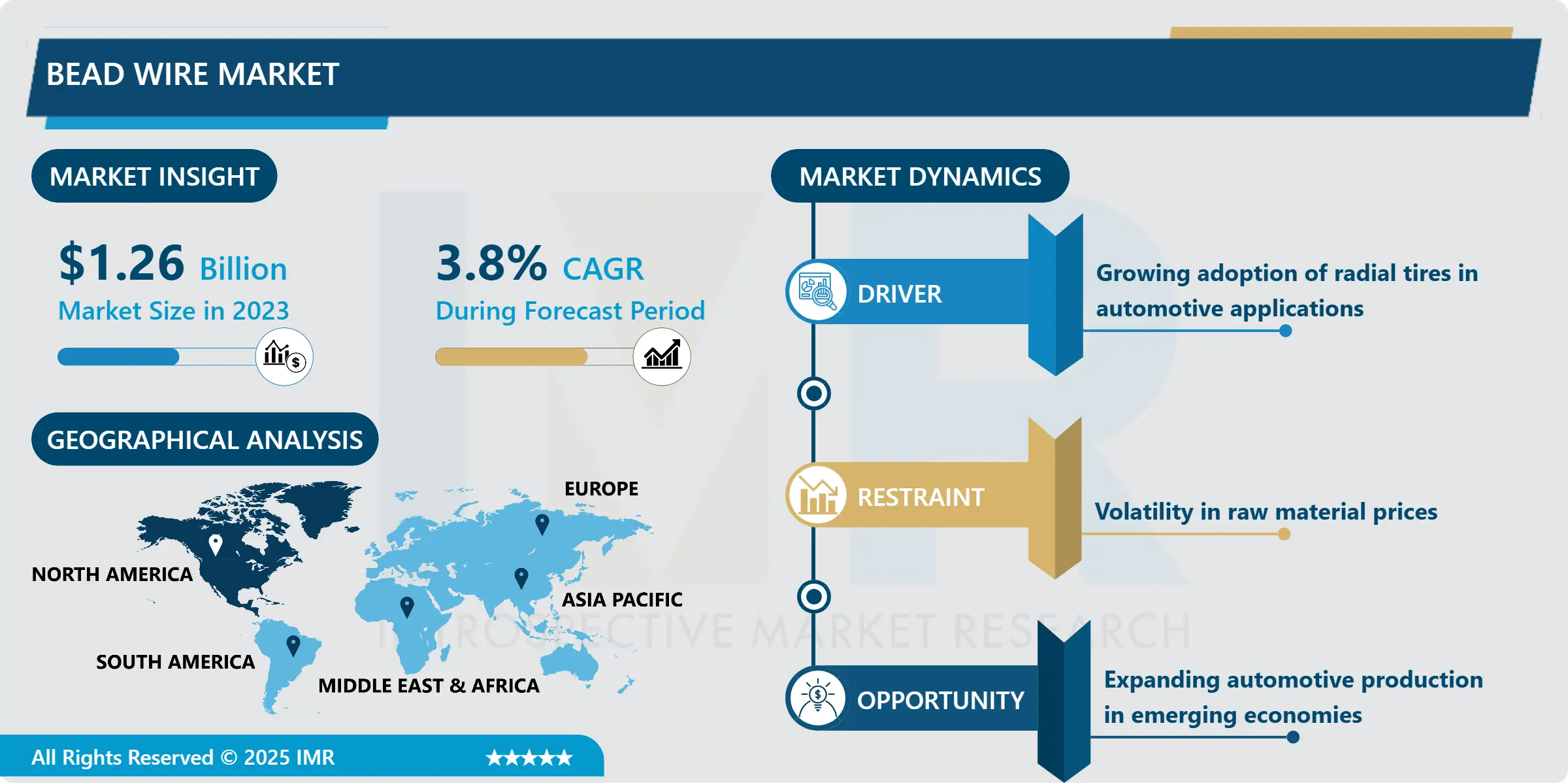
Bead Wire Market Trend Analysis:
Rising Demand for High-Tensile Bead Wire in Automotive Tires
- Among the current trends prevailing in the Bead Wire Market is upgrade towards high tensile bead wire material in tyres industries. As the original equipment manufacturers strive to achieve efficiency and safety of automobiles, high tensile bead wires have become necessity. These wires are also comprehensive comparing to the tensile wires usually and are less deformable and less in total mass. This is s this is especially relevant to the modern radial tire used is particularly relevant for the modern radial tire that is intended for offering long service and enhanced performance. This has been made worse by advancements in material technology that has resulted put in the production of bead wire that can respond to high-performance and heave duty vehicles.
Expanding Automotive Production in Emerging Economies
- The global Bead Wire Market has even higher growth potential in emerging markets mainly due to the increasing automotive industry. The automobile industries of the Asia-Pacific, Latin America, and African nations are rising due to improved economic status, growth and urbanization, and improved disposable income. This increase in automobile production has required high-quality bead wire among other tire accessories. Further, the existing policies for the improvement of infrastructure and transport facilities in these regions is putting pressure on the commercial vehicles market to offer improved tires that deliver superior longevity and performance. As a result of regional production facilities and strategic partnerships, by building up investment in such high-growth areas this opportunity can be utilized by market players.
Bead Wire Market Segment Analysis:
Bead Wire Market is Segmented on the basis of product type, tensile strength. End user, and Region.
By Product Type, the Radial Tire Segment is expected to dominate the market during the forecast period
- In this forecast, it was noted that the Radial Tire Segment will anticipatedly remain the largest seller to the Bead Wire Market because of its use in the manufacturing of passenger; commercial as well as industrial vehicles. Radial tires offer a higher degree of durability, lower fuel consumption, and satisfied ride comfort than bias tires, that is why radial tires are suitable for today’s vehicles. The main two wire designing functions of bead wire are the reinforcement to the tire bead region area and anti-slip provision to each tire under high-stress situations. The transition to radial tires is best observed with the threats among the emerging markets, which increases automotive production as well as the implementation of standards regarding fuel efficiency. In that regard, the rolling resistance of radial tires is slightly lower and they last longer; conditions that make the aspiration of sustainable goals easier.
By Tensile Strength, the High Tensile segment expected to held the largest share
- In this forecast, it was noted that the Radial Tire Segment will anticipatedly remain the largest seller to the Bead Wire Market because of its use in the manufacturing of passenger; commercial as well as industrial vehicles. Radial tires offer a higher degree of durability, lower fuel consumption, and satisfied ride comfort than bias tyres, which is why radial tires are suitable for today’s vehicles. The main two wire designing functions of bead wire are the reinforcement to the tire bead region area and anti-slip provision to each tire under high-stress situations. The transition to radial tires is best observed with the threats among the emerging markets, which increases automotive production as well as the implementation of standards regarding fuel efficiency. In that regard, the rolling resistance of radial tires is slightly lower and they last longer; conditions that make the aspiration of sustainable goals easier. Since car makers are showing increasing demand for enhanced automobile tire technologies, it may be concluded that the demand for high-quality bead wire by radial tires is another market driver.
Bead Wire Market Regional Insights:
Nrth America is Expected to Dominate the Market Over the Forecast period
- North America is expected to continue to be the largest consumer in the global Bead Wire Market throughout the forecast period because of the sound automotive market and growing demand for more performing tires. Consequently, the application of radial tyre in the United States and And Canada in particular has grown rapidly on both the passenger and the commercial automobile. The local bead wire manufacturers have modern production equipment; excellent research facilities and supplies chain that support automobile and other industries.
- For that matter, rising sales of electric vehicles are also boosting the adoption of high-quality bead wire across the North American landscape. EV-specific tires require better reinforcement for some constraints that are characteristic of electric-driven trains such as high torque and additional load-bearing capability on their wheels. It has led to a need to invest more in the enhancement of superior bead wire, majoring in EV use. In addition, new environmental concerns like environmentally conscious living and circular economy have prompted changes in the tire recycling and bead wire manufacturing industries in North America. For this reason, the region has remained open to friendly trade policies and relationships that exist between car makers and tire manufacturers.
Active Key Players in the Bead Wire Market:
- Bekaert (Belgium)
- Bridgestone Corporation (Japan)
- Camesa Wire Rope (Mexico)
- Chun Yu Works & Co., Ltd. (Taiwan)
- Heico Wire Group (USA)
- Himadri Specialty Chemical Ltd. (India)
- Jiangsu Xingda Steel Tyre Cord Co., Ltd. (China)
- Kiswire Ltd. (South Korea)
- Shandong Daye Coated Steel Coil Co., Ltd. (China)
- Sumitomo Electric Industries, Ltd. (Japan)
- Suzhou Sugang Wire Co., Ltd. (China)
- Tata Steel Ltd. (India)
- TOKUSEN U.S.A., Inc. (USA)
- Usha Martin Limited (India)
- WireCo WorldGroup (USA)
- Other Active Players
|
Bead Wire Market |
|||
|
Base Year: |
2023 |
Forecast Period: |
2024-2032 |
|
Historical Data: |
2017 to 2023 |
Market Size in 2023: |
USD 1.26 Billion |
|
Forecast Period 2024-32 CAGR: |
3.8 % |
Market Size in 2032: |
USD 1.76 Billion |
|
Segments Covered: |
By Product Type |
|
|
|
By Tensile Strength |
|
||
|
By End User |
|
||
|
By Region |
|
||
|
Key Market Drivers: |
|
||
|
Key Market Restraints: |
|
||
|
Key Opportunities: |
|
||
|
Companies Covered in the report: |
|
||
Chapter 1: Introduction
1.1 Scope and Coverage
Chapter 2:Executive Summary
Chapter 3: Market Landscape
3.1 Market Dynamics
3.1.1 Drivers
3.1.2 Restraints
3.1.3 Opportunities
3.1.4 Challenges
3.2 Market Trend Analysis
3.3 PESTLE Analysis
3.4 Porter's Five Forces Analysis
3.5 Industry Value Chain Analysis
3.6 Ecosystem
3.7 Regulatory Landscape
3.8 Price Trend Analysis
3.9 Patent Analysis
3.10 Technology Evolution
3.11 Investment Pockets
3.12 Import-Export Analysis
Chapter 4: Bead Wire Market by Product Type
4.1 Bead Wire Market Snapshot and Growth Engine
4.2 Bead Wire Market Overview
4.3 Radial tiles
4.3.1 Introduction and Market Overview
4.3.2 Historic and Forecasted Market Size in Value USD and Volume Units (2017-2032F)
4.3.3 Key Market Trends, Growth Factors and Opportunities
4.3.4 Radial tiles: Geographic Segmentation Analysis
4.4 Bias tiles
4.4.1 Introduction and Market Overview
4.4.2 Historic and Forecasted Market Size in Value USD and Volume Units (2017-2032F)
4.4.3 Key Market Trends, Growth Factors and Opportunities
4.4.4 Bias tiles: Geographic Segmentation Analysis
Chapter 5: Bead Wire Market by Tensile Strength
5.1 Bead Wire Market Snapshot and Growth Engine
5.2 Bead Wire Market Overview
5.3 High Tensile
5.3.1 Introduction and Market Overview
5.3.2 Historic and Forecasted Market Size in Value USD and Volume Units (2017-2032F)
5.3.3 Key Market Trends, Growth Factors and Opportunities
5.3.4 High Tensile: Geographic Segmentation Analysis
5.4 Regular Tensile
5.4.1 Introduction and Market Overview
5.4.2 Historic and Forecasted Market Size in Value USD and Volume Units (2017-2032F)
5.4.3 Key Market Trends, Growth Factors and Opportunities
5.4.4 Regular Tensile: Geographic Segmentation Analysis
Chapter 6: Bead Wire Market by End User
6.1 Bead Wire Market Snapshot and Growth Engine
6.2 Bead Wire Market Overview
6.3 Automotive
6.3.1 Introduction and Market Overview
6.3.2 Historic and Forecasted Market Size in Value USD and Volume Units (2017-2032F)
6.3.3 Key Market Trends, Growth Factors and Opportunities
6.3.4 Automotive: Geographic Segmentation Analysis
6.4 Construction
6.4.1 Introduction and Market Overview
6.4.2 Historic and Forecasted Market Size in Value USD and Volume Units (2017-2032F)
6.4.3 Key Market Trends, Growth Factors and Opportunities
6.4.4 Construction: Geographic Segmentation Analysis
6.5 Mining
6.5.1 Introduction and Market Overview
6.5.2 Historic and Forecasted Market Size in Value USD and Volume Units (2017-2032F)
6.5.3 Key Market Trends, Growth Factors and Opportunities
6.5.4 Mining: Geographic Segmentation Analysis
6.6 Agriculture
6.6.1 Introduction and Market Overview
6.6.2 Historic and Forecasted Market Size in Value USD and Volume Units (2017-2032F)
6.6.3 Key Market Trends, Growth Factors and Opportunities
6.6.4 Agriculture: Geographic Segmentation Analysis
6.7 Others
6.7.1 Introduction and Market Overview
6.7.2 Historic and Forecasted Market Size in Value USD and Volume Units (2017-2032F)
6.7.3 Key Market Trends, Growth Factors and Opportunities
6.7.4 Others: Geographic Segmentation Analysis
Chapter 7: Company Profiles and Competitive Analysis
7.1 Competitive Landscape
7.1.1 Competitive Benchmarking
7.1.2 Bead Wire Market Share by Manufacturer (2023)
7.1.3 Industry BCG Matrix
7.1.4 Heat Map Analysis
7.1.5 Mergers and Acquisitions
7.2 BEKAERT (BELGIUM)
7.2.1 Company Overview
7.2.2 Key Executives
7.2.3 Company Snapshot
7.2.4 Role of the Company in the Market
7.2.5 Sustainability and Social Responsibility
7.2.6 Operating Business Segments
7.2.7 Product Portfolio
7.2.8 Business Performance
7.2.9 Key Strategic Moves and Recent Developments
7.2.10 SWOT Analysis
7.3 BRIDGESTONE CORPORATION (JAPAN)
7.4 CAMESA WIRE ROPE (MEXICO)
7.5 CHUN YU WORKS & CO. LTD. (TAIWAN)
7.6 HEICO WIRE GROUP (USA)
7.7 HIMADRI SPECIALTY CHEMICAL LTD. (INDIA)
7.8 JIANGSU XINGDA STEEL TYRE CORD CO. LTD. (CHINA)
7.9 KISWIRE LTD. (SOUTH KOREA)
7.10 SHANDONG DAYE COATED STEEL COIL CO. LTD. (CHINA)
7.11 SUMITOMO ELECTRIC INDUSTRIES
7.12 LTD. (JAPAN)
7.13 SUZHOU SUGANG WIRE CO. LTD. (CHINA)
7.14 TATA STEEL LTD. (INDIA)
7.15 TOKUSEN U.S.A. INC. (USA)
7.16 USHA MARTIN LIMITED (INDIA)
7.17 WIRECO WORLDGROUP (USA)
7.18 OTHER ACTIVE PLAYERS
Chapter 8: Global Bead Wire Market By Region
8.1 Overview
8.2. North America Bead Wire Market
8.2.1 Key Market Trends, Growth Factors and Opportunities
8.2.2 Top Key Companies
8.2.3 Historic and Forecasted Market Size by Segments
8.2.4 Historic and Forecasted Market Size By Product Type
8.2.4.1 Radial tiles
8.2.4.2 Bias tiles
8.2.5 Historic and Forecasted Market Size By Tensile Strength
8.2.5.1 High Tensile
8.2.5.2 Regular Tensile
8.2.6 Historic and Forecasted Market Size By End User
8.2.6.1 Automotive
8.2.6.2 Construction
8.2.6.3 Mining
8.2.6.4 Agriculture
8.2.6.5 Others
8.2.7 Historic and Forecast Market Size by Country
8.2.7.1 US
8.2.7.2 Canada
8.2.7.3 Mexico
8.3. Eastern Europe Bead Wire Market
8.3.1 Key Market Trends, Growth Factors and Opportunities
8.3.2 Top Key Companies
8.3.3 Historic and Forecasted Market Size by Segments
8.3.4 Historic and Forecasted Market Size By Product Type
8.3.4.1 Radial tiles
8.3.4.2 Bias tiles
8.3.5 Historic and Forecasted Market Size By Tensile Strength
8.3.5.1 High Tensile
8.3.5.2 Regular Tensile
8.3.6 Historic and Forecasted Market Size By End User
8.3.6.1 Automotive
8.3.6.2 Construction
8.3.6.3 Mining
8.3.6.4 Agriculture
8.3.6.5 Others
8.3.7 Historic and Forecast Market Size by Country
8.3.7.1 Russia
8.3.7.2 Bulgaria
8.3.7.3 The Czech Republic
8.3.7.4 Hungary
8.3.7.5 Poland
8.3.7.6 Romania
8.3.7.7 Rest of Eastern Europe
8.4. Western Europe Bead Wire Market
8.4.1 Key Market Trends, Growth Factors and Opportunities
8.4.2 Top Key Companies
8.4.3 Historic and Forecasted Market Size by Segments
8.4.4 Historic and Forecasted Market Size By Product Type
8.4.4.1 Radial tiles
8.4.4.2 Bias tiles
8.4.5 Historic and Forecasted Market Size By Tensile Strength
8.4.5.1 High Tensile
8.4.5.2 Regular Tensile
8.4.6 Historic and Forecasted Market Size By End User
8.4.6.1 Automotive
8.4.6.2 Construction
8.4.6.3 Mining
8.4.6.4 Agriculture
8.4.6.5 Others
8.4.7 Historic and Forecast Market Size by Country
8.4.7.1 Germany
8.4.7.2 UK
8.4.7.3 France
8.4.7.4 The Netherlands
8.4.7.5 Italy
8.4.7.6 Spain
8.4.7.7 Rest of Western Europe
8.5. Asia Pacific Bead Wire Market
8.5.1 Key Market Trends, Growth Factors and Opportunities
8.5.2 Top Key Companies
8.5.3 Historic and Forecasted Market Size by Segments
8.5.4 Historic and Forecasted Market Size By Product Type
8.5.4.1 Radial tiles
8.5.4.2 Bias tiles
8.5.5 Historic and Forecasted Market Size By Tensile Strength
8.5.5.1 High Tensile
8.5.5.2 Regular Tensile
8.5.6 Historic and Forecasted Market Size By End User
8.5.6.1 Automotive
8.5.6.2 Construction
8.5.6.3 Mining
8.5.6.4 Agriculture
8.5.6.5 Others
8.5.7 Historic and Forecast Market Size by Country
8.5.7.1 China
8.5.7.2 India
8.5.7.3 Japan
8.5.7.4 South Korea
8.5.7.5 Malaysia
8.5.7.6 Thailand
8.5.7.7 Vietnam
8.5.7.8 The Philippines
8.5.7.9 Australia
8.5.7.10 New Zealand
8.5.7.11 Rest of APAC
8.6. Middle East & Africa Bead Wire Market
8.6.1 Key Market Trends, Growth Factors and Opportunities
8.6.2 Top Key Companies
8.6.3 Historic and Forecasted Market Size by Segments
8.6.4 Historic and Forecasted Market Size By Product Type
8.6.4.1 Radial tiles
8.6.4.2 Bias tiles
8.6.5 Historic and Forecasted Market Size By Tensile Strength
8.6.5.1 High Tensile
8.6.5.2 Regular Tensile
8.6.6 Historic and Forecasted Market Size By End User
8.6.6.1 Automotive
8.6.6.2 Construction
8.6.6.3 Mining
8.6.6.4 Agriculture
8.6.6.5 Others
8.6.7 Historic and Forecast Market Size by Country
8.6.7.1 Turkiye
8.6.7.2 Bahrain
8.6.7.3 Kuwait
8.6.7.4 Saudi Arabia
8.6.7.5 Qatar
8.6.7.6 UAE
8.6.7.7 Israel
8.6.7.8 South Africa
8.7. South America Bead Wire Market
8.7.1 Key Market Trends, Growth Factors and Opportunities
8.7.2 Top Key Companies
8.7.3 Historic and Forecasted Market Size by Segments
8.7.4 Historic and Forecasted Market Size By Product Type
8.7.4.1 Radial tiles
8.7.4.2 Bias tiles
8.7.5 Historic and Forecasted Market Size By Tensile Strength
8.7.5.1 High Tensile
8.7.5.2 Regular Tensile
8.7.6 Historic and Forecasted Market Size By End User
8.7.6.1 Automotive
8.7.6.2 Construction
8.7.6.3 Mining
8.7.6.4 Agriculture
8.7.6.5 Others
8.7.7 Historic and Forecast Market Size by Country
8.7.7.1 Brazil
8.7.7.2 Argentina
8.7.7.3 Rest of SA
Chapter 9 Analyst Viewpoint and Conclusion
9.1 Recommendations and Concluding Analysis
9.2 Potential Market Strategies
Chapter 10 Research Methodology
10.1 Research Process
10.2 Primary Research
10.3 Secondary Research
|
Bead Wire Market |
|||
|
Base Year: |
2023 |
Forecast Period: |
2024-2032 |
|
Historical Data: |
2017 to 2023 |
Market Size in 2023: |
USD 1.26 Billion |
|
Forecast Period 2024-32 CAGR: |
3.8 % |
Market Size in 2032: |
USD 1.76 Billion |
|
Segments Covered: |
By Product Type |
|
|
|
By Tensile Strength |
|
||
|
By End User |
|
||
|
By Region |
|
||
|
Key Market Drivers: |
|
||
|
Key Market Restraints: |
|
||
|
Key Opportunities: |
|
||
|
Companies Covered in the report: |
|
||