




Automotive Powertrain Dynamometers Market Synopsis:
Automotive Powertrain Dynamometers Market Was Valued at USD 299.82 Million in 2023 and is Projected to Reach USD 459.96 Million by 2032, Growing at a CAGR of 4.87% from 2024 to 2032.
The Automotive Powertrain Dynamometers Market can be defined as that specific sub-sector of the automotive business where equipment used for testing and evaluating powertrain performance is manufactured and applied. A powertrain dynamometer is a test equipment that measures and analyzes several parts of the powertrain system such as the engine, the transmission, and the driving shaft under actual like conditions. These test facilitate the manufacturer to understand the performance of powertrain system and its efficiency and durability under various operation conditions necessary safety and environmental standards. The market is pioneered by the development of automotive technologies, increasing awareness of fuel-efficient cars, and the increasing need for performance testing due to the constantly changing automotive regulatory requirements.
APDM stands for Automotive Powertrain Dynamometers; it is an industry segment of automotive testing which mainly focuses on design, testing & development of Powertrain. These dynamometers are to assess the performance of engines, transmissions, and other powertrain components and verify compliance of the produced vehicles with the necessary criteria as to fuel consumption, exhaust emissions, and other parameters. Due to the rising global thirst for fuel efficient automobiles and the current enhancements and advancements of CO2 emission standards, the automotive powertrain dynamometers have found a good market. Members within the automotive area, such as OEMs and tier suppliers, are purchasing new testing systems, as it increases market growth to meet the new emerging standards.
With the rapidly growing technological trends within the automotive power train systems including the emergence of the EVs and Hybrid power trains, there is further amplified demand for elaborate dynamometer testing. Modern dynamometers can test any type of powertrain – and not only conventional ICE, but also electric motors or their hybrids, in various conditions for maximum efficiency across platforms. In addition, automation, artificial intelligence, and real-time data analysis have been incorporated into dynamometer systems; this made testing procedures to be far much efficient, and results obtained much faster. This is driven by increasing focus on shortening product development cycle, its cost reduction and at the same time enhance on the quality and performances.
The market is also credited to other factors including; the ever growing trend towards sustainability in the automobile industry. Courtesy of the increasing prime on the environmental impact of powertrain systems, there is an increasing market demand for cleaner and green systems. Dynamometers are used where these systems have to be subjected to tests for fuel efficiency as well as emissions and this makes them of great emphasis. Besides this, rising global government policies towards stricter emission norms has forced automobile manufacturers to install technologically superior dynamometer systems required to meet the emission requirements. Geographically, the market has high demand in North America, Europe, and Asia-Pacific region because automotive industries are focused and investment in traditional and electric vehicles is high.
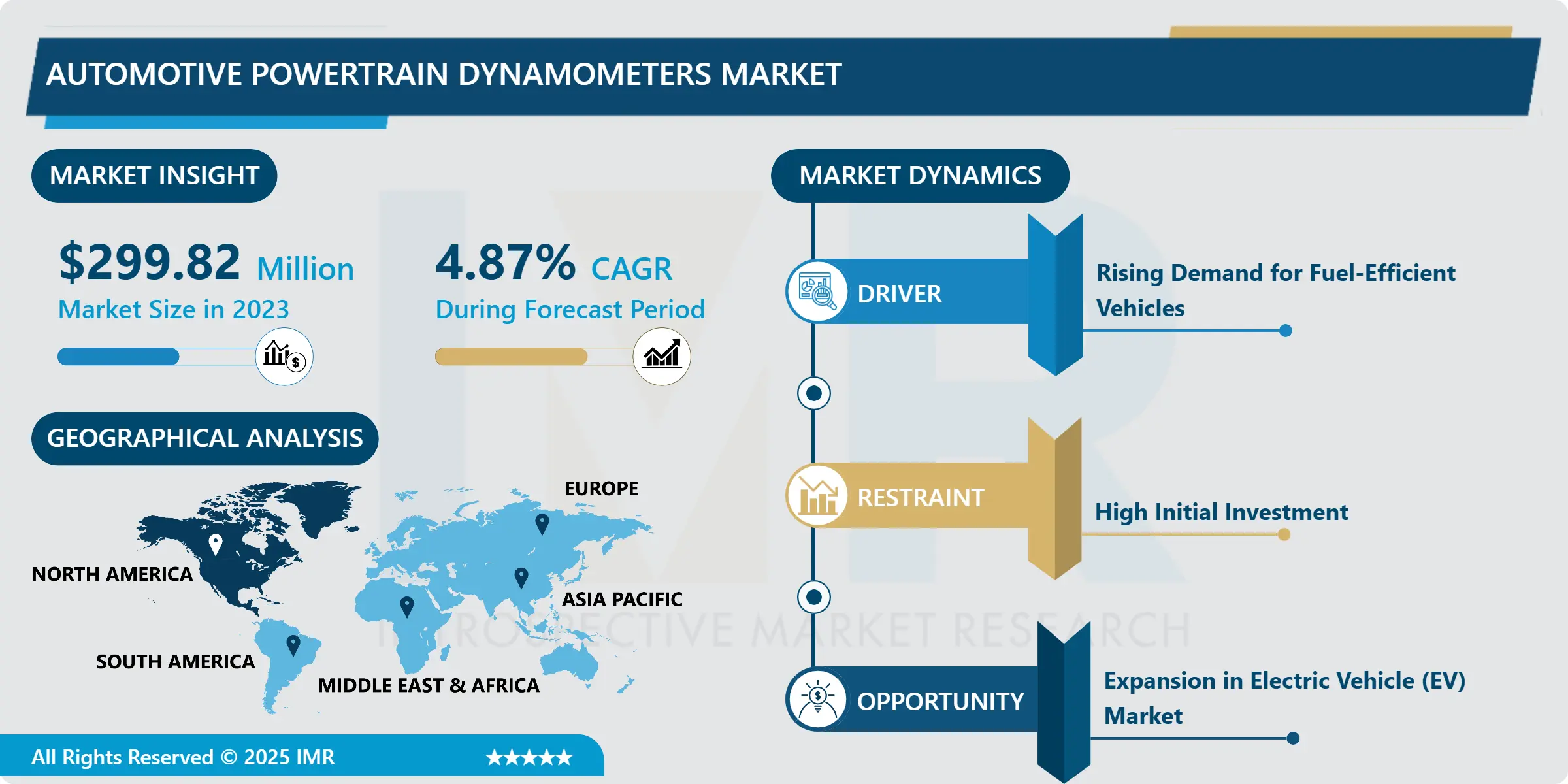
Automotive Powertrain Dynamometers Market Trend Analysis:
Impact of Stringent Regulatory Standards and Technological Advancements on the Automotive Powertrain Dynamometers Market
- Because regulatory standards for fuel economy and environmental concerns continue to rise, manufacturers are also placing emphasis on improved powertrain testing technologies. A dynamic analyzer always has a significant function in this process through explaining affairs of powertrain constituents including engines, transmissions, and drivetrains to optimize them under different load conditions. These testing systems can be used to accurately quantify critical elements such as power, consumption rates and emission rates among others. Due to increasing concern on the carbon emissions and meeting the international emission standards dynamometer play an important role of checking that the vehicles not only meet the performance and handling standards, but they also meet the emission norms. The automotive industry is demanding more fuel efficient and sustainable powertrains at present, thus the significance of powertrain testing technologies.
- The growing adoption in electric vehicles and hybrid powertrains has also steeped up the need for the automotive powertrain dynamometer. Thanks to their sophisticated powertrain and battery systems, EVs need focused calibration to allow for the most efficient energy consumption, longest travel on a single charge or best performance. Similarly, in hybrid cars, the combination between the internal combustion engine and the motor must excellent to give maximum efficiency of fuel and minimal output. The above technological development calls for dynamometers that can cater for the up-to-date powertrain layouts. International automakers are under pressure to introduce new and develop novel power train technologies, making dynamometers more relevant thus catalysing market expansion. Due to rising spending on research and development, there will be a steady market demand for these complex testing systems, which will enable upcoming vehicles to perform to their best given the intensity of the guidelines and new technologies in the market.
Driving Opportunities in the Automotive Powertrain Dynamometers Market
- Automotive industry is moving up the value chain and pivoting towards innovation for electric vehicles (EVs) and such change is requiring test and validation tools like powertrain dynamometers. Since electric vehicles have unique powertrain components including batteries, motors, and control system, Dynamometers have been used to assess performance, reliability, and efficiency of the powertrain in such vehicles. The shift to EVs made the emphasis on powertrain efficiency even more important than was before, which resulted in a need for equipment capable of emulating various conditions. While manufacturers look for ways to optimize new powertrains, there is increasing need for powertrain dynamometers this can accommodate both ICEs and electric drive systems.
- That trend is opening up large opportunities for dynamometer suppliers, especially those at the high end offering general-purpose dynamometers that are designed to accommodate various types of automobiles. With automotive powertrain systems getting more complex compounded by the inclusion of electric and hybrid systems, manufacturers are increasingly sourcing dynamometers with multi-axial solutions. This includes systems that provide capability for the prediction of different load factors, torque, efficiency across diverse powertrain types. Furthermore, persistent trends in the industry such as increasing performance and the efficiency of technical automotive components also can be considered as potential for dynamometer manufacturers to provide innovative solutions that can meet the constantly developing automotive technologies. Thus, utilizing these trends business can get ahead and provide more and more requests to advanced powertrain testing solutions on the market.
Automotive Powertrain Dynamometers Market Segment Analysis:
Automotive Powertrain Dynamometers Market is Segmented on the basis of Type, Application, and Region.
By Type, ICE Powertrain segment is expected to dominate the market during the forecast period
- The ICE powertrain has been the industry’s standard for the greatest period, where gasoline or diesel fuels the engine utilised in vehicles. This conventional structure can be found in automobiles globally, more precisely in areas that already possess an efficient developed fuel network and have been heavily relying on ICE technology. In these markets, ICE vehicles have better market numbers in comparison to electric and hybrid vehicles because of available fuelling infrastructure and relatively lower costs of vehicles. Although there is pressure by market forces towards a more sustainable solution the ICE powertrain is still a key segment within the global automobile market particularly in tier one developing economies where electric or hybrid vehicles cannot be afforded or supported by the infrastructure systems.
- However, the double-pipe ICE powertrain is gradually losing market shares owing to increasing use of electric and hybrid powertrains dictated by the stringent environment standards and environmental protection policies across the world. Countries globally are increasingly raising their limits on emissions, making automakers search for alternatives to the traditional ICE. Thus, due to innovations that are seen in the Electric Vehicle (EV) technology, with development of battery range and decrease of costs, shift towards EVs is gradually occurring. Further, this shift is driven by increasing stakes in fuel prices and expenditure and the environmental effects of fossil fuel products. Technological and regulatory pressures will also continue to reduce overall ICE powertrain market share over time in lieu of cheaper and ecologically friendly systems.
By Application, Passenger Vehicles segment expected to held the largest share
- Passenger vehicle application is one of the broadest and most extensive uses of automotive powertrains, including automobiles, compact cars, two-box coupes, and SUVs, designed for individual usage. This segment has continued to grow mainly due to population for example through urbanization, increased disposable income and the desire for personal mobility among others. Since more consumers are likely to become middle-income earners in the developing world, the market for personal vehicles is ever-growing. Also at the same, environmentalism and the increasing price of fuel have helped in increasing the demand for efficient fuel and environmentally friendly cars. This has been so because the hybrid and electric powertrains are popular in the market since they provide better fuel economy and low emission system as per the government policies.
- Going forward, the analysts of the industry were confident that the sales of the electric power trains will penetrate deeper into the passenger vehicle market than before. Buffett made these remarks when arising his concern on gasoline vehicles, which he pointed out are increasingly pushing the EVs aside as; evolving battery technology is making the EVs longer ranges and with considerably cheaper charging prospects. Because of the increasing consumer consciousness of sustainability and environmentalism, it is expected that alternative transportation such as EVs will receive a greater market share. Also, the passenger vehicle segment is also experiencing the implementation of autonomous driving and connection features such as advanced driver assist systems (ADAS), which continue to increase the call for enhance powertrain solutions. They are not only changing the functional purpose of the car but are also impacting the progressive evolutionary changes leading towards the optimum mix of powertrain attributes in the long run.
Automotive Powertrain Dynamometers Market Regional Insights:
North America is Expected to Dominate the Market Over the Forecast period
- The automotive powertrain dynamometer market in North America is relatively mature and experiencing a steady increase, mainly due to the well-developed automotive industry in this area. The United States and Mexico are a focal driving force to this growth because both countries are find with automobiles producers and suppliers. With prominent automotive Original Equipment Manufacturers like General Motors, Ford, and Fiat Chrysler, coupled with the dense supplier networks, the need for exceptional performance testing equipment including a powertrain dynamometer has been established. These devices are crucial for measuring power and fuel consumption of engines and overall vehicle efficiency – critical for automotive R&D in the region. This is a reality because while automotive manufacturers are designing their cars with better performance and reliability the demand for better and more accurate testing systems grows.
- However, it is worth mentioning that North America, which has some of the highest emission standards for vehicles, and the growing focus on improved fuel efficiency is driving demand for powertrain dynamometers. Of course, it is important to take into account that the United States, which has well-developed automobile industry, has a major impact on the configuration of the region. The government, through agencies like the EPA, has set very high emission standards, that push manufacturers into adopting better testing regimes from which they can meet the set standards. The above regulations coupled with the increasing popularity of EVs and hybrids and power train derivations, add to the need for specific test equipment to assess the merits of emergent power train technologies. Therefore powertrain dynamometers are inevitable tool for designing and developing vehicle that can be complied with the environmental regulations and at the same time be able to meet the performance criteria of the consumers, hence making the market for powertrain dynamometer stronger in the future of northern America.
Active Key Players in the Automotive Powertrain Dynamometers Market:
- AIP GmbH & Co. KG
- AVL List GmbH
- Burke E. Porter Machinery Company (BEPCO)
- FEV Group
- Horiba, Ltd.
- Intertek Group PLC
- Ricardo
- Rototest
- Sakor Technologies, Inc
- Other Active Players
|
Automotive Powertrain Dynamometers Market |
|||
|
Base Year: |
2023 |
Forecast Period: |
2024-2032 |
|
Historical Data: |
2017 to 2023 |
Market Size in 2023: |
USD 299.82 Million |
|
Forecast Period 2024-32 CAGR: |
4.87% |
Market Size in 2032: |
USD 459.96 Million |
|
Segments Covered: |
By Type |
|
|
|
By Application |
|
||
|
By Region |
|
||
|
Key Market Drivers: |
|
||
|
Key Market Restraints: |
|
||
|
Key Opportunities: |
|
||
|
Companies Covered in the report: |
|
||
Chapter 1: Introduction
1.1 Scope and Coverage
Chapter 2:Executive Summary
Chapter 3: Market Landscape
3.1 Market Dynamics
3.1.1 Drivers
3.1.2 Restraints
3.1.3 Opportunities
3.1.4 Challenges
3.2 Market Trend Analysis
3.3 PESTLE Analysis
3.4 Porter's Five Forces Analysis
3.5 Industry Value Chain Analysis
3.6 Ecosystem
3.7 Regulatory Landscape
3.8 Price Trend Analysis
3.9 Patent Analysis
3.10 Technology Evolution
3.11 Investment Pockets
3.12 Import-Export Analysis
Chapter 4: Automotive Powertrain Dynamometers Market by Type
4.1 Automotive Powertrain Dynamometers Market Snapshot and Growth Engine
4.2 Automotive Powertrain Dynamometers Market Overview
4.3 ICE Powertrain
4.3.1 Introduction and Market Overview
4.3.2 Historic and Forecasted Market Size in Value USD and Volume Units (2017-2032F)
4.3.3 Key Market Trends, Growth Factors and Opportunities
4.3.4 ICE Powertrain: Geographic Segmentation Analysis
4.4 Hybrid and Electric Powertrain. Application
4.4.1 Introduction and Market Overview
4.4.2 Historic and Forecasted Market Size in Value USD and Volume Units (2017-2032F)
4.4.3 Key Market Trends, Growth Factors and Opportunities
4.4.4 Hybrid and Electric Powertrain. Application: Geographic Segmentation Analysis
Chapter 5: Company Profiles and Competitive Analysis
5.1 Competitive Landscape
5.1.1 Competitive Benchmarking
5.1.2 Automotive Powertrain Dynamometers Market Share by Manufacturer (2023)
5.1.3 Industry BCG Matrix
5.1.4 Heat Map Analysis
5.1.5 Mergers and Acquisitions
5.2 HORIBA
5.2.1 Company Overview
5.2.2 Key Executives
5.2.3 Company Snapshot
5.2.4 Role of the Company in the Market
5.2.5 Sustainability and Social Responsibility
5.2.6 Operating Business Segments
5.2.7 Product Portfolio
5.2.8 Business Performance
5.2.9 Key Strategic Moves and Recent Developments
5.2.10 SWOT Analysis
5.3 LTD.
5.4 RICARDO
5.5 AVL LIST GMBH
5.6 ROTOTEST
5.7 FEV GROUP
5.8 INTERTEK GROUP PLC
5.9 AIP GMBH & CO. KG
5.10 BURKE E. PORTER MACHINERY COMPANY (BEPCO)
5.11 AND SAKOR TECHNOLOGIES INC
5.12 OTHER ACTIVE PLAYERS
Chapter 6: Global Automotive Powertrain Dynamometers Market By Region
6.1 Overview
6.2. North America Automotive Powertrain Dynamometers Market
6.2.1 Key Market Trends, Growth Factors and Opportunities
6.2.2 Top Key Companies
6.2.3 Historic and Forecasted Market Size by Segments
6.2.4 Historic and Forecasted Market Size By Type
6.2.4.1 ICE Powertrain
6.2.4.2 Hybrid and Electric Powertrain. Application
6.2.5 Historic and Forecast Market Size by Country
6.2.5.1 US
6.2.5.2 Canada
6.2.5.3 Mexico
6.3. Eastern Europe Automotive Powertrain Dynamometers Market
6.3.1 Key Market Trends, Growth Factors and Opportunities
6.3.2 Top Key Companies
6.3.3 Historic and Forecasted Market Size by Segments
6.3.4 Historic and Forecasted Market Size By Type
6.3.4.1 ICE Powertrain
6.3.4.2 Hybrid and Electric Powertrain. Application
6.3.5 Historic and Forecast Market Size by Country
6.3.5.1 Bulgaria
6.3.5.2 The Czech Republic
6.3.5.3 Hungary
6.3.5.4 Poland
6.3.5.5 Romania
6.3.5.6 Rest of Eastern Europe
6.4. Western Europe Automotive Powertrain Dynamometers Market
6.4.1 Key Market Trends, Growth Factors and Opportunities
6.4.2 Top Key Companies
6.4.3 Historic and Forecasted Market Size by Segments
6.4.4 Historic and Forecasted Market Size By Type
6.4.4.1 ICE Powertrain
6.4.4.2 Hybrid and Electric Powertrain. Application
6.4.5 Historic and Forecast Market Size by Country
6.4.5.1 Germany
6.4.5.2 UK
6.4.5.3 France
6.4.5.4 Netherlands
6.4.5.5 Italy
6.4.5.6 Russia
6.4.5.7 Spain
6.4.5.8 Rest of Western Europe
6.5. Asia Pacific Automotive Powertrain Dynamometers Market
6.5.1 Key Market Trends, Growth Factors and Opportunities
6.5.2 Top Key Companies
6.5.3 Historic and Forecasted Market Size by Segments
6.5.4 Historic and Forecasted Market Size By Type
6.5.4.1 ICE Powertrain
6.5.4.2 Hybrid and Electric Powertrain. Application
6.5.5 Historic and Forecast Market Size by Country
6.5.5.1 China
6.5.5.2 India
6.5.5.3 Japan
6.5.5.4 South Korea
6.5.5.5 Malaysia
6.5.5.6 Thailand
6.5.5.7 Vietnam
6.5.5.8 The Philippines
6.5.5.9 Australia
6.5.5.10 New Zealand
6.5.5.11 Rest of APAC
6.6. Middle East & Africa Automotive Powertrain Dynamometers Market
6.6.1 Key Market Trends, Growth Factors and Opportunities
6.6.2 Top Key Companies
6.6.3 Historic and Forecasted Market Size by Segments
6.6.4 Historic and Forecasted Market Size By Type
6.6.4.1 ICE Powertrain
6.6.4.2 Hybrid and Electric Powertrain. Application
6.6.5 Historic and Forecast Market Size by Country
6.6.5.1 Turkey
6.6.5.2 Bahrain
6.6.5.3 Kuwait
6.6.5.4 Saudi Arabia
6.6.5.5 Qatar
6.6.5.6 UAE
6.6.5.7 Israel
6.6.5.8 South Africa
6.7. South America Automotive Powertrain Dynamometers Market
6.7.1 Key Market Trends, Growth Factors and Opportunities
6.7.2 Top Key Companies
6.7.3 Historic and Forecasted Market Size by Segments
6.7.4 Historic and Forecasted Market Size By Type
6.7.4.1 ICE Powertrain
6.7.4.2 Hybrid and Electric Powertrain. Application
6.7.5 Historic and Forecast Market Size by Country
6.7.5.1 Brazil
6.7.5.2 Argentina
6.7.5.3 Rest of SA
Chapter 7 Analyst Viewpoint and Conclusion
7.1 Recommendations and Concluding Analysis
7.2 Potential Market Strategies
Chapter 8 Research Methodology
8.1 Research Process
8.2 Primary Research
8.3 Secondary Research
|
Automotive Powertrain Dynamometers Market |
|||
|
Base Year: |
2023 |
Forecast Period: |
2024-2032 |
|
Historical Data: |
2017 to 2023 |
Market Size in 2023: |
USD 299.82 Million |
|
Forecast Period 2024-32 CAGR: |
4.87% |
Market Size in 2032: |
USD 459.96 Million |
|
Segments Covered: |
By Type |
|
|
|
By Application |
|
||
|
By Region |
|
||
|
Key Market Drivers: |
|
||
|
Key Market Restraints: |
|
||
|
Key Opportunities: |
|
||
|
Companies Covered in the report: |
|
||


