




Automated Liquid Handling Market Synopsis:
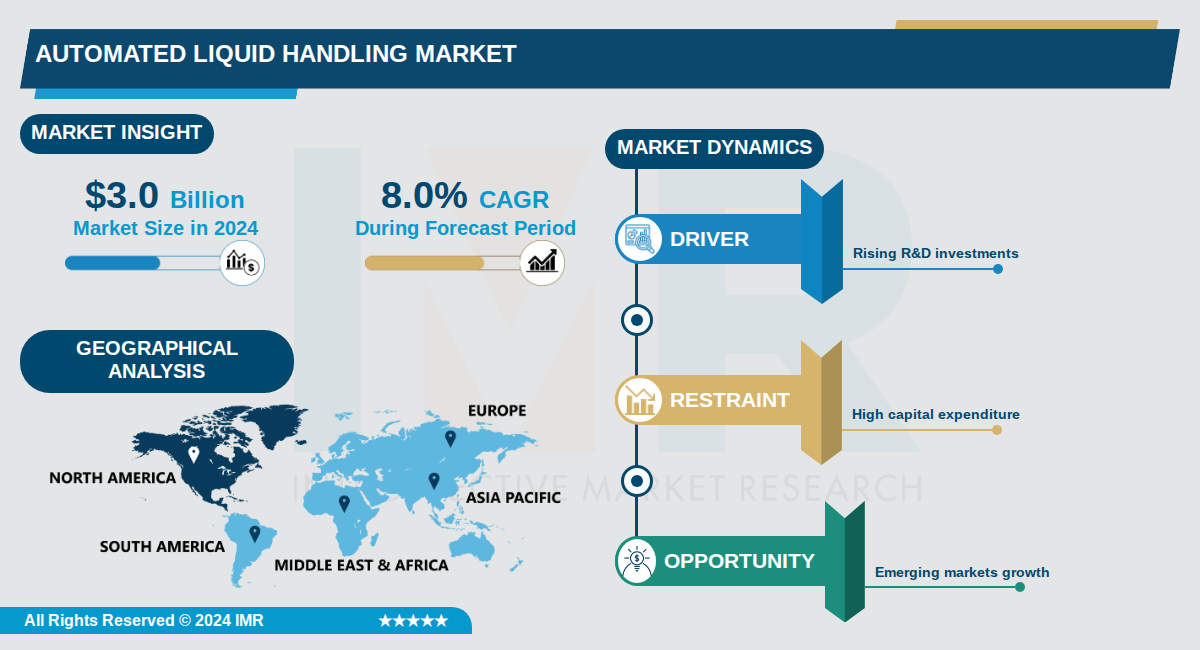
Automated Liquid Handling Market Size Was Valued at USD 3.0 Billion in 2024, and is Projected to Reach USD 6.0 Billion by 2035, Growing at a CAGR of 8.0% From 2024-2035.
The Automated Liquid Handling Market, valued at $3.0 billion in 2024, is projected to reach $6.0 billion by 2035, growing at a compound annual growth rate (CAGR) of 8.0%. This expansion reflects the increasing adoption of automation in laboratories to enhance precision, throughput, and efficiency in handling liquids for various scientific applications.
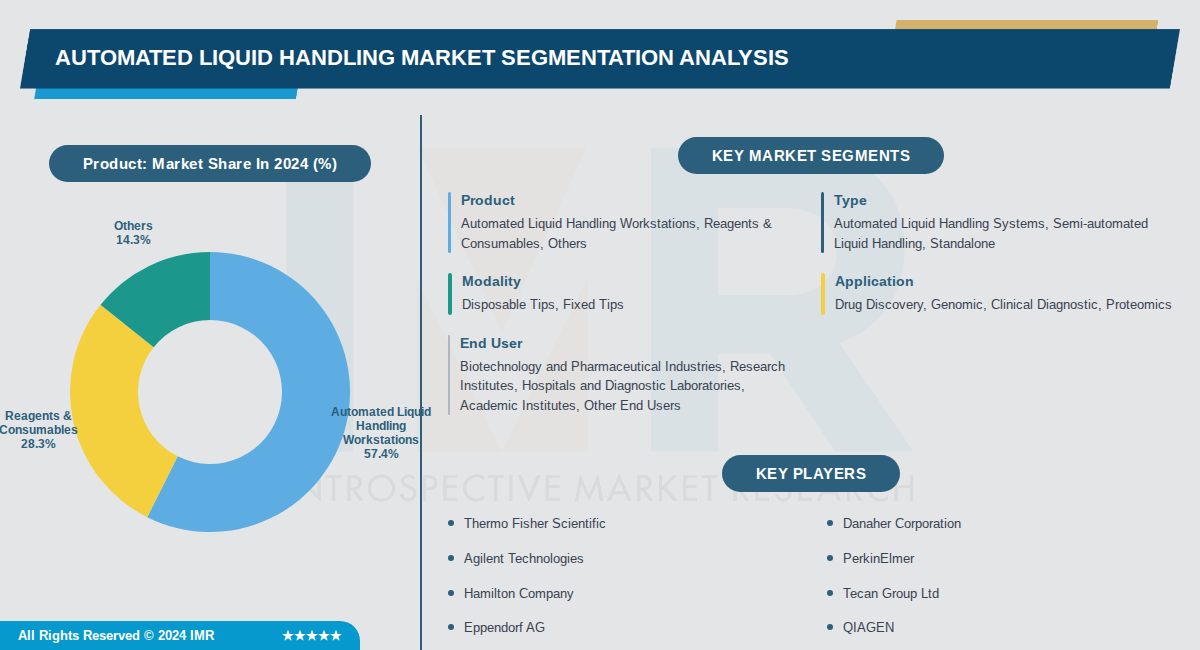
Key market segments include automated workstations, reagents & consumables, and applications such as drug discovery, genomics, proteomics, and clinical diagnostics. End-users span pharmaceutical and biotechnology industries, research institutes, hospitals, and academic institutions, with workstations dominating due to their versatility in high-throughput tasks.
North America leads with approximately 40% market share, driven by robust R&D investments and strong industry presence, while Asia-Pacific emerges as the fastest-growing region due to expanding biotechnology sectors and investments in life sciences. The market benefits from integrations like AI and machine learning for improved accuracy and reduced errors.
Automated Liquid Handling Market Trend Analysis:
Integration with AI and Machine Learning for Enhanced Automation
- Artificial intelligence and machine learning capabilities are being integrated into automated liquid handling systems to optimize protocols, identify anomalies, and predict potential failures within laboratory workflows. This advancement goes beyond simple robotic automation, enabling systems to learn from previous experiments and improve efficiency and accuracy over time.
- The convergence of AI/ML technologies with automated liquid handling is driving enhanced data interpretation and decision-making capabilities in laboratories. These intelligent systems are expected to become increasingly adopted as laboratories seek to improve sample processing accuracy and reduce manual intervention in complex workflows.
- Integration with laboratory information management systems (LIMS) and electronic laboratory notebooks (ELNs) is being enhanced through AI capabilities, creating end-to-end workflow automation that decreases manual work and establishes standardized, auditable processes for tracking and quality control.
Expansion in Emerging Markets, Particularly Asia Pacific
- Asia Pacific is experiencing the fastest regional growth with a projected compound annual growth rate of 14.45% from 2026 to 2033, driven by rising government and private sector investments in life sciences research. Countries like China, Japan, and India are leading this expansion through increased R&D activities and supportive government initiatives for healthcare and scientific innovation.
- The region's growth is fueled by the rapid expansion of pharmaceutical and biotechnology industries, increasing focus on improving healthcare infrastructure and diagnostic capabilities, and the presence of key market players establishing operations in these emerging economies. This contrasts with North America, which maintained the largest global market share at 39.75% in 2025 but is growing at a slower pace.
- Emerging regions including Latin America and the Middle East & Africa are also offering growth opportunities due to expanding laboratory infrastructure and supportive government initiatives, presenting new market entry points for automated liquid handling technology providers.
Shift Toward Digital and Smart Laboratory Ecosystems
- Laboratories are transitioning to integrated digital and smart laboratory ecosystems where automated liquid handlers connect with robotics, scheduling software, LIMS, and ELNs to enable comprehensive workflow automation. This shift addresses the need for standardized processes that can be tracked and audited as sample volumes and protocol complexity increase.
- The demand for advanced non-contact automated liquid-handling workstations is rising as laboratories respond to shrinking sample volumes and evolving workflow requirements. The reagents and consumables segment is experiencing the fastest growth, with increasing demand for compatible specialized pipette tips, plates, and liquid handling cartridges critical to maintaining accuracy and reliability in these automated workflows.
- Integration with digital laboratory systems is enhancing data management, workflow efficiency, and quality control, particularly in regulated industries like pharmaceuticals and diagnostics where data integrity and compliance are critical requirements for maintaining operational standards.
Automated Liquid Handling Market Segment Analysis:
Automated Liquid Handling Market is Segmented on the basis of By Product, By Type, By Modality
By Product, Automated Liquid Handling Workstations segment is expected to dominate the market during the forecast period
- Automated liquid handling workstations dominate due to their versatility in performing complex, high-volume tasks essential for high-throughput screening in drug discovery and genomics.
- They enable reproducible experiments across diverse applications, making them indispensable in modern laboratories with surging R&D investments.
By Type, Automated Liquid Handling Systems segment is expected to dominate the market during the forecast period
- Automated liquid handling systems lead due to the industry shift towards full automation to minimize manual errors and boost precision in research workflows.
- High demand in pharmaceutical R&D for increased throughput drives their dominance over semi-automated options.
By Modality, Disposable Tips segment is expected to dominate the market during the forecast period
- Disposable tips dominate because they prevent cross-contamination and ensure sterility in sensitive genomic and clinical procedures.
- Their role in maintaining sample integrity across high-throughput applications fuels over 75% market revenue share.
By Application, Drug Discovery segment is expected to dominate the market during the forecast period
- Drug discovery leads due to the critical need for high-throughput automated liquid handling in compound screening and lead optimization stages.
- Pharmaceutical companies' substantial R&D investments prioritize automation for precision in early drug development pipelines.
By End User, Biotechnology and Pharmaceutical Industries segment is expected to dominate the market during the forecast period
- Biotechnology and pharmaceutical industries dominate with substantial R&D funding and numerous drug discovery projects requiring high precision.
- Stringent throughput demands in these sectors drive adoption of advanced automation systems.
Automated Liquid Handling Market Regional Insights:
North America is Expected to Dominate the Market Over the Forecast Period
- North America dominates the automated liquid handling market with the largest share, exceeding 40% in 2026 and 39.75% in 2025. This leadership is driven by the U.S. and Canada, where approximately one-third of global life science research occurs. Countries like the U.S., Canada, and Mexico benefit from concentrated pharmaceutical clusters and high adoption rates of lab automation technologies.
- The region features developed infrastructure, including permanent molecular diagnostic setups and robust R&D investments in pharmaceuticals and biotechnology. Steady funding supports advanced laboratory automation, with well-established distribution networks for key players. Unlike developing regions, North America has higher adoption of precision automation integrated into high-throughput workflows, bolstered by venture capital for AI-driven lab tech.
- Major players like Thermo Fisher have invested USD 2 billion in U.S. manufacturing, ensuring supply chain efficiency and compliance. Canada strengthens the region through genomics research, while Mexico advances in agrigenomics automation. Recent developments include government-backed lab automation efforts and a network of top research institutions driving early technology adoption.
Active Key Players in the Automated Liquid Handling Market:
- Thermo Fisher Scientific (USA)
- Danaher Corporation (USA)
- Agilent Technologies (USA)
- PerkinElmer (USA)
- Hamilton Company (USA)
- Tecan Group Ltd (Switzerland)
- Eppendorf AG (Germany)
- QIAGEN (Netherlands)
- Mettler-Toledo International (USA)
- Corning Incorporated (USA)
- Aurora Biomed (Canada)
- Gilson (USA)
- Hudson Robotics (USA)
- Analytik Jena (Germany)
- SPT Labtech (United Kingdom)
- Lonza Group Ltd (Switzerland)
- Bio-Rad Laboratories (USA)
- Sartorius AG (Germany)
- Integra Biosciences AG (Switzerland)
- Dispendix (Germany)
- Other Active Players
|
Automated Liquid Handling Market |
|||
|
Base Year: |
2024 |
Forecast Period: |
2024-2035 |
|
Historical Data: |
2017 to 2024 |
Market Size in 2024: |
USD 3.0 Billion |
|
Forecast Period 2024-2035 CAGR: |
8.0 % |
Market Size in 2035: |
USD 6.0 Billion |
|
Segments Covered: |
By Product |
|
|
|
By Type |
|
||
|
By Modality |
|
||
|
By Application |
|
||
|
By End User |
|
||
|
By Region |
|
||
|
Key Market Drivers: |
|
||
|
Key Market Restraints: |
|
||
|
Key Opportunities: |
|
||
|
Companies Covered in the report: |
|
||
Chapter 1: Introduction
1.1 Scope and Coverage
Chapter 2: Executive Summary
Chapter 3: Market Landscape
3.1 Market Dynamics and Opportunity Analysis
3.1.1 Growth Drivers
3.1.2 Limiting Factors
3.1.3 Growth Opportunities
3.1.4 Challenges and Risks
3.2 Market Trend Analysis
3.3 Industry Ecosystem
3.4 Industry Value Chain Mapping
3.5 Strategic PESTLE Overview
3.6 Porter's Five Forces Framework
3.7 Regulatory Framework
3.8 Pricing Trend Analysis
3.9 Intellectual Property Review
3.10 Technology Evolution
3.11 Import-Export Analysis
3.12 Consumer Behavior Analysis
3.13 Investment Pocket Analysis
3.14 Go-To Market Strategy
Chapter 4: Automated Liquid Handling Market by Product (2017-2035)
4.1 Automated Liquid Handling Market Snapshot and Growth Engine
4.2 Market Overview
4.3 Automated Liquid Handling Workstations
4.3.1 Introduction and Market Overview
4.3.2 Historic and Forecasted Market Size in Value USD and Volume Units
4.3.3 Key Market Trends, Growth Factors, and Opportunities
4.3.4 Geographic Segmentation Analysis
4.4 Reagents & Consumables
4.5 Others
Chapter 5: Automated Liquid Handling Market by Type (2017-2035)
5.1 Automated Liquid Handling Market Snapshot and Growth Engine
5.2 Market Overview
5.3 Automated Liquid Handling Systems
5.3.1 Introduction and Market Overview
5.3.2 Historic and Forecasted Market Size in Value USD and Volume Units
5.3.3 Key Market Trends, Growth Factors, and Opportunities
5.3.4 Geographic Segmentation Analysis
5.4 Semi-automated Liquid Handling
5.5 Standalone
Chapter 6: Automated Liquid Handling Market by Modality (2017-2035)
6.1 Automated Liquid Handling Market Snapshot and Growth Engine
6.2 Market Overview
6.3 Disposable Tips
6.3.1 Introduction and Market Overview
6.3.2 Historic and Forecasted Market Size in Value USD and Volume Units
6.3.3 Key Market Trends, Growth Factors, and Opportunities
6.3.4 Geographic Segmentation Analysis
6.4 Fixed Tips
Chapter 7: Automated Liquid Handling Market by Application (2017-2035)
7.1 Automated Liquid Handling Market Snapshot and Growth Engine
7.2 Market Overview
7.3 Drug Discovery
7.3.1 Introduction and Market Overview
7.3.2 Historic and Forecasted Market Size in Value USD and Volume Units
7.3.3 Key Market Trends, Growth Factors, and Opportunities
7.3.4 Geographic Segmentation Analysis
7.4 Genomic
7.5 Clinical Diagnostic
7.6 Proteomics
Chapter 8: Automated Liquid Handling Market by End User (2017-2035)
8.1 Automated Liquid Handling Market Snapshot and Growth Engine
8.2 Market Overview
8.3 Biotechnology and Pharmaceutical Industries
8.3.1 Introduction and Market Overview
8.3.2 Historic and Forecasted Market Size in Value USD and Volume Units
8.3.3 Key Market Trends, Growth Factors, and Opportunities
8.3.4 Geographic Segmentation Analysis
8.4 Research Institutes
8.5 Hospitals and Diagnostic Laboratories
8.6 Academic Institutes
8.7 Other End Users
Chapter 9: Company Profiles and Competitive Analysis
9.1 Competitive Landscape
9.1.1 Competitive Benchmarking
9.1.2 Automated Liquid Handling Market Share by Manufacturer/Service Provider (2024)
9.1.3 Industry BCG Matrix
9.1.4 Partnerships, Mergers & Acquisitions
9.2 THERMO FISHER SCIENTIFIC
9.2.1 Company Overview
9.2.2 Key Executives
9.2.3 Company Snapshot
9.2.4 Role of the Company in the Market
9.2.5 Sustainability and Social Responsibility
9.2.6 Operating Business Segments
9.2.7 Product Portfolio
9.2.8 Business Performance
9.2.9 Recent News & Developments
9.2.10 SWOT Analysis
9.3 DANAHER CORPORATION
9.4 AGILENT TECHNOLOGIES
9.5 PERKINELMER
9.6 HAMILTON COMPANY
9.7 TECAN GROUP LTD
9.8 EPPENDORF AG
9.9 QIAGEN
9.10 METTLER-TOLEDO INTERNATIONAL
9.11 CORNING INCORPORATED
9.12 AURORA BIOMED
9.13 GILSON
9.14 HUDSON ROBOTICS
9.15 ANALYTIK JENA
9.16 SPT LABTECH
9.17 LONZA GROUP LTD
9.18 BIO-RAD LABORATORIES
9.19 SARTORIUS AG
9.20 INTEGRA BIOSCIENCES AG
9.21 DISPENDIX
Chapter 10: Global Automated Liquid Handling Market By Region
10.1 Overview
10.2. North America Automated Liquid Handling Market
10.2.1 Key Market Trends, Growth Factors and Opportunities
10.2.2 Top Key Companies
10.2.3 Historic and Forecasted Market Size by Segments
10.2.4 Historic and Forecast Market Size by Country
10.3. Eastern Europe Automated Liquid Handling Market
10.3.1 Key Market Trends, Growth Factors and Opportunities
10.3.2 Top Key Companies
10.3.3 Historic and Forecasted Market Size by Segments
10.3.4 Historic and Forecast Market Size by Country
10.4. Western Europe Automated Liquid Handling Market
10.4.1 Key Market Trends, Growth Factors and Opportunities
10.4.2 Top Key Companies
10.4.3 Historic and Forecasted Market Size by Segments
10.4.4 Historic and Forecast Market Size by Country
10.5. Asia Pacific Automated Liquid Handling Market
10.5.1 Key Market Trends, Growth Factors and Opportunities
10.5.2 Top Key Companies
10.5.3 Historic and Forecasted Market Size by Segments
10.5.4 Historic and Forecast Market Size by Country
10.6. Middle East & Africa Automated Liquid Handling Market
10.6.1 Key Market Trends, Growth Factors and Opportunities
10.6.2 Top Key Companies
10.6.3 Historic and Forecasted Market Size by Segments
10.6.4 Historic and Forecast Market Size by Country
10.7. South America Automated Liquid Handling Market
10.7.1 Key Market Trends, Growth Factors and Opportunities
10.7.2 Top Key Companies
10.7.3 Historic and Forecasted Market Size by Segments
10.7.4 Historic and Forecast Market Size by Country
Chapter 11: Analyst Viewpoint and Conclusion
Chapter 12: Research Methodology
12.1 Research Process
12.2 Primary Research
12.3 Secondary Research
Chapter 13: Case Study
Chapter 14: Appendix
14.1 Sources
14.2 List of Tables and Figures
14.3 Short Forms and Citations
14.4 Assumption and Conversion
14.5 Disclaimer
|
Automated Liquid Handling Market |
|||
|
Base Year: |
2024 |
Forecast Period: |
2024-2035 |
|
Historical Data: |
2017 to 2024 |
Market Size in 2024: |
USD 3.0 Billion |
|
Forecast Period 2024-2035 CAGR: |
8.0 % |
Market Size in 2035: |
USD 6.0 Billion |
|
Segments Covered: |
By Product |
|
|
|
By Type |
|
||
|
By Modality |
|
||
|
By Application |
|
||
|
By End User |
|
||
|
By Region |
|
||
|
Key Market Drivers: |
|
||
|
Key Market Restraints: |
|
||
|
Key Opportunities: |
|
||
|
Companies Covered in the report: |
|
||


