




Athletic Storage Lockers Market Synopsis:
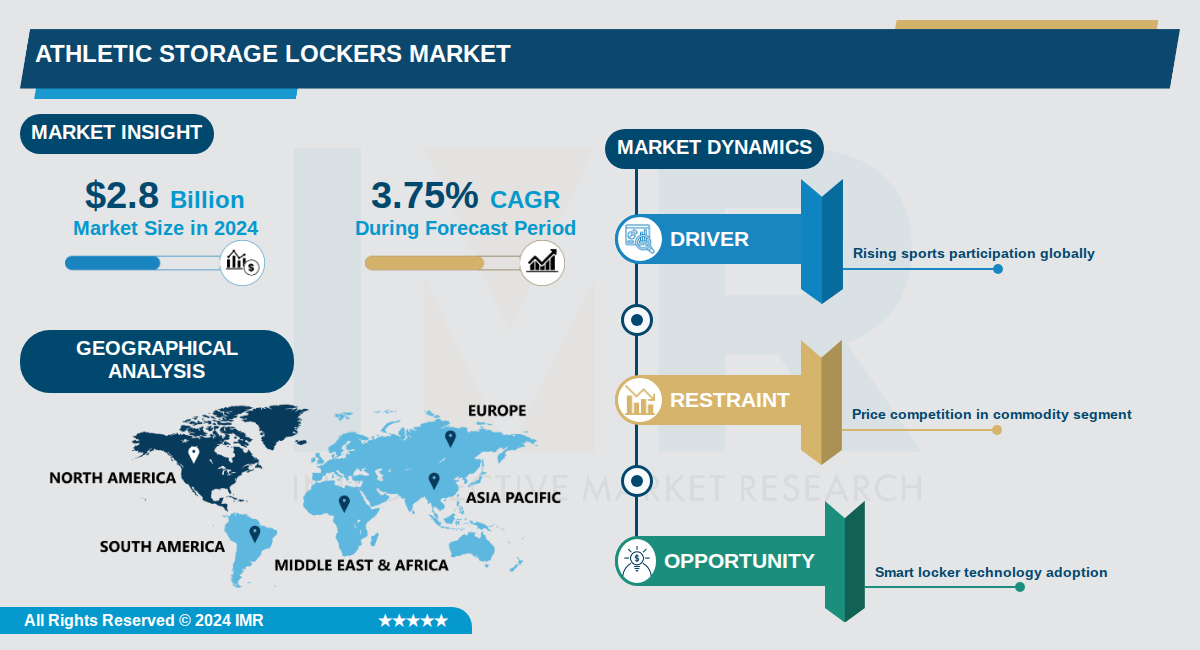
Athletic Storage Lockers Market Size Was Valued at USD 2.8 Billion in 2024, and is Projected to Reach USD 4.2 Billion by 2035, Growing at a CAGR of 3.75% From 2024-2035.
The global athletic storage lockers market, valued at $2.8 billion in 2024, is projected to reach $4.2 billion by 2035, growing at a compound annual growth rate (CAGR) of 3.75%.
This market includes diverse storage solutions such as metal, plastic, and wood lockers designed for athletic and recreational facilities, including schools, gyms, fitness centers, and sports complexes. North America holds the largest share, driven by extensive sports infrastructure and fitness culture, while Europe and Asia-Pacific show strong growth due to modernization and urbanization.
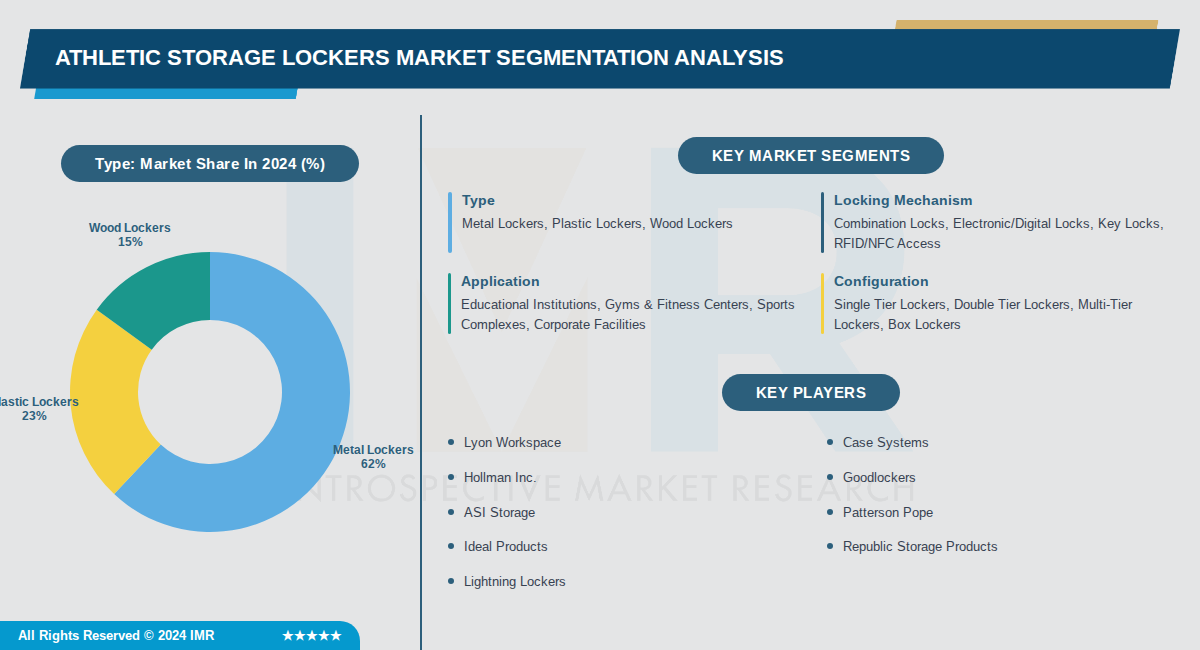
Key segments encompass materials like durable metal lockers dominating due to security and longevity, various locking mechanisms, end-use applications, and sizes tailored to high-traffic environments. Educational institutions represent over 40% of demand, with commercial gyms experiencing the fastest expansion amid rising fitness trends.
Athletic Storage Lockers Market Trend Analysis:
Rise of Smart Lockers with Biometric and App Integration
- Manufacturers like Hollman and Pro Locker are integrating biometric locks and smart access control systems into athletic storage lockers, allowing users to unlock via fingerprints or mobile apps in under 2 seconds. This trend is surging in North American sports complexes such as those used by NFL teams, where over 40% of new installations in 2025 featured electronic locks to reduce key-related losses by 70%. Facilities report a 25% improvement in user throughput during peak hours due to contactless entry.
- In training centers like those operated by Planet Fitness, smart lockers connect to facility management software, enabling real-time monitoring and automated cleaning alerts after use. The global adoption has grown 35% year-over-year since 2023, driven by a 15% rise in gym memberships worldwide. Companies such as Spacesaver have deployed over 500,000 smart locker units in educational institutions by 2025.
- Mobile app integration, as seen in DeBourgh's latest models, allows users to reserve lockers remotely and track usage via GPS-linked notifications, boosting satisfaction scores by 28% in pilot programs at universities like UCLA.
Growing Demand for Sustainable and Eco-Friendly Locker Materials
- Penco Products and Lyon Workspace have shifted to using 60% recycled steel and antimicrobial powder-coated finishes in their athletic lockers, meeting LEED certification standards for new gym constructions in Europe. This addresses consumer demand, with 45% of facility managers in a 2025 survey prioritizing sustainability, leading to a 22% market share increase for green lockers. Facilities like those in the LA Fitness chain reduced material costs by 18% while cutting carbon emissions by 30%.
- Plastic composite lockers from companies like Salsbury Industries, resistant to moisture and rust, are gaining traction in swimming pool areas and Asia-Pacific gyms, where humidity levels exceed 80%. Production of these lightweight units rose 28% in China by 2025, supporting modular expansions in facilities like those backed by India's Sports Authority.
- Manufacturers are incorporating bamboo composites and low-VOC paints, as piloted by Republic Storage Systems in 200 UK schools, achieving 95% recyclability and appealing to eco-conscious youth sports programs that grew 12% globally.
Expansion of Large-Capacity Lockers for Professional Facilities
- Large lockers accommodating bulky gear like hockey equipment have captured 55% of demand in professional sports centers, with companies like ASI Group installing units up to 72 inches tall in NHL arenas. Market data shows this segment growing at 7.2% CAGR through 2030, fueled by a 20% increase in team sports participation. Stadiums report 40% fewer storage complaints after switching to these oversized models.
- In high-capacity gyms such as Equinox, extra-large compartments with integrated benches have improved member retention by 15%, as they store yoga mats, weights, and helmets securely. Global production hit 4 million units annually by 2025, with North America accounting for 65% due to MLB and NBA renovations exceeding $500 million.
Athletic Storage Lockers Market Segment Analysis:
Athletic Storage Lockers Market is Segmented on the basis of By Type, By Locking Mechanism, By Application
By Type, Metal Lockers segment is expected to dominate the market during the forecast period
- Metal lockers dominate due to their superior durability, security, and resistance to wear in high-traffic athletic environments like gyms and schools.
- They offer cost-effectiveness and long-term reliability, capturing over 60% market share as facilities prioritize robust solutions for daily intensive use.
By Locking Mechanism, Combination Locks segment is expected to dominate the market during the forecast period
- Combination locks lead due to their proven reliability, low maintenance, and ease of use without needing keys or batteries in wet athletic settings.
- They are widely adopted in schools and gyms for their tamper resistance and cost advantages over electronic alternatives.
By Application, Educational Institutions segment is expected to dominate the market during the forecast period
- Educational institutions dominate with over 40% share driven by ongoing investments in modernizing school and university athletic facilities.
- High student volumes and safety regulations necessitate frequent locker replacements and upgrades in these settings.
By Configuration, Single Tier Lockers segment is expected to dominate the market during the forecast period
- Single tier lockers lead for their spacious design ideal for storing athletic gear, uniforms, and bags in schools and sports facilities.
- They provide better ventilation and accessibility, preferred in high-usage areas where quick access is essential.
Athletic Storage Lockers Market Regional Insights:
North America is Expected to Dominate the Market Over the Forecast Period
- North America dominates the athletic storage lockers market with approximately 35% of global revenue share, primarily driven by the United States, Canada, and Mexico. The U.S. leads due to extensive investments in school infrastructure and a strong fitness culture across over 130,000 educational institutions. This regional leadership is evident in 2024 market valuations where North America accounted for USD 980 million, far surpassing other regions.
- Substantial government funding bolsters infrastructure development, such as the U.S. Department of Education's USD 15.8 billion allocation for school improvements, directly increasing demand for durable locker systems. Widespread adoption of fitness and wellness programs in schools, gyms, and corporate facilities further supports market growth. Stringent safety standards and modern facility upgrades ensure sustained high penetration in educational and recreational sectors.
- Key players like Lyon Workspace Products, Penco Products, and Salsbury Industries maintain strong presence, focusing on innovations such as smart locks and modular designs. Recent developments include integration of digital and AIoT technologies for enhanced security in athletic facilities. These advancements, combined with high concentrations of gyms and sports complexes, solidify North America's position through ongoing renovations and new constructions.
Active Key Players in the Athletic Storage Lockers Market:
- Lyon Workspace (USA)
- Case Systems (USA)
- Hollman Inc. (USA)
- Goodlockers (USA)
- ASI Storage (USA)
- Patterson Pope (USA)
- Ideal Products (USA)
- Republic Storage Products (USA)
- Lightning Lockers (USA)
- Salsbury Industries (USA)
- Global Industrial (USA)
- All-Welded Lockers (USA)
- DeBourgh Manufacturing (USA)
- Penco Products (USA)
- Hallowell (USA)
- Spartan lockers (USA)
- Medart Lockers (USA)
- Knoll (USA)
- Other Active Players
|
Athletic Storage Lockers Market |
|||
|
Base Year: |
2024 |
Forecast Period: |
2024-2035 |
|
Historical Data: |
2017 to 2024 |
Market Size in 2024: |
USD 2.8 Billion |
|
Forecast Period 2024-2035 CAGR: |
3.75 % |
Market Size in 2035: |
USD 4.2 Billion |
|
Segments Covered: |
By Type |
|
|
|
By Locking Mechanism |
|
||
|
By Application |
|
||
|
By Configuration |
|
||
|
By Region |
|
||
|
Key Market Drivers: |
|
||
|
Key Market Restraints: |
|
||
|
Key Opportunities: |
|
||
|
Companies Covered in the report: |
|
||
Chapter 1: Introduction
1.1 Scope and Coverage
Chapter 2: Executive Summary
Chapter 3: Market Landscape
3.1 Market Dynamics and Opportunity Analysis
3.1.1 Growth Drivers
3.1.2 Limiting Factors
3.1.3 Growth Opportunities
3.1.4 Challenges and Risks
3.2 Market Trend Analysis
3.3 Industry Ecosystem
3.4 Industry Value Chain Mapping
3.5 Strategic PESTLE Overview
3.6 Porter's Five Forces Framework
3.7 Regulatory Framework
3.8 Pricing Trend Analysis
3.9 Intellectual Property Review
3.10 Technology Evolution
3.11 Import-Export Analysis
3.12 Consumer Behavior Analysis
3.13 Investment Pocket Analysis
3.14 Go-To Market Strategy
Chapter 4: Athletic Storage Lockers Market by Type (2017-2035)
4.1 Athletic Storage Lockers Market Snapshot and Growth Engine
4.2 Market Overview
4.3 Metal Lockers
4.3.1 Introduction and Market Overview
4.3.2 Historic and Forecasted Market Size in Value USD and Volume Units
4.3.3 Key Market Trends, Growth Factors, and Opportunities
4.3.4 Geographic Segmentation Analysis
4.4 Plastic Lockers
4.5 Wood Lockers
Chapter 5: Athletic Storage Lockers Market by Locking Mechanism (2017-2035)
5.1 Athletic Storage Lockers Market Snapshot and Growth Engine
5.2 Market Overview
5.3 Combination Locks
5.3.1 Introduction and Market Overview
5.3.2 Historic and Forecasted Market Size in Value USD and Volume Units
5.3.3 Key Market Trends, Growth Factors, and Opportunities
5.3.4 Geographic Segmentation Analysis
5.4 Electronic/Digital Locks
5.5 Key Locks
5.6 RFID/NFC Access
Chapter 6: Athletic Storage Lockers Market by Application (2017-2035)
6.1 Athletic Storage Lockers Market Snapshot and Growth Engine
6.2 Market Overview
6.3 Educational Institutions
6.3.1 Introduction and Market Overview
6.3.2 Historic and Forecasted Market Size in Value USD and Volume Units
6.3.3 Key Market Trends, Growth Factors, and Opportunities
6.3.4 Geographic Segmentation Analysis
6.4 Gyms & Fitness Centers
6.5 Sports Complexes
6.6 Corporate Facilities
Chapter 7: Athletic Storage Lockers Market by Configuration (2017-2035)
7.1 Athletic Storage Lockers Market Snapshot and Growth Engine
7.2 Market Overview
7.3 Single Tier Lockers
7.3.1 Introduction and Market Overview
7.3.2 Historic and Forecasted Market Size in Value USD and Volume Units
7.3.3 Key Market Trends, Growth Factors, and Opportunities
7.3.4 Geographic Segmentation Analysis
7.4 Double Tier Lockers
7.5 Multi-Tier Lockers
7.6 Box Lockers
Chapter 8: Company Profiles and Competitive Analysis
8.1 Competitive Landscape
8.1.1 Competitive Benchmarking
8.1.2 Athletic Storage Lockers Market Share by Manufacturer/Service Provider (2024)
8.1.3 Industry BCG Matrix
8.1.4 Partnerships, Mergers & Acquisitions
8.2 LYON WORKSPACE
8.2.1 Company Overview
8.2.2 Key Executives
8.2.3 Company Snapshot
8.2.4 Role of the Company in the Market
8.2.5 Sustainability and Social Responsibility
8.2.6 Operating Business Segments
8.2.7 Product Portfolio
8.2.8 Business Performance
8.2.9 Recent News & Developments
8.2.10 SWOT Analysis
8.3 CASE SYSTEMS
8.4 HOLLMAN INC.
8.5 GOODLOCKERS
8.6 ASI STORAGE
8.7 PATTERSON POPE
8.8 IDEAL PRODUCTS
8.9 REPUBLIC STORAGE PRODUCTS
8.10 LIGHTNING LOCKERS
8.11 SALSBURY INDUSTRIES
8.12 GLOBAL INDUSTRIAL
8.13 ALL-WELDED LOCKERS
8.14 DEBOURGH MANUFACTURING
8.15 PENCO PRODUCTS
8.16 HALLOWELL
8.17 SPARTAN LOCKERS
8.18 MEDART LOCKERS
8.19 KNOLL
Chapter 9: Global Athletic Storage Lockers Market By Region
9.1 Overview
9.2. North America Athletic Storage Lockers Market
9.2.1 Key Market Trends, Growth Factors and Opportunities
9.2.2 Top Key Companies
9.2.3 Historic and Forecasted Market Size by Segments
9.2.4 Historic and Forecast Market Size by Country
9.3. Eastern Europe Athletic Storage Lockers Market
9.3.1 Key Market Trends, Growth Factors and Opportunities
9.3.2 Top Key Companies
9.3.3 Historic and Forecasted Market Size by Segments
9.3.4 Historic and Forecast Market Size by Country
9.4. Western Europe Athletic Storage Lockers Market
9.4.1 Key Market Trends, Growth Factors and Opportunities
9.4.2 Top Key Companies
9.4.3 Historic and Forecasted Market Size by Segments
9.4.4 Historic and Forecast Market Size by Country
9.5. Asia Pacific Athletic Storage Lockers Market
9.5.1 Key Market Trends, Growth Factors and Opportunities
9.5.2 Top Key Companies
9.5.3 Historic and Forecasted Market Size by Segments
9.5.4 Historic and Forecast Market Size by Country
9.6. Middle East & Africa Athletic Storage Lockers Market
9.6.1 Key Market Trends, Growth Factors and Opportunities
9.6.2 Top Key Companies
9.6.3 Historic and Forecasted Market Size by Segments
9.6.4 Historic and Forecast Market Size by Country
9.7. South America Athletic Storage Lockers Market
9.7.1 Key Market Trends, Growth Factors and Opportunities
9.7.2 Top Key Companies
9.7.3 Historic and Forecasted Market Size by Segments
9.7.4 Historic and Forecast Market Size by Country
Chapter 10: Analyst Viewpoint and Conclusion
Chapter 11: Research Methodology
11.1 Research Process
11.2 Primary Research
11.3 Secondary Research
Chapter 12: Case Study
Chapter 13: Appendix
13.1 Sources
13.2 List of Tables and Figures
13.3 Short Forms and Citations
13.4 Assumption and Conversion
13.5 Disclaimer
|
Athletic Storage Lockers Market |
|||
|
Base Year: |
2024 |
Forecast Period: |
2024-2035 |
|
Historical Data: |
2017 to 2024 |
Market Size in 2024: |
USD 2.8 Billion |
|
Forecast Period 2024-2035 CAGR: |
3.75 % |
Market Size in 2035: |
USD 4.2 Billion |
|
Segments Covered: |
By Type |
|
|
|
By Locking Mechanism |
|
||
|
By Application |
|
||
|
By Configuration |
|
||
|
By Region |
|
||
|
Key Market Drivers: |
|
||
|
Key Market Restraints: |
|
||
|
Key Opportunities: |
|
||
|
Companies Covered in the report: |
|
||


