




Artificial Intelligence In Military Market Synopsis:
Artificial Intelligence (AI) in Military Market Size Was Valued at USD 9.56 Billion in 2024, and is Projected to Reach USD 36.32 Billion by 2035, Growing at a CAGR of 12.9% From 2025–2035.
Artificial Intelligence (AI) in the military refers to the use of advanced algorithms and machine learning technologies to enhance defence capabilities, including autonomous systems, cybersecurity, intelligence analysis, and decision-making processes. The AI military market is experiencing significant growth, driven by rising defence budgets and rapid technological advancements.
This growth reflects increasing adoption of AI-powered applications such as autonomous drones, robotic soldiers, and enhanced surveillance systems. The Recent changes in the market include a greater focus on AI integration for real-time battlefield analytics and cybersecurity, driven by evolving warfare strategies and the need for faster, data-driven decisions.
However, ethical concerns regarding autonomous weapons and challenges in establishing global regulatory standards continue to impact market dynamics. Despite these hurdles, ongoing investments and innovation are accelerating AI adoption, promising to transform military operations while raising important considerations around security and governance.
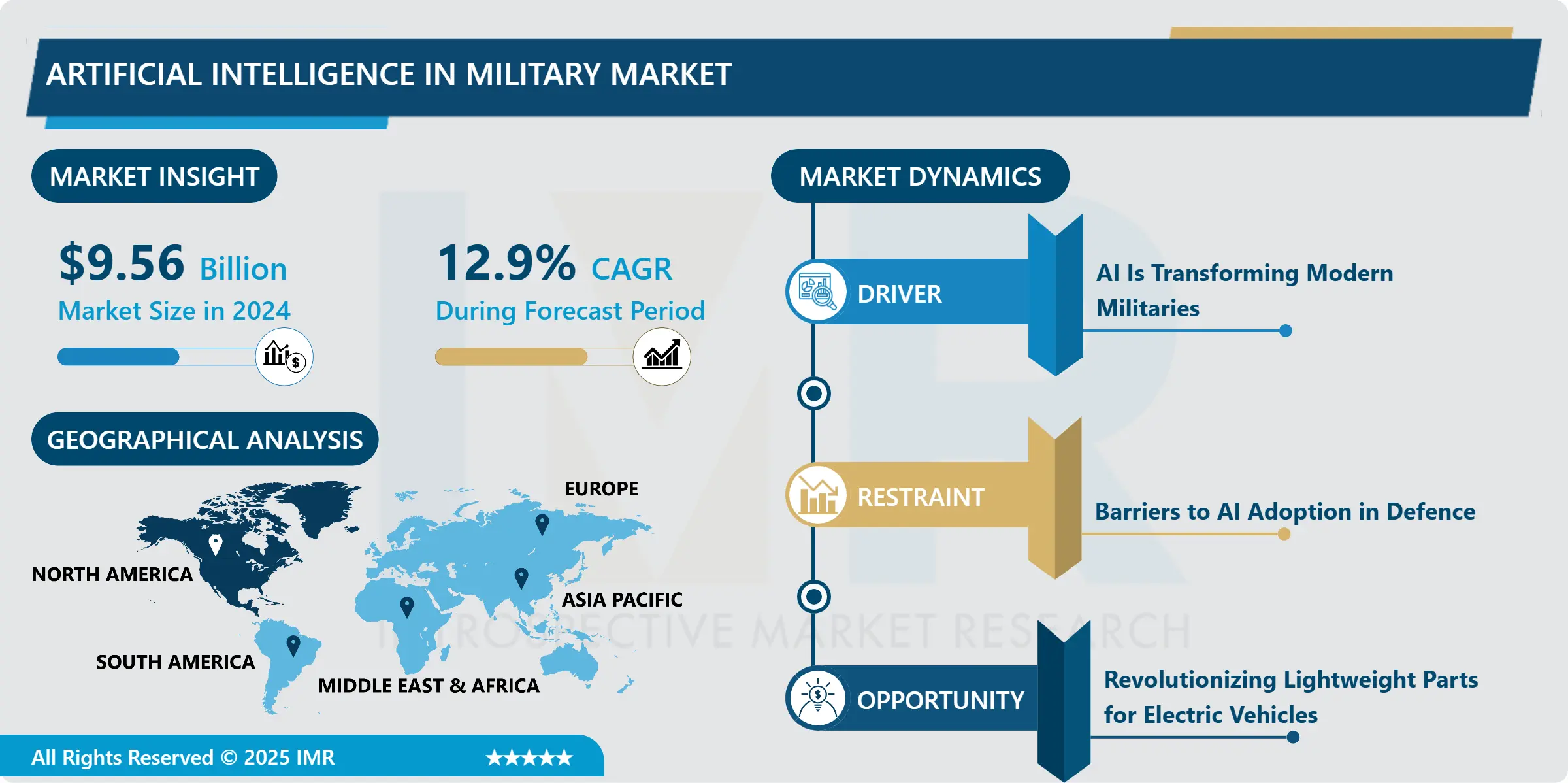
Artificial Intelligence In Military Market Growth and Trend Analysis:
Artificial Intelligence In Military Market Growth Driver – Transforming of AI in Modern Militaries
- Artificial Intelligence (AI) is becoming a powerful tool in military operations around the world. It helps armies, air forces, and navies make faster and smarter decisions on the battlefield. One of the biggest reasons for using AI in the military is better situational awareness. With AI, the military can quickly study data from cameras, drones, satellites, and sensors to understand what’s happening around them. This helps soldiers and commanders know where enemies are, what the terrain looks like, and what actions to take all in real time.
- The AI in military market is growing fast. Many countries are increasing their defence budgets to include modern AI systems. AI helps them gain an edge in warfare and better protect their borders. With more investment in AI-based drones, surveillance systems, and smart weapons, the global market is expected to grow significantly in the next 5–10 years.
- On the positive side, there’s a big opportunity in AI-powered drones and autonomous vehicles. These smart machines can carry out dangerous tasks like surveillance or supply delivery without putting human lives at risk. In the future, they may be used in search and rescue missions or combat support.
Artificial Intelligence in the Military Market Limiting Factor- Barriers to AI Adoption in Defence
- Developing AI systems needs a lot of money, advanced hardware, skilled workers, and testing. Not all countries can afford this, especially smaller or developing nations. Even after development, maintaining and upgrading AI systems adds more expenses. Also, some military staff need special training to use AI properly, which takes time and money.
- Developing and deploying Artificial Intelligence (AI) in the military is an expensive and complex process. It demands significant financial investment, access to advanced computing hardware, a highly skilled workforce, and extensive testing protocols. These requirements pose major challenges for smaller or developing nations that often lack the resources to compete with larger powers. Even after initial development, the ongoing maintenance, system upgrades, and integration with existing defence infrastructure add further costs. Additionally, military personnel require specialized training to effectively operate and interpret AI-driven systems, which consumes both time and budget.
- As a result, the adoption of AI in defence is progressing unevenly across the globe. Wealthier nations with higher defence budgets are advancing rapidly, while less affluent countries fall behind. This growing disparity creates a technological gap, potentially leading to imbalances in global military capabilities and increasing the digital divide in defence technologies between developed and developing countries. Developing and deploying Artificial Intelligence (AI) in the military is an expensive and complex. By adopting 3D printing, automakers can accelerate innovation, reduce development time, and produce more efficient EVs, supporting the shift toward sustainable transportation.
Artificial Intelligence in the Military Market Expansion Opportunity - Revolutionizing Lightweight Parts for Electric Vehicles
- EVs need lightweight, strong parts to improve battery performance and energy use. 3D printing can make complex and lightweight parts easily, helping carmakers design better electric cars faster. Electric vehicles (EVs) require lightweight yet strong components to enhance battery efficiency and overall energy consumption. Reducing the weight of parts directly improves the vehicle’s range and performance by lowering the energy needed for movement. Traditional manufacturing methods often struggle to produce complex, lightweight designs quickly and cost-effectively.
- This is where 3D printing offers a significant advantage. It allows car manufacturers to create intricate, customized parts with reduced weight, without compromising strength or durability. Additionally, 3D printing speeds up the prototyping and production process, enabling faster innovation and design improvements. By integrating 3D printing technology, automakers can build better, more efficient electric vehicles while reducing time-to-market and development costs, ultimately accelerating the adoption of sustainable transportation solutions.
Artificial Intelligence in the Military Market Challenge and Risk - Limited choice of materials and lack of standards.
- Many 3D printing materials still don’t meet the safety and strength standards required for automotive use. Also, there are not enough common rules to certify 3D-printed car parts. This slows down large-scale use in production. Many 3D printing materials still fall short of meeting the strict safety and strength standards required for automotive applications. Additionally, the lack of unified certification rules for 3D-printed car parts slows their widespread adoption in mass production.
- Beyond manufacturing issues, the integration of AI raises ethical and security concerns. Granting machines the authority to make critical life-or-death decisions poses serious moral dilemmas. Furthermore, AI systems are vulnerable to hacking or misuse, which could turn them into significant threats rather than helpful tools. Ensuring responsible AI use and robust cybersecurity measures is crucial to prevent risks and maintain trust in these advanced technologies across industries.
- Ethical and security concerns it is also another challenge. If machines are given the power to make life-or-death decisions, it can lead to serious moral questions. Also, if these systems are hacked or misused, they can become a danger instead of a solution. It’s important to make sure AI is used responsibly and is well-protected from cyber threats. Additionally, the integration of AI in these technologies introduces significant ethical and security challenges that must be carefully addressed. Responsible use and strong cybersecurity are essential to ensure
Artificial Intelligence In Military Market Segment Analysis:
Artificial Intelligence In Military Market is segmented based on Type, Application, End-Users, and Region.
By Type, Artificial Intelligence In Military Market Segment is Expected to Dominate the Market During the Forecast Period
- The Artificial Intelligence (AI) in Military Market is growing quickly, especially in the Solution Type segment. This segment includes software, hardware, and services. Among these, software plays a very important role. It helps improve military communication and supports better decision-making. These software tools allow military teams to act faster and more effectively in critical situations.
- Hardware is also an important part of AI in the military. It includes things like sensors and robotic systems. These tools help process data in real time and improve the way missions are carried out. They make military operations more efficient. Services such as maintenance and training are also key. They help ensure that the AI systems keep working properly over time.
- One major reason for the rise in AI use in the military is the need to manage resources better and increase awareness during operations. AI helps commanders get a clearer picture of the battlefield and make smarter choices. Governments around the world are investing in this technology. They understand that AI can give their defence systems a strong advantage.
- The reason AI is being used more in the military is that it helps save time, manage resources better, and gives soldiers more information to stay safe and make the right choices. Many governments around the world are putting money into AI for their defence systems. They know that using AI can make their military stronger and more prepared for future challenges. Reports show that this area is growing quickly, especially with software leading the way. Countries are updating their military tools using AI to stay ahead. The strong focus on AI in software, hardware, and services shows that technology is changing how the military works. AI is helping make military actions faster, safer, and more effective.
By Application, By Application, Artificial Intelligence In Military Market Segment Held the Largest Share in 2024
- In 2024, the space segment held the largest share of the Artificial Intelligence (AI) in Military Market. This segment includes systems like satellite data processing, smart navigation tools, and AI-powered robots used for space missions. Using AI in space helps improve communication between ground stations and spacecraft. Satellites with AI are also used to support other communication systems, making them very important for military operations.
- In the defence industry, space-based sensors and AI work together to provide better information for missions. These systems help detect and recognize targets more accurately. They are also connected to the army's weapons systems, which helps improve how they respond during missions. As a result, AI in the space segment is becoming a key part of modern military strategies.
- On the other hand, the land segment is also showing strong growth. This segment includes things like driverless combat vehicles, unmanned ground vehicles (UGVs), and AI-powered combat robots. These technologies are used more and more because they can do dangerous jobs without risking human lives. For example, UGVs can be sent into unsafe areas to complete tasks that would be too risky for soldiers. The demand for these machines is increasing as they help save lives and complete missions more efficiently. By using AI in land-based military vehicles, countries can reduce the number of casualties in war zones. The mix of smart technology and military vehicles is becoming very important for future military planning.
- Overall, both the space and land segments are key to the growth of AI in the military. They offer new ways to improve safety, communication, and mission success through advanced technologies.
Artificial Intelligence (AI) in Military Market Regional Insights:
- North America leads the global military AI market, largely driven by the United States’ extensive investment and innovation in defense technology. The U.S. Department of Defense has established multiple programs to integrate AI across military operations, such as the Joint Artificial Intelligence Center (JAIC), Project Maven, and the Joint All-Domain Command and Control (JADC2). These initiatives aim to enhance decision-making, automate threat detection, and improve battlefield coordination through advanced AI systems. U.S. based defense companies like Lockheed Martin, Raytheon, and Northrop Grumman work closely with tech firms such as Palantir and Anduril to develop cutting-edge.
- AI applications in autonomous vehicles, cybersecurity, surveillance, and intelligence analysis. Canada also plays a supporting role in the region with a focus on cybersecurity and participation in international defense collaborations. The strong ecosystem of military institutions, private sector innovation, and government funding allows North America to maintain its leadership in the development and deployment of AI-powered defense capabilities, ensuring the region remains at the forefront of global military modernization.
Artificial Intelligence In Military Market Active Players:
- Airbus (Netherlands)
- AMZ Kunto (Poland)
- BAE Systems Plc (UK)
- Charles River Analytics, Inc (United States)
- Dassault Aviation (France)
- Defenture Bv (Netherlands)
- Dongfeng Motor co-operation (China)
- General Dynamics motor (United States)
- Hanwha aerospace (South Korea)
- Hindustan Aeronautical limited (India)
- International Business Machines Corporation (US)
- Israeli Aerospace Industries (Israel)
- Iveco defence vechile (Italy)
- L3Harris Technologies Inc (United States)
- Lockheed Martin Corporation (US)
- Lokheed martin (United States)
- Mahindra motors (India)
- Malyshev Factoy (Netherlands)
- Northrop Grumman Corporation (US)
- Otokar (Turkey)
- Rafael Advanced Defence Systems (Israel)
- Raytheon Technologies Corporation (US)
- Rhenimetall (Germany)
- Saudi Arabian Military industries (Saudi Arabia)
- Spark Cognition (California)
- Sungri motor plant (Korea)
- Tata Motors (India)
- Thales Group (France)
- The Indian space research organisation (India)
- United Aircraft Co-operation (Russia)
- Other Active Players
|
Artificial Intelligence In Military Market |
|||
|
Base Year: |
2024 |
Forecast Period: |
2025-2035 |
|
Historical Data: |
2018 to 2023 |
Market Size in 2024: |
USD 9.56 Billion |
|
Forecast Period 2025-35 CAGR: |
12.9% |
Market Size in 2035: |
USD 36.32 Billion |
|
Segments Covered: |
By Type |
|
|
|
By Application |
|
||
|
By Technology
|
|
||
|
By Platform |
|
||
|
By Installation |
|
||
|
By Offering
|
|
||
|
By Region |
|
||
|
Growth Driver: |
|
||
|
Limiting Factor |
|
||
|
Expansion Opportunity |
|
||
|
Challenge and Risk |
|
||
|
Companies Covered in the Report: |
and Other Active Players. |
||
Chapter 1: Introduction
1.1 Scope and Coverage
Chapter 2:Executive Summary
Chapter 3: Market Landscape
3.1 Market Dynamics and Opportunity Analysis
3.1.1 Growth Drivers
3.1.2 Limiting Factors
3.1.3 Growth Opportunities
3.1.4 Challenges and Risks
3.2 Market Trend Analysis
3.3 Industry Ecosystem
3.4 Industry Value Chain Mapping
3.5 Strategic PESTLE Overview
3.6 Porter's Five Forces Framework
3.7 Regulatory Framework
3.8 Pricing Trend Analysis
3.9 Intellectual Property Review
3.10 Technology Evolution
3.11 Import-Export Analysis
3.12 Consumer Behavior Analysis
3.13 Investment Pocket Analysis
3.14 Go-To Market Strategy
Chapter 4: Artificial Intelligence In Military Market by Application (2018-2035)
4.1 Artificial Intelligence In Military Market Snapshot and Growth Engine
4.2 Market Overview
4.3 Warfare Platform
4.3.1 Introduction and Market Overview
4.3.2 Historic and Forecasted Market Size in Value USD and Volume Units
4.3.3 Key Market Trends, Growth Factors, and Opportunities
4.3.4 Geographic Segmentation Analysis
4.4 Logistics & Transportation
Chapter 5: Artificial Intelligence In Military Market by Technology (2018-2035)
5.1 Artificial Intelligence In Military Market Snapshot and Growth Engine
5.2 Market Overview
5.3 Machine Learning
5.3.1 Introduction and Market Overview
5.3.2 Historic and Forecasted Market Size in Value USD and Volume Units
5.3.3 Key Market Trends, Growth Factors, and Opportunities
5.3.4 Geographic Segmentation Analysis
5.4 Books and Journals
5.5 Natural Language Processing
5.6 Context-Aware Computing
5.7 Computer Vision
5.8 Intelligent Virtual Agent (IVA)
5.9 Other
Chapter 6: Artificial Intelligence In Military Market by Platform (2018-2035)
6.1 Artificial Intelligence In Military Market Snapshot and Growth Engine
6.2 Market Overview
6.3 Aerospace
6.3.1 Introduction and Market Overview
6.3.2 Historic and Forecasted Market Size in Value USD and Volume Units
6.3.3 Key Market Trends, Growth Factors, and Opportunities
6.3.4 Geographic Segmentation Analysis
6.4 Land
6.5 Space
Chapter 7: Artificial Intelligence In Military Market by Installation (2018-2035)
7.1 Artificial Intelligence In Military Market Snapshot and Growth Engine
7.2 Market Overview
7.3 New Procurement
7.3.1 Introduction and Market Overview
7.3.2 Historic and Forecasted Market Size in Value USD and Volume Units
7.3.3 Key Market Trends, Growth Factors, and Opportunities
7.3.4 Geographic Segmentation Analysis
7.4 Upgrade
Chapter 8: Artificial Intelligence In Military Market by Offering (2018-2035)
8.1 Artificial Intelligence In Military Market Snapshot and Growth Engine
8.2 Market Overview
8.3 Hardware
8.3.1 Introduction and Market Overview
8.3.2 Historic and Forecasted Market Size in Value USD and Volume Units
8.3.3 Key Market Trends, Growth Factors, and Opportunities
8.3.4 Geographic Segmentation Analysis
8.4 Software
8.5 Services
Chapter 9: Company Profiles and Competitive Analysis
9.1 Competitive Landscape
9.1.1 Competitive Benchmarking
9.1.2 Artificial Intelligence In Military Market Share by Manufacturer/Service Provider(2024)
9.1.3 Industry BCG Matrix
9.1.4 PArtnerships, Mergers & Acquisitions
9.2 AIRBUS (NETHERLANDS)
9.2.1 Company Overview
9.2.2 Key Executives
9.2.3 Company Snapshot
9.2.4 Role of the Company in the Market
9.2.5 Sustainability and Social Responsibility
9.2.6 Operating Business Segments
9.2.7 Product Portfolio
9.2.8 Business Performance
9.2.9 Recent News & Developments
9.2.10 SWOT Analysis
9.3 AMZ KUNTO (POLAND)
9.4 BAE SYSTEMS PLC (UK)
9.5 CHARLES RIVER ANALYTICS
9.6 INC. (UNITED STATES)
9.7 DASSAULT AVIATION (PARIS)
9.8 DEFENTURE BV (NETHERLANDS)
9.9 DONGFENG MOTOR CORPORATION (CHINA)
9.10 GENERAL DYNAMICS MOTOR (DETROIT
9.11 UNITED STATES)
9.12 HANWHA AEROSPACE (SOUTH KOREA)
9.13 AND HINDUSTAN AERONAUTICS LIMITED (INDIA)
9.14 ISRAELI AEROSPACE INDUSTRIES (ISRAEL)
9.15 IVECO DEFENCE VEHICLES (ITALY)
9.16 L3HARRIS TECHNOLOGIES INC. (UNITED STATES)
9.17 LOCKHEED MARTIN CORPORATION (BETHESDA
9.18 MD / UNITED STATES)
9.19 MAHINDRA MOTORS (INDIA)
9.20 MALYSHEV FACTORY (NETHERLANDS)
9.21 NORTHROP GRUMMAN CORPORATION (WASHINGTON)
9.22 OTOKAR (TURKEY)
9.23 RAFAEL ADVANCED DEFENCE SYSTEMS (ISRAEL)
9.24 AND RAYTHEON TECHNOLOGIES CORPORATION (VIRGINIA)
9.25 RHEINMETALL (GERMANY)
9.26 SAUDI ARABIAN MILITARY INDUSTRIES (SAUDI ARABIA)
9.27 SPARKCOGNITION (CALIFORNIA)
9.28 SUNGRI MOTOR PLANT (KOREA)
9.29 TATA MOTORS (INDIA)
9.30 THALES GROUP (FRANCE)
9.31 THE INDIAN SPACE RESEARCH ORGANISATION (INDIA)
9.32 UNITED AIRCRAFT CORPORATION (MOSCOW)
9.33 AND OTHER ACTIVE PLAYERS
Chapter 10: Global Artificial Intelligence In Military Market By Region
10.1 Overview
10.2. North America Artificial Intelligence In Military Market
10.2.1 Key Market Trends, Growth Factors and Opportunities
10.2.2 Top Key Companies
10.2.3 Historic and Forecasted Market Size by Segments
10.2.4 Historic and Forecast Market Size by Country
10.2.4.1 US
10.2.4.2 Canada
10.2.4.3 Mexico
10.3. Eastern Europe Artificial Intelligence In Military Market
10.3.1 Key Market Trends, Growth Factors and Opportunities
10.3.2 Top Key Companies
10.3.3 Historic and Forecasted Market Size by Segments
10.3.4 Historic and Forecast Market Size by Country
10.3.4.1 Russia
10.3.4.2 Bulgaria
10.3.4.3 The Czech Republic
10.3.4.4 Hungary
10.3.4.5 Poland
10.3.4.6 Romania
10.3.4.7 Rest of Eastern Europe
10.4. Western Europe Artificial Intelligence In Military Market
10.4.1 Key Market Trends, Growth Factors and Opportunities
10.4.2 Top Key Companies
10.4.3 Historic and Forecasted Market Size by Segments
10.4.4 Historic and Forecast Market Size by Country
10.4.4.1 Germany
10.4.4.2 UK
10.4.4.3 France
10.4.4.4 The Netherlands
10.4.4.5 Italy
10.4.4.6 Spain
10.4.4.7 Rest of Western Europe
10.5. Asia Pacific Artificial Intelligence In Military Market
10.5.1 Key Market Trends, Growth Factors and Opportunities
10.5.2 Top Key Companies
10.5.3 Historic and Forecasted Market Size by Segments
10.5.4 Historic and Forecast Market Size by Country
10.5.4.1 China
10.5.4.2 India
10.5.4.3 Japan
10.5.4.4 South Korea
10.5.4.5 Malaysia
10.5.4.6 Thailand
10.5.4.7 Vietnam
10.5.4.8 The Philippines
10.5.4.9 Australia
10.5.4.10 New Zealand
10.5.4.11 Rest of APAC
10.6. Middle East & Africa Artificial Intelligence In Military Market
10.6.1 Key Market Trends, Growth Factors and Opportunities
10.6.2 Top Key Companies
10.6.3 Historic and Forecasted Market Size by Segments
10.6.4 Historic and Forecast Market Size by Country
10.6.4.1 Turkiye
10.6.4.2 Bahrain
10.6.4.3 Kuwait
10.6.4.4 Saudi Arabia
10.6.4.5 Qatar
10.6.4.6 UAE
10.6.4.7 Israel
10.6.4.8 South Africa
10.7. South America Artificial Intelligence In Military Market
10.7.1 Key Market Trends, Growth Factors and Opportunities
10.7.2 Top Key Companies
10.7.3 Historic and Forecasted Market Size by Segments
10.7.4 Historic and Forecast Market Size by Country
10.7.4.1 Brazil
10.7.4.2 Argentina
10.7.4.3 Rest of SA
Chapter 11 Analyst Viewpoint and Conclusion
Chapter 12 Our Thematic Research Methodology
12.1 Research Process
12.2 Primary Research
12.3 Secondary Research
Chapter 13 Case Study
Chapter 14 Appendix
14.1 Sources
14.2 List of Tables and figures
14.3 Short Forms and Citations
14.4 Assumption and Conversion
14.5 Disclaimer
|
Artificial Intelligence In Military Market |
|||
|
Base Year: |
2024 |
Forecast Period: |
2025-2035 |
|
Historical Data: |
2018 to 2023 |
Market Size in 2024: |
USD 9.56 Billion |
|
Forecast Period 2025-35 CAGR: |
12.9% |
Market Size in 2035: |
USD 36.32 Billion |
|
Segments Covered: |
By Type |
|
|
|
By Application |
|
||
|
By Technology
|
|
||
|
By Platform |
|
||
|
By Installation |
|
||
|
By Offering
|
|
||
|
By Region |
|
||
|
Growth Driver: |
|
||
|
Limiting Factor |
|
||
|
Expansion Opportunity |
|
||
|
Challenge and Risk |
|
||
|
Companies Covered in the Report: |
and Other Active Players. |
||


