




Aromatherapy Market Synopsis
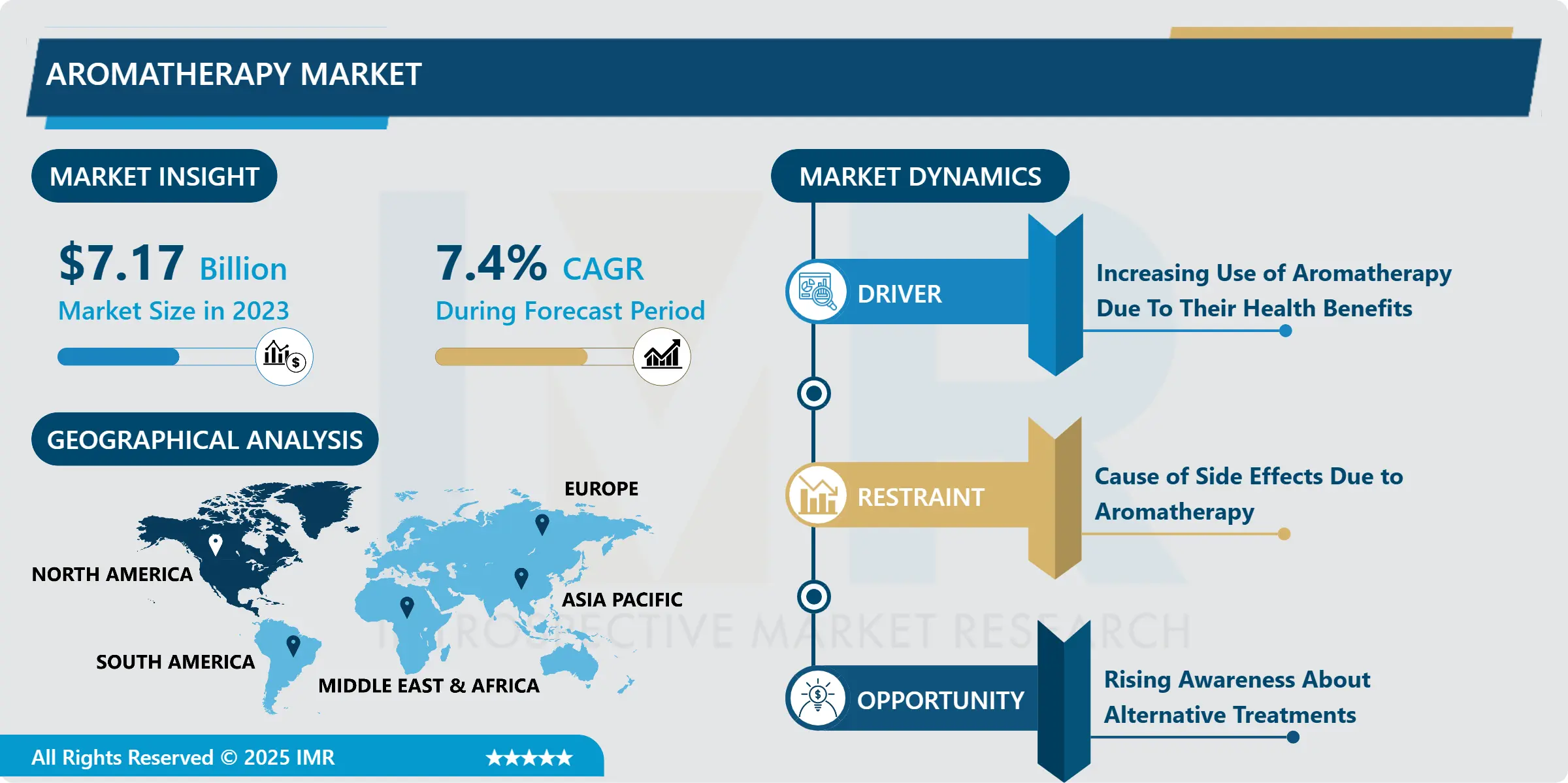
The global market for Aromatherapy estimated at USD 7.17 Billion in the year 2023, is anticipated to reach a revised size of USD 13.63 Billion by 2032, growing at a CAGR of 7.4% over the period 2024-2032.
Aromatherapy is the practice of using essential oils for therapeutic benefit. Aromatherapy has been used for centuries. When inhaled, the scent molecules in essential oils travel from the olfactory nerves directly to the brain and especially impact the amygdala, the emotional center of the brain.
Experts think aromatherapy activates areas in your nose called smell receptors, which send messages through your nervous system to your brain. The oils may activate certain areas of your brain, like your limbic system, which plays a role in your emotions. They could also have an impact on your hypothalamus, which may respond to the oil by creating feel-good brain chemicals like serotonin.
The use of essential oils for therapeutic, spiritual, hygienic, and ritualistic purposes goes back to ancient civilizations including the Indians, Chinese, Egyptians, Greeks, and Romans who used them in cosmetics, perfumes, and drugs. Oils were used for aesthetic pleasure and in the beauty industry. They were a luxury item and a means of payment.
Aromatherapy is generally safe. Essential oils can cause side effects, though. Some can irritate your eyes, skin, or mucous membranes in your nose. Aroma therapists, people who specialize in the practice of aromatherapy, utilize blends of supposedly therapeutic essential oils that can be used as a topical application, massage, inhalation, or water immersion

The Aromatherapy Market Trend Analysis
Increasing Use of Aromatherapy Due To Their Health Benefits
- Aromatherapy is used in a wide range of settings, from health spas to hospitals, to treat a variety of conditions. In general, it seems to relieve pain, improve mood, and promote a sense of relaxation. Several essential oils, including lavender, rose, orange, bergamot, lemon, sandalwood, and others, have been shown to relieve anxiety, stress, and depression.
- Several clinical studies suggest that when essential oils (particularly rose, lavender, and frankincense) were used by qualified midwives, pregnant women felt less anxiety and fear, had a stronger sense of well-being, and had less need for pain medications during delivery.? Many women also report that peppermint oil relieves nausea and vomiting during labor.
- Preliminary studies suggest aromatherapy may be an effective approach for post-operative nausea. Other studies suggest aromatherapy in conjunction with massage can help reduce symptoms of colic in infants.?

Essential oils are oils that contain the “essence” of a plant, such as its aroma or flavor. The global demand for essential oils increased between 2018 and 2021; from around 226.9 kilotons to 290.6 kilotons.
Rising Awareness About Alternative Treatments
- 'Aromatherapy' is one of the most actively growing forms of alternative medicine combining massage with counseling and a nice odor. Most clients suffer from some kind of stress-related disorder and aromatherapy encourages the healing process largely through relaxation and the relief of stress.
- Hospitals, hospices, and homes for the elderly and those who are physically or mentally challenged all struggle with stress daily. Nurses who want to be near their patients and doctors who can refer patients with stress-related disorders who don't respond to conventional medications both welcome aromatherapy.
- Studies have shown that essential oils have an effect on brainwaves and can also alter behavior. Most of the effects of the oils may be probably transmitted through the brain via the olfactory system. Used professionally and safely, aromatherapy can be of great benefit as an adjunct to conventional medicine or used simply as an alternative.
- The actual mode of action of essential oils in vivo is still far from known, although it is strong in vitro evidence that essential oils can act as an antimicrobial or antioxidant agent or have a pharmacological effect on various tissues.
Segmentation Analysis of The Aromatherapy Market
Aromatherapy market segments cover the Type, Application, Mode Of Delivery, Distribution Channel, and End-Users. By Application, the Relaxation segment is Anticipated to Dominate the Market Over the Forecast period.
- All such products have a calming effect that helps maintain mental equilibrium. People choose these therapies because of the pervasive trend of natural remedies, which is in line with the rising concerns about managing their stress.
- Lavender is one of the most popular essential oils for beginners and aromatherapy experts alike. As one of the several essential oils with anxiolytic, or anti-anxiety, properties, lavender can create an overall calming effect.
- In a 2013 study, aromatherapy using a 3 percent lavender oil spray on clothing was shown to reduce workplace stress. Lavender emits a floral, aromatic scent and has many uses. You can add a few drops to a diffuser, apply it directly to your skin, or combine it with other products or oils.
Regional Analysis of The Aromatherapy Market
North America is Expected to Dominate the Market Over the Forecast Period.
- In the United States, it is estimated that 62% of adults have used some form of complementary or alternative therapy in the last 12?months, although adult use specifically of essential oils or aromatherapy is unknown. A recent Swiss study estimated that 10.7% of patients with chronic low back pain used aromatherapy and rated it a 4.2 out of a 10-point scale for usefulness.
- In this study of US clinicians interested in integrative medicine, nearly all clinicians used integrative therapies for themselves and their families (92.6%) and recommended them to patients (96.8%). However, only 61% personally used aromatherapy for themselves or their families, and only 11.5% had any kind of clinician-oriented education on essential oils
- Due to rising levels of disposable income, rising consumer demand for natural products, rising rates of lifestyle diseases, and rising rates of skin issues. Furthermore, it is anticipated that the trend will be further supported by the rise in R&D initiatives and the prevalence of chronic illnesses, Aromatherapy market is growing in North America
- Due to its established healthcare system, a growing understanding of the advantages of complementary therapies, and high healthcare spending in developed economies like the U.S. and Canada, North America dominates the global aromatherapy market.
Covid-19 Impact Analysis on Aromatherapy Market
Due to the COVID-19 pandemic, the market for essential oils is predicted to grow more rapidly globally. Increased consumer interest in using aromatherapy to protect their mental health and combat pandemic situations is what led to this growth. Patients are given jasmine and sandalwood essential oils to help them deal with stress, sadness, and depression. Since the main symptoms of COVID-19 are cough, cold, and fever, using aromatherapy to treat these conditions is anticipated to have a positive effect on the mark. Besides that negatively impacted by COVID-19, this market. To contain the COVID-19 pandemic outbreak, the government imposed lockdown and social segregation restrictions, which caused several manufacturing operations to cease operations, supply chain disruptions, stunted business growth, technology event cancellations, halted new developments, and negatively impacted overall production and sales, restricting the industry's growth.
Top Key Players Covered in The Aromatherapy Market
- Doterra(U.S.)
- Young Living Essential Oils (U.S.)
- Isagenix Worldwide Inc. (U.S.)
- Eden Gardens (India)
- Florihana (France)
- Cargill, Incorporated (U.S.)
- Sensient Technologies Corporation (U.S.)
- Mountain Rose Herbs (U.S.)
- Plant Therapy Essential Oils (U.S.)
- Rocky Mountain Oils LLC. (U.S.)
- Biolandes (France)
- Stadler Form (Switzerland)
- Hubmar (U.S)
- Symrise (Germany)
Key Industry Developments in the Aromatherapy Market
- In January 2024, P&G introduced Romance & Desire, designed to kindle the flames of connection and set an intimate ambiance throughout any space.
- In November 2021, Rose Herbs announced the opening of the new Mountain Rose Aroma Bar. With two paramount locations, through superior, ethically sourced essential oils and customized aromatherapy products, this first-of-its-kind essential oil market aims to stimulate the senses.
- In December 2020, Young Living announced that its Young Living Essential Oils Aromatic Plant Herbarium (YLAH) has been officially registered with the New York Botanical Garden. The YLAH is a crucial resource for the storage and study of botanical specimens, particularly those from aromatic plants.
- In October 2020, Backyard poultry owners want wholesome, natural feeds that support their birds' health, preserve the quality of their eggs, and keep their coops clean. By incorporating essential oils into its Nutrena® Naturewise® poultry feeds, Cargill is meeting this demand. The natural essential oils improve egg weight, size, and production while also improving palatability and providing a fresh aroma straight from the bag.
|
Global Aromatherapy Market |
|||
|
Base Year: |
2023 |
Forecast Period: |
2024-2032 |
|
Historical Data: |
2017 to 2023 |
Market Size in 2023: |
USD 7.17 Bn. |
|
Forecast Period 2024-32 CAGR: |
7.4% |
Market Size in 2032: |
USD 13.63 Bn. |
|
Segments Covered: |
By Product Type |
|
|
|
By Mode of Delivery |
|
||
|
By Application |
|
||
|
By Distribution Channel |
|
||
|
By End Users |
|
||
|
By Region |
|
||
|
Key Market Drivers: |
|
||
|
Key Market Restraints: |
|
||
|
Key Opportunities: |
|
||
|
Companies Covered in the report: |
|
||
1.1 Scope and Coverage
Chapter 2:Executive Summary
Chapter 3: Market Landscape
3.1 Market Dynamics
3.1.1 Drivers
3.1.2 Restraints
3.1.3 Opportunities
3.1.4 Challenges
3.2 Market Trend Analysis
3.3 PESTLE Analysis
3.4 Porter's Five Forces Analysis
3.5 Industry Value Chain Analysis
3.6 Ecosystem
3.7 Regulatory Landscape
3.8 Price Trend Analysis
3.9 Patent Analysis
3.10 Technology Evolution
3.11 Investment Pockets
3.12 Import-Export Analysis
Chapter 4: Aromatherapy Market by Product Type (2018-2032)
4.1 Aromatherapy Market Snapshot and Growth Engine
4.2 Market Overview
4.3 Consumables
4.3.1 Introduction and Market Overview
4.3.2 Historic and Forecasted Market Size in Value USD and Volume Units
4.3.3 Key Market Trends, Growth Factors, and Opportunities
4.3.4 Geographic Segmentation Analysis
4.4 Equipment
Chapter 5: Aromatherapy Market by Mode of Delivery (2018-2032)
5.1 Aromatherapy Market Snapshot and Growth Engine
5.2 Market Overview
5.3 Topical Application
5.3.1 Introduction and Market Overview
5.3.2 Historic and Forecasted Market Size in Value USD and Volume Units
5.3.3 Key Market Trends, Growth Factors, and Opportunities
5.3.4 Geographic Segmentation Analysis
5.4 Direct Inhalation
5.5 Aerial Diffusion
Chapter 6: Aromatherapy Market by Application (2018-2032)
6.1 Aromatherapy Market Snapshot and Growth Engine
6.2 Market Overview
6.3 Relaxation
6.3.1 Introduction and Market Overview
6.3.2 Historic and Forecasted Market Size in Value USD and Volume Units
6.3.3 Key Market Trends, Growth Factors, and Opportunities
6.3.4 Geographic Segmentation Analysis
6.4 Pain Management
6.5 Skin and Hair Care
6.6 Others
Chapter 7: Aromatherapy Market by Distribution Channel (2018-2032)
7.1 Aromatherapy Market Snapshot and Growth Engine
7.2 Market Overview
7.3 Direct Distribution
7.3.1 Introduction and Market Overview
7.3.2 Historic and Forecasted Market Size in Value USD and Volume Units
7.3.3 Key Market Trends, Growth Factors, and Opportunities
7.3.4 Geographic Segmentation Analysis
7.4 E-commerce
7.5 Supermarkets and Hypermarkets
7.6 Specialty Stores
7.7 Others
Chapter 8: Aromatherapy Market by End Users (2018-2032)
8.1 Aromatherapy Market Snapshot and Growth Engine
8.2 Market Overview
8.3 Hospitals and Clinics
8.3.1 Introduction and Market Overview
8.3.2 Historic and Forecasted Market Size in Value USD and Volume Units
8.3.3 Key Market Trends, Growth Factors, and Opportunities
8.3.4 Geographic Segmentation Analysis
8.4 Yoga and Meditation Centers
8.5 Spa and Wellness Centers
Chapter 9: Company Profiles and Competitive Analysis
9.1 Competitive Landscape
9.1.1 Competitive Benchmarking
9.1.2 Aromatherapy Market Share by Manufacturer (2024)
9.1.3 Industry BCG Matrix
9.1.4 Heat Map Analysis
9.1.5 Mergers and Acquisitions
9.2 ILLINOIS TOOL WORKS INC. (U.S.)
9.2.1 Company Overview
9.2.2 Key Executives
9.2.3 Company Snapshot
9.2.4 Role of the Company in the Market
9.2.5 Sustainability and Social Responsibility
9.2.6 Operating Business Segments
9.2.7 Product Portfolio
9.2.8 Business Performance
9.2.9 Key Strategic Moves and Recent Developments
9.2.10 SWOT Analysis
9.3 AERO SPECIALTIES INC. (U.S.)
9.4 ITW GSE (U.S.)
9.5 TEXTRON GSE (U.S.)
9.6 JBT CORPORATION (U.S.)
9.7 AERO SPECIALTIES INC. (U.S.)
9.8 GATE GSE (U.S.)
9.9 OSHKOSH CORPORATION (U.S.)
9.10 CURTIS INSTRUMENTS INC. (U.S.)
9.11 TRONAIR (U.S.)
9.12 TLD (CANADA)
9.13 MALLAGHAN (UK)
9.14 AND
Chapter 10: Global Aromatherapy Market By Region
10.1 Overview
10.2. North America Aromatherapy Market
10.2.1 Key Market Trends, Growth Factors and Opportunities
10.2.2 Top Key Companies
10.2.3 Historic and Forecasted Market Size by Segments
10.2.4 Historic and Forecasted Market Size by Product Type
10.2.4.1 Consumables
10.2.4.2 Equipment
10.2.5 Historic and Forecasted Market Size by Mode of Delivery
10.2.5.1 Topical Application
10.2.5.2 Direct Inhalation
10.2.5.3 Aerial Diffusion
10.2.6 Historic and Forecasted Market Size by Application
10.2.6.1 Relaxation
10.2.6.2 Pain Management
10.2.6.3 Skin and Hair Care
10.2.6.4 Others
10.2.7 Historic and Forecasted Market Size by Distribution Channel
10.2.7.1 Direct Distribution
10.2.7.2 E-commerce
10.2.7.3 Supermarkets and Hypermarkets
10.2.7.4 Specialty Stores
10.2.7.5 Others
10.2.8 Historic and Forecasted Market Size by End Users
10.2.8.1 Hospitals and Clinics
10.2.8.2 Yoga and Meditation Centers
10.2.8.3 Spa and Wellness Centers
10.2.9 Historic and Forecast Market Size by Country
10.2.9.1 US
10.2.9.2 Canada
10.2.9.3 Mexico
10.3. Eastern Europe Aromatherapy Market
10.3.1 Key Market Trends, Growth Factors and Opportunities
10.3.2 Top Key Companies
10.3.3 Historic and Forecasted Market Size by Segments
10.3.4 Historic and Forecasted Market Size by Product Type
10.3.4.1 Consumables
10.3.4.2 Equipment
10.3.5 Historic and Forecasted Market Size by Mode of Delivery
10.3.5.1 Topical Application
10.3.5.2 Direct Inhalation
10.3.5.3 Aerial Diffusion
10.3.6 Historic and Forecasted Market Size by Application
10.3.6.1 Relaxation
10.3.6.2 Pain Management
10.3.6.3 Skin and Hair Care
10.3.6.4 Others
10.3.7 Historic and Forecasted Market Size by Distribution Channel
10.3.7.1 Direct Distribution
10.3.7.2 E-commerce
10.3.7.3 Supermarkets and Hypermarkets
10.3.7.4 Specialty Stores
10.3.7.5 Others
10.3.8 Historic and Forecasted Market Size by End Users
10.3.8.1 Hospitals and Clinics
10.3.8.2 Yoga and Meditation Centers
10.3.8.3 Spa and Wellness Centers
10.3.9 Historic and Forecast Market Size by Country
10.3.9.1 Russia
10.3.9.2 Bulgaria
10.3.9.3 The Czech Republic
10.3.9.4 Hungary
10.3.9.5 Poland
10.3.9.6 Romania
10.3.9.7 Rest of Eastern Europe
10.4. Western Europe Aromatherapy Market
10.4.1 Key Market Trends, Growth Factors and Opportunities
10.4.2 Top Key Companies
10.4.3 Historic and Forecasted Market Size by Segments
10.4.4 Historic and Forecasted Market Size by Product Type
10.4.4.1 Consumables
10.4.4.2 Equipment
10.4.5 Historic and Forecasted Market Size by Mode of Delivery
10.4.5.1 Topical Application
10.4.5.2 Direct Inhalation
10.4.5.3 Aerial Diffusion
10.4.6 Historic and Forecasted Market Size by Application
10.4.6.1 Relaxation
10.4.6.2 Pain Management
10.4.6.3 Skin and Hair Care
10.4.6.4 Others
10.4.7 Historic and Forecasted Market Size by Distribution Channel
10.4.7.1 Direct Distribution
10.4.7.2 E-commerce
10.4.7.3 Supermarkets and Hypermarkets
10.4.7.4 Specialty Stores
10.4.7.5 Others
10.4.8 Historic and Forecasted Market Size by End Users
10.4.8.1 Hospitals and Clinics
10.4.8.2 Yoga and Meditation Centers
10.4.8.3 Spa and Wellness Centers
10.4.9 Historic and Forecast Market Size by Country
10.4.9.1 Germany
10.4.9.2 UK
10.4.9.3 France
10.4.9.4 The Netherlands
10.4.9.5 Italy
10.4.9.6 Spain
10.4.9.7 Rest of Western Europe
10.5. Asia Pacific Aromatherapy Market
10.5.1 Key Market Trends, Growth Factors and Opportunities
10.5.2 Top Key Companies
10.5.3 Historic and Forecasted Market Size by Segments
10.5.4 Historic and Forecasted Market Size by Product Type
10.5.4.1 Consumables
10.5.4.2 Equipment
10.5.5 Historic and Forecasted Market Size by Mode of Delivery
10.5.5.1 Topical Application
10.5.5.2 Direct Inhalation
10.5.5.3 Aerial Diffusion
10.5.6 Historic and Forecasted Market Size by Application
10.5.6.1 Relaxation
10.5.6.2 Pain Management
10.5.6.3 Skin and Hair Care
10.5.6.4 Others
10.5.7 Historic and Forecasted Market Size by Distribution Channel
10.5.7.1 Direct Distribution
10.5.7.2 E-commerce
10.5.7.3 Supermarkets and Hypermarkets
10.5.7.4 Specialty Stores
10.5.7.5 Others
10.5.8 Historic and Forecasted Market Size by End Users
10.5.8.1 Hospitals and Clinics
10.5.8.2 Yoga and Meditation Centers
10.5.8.3 Spa and Wellness Centers
10.5.9 Historic and Forecast Market Size by Country
10.5.9.1 China
10.5.9.2 India
10.5.9.3 Japan
10.5.9.4 South Korea
10.5.9.5 Malaysia
10.5.9.6 Thailand
10.5.9.7 Vietnam
10.5.9.8 The Philippines
10.5.9.9 Australia
10.5.9.10 New Zealand
10.5.9.11 Rest of APAC
10.6. Middle East & Africa Aromatherapy Market
10.6.1 Key Market Trends, Growth Factors and Opportunities
10.6.2 Top Key Companies
10.6.3 Historic and Forecasted Market Size by Segments
10.6.4 Historic and Forecasted Market Size by Product Type
10.6.4.1 Consumables
10.6.4.2 Equipment
10.6.5 Historic and Forecasted Market Size by Mode of Delivery
10.6.5.1 Topical Application
10.6.5.2 Direct Inhalation
10.6.5.3 Aerial Diffusion
10.6.6 Historic and Forecasted Market Size by Application
10.6.6.1 Relaxation
10.6.6.2 Pain Management
10.6.6.3 Skin and Hair Care
10.6.6.4 Others
10.6.7 Historic and Forecasted Market Size by Distribution Channel
10.6.7.1 Direct Distribution
10.6.7.2 E-commerce
10.6.7.3 Supermarkets and Hypermarkets
10.6.7.4 Specialty Stores
10.6.7.5 Others
10.6.8 Historic and Forecasted Market Size by End Users
10.6.8.1 Hospitals and Clinics
10.6.8.2 Yoga and Meditation Centers
10.6.8.3 Spa and Wellness Centers
10.6.9 Historic and Forecast Market Size by Country
10.6.9.1 Turkiye
10.6.9.2 Bahrain
10.6.9.3 Kuwait
10.6.9.4 Saudi Arabia
10.6.9.5 Qatar
10.6.9.6 UAE
10.6.9.7 Israel
10.6.9.8 South Africa
10.7. South America Aromatherapy Market
10.7.1 Key Market Trends, Growth Factors and Opportunities
10.7.2 Top Key Companies
10.7.3 Historic and Forecasted Market Size by Segments
10.7.4 Historic and Forecasted Market Size by Product Type
10.7.4.1 Consumables
10.7.4.2 Equipment
10.7.5 Historic and Forecasted Market Size by Mode of Delivery
10.7.5.1 Topical Application
10.7.5.2 Direct Inhalation
10.7.5.3 Aerial Diffusion
10.7.6 Historic and Forecasted Market Size by Application
10.7.6.1 Relaxation
10.7.6.2 Pain Management
10.7.6.3 Skin and Hair Care
10.7.6.4 Others
10.7.7 Historic and Forecasted Market Size by Distribution Channel
10.7.7.1 Direct Distribution
10.7.7.2 E-commerce
10.7.7.3 Supermarkets and Hypermarkets
10.7.7.4 Specialty Stores
10.7.7.5 Others
10.7.8 Historic and Forecasted Market Size by End Users
10.7.8.1 Hospitals and Clinics
10.7.8.2 Yoga and Meditation Centers
10.7.8.3 Spa and Wellness Centers
10.7.9 Historic and Forecast Market Size by Country
10.7.9.1 Brazil
10.7.9.2 Argentina
10.7.9.3 Rest of SA
Chapter 11 Analyst Viewpoint and Conclusion
11.1 Recommendations and Concluding Analysis
11.2 Potential Market Strategies
Chapter 12 Research Methodology
12.1 Research Process
12.2 Primary Research
12.3 Secondary Research
|
Global Aromatherapy Market |
|||
|
Base Year: |
2023 |
Forecast Period: |
2024-2032 |
|
Historical Data: |
2017 to 2023 |
Market Size in 2023: |
USD 7.17 Bn. |
|
Forecast Period 2024-32 CAGR: |
7.4% |
Market Size in 2032: |
USD 13.63 Bn. |
|
Segments Covered: |
By Product Type |
|
|
|
By Mode of Delivery |
|
||
|
By Application |
|
||
|
By Distribution Channel |
|
||
|
By End Users |
|
||
|
By Region |
|
||
|
Key Market Drivers: |
|
||
|
Key Market Restraints: |
|
||
|
Key Opportunities: |
|
||
|
Companies Covered in the report: |
|
||


