Air Freight Services Market Synopsis:
Air Freight Services Market Size Was Valued at USD 143.44 Billion in 2023, and is Projected to Reach USD 228.31 Billion by 2032, Growing at a CAGR of 5.30% From 2024-2032.
The Air Freight Services market deals with the movement of goods and shipment through airlines to meet the urgent and timely demand for the delivery of packages and consignments within and over different countries. Also embraced by some of the identified markets below are Express shipping, Freight forwarding, and Third-party logistics, services for perishable goods, Hazmat, and Oversized shipment, specific to e-commerce, automotive, healthcare, and manufacturing markets. This is motivated by factors such as the increase in demand for time-sensitive products, globalisation of trade, technological improvement in air cargo and efficiency in supply chain process. Postal flights refer to the necessary means of international time-sensitive commerce and the integral connection of shipment.
The Air Freight Services Market is a very important subsector of the global transportation and logistics sector, which ensures timely transport of goods across borders. It has been advocating for better market growth especially as globalization intensifies, e-commerce gains ground, and supply chain requirement hastens. Airline operators, freight forwarders, and integrators are now marking high technological investments in efficiency, tracking, and the overall customer experience. It has been found that the use of artificial intelligence, IoT and smart data analytics has advanced the cause of route optimization, cargo management and real time tracking and thus has fuelled growth of the market. Further, demand for perishable products and drugs and other products that need certain conditions for transportation have also fuelled the use of air freight services. All these trends are anticipated to propel a constant CAGR in the coming years.
On a regional basis, the Asia-Pacific remains as the largest market for air freight services owing to increased manufacturing sectors especially in China, Japan and South Korea. The growth attributes for this region are increasing e-retailing, and export of electronics, automotive parts and textiles. The next two regions include North America and Europe because of strong buying and selling activities, accompanied by well-developed logistics infrastructure. Recently, other regions such as the Africa and Latin American markets have also indicated some amount of growth because of their enhanced infrastructure and regional integration. Potential disadvantages that has been observed in the growth of the market is volatility of fuel prices, government regulations and measures and geopolitical instabilities. But, such factors as the transition to green logistics and the growing importance of cargo unmanned aerial vehicles are the opportunities for the development of the sector.
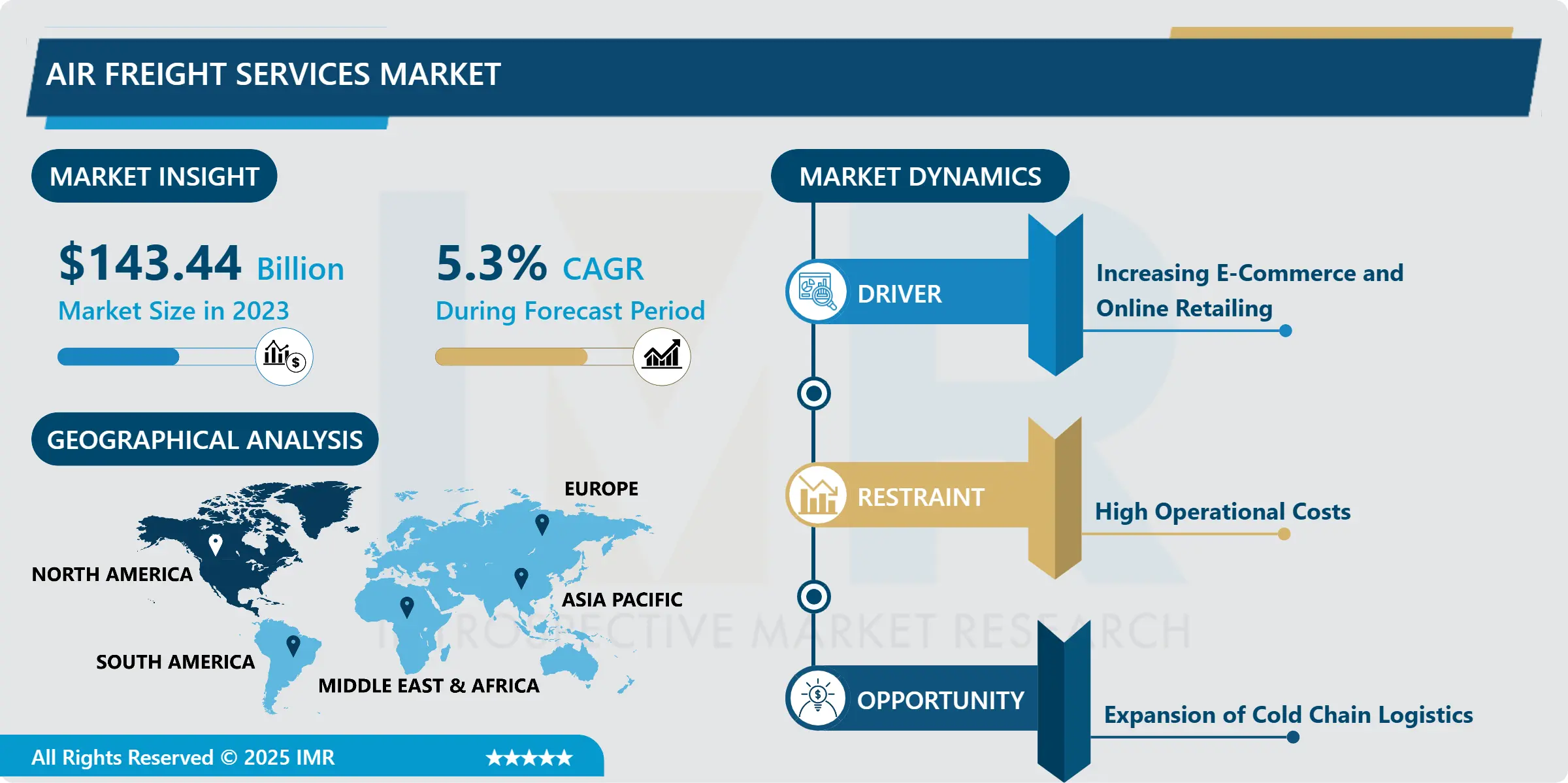
Air Freight Services Market Trend Analysis:
The Role of E-Commerce and Technology in Transforming the Air Freight Services Market
- The need for rapid delivery has structure a key part of several B2B air freight services contracts, on account of the driving factor currently fueled by online sales. The increase in import and export business activities has however increase the demand for air freights through increases in e-commerce particularly for small, valuable and perishable products like electronics, drugs and luxury products. Consumers are demanding delivery within the shortest time possible, thereby exerting pressure on organizations to embrace air freight as a means of delivering products on time as a way of satisfying their customers in a world with stiff competition.
- At the same time it is expanding through improving cold chain transportation, which is crucial for delivering goods that easily spoil such as fruits and vegetables, seafood, or vaccines. These innovations have proved very useful in meeting the requirements on temperature that accompany sensitive cargo. To increase productivity and improve customer satisfaction, the aviation and logistics industries have tried to ramp up the uptake of artificial intelligence, blockchain, and IoT. These tools improve the operation excellence challenging the difficulties of the supply chain such as route optimization, shipment tracking and effective communication to enhance customer confidence in the air freight services.
Advancements in the Air Freight Services Market
- I noted the e commerce business and particularly the emerging economy boost the demand for the goods delivered with great speed, and this makes the air freight service important in providing the needed speed in delivering the goods. While the prevailing trend of focusing on faster turnaround time to meet consumer needs following the growth of e-commerce, air freight solution providers continue to identify new ways to stand out from the pack through value added services such as time sensitive shipment, refrigerated shipping for food stuffs, and real time shipment tracking. These services also improve the ability to satisfy the customer while also serving industries where the need for air freight is even greater, for instance, chemical and pharmaceuticals, valuable electronics, and luxury products among others.
- However, to these market drivers, the use of advanced digital technologies, including artificial intelligence and blockchain in air freight is revolutionizing markets. Automated systems are making new technologies such as route optimization, predictive maintenance, and demand forecasts possible while blockchain strengthens security and transparency in supply chain activities. It is clear that such innovations help minimize expenditures while addressing clients’ concerns about shipment’s dependability and safety. When combined, all these innovations are modernising the air freight service industry into a market preferred choice of any spirited business organisation that is keen on flexibility, scalability and growth in a global economic climate.
Air Freight Services Market Segment Analysis:
Air Freight Services Market is Segmented on the basis of By Services, Destination, End User, and Region.
By Services, Freight segment is expected to dominate the market during the forecast period
- Freight services are an essential for transporting goods across borders and internationally in large quantities through sea, air, rail and road transport. This segment is vital for industries like manufacturing, retailing and agricultural products which need timely transportation of bulky items to overcome the supply chain constraint’s test. This is especially the case as more companies venture into the international markets’ nay vista the ever-rising call for efficient timely deliveries. The expansion of the global economy through international trade coupled with the rapid growth of the electronic marketplace for goods has enhanced the demand for effective freight that could accommodate the increasing flow, as well as the diversity of consignments.
- Overall growth is expected to continue in the freight services segment, due to rising requirements for efficient supply chain operations and growing internationalization of commerce. There is increasing pressure to adopt more environmentally friendly and economic ways of moving freight, and firms are seeking out electric vehicles and other improvements in the shipping process. Logistics advancements, particularly automation, artificial intelligence, and blockchain technologies, are also driving better freight service quality and, in some cases, greater service clarity. These trends together with continued growth of the emerging markets and changes in international business environment will remain the driving forces behind the growth of freight services companies.
By End User, Private segment expected to held the largest share
- Private end-users, expending the services for personal purposes, including individual consumers and households, need logistics services for online purchases, gifts, and letter deliveries. As e-commerce continues to grow, primarily in the delivery of items, the logistics services required for the speedy delivery of the products continue to be prompted. This had resulted in increased service expectations in the mobile platforms and apps which presents a tough task to realize the needs and demands of the consumers and the feat of providing convenience, real time tracking and promised delivery options through preferred mode of choice. While the consumers have accepted these technologies, the desire for quicker and more open methods of delivery has defined the private end user market.
- This segment is to continue with a growth in the near future because of increasing trend of personal goods shipment. So as the dominance of e-commerce continues the the face of global retail, the need for specific logistics solutions for example, subscribed deliveries, same day deliveries is anticipated to increase. Besides, the availability of orders at the buyer’s convenience where they enjoy flexible shipping options based on logistics providers has shifted the market towards the desires of the typical private consumers. The private and end-user segment seems to become more relevant to the long term due to focus on the customer experience, technology advancement and fast, reliable and customized delivery solutions.
Air Freight Services Market Regional Insights:
North America is Expected to Dominate the Market Over the Forecast period
- North America position itself, as a leading region in the market of air freight services thanks to their well-developed logistics infrastructures and fast-growing need in urgent and time-sensitive transportation. Market leaders are the United States and Canada as industries like the pharmaceuticals, e-commerce and the automobile industry highly depend on air freights for timely delivery. The air freight recently provides further growth by e-commerce and other firms that search the raise demand by delivery services. New technologies including digital freight booking platforms are also providing operational improvement through increased, efficient, flexible manner of bookings and tracking of freights. This digital transformation is bringing air freight services within reach and affordable especially to the big organizations and the small businesses.
- The infrastructure then takes shape further as some of the significant air cargo hubs such as Memphis site, Louisville among the most active world and Anchorage further providing uplink across the North America and across the globe. They are essential station for delivering the products especially for the express cargo whether imported or domestic. Furthermore, rising concern for cold chain logistics due to transportation of products that require specialized climate control such as pharmaceuticals, perishable goods and biotech products has created investment opportunities in specialized air freight services. Such change is driving regional growth, as logistics operators adjust the services to guarantee safe and timely deliveries of these valuable and sensitive goods, thereby affirming North America’s dominance in the air freight segment.
Active Key Players in the Air Freight Services Market
- American Airlines
- CargoLux Airlines International S.A.
- DB Schenker
- Delta Airlines
- DHL Group
- DSV
- Emirates
- Etihad Airways
- FedEx Corporation
- Korean Air Lines Co. Ltd.
- Kuehne and Nagel
- Lufthansa
- Qatar Airways
- Singapore Airlines
- United Airlines
- UPS
- Other Active Players.
|
Global Air Freight Services Market |
|||
|
Base Year: |
2023 |
Forecast Period: |
2024-2032 |
|
Historical Data: |
2017 to 2023 |
Market Size in 2023: |
USD 143.44 Billion |
|
Forecast Period 2024-32 CAGR: |
5.30% |
Market Size in 2032: |
USD 228.31 Billion |
|
Segments Covered: |
By Services |
|
|
|
By Destination |
|
||
|
By End User |
|
||
|
By Region |
|
||
|
Key Market Drivers: |
|
||
|
Key Market Restraints: |
|
||
|
Key Opportunities: |
|
||
|
Companies Covered in the report: |
|
||
Chapter 1: Introduction
1.1 Scope and Coverage
Chapter 2:Executive Summary
Chapter 3: Market Landscape
3.1 Market Dynamics
3.1.1 Drivers
3.1.2 Restraints
3.1.3 Opportunities
3.1.4 Challenges
3.2 Market Trend Analysis
3.3 PESTLE Analysis
3.4 Porter's Five Forces Analysis
3.5 Industry Value Chain Analysis
3.6 Ecosystem
3.7 Regulatory Landscape
3.8 Price Trend Analysis
3.9 Patent Analysis
3.10 Technology Evolution
3.11 Investment Pockets
3.12 Import-Export Analysis
Chapter 4: Air Freight Services Market by Services
4.1 Air Freight Services Market Snapshot and Growth Engine
4.2 Air Freight Services Market Overview
4.3 Freight
4.3.1 Introduction and Market Overview
4.3.2 Historic and Forecasted Market Size in Value USD and Volume Units (2017-2032F)
4.3.3 Key Market Trends, Growth Factors and Opportunities
4.3.4 Freight: Geographic Segmentation Analysis
4.4 Express
4.4.1 Introduction and Market Overview
4.4.2 Historic and Forecasted Market Size in Value USD and Volume Units (2017-2032F)
4.4.3 Key Market Trends, Growth Factors and Opportunities
4.4.4 Express: Geographic Segmentation Analysis
4.5 Mail
4.5.1 Introduction and Market Overview
4.5.2 Historic and Forecasted Market Size in Value USD and Volume Units (2017-2032F)
4.5.3 Key Market Trends, Growth Factors and Opportunities
4.5.4 Mail: Geographic Segmentation Analysis
4.6 and Other
4.6.1 Introduction and Market Overview
4.6.2 Historic and Forecasted Market Size in Value USD and Volume Units (2017-2032F)
4.6.3 Key Market Trends, Growth Factors and Opportunities
4.6.4 and Other: Geographic Segmentation Analysis
Chapter 5: Air Freight Services Market by Destination,
5.1 Air Freight Services Market Snapshot and Growth Engine
5.2 Air Freight Services Market Overview
5.3 Domestic and International
5.3.1 Introduction and Market Overview
5.3.2 Historic and Forecasted Market Size in Value USD and Volume Units (2017-2032F)
5.3.3 Key Market Trends, Growth Factors and Opportunities
5.3.4 Domestic and International: Geographic Segmentation Analysis
Chapter 6: Air Freight Services Market by End User
6.1 Air Freight Services Market Snapshot and Growth Engine
6.2 Air Freight Services Market Overview
6.3 Private and Commercial
6.3.1 Introduction and Market Overview
6.3.2 Historic and Forecasted Market Size in Value USD and Volume Units (2017-2032F)
6.3.3 Key Market Trends, Growth Factors and Opportunities
6.3.4 Private and Commercial: Geographic Segmentation Analysis
Chapter 7: Company Profiles and Competitive Analysis
7.1 Competitive Landscape
7.1.1 Competitive Benchmarking
7.1.2 Air Freight Services Market Share by Manufacturer (2023)
7.1.3 Industry BCG Matrix
7.1.4 Heat Map Analysis
7.1.5 Mergers and Acquisitions
7.2 AMERICAN AIRLINES
7.2.1 Company Overview
7.2.2 Key Executives
7.2.3 Company Snapshot
7.2.4 Role of the Company in the Market
7.2.5 Sustainability and Social Responsibility
7.2.6 Operating Business Segments
7.2.7 Product Portfolio
7.2.8 Business Performance
7.2.9 Key Strategic Moves and Recent Developments
7.2.10 SWOT Analysis
7.3 CARGOLUX AIRLINES INTERNATIONAL S.A.
7.4 DB SCHENKER
7.5 DELTA AIRLINES
7.6 DHL GROUP
7.7 DSV
7.8 EMIRATES
7.9 ETIHAD AIRWAYS
7.10 FEDEX CORPORATION
7.11 KOREAN AIR LINES CO. LTD.
7.12 KUEHNE AND NAGEL
7.13 LUFTHANSA
7.14 QATAR AIRWAYS
7.15 SINGAPORE AIRLINES
7.16 UNITED AIRLINES
7.17 AND UPS
7.18 OTHER ACTIVE PLAYERS
7.19 OTHER ACTIVE PLAYERS
Chapter 8: Global Air Freight Services Market By Region
8.1 Overview
8.2. North America Air Freight Services Market
8.2.1 Key Market Trends, Growth Factors and Opportunities
8.2.2 Top Key Companies
8.2.3 Historic and Forecasted Market Size by Segments
8.2.4 Historic and Forecasted Market Size By Services
8.2.4.1 Freight
8.2.4.2 Express
8.2.4.3 Mail
8.2.4.4 and Other
8.2.5 Historic and Forecasted Market Size By Destination,
8.2.5.1 Domestic and International
8.2.6 Historic and Forecasted Market Size By End User
8.2.6.1 Private and Commercial
8.2.7 Historic and Forecast Market Size by Country
8.2.7.1 US
8.2.7.2 Canada
8.2.7.3 Mexico
8.3. Eastern Europe Air Freight Services Market
8.3.1 Key Market Trends, Growth Factors and Opportunities
8.3.2 Top Key Companies
8.3.3 Historic and Forecasted Market Size by Segments
8.3.4 Historic and Forecasted Market Size By Services
8.3.4.1 Freight
8.3.4.2 Express
8.3.4.3 Mail
8.3.4.4 and Other
8.3.5 Historic and Forecasted Market Size By Destination,
8.3.5.1 Domestic and International
8.3.6 Historic and Forecasted Market Size By End User
8.3.6.1 Private and Commercial
8.3.7 Historic and Forecast Market Size by Country
8.3.7.1 Russia
8.3.7.2 Bulgaria
8.3.7.3 The Czech Republic
8.3.7.4 Hungary
8.3.7.5 Poland
8.3.7.6 Romania
8.3.7.7 Rest of Eastern Europe
8.4. Western Europe Air Freight Services Market
8.4.1 Key Market Trends, Growth Factors and Opportunities
8.4.2 Top Key Companies
8.4.3 Historic and Forecasted Market Size by Segments
8.4.4 Historic and Forecasted Market Size By Services
8.4.4.1 Freight
8.4.4.2 Express
8.4.4.3 Mail
8.4.4.4 and Other
8.4.5 Historic and Forecasted Market Size By Destination,
8.4.5.1 Domestic and International
8.4.6 Historic and Forecasted Market Size By End User
8.4.6.1 Private and Commercial
8.4.7 Historic and Forecast Market Size by Country
8.4.7.1 Germany
8.4.7.2 UK
8.4.7.3 France
8.4.7.4 The Netherlands
8.4.7.5 Italy
8.4.7.6 Spain
8.4.7.7 Rest of Western Europe
8.5. Asia Pacific Air Freight Services Market
8.5.1 Key Market Trends, Growth Factors and Opportunities
8.5.2 Top Key Companies
8.5.3 Historic and Forecasted Market Size by Segments
8.5.4 Historic and Forecasted Market Size By Services
8.5.4.1 Freight
8.5.4.2 Express
8.5.4.3 Mail
8.5.4.4 and Other
8.5.5 Historic and Forecasted Market Size By Destination,
8.5.5.1 Domestic and International
8.5.6 Historic and Forecasted Market Size By End User
8.5.6.1 Private and Commercial
8.5.7 Historic and Forecast Market Size by Country
8.5.7.1 China
8.5.7.2 India
8.5.7.3 Japan
8.5.7.4 South Korea
8.5.7.5 Malaysia
8.5.7.6 Thailand
8.5.7.7 Vietnam
8.5.7.8 The Philippines
8.5.7.9 Australia
8.5.7.10 New Zealand
8.5.7.11 Rest of APAC
8.6. Middle East & Africa Air Freight Services Market
8.6.1 Key Market Trends, Growth Factors and Opportunities
8.6.2 Top Key Companies
8.6.3 Historic and Forecasted Market Size by Segments
8.6.4 Historic and Forecasted Market Size By Services
8.6.4.1 Freight
8.6.4.2 Express
8.6.4.3 Mail
8.6.4.4 and Other
8.6.5 Historic and Forecasted Market Size By Destination,
8.6.5.1 Domestic and International
8.6.6 Historic and Forecasted Market Size By End User
8.6.6.1 Private and Commercial
8.6.7 Historic and Forecast Market Size by Country
8.6.7.1 Turkiye
8.6.7.2 Bahrain
8.6.7.3 Kuwait
8.6.7.4 Saudi Arabia
8.6.7.5 Qatar
8.6.7.6 UAE
8.6.7.7 Israel
8.6.7.8 South Africa
8.7. South America Air Freight Services Market
8.7.1 Key Market Trends, Growth Factors and Opportunities
8.7.2 Top Key Companies
8.7.3 Historic and Forecasted Market Size by Segments
8.7.4 Historic and Forecasted Market Size By Services
8.7.4.1 Freight
8.7.4.2 Express
8.7.4.3 Mail
8.7.4.4 and Other
8.7.5 Historic and Forecasted Market Size By Destination,
8.7.5.1 Domestic and International
8.7.6 Historic and Forecasted Market Size By End User
8.7.6.1 Private and Commercial
8.7.7 Historic and Forecast Market Size by Country
8.7.7.1 Brazil
8.7.7.2 Argentina
8.7.7.3 Rest of SA
Chapter 9 Analyst Viewpoint and Conclusion
9.1 Recommendations and Concluding Analysis
9.2 Potential Market Strategies
Chapter 10 Research Methodology
10.1 Research Process
10.2 Primary Research
10.3 Secondary Research
|
Global Air Freight Services Market |
|||
|
Base Year: |
2023 |
Forecast Period: |
2024-2032 |
|
Historical Data: |
2017 to 2023 |
Market Size in 2023: |
USD 143.44 Billion |
|
Forecast Period 2024-32 CAGR: |
5.30% |
Market Size in 2032: |
USD 228.31 Billion |
|
Segments Covered: |
By Services |
|
|
|
By Destination |
|
||
|
By End User |
|
||
|
By Region |
|
||
|
Key Market Drivers: |
|
||
|
Key Market Restraints: |
|
||
|
Key Opportunities: |
|
||
|
Companies Covered in the report: |
|
||