Smart Vent System Market Synopsis:
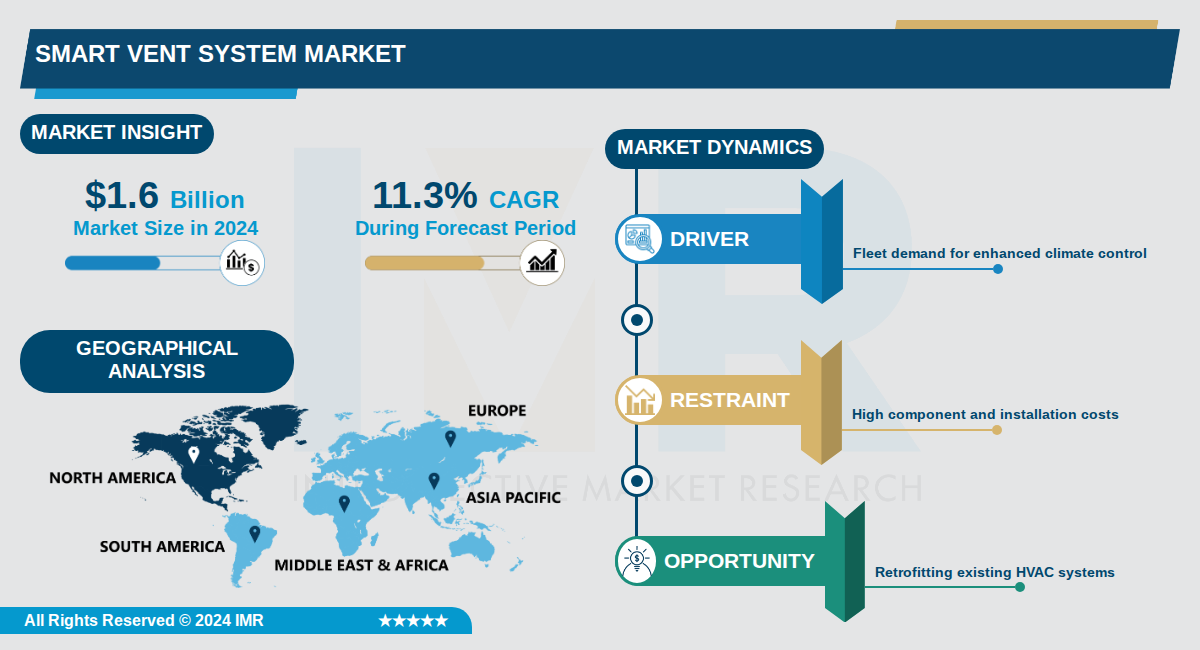
Smart Vent System Market Size Was Valued at USD 1.6 Billion in 2024, and is Projected to Reach USD 5.1 Billion by 2035, Growing at a CAGR of 11.3% From 2024-2035.
The Smart Vent System Market, valued at $1.6 billion in 2024, is projected to reach $5.1 billion by 2035, growing at a compound annual growth rate (CAGR) of 11.3%. This expansion reflects the increasing integration of smart vents into HVAC systems, enabling automated airflow regulation based on occupancy, temperature, and air quality for enhanced energy efficiency and comfort.
Smart vents are gaining traction in residential, commercial, and industrial applications, with residential leading due to rising smart home adoption and consumer focus on cost-saving automation. North America holds a significant share, supported by high HVAC penetration, while Asia-Pacific shows the fastest growth driven by urbanization and smart city initiatives.
The market features a fragmented competitive landscape with key players like Honeywell, Panasonic, and Carrier innovating in IoT connectivity, AI sensors, and partnerships with HVAC providers. These advancements position smart vents as essential components in energy-efficient building management systems globally.
Smart Vent System Market Trend Analysis:
AI-Driven HVAC Optimization
- AI algorithms in smart vent systems analyze real-time data from occupancy sensors and temperature readings to dynamically adjust airflow, reducing energy consumption by up to 35% in residential settings. Companies like Flair are leading this trend with their Pro Smart Vent Zoning solutions that incorporate AI for precise climate control. This optimization ensures personalized comfort while minimizing waste in HVAC operations.
- Integration of AI enables predictive maintenance by forecasting system needs based on usage patterns, preventing inefficiencies common in traditional vents. Manufacturers report that AI-enhanced vents can cut heating costs by 25% through intelligent zoning in multi-room homes. Flair's systems, for instance, use AI to balance air pressure across zones automatically.
- The trend is accelerating with partnerships between AI tech firms and HVAC giants, positioning smart vents as core components in next-generation smart buildings.
Integration with Smart Home Ecosystems
- Smart vents now seamlessly connect with platforms like Google Home and Amazon Alexa via IoT, allowing voice-activated control and app-based monitoring for users. Flair's vents integrate with leading smart thermostats such as Nest and Ecobee, enabling unified home automation that responds to occupancy in real-time. This has driven a 35% increase in adoption during residential renovations.
- The Granite Group's April 2024 distribution partnership with Flair expanded access to these integrated systems across New England, boosting market penetration in smart home upgrades. Compatibility with 5G enhances responsiveness, cutting latency for remote adjustments to under 50 milliseconds. Homeowners benefit from bundled offerings that combine vents with thermostats for holistic energy management.
Expansion in Smart Cities and Automotive Applications
- Smart vent adoption is surging in smart city initiatives, with Asia-Pacific leading at 29% growth fueled by urbanization and green building projects in China, where revenue is projected to grow at 14.1% CAGR through 2036. Manufacturers are targeting sustainable infrastructure, integrating vents into commercial HVAC for energy recovery and air quality monitoring. This aligns with global pushes for net-zero buildings.
- In the automotive sector, motorized smart vents dominate with 50.6% market share, particularly in passenger EVs holding 66.7% of vehicle applications, enhancing cabin climate control. Fact.MR forecasts the overall market to reach USD 2.4 billion by 2036 at 11.8% CAGR, driven by EV infrastructure in regions like China.
Smart Vent System Market Segment Analysis:
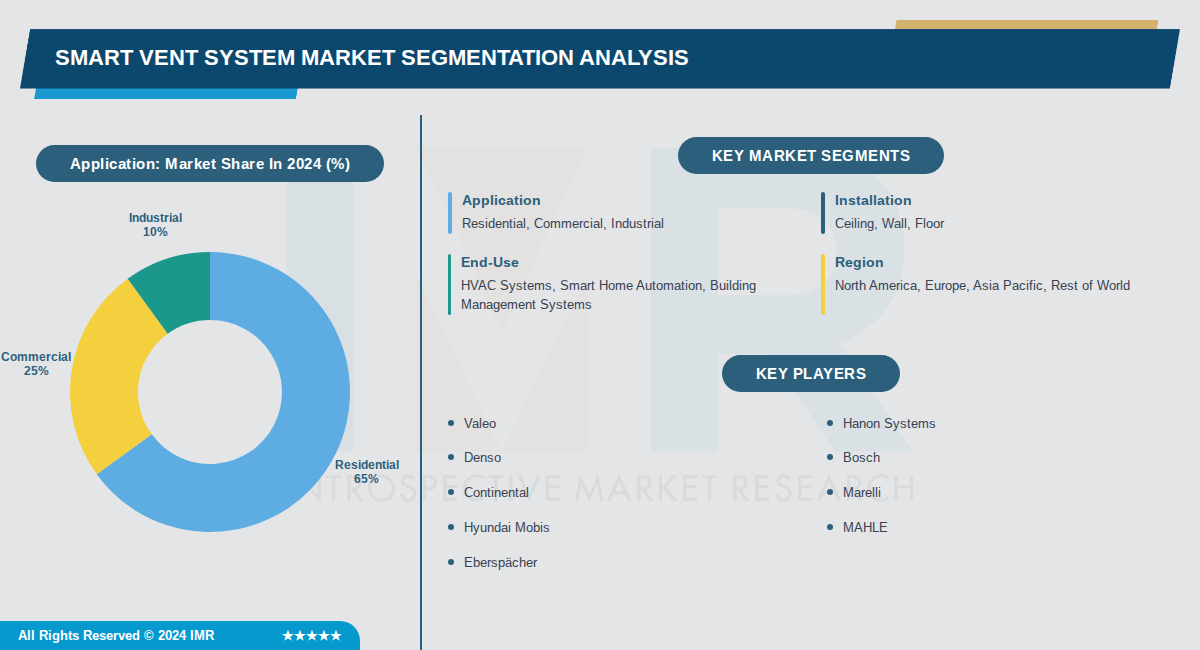
Smart Vent System Market is Segmented on the basis of By Application, By Installation, By End-Use
By Application, Residential segment is expected to dominate the market during the forecast period
- Residential segment dominates due to increasing adoption of smart home technologies and consumer focus on energy efficiency and indoor air quality.
- Rising smart home constructions globally, particularly in North America and Asia Pacific, drive over 65% market share for residential applications.
By Installation, Ceiling segment is expected to dominate the market during the forecast period
- Ceiling installation leads due to superior airflow management, even temperature distribution, and seamless integration with existing HVAC ductwork.
- Forecasts indicate ceiling vents will witness the highest growth owing to advanced temperature-controlling features preferred in both residential and commercial settings.
By End-Use, HVAC Systems segment is expected to dominate the market during the forecast period
- HVAC systems dominate as smart vents primarily enhance traditional HVAC functionality with IoT controls for precise air distribution.
- Integration with HVAC drives majority share due to global emphasis on IAQ improvement and energy savings in buildings.
By Region, North America segment is expected to dominate the market during the forecast period
- North America leads due to high concentration of smart vent vendors like Keen Home, Flair, and early adoption of smart home ecosystems.
- Presence of major players and stringent energy efficiency regulations propel North America to hold the largest regional market share.
Smart Vent System Market Regional Insights:
North America is Expected to Dominate the Market Over the Forecast Period
- North America dominates the Smart Vent System market, holding nearly 34% market share, primarily driven by the U.S., Canada, and Mexico. The region leads due to extensive adoption of smart home technologies and high consumer awareness. This positions North America ahead of other regions in market penetration and innovation.
- Advanced HVAC infrastructure, favorable government policies promoting energy-efficient buildings, and integration of AI-driven solutions bolster dominance. Stringent regulations encourage retrofits and new constructions with smart ventilation. These factors create a mature ecosystem supporting widespread deployment.
- Key players focus on strategic partnerships and innovations tailored for the U.S. market, enhancing HVAC solutions. Recent developments include IoT-enabled devices and environmental sensors for personalized comfort. Ongoing investments in smart home automation further solidify the region's leadership.
Active Key Players in the Smart Vent System Market:
- Valeo (France)
- Hanon Systems (South Korea)
- Denso (Japan)
- Bosch (Germany)
- Continental (Germany)
- Marelli (Japan)
- Hyundai Mobis (South Korea)
- MAHLE (Germany)
- Eberspächer (Germany)
- Gentherm (USA)
- IPS Roofing Products (USA)
- Ecovent Systems (USA)
- DCI Products (USA)
- Enerbee (Switzerland)
- CSR Electrical (Australia)
- Flair (USA)
- Keen Home (USA)
- Nest Labs (USA)
- Rowan Dron Electrical (UK)
- Other Active Players
|
Smart Vent System Market |
|||
|
Base Year: |
2024 |
Forecast Period: |
2024-2035 |
|
Historical Data: |
2017 to 2024 |
Market Size in 2024: |
USD 1.6 Billion |
|
Forecast Period 2024-2035 CAGR: |
11.3 % |
Market Size in 2035: |
USD 5.1 Billion |
|
Segments Covered: |
By Application |
|
|
|
By Installation |
|
||
|
By End-Use |
|
||
|
By Region |
|
||
|
By Region |
|
||
|
Key Market Drivers: |
|
||
|
Key Market Restraints: |
|
||
|
Key Opportunities: |
|
||
|
Companies Covered in the report: |
|
||
Chapter 1: Introduction
1.1 Scope and Coverage
Chapter 2: Executive Summary
Chapter 3: Market Landscape
3.1 Market Dynamics and Opportunity Analysis
3.1.1 Growth Drivers
3.1.2 Limiting Factors
3.1.3 Growth Opportunities
3.1.4 Challenges and Risks
3.2 Market Trend Analysis
3.3 Industry Ecosystem
3.4 Industry Value Chain Mapping
3.5 Strategic PESTLE Overview
3.6 Porter's Five Forces Framework
3.7 Regulatory Framework
3.8 Pricing Trend Analysis
3.9 Intellectual Property Review
3.10 Technology Evolution
3.11 Import-Export Analysis
3.12 Consumer Behavior Analysis
3.13 Investment Pocket Analysis
3.14 Go-To Market Strategy
Chapter 4: Smart Vent System Market by Application (2017-2035)
4.1 Smart Vent System Market Snapshot and Growth Engine
4.2 Market Overview
4.3 Residential
4.3.1 Introduction and Market Overview
4.3.2 Historic and Forecasted Market Size in Value USD and Volume Units
4.3.3 Key Market Trends, Growth Factors, and Opportunities
4.3.4 Geographic Segmentation Analysis
4.4 Commercial
4.5 Industrial
Chapter 5: Smart Vent System Market by Installation (2017-2035)
5.1 Smart Vent System Market Snapshot and Growth Engine
5.2 Market Overview
5.3 Ceiling
5.3.1 Introduction and Market Overview
5.3.2 Historic and Forecasted Market Size in Value USD and Volume Units
5.3.3 Key Market Trends, Growth Factors, and Opportunities
5.3.4 Geographic Segmentation Analysis
5.4 Wall
5.5 Floor
Chapter 6: Smart Vent System Market by End-Use (2017-2035)
6.1 Smart Vent System Market Snapshot and Growth Engine
6.2 Market Overview
6.3 HVAC Systems
6.3.1 Introduction and Market Overview
6.3.2 Historic and Forecasted Market Size in Value USD and Volume Units
6.3.3 Key Market Trends, Growth Factors, and Opportunities
6.3.4 Geographic Segmentation Analysis
6.4 Smart Home Automation
6.5 Building Management Systems
Chapter 7: Smart Vent System Market by Region (2017-2035)
7.1 Smart Vent System Market Snapshot and Growth Engine
7.2 Market Overview
7.3 North America
7.3.1 Introduction and Market Overview
7.3.2 Historic and Forecasted Market Size in Value USD and Volume Units
7.3.3 Key Market Trends, Growth Factors, and Opportunities
7.3.4 Geographic Segmentation Analysis
7.4 Europe
7.5 Asia Pacific
7.6 Rest of World
Chapter 8: Company Profiles and Competitive Analysis
8.1 Competitive Landscape
8.1.1 Competitive Benchmarking
8.1.2 Smart Vent System Market Share by Manufacturer/Service Provider (2024)
8.1.3 Industry BCG Matrix
8.1.4 Partnerships, Mergers & Acquisitions
8.2 VALEO
8.2.1 Company Overview
8.2.2 Key Executives
8.2.3 Company Snapshot
8.2.4 Role of the Company in the Market
8.2.5 Sustainability and Social Responsibility
8.2.6 Operating Business Segments
8.2.7 Product Portfolio
8.2.8 Business Performance
8.2.9 Recent News & Developments
8.2.10 SWOT Analysis
8.3 HANON SYSTEMS
8.4 DENSO
8.5 BOSCH
8.6 CONTINENTAL
8.7 MARELLI
8.8 HYUNDAI MOBIS
8.9 MAHLE
8.10 EBERSPÄCHER
8.11 GENTHERM
8.12 IPS ROOFING PRODUCTS
8.13 ECOVENT SYSTEMS
8.14 DCI PRODUCTS
8.15 ENERBEE
8.16 CSR ELECTRICAL
8.17 FLAIR
8.18 KEEN HOME
8.19 NEST LABS
8.20 ROWAN DRON ELECTRICAL
Chapter 9: Global Smart Vent System Market By Region
9.1 Overview
9.2. North America Smart Vent System Market
9.2.1 Key Market Trends, Growth Factors and Opportunities
9.2.2 Top Key Companies
9.2.3 Historic and Forecasted Market Size by Segments
9.2.4 Historic and Forecast Market Size by Country
9.3. Eastern Europe Smart Vent System Market
9.3.1 Key Market Trends, Growth Factors and Opportunities
9.3.2 Top Key Companies
9.3.3 Historic and Forecasted Market Size by Segments
9.3.4 Historic and Forecast Market Size by Country
9.4. Western Europe Smart Vent System Market
9.4.1 Key Market Trends, Growth Factors and Opportunities
9.4.2 Top Key Companies
9.4.3 Historic and Forecasted Market Size by Segments
9.4.4 Historic and Forecast Market Size by Country
9.5. Asia Pacific Smart Vent System Market
9.5.1 Key Market Trends, Growth Factors and Opportunities
9.5.2 Top Key Companies
9.5.3 Historic and Forecasted Market Size by Segments
9.5.4 Historic and Forecast Market Size by Country
9.6. Middle East & Africa Smart Vent System Market
9.6.1 Key Market Trends, Growth Factors and Opportunities
9.6.2 Top Key Companies
9.6.3 Historic and Forecasted Market Size by Segments
9.6.4 Historic and Forecast Market Size by Country
9.7. South America Smart Vent System Market
9.7.1 Key Market Trends, Growth Factors and Opportunities
9.7.2 Top Key Companies
9.7.3 Historic and Forecasted Market Size by Segments
9.7.4 Historic and Forecast Market Size by Country
Chapter 10: Analyst Viewpoint and Conclusion
Chapter 11: Research Methodology
11.1 Research Process
11.2 Primary Research
11.3 Secondary Research
Chapter 12: Case Study
Chapter 13: Appendix
13.1 Sources
13.2 List of Tables and Figures
13.3 Short Forms and Citations
13.4 Assumption and Conversion
13.5 Disclaimer
|
Smart Vent System Market |
|||
|
Base Year: |
2024 |
Forecast Period: |
2024-2035 |
|
Historical Data: |
2017 to 2024 |
Market Size in 2024: |
USD 1.6 Billion |
|
Forecast Period 2024-2035 CAGR: |
11.3 % |
Market Size in 2035: |
USD 5.1 Billion |
|
Segments Covered: |
By Application |
|
|
|
By Installation |
|
||
|
By End-Use |
|
||
|
By Region |
|
||
|
By Region |
|
||
|
Key Market Drivers: |
|
||
|
Key Market Restraints: |
|
||
|
Key Opportunities: |
|
||
|
Companies Covered in the report: |
|
||