




Hydraulic Tiltrotator Market Synopsis:
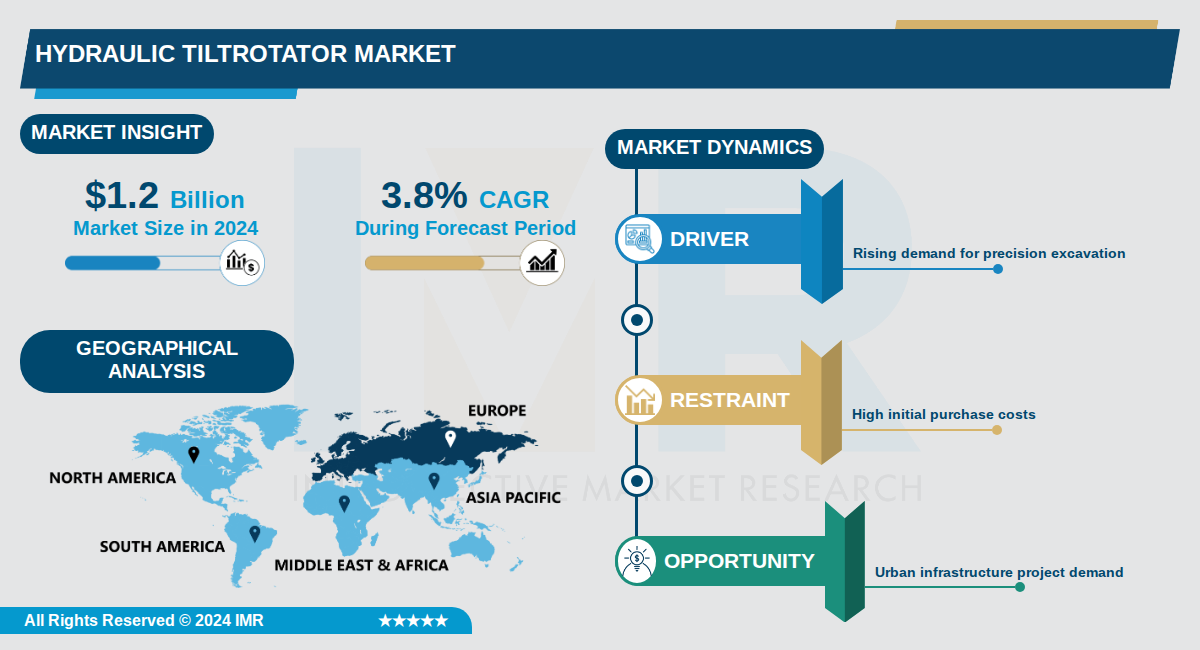
Hydraulic Tiltrotator Market Size Was Valued at USD 1.2 Billion in 2024, and is Projected to Reach USD 1.8 Billion by 2035, Growing at a CAGR of 3.8% From 2024-2035.
The Hydraulic Tiltrotator Market is valued at $1.2 billion in 2024 and is projected to reach $1.8 billion by 2035, growing at a CAGR of 3.8%. Hydraulic tiltrotators are advanced attachments for excavators and backhoes, enabling 360-degree rotation and tilting for enhanced precision in tasks like digging, grading, and demolition.
This market has seen varying growth projections across reports, with estimates ranging from $0.75-1.42 billion in 2024 to $1.5-2.36 billion by 2030-2034 at CAGRs of 7.1-25.97%, reflecting strong demand in construction and related sectors. Europe leads adoption, particularly in urban areas, while North America and Asia-Pacific show rising penetration.
Key applications span construction, utilities, forestry, agriculture, and mining, with end-users including OEMs, contractors, and rental companies. Innovations focus on system integration, automation, and user-friendly controls, positioning tiltrotators as essential for efficient, multifunctional equipment.
Hydraulic Tiltrotator Market Trend Analysis:
OEM Integration and Factory-Ready Systems
- Leading manufacturers like Caterpillar and Engcon are increasingly offering factory-installed tiltrotator options on excavators, smoothing adoption for contractors by eliminating retrofit complexities. This integration allows seamless compatibility with OEM hydraulic systems, reducing installation time by up to 50% compared to aftermarket attachments. In Europe, where tiltrotators are standard in over 40% of excavator fleets, companies like Rototilt Group partner with Volvo and Hitachi for pre-configured models.
- North American OEMs such as John Deere are exploring similar integrations to boost penetration from under 10% currently, driven by demand in urban utility projects. Strategic Market Research notes this trend accelerates market growth to USD 2.36 billion by 2030 at 8.9% CAGR. Rental companies like United Rentals benefit by offering plug-and-play units that cut setup downtime on job sites.
- Japanese firms like Yanmar and Korean OEMs are forming export partnerships, embedding tiltrotators in compact excavators for Asian and Latin American markets, positioning them as core components rather than add-ons.
Integration with Digital Controls and Machine Automation
- Tiltrotators are evolving into digital jobsite components with joystick-integrated controls and 3D machine control tie-ins from companies like Steelwrist and KINSHOFER. These systems provide real-time data feedback and precision positioning, reducing operator repositioning time by 30-40% on tight urban sites. Verified Market Reports highlights enhanced telematics integration attracting interest amid rising automation in construction machinery.
- Engcon's latest models feature embedded sensors for wear tracking and automated maintenance alerts, appealing to rental fleets where downtime impacts ROI. This shift elevates tiltrotators from mechanical attachments to smart ecosystem enablers, with market forecasts projecting USD 250 million by 2033 at 8.5% CAGR. Operators gain ergonomic benefits through intuitive cab interfaces that simplify high-precision tasks for mid-level users.
- SMP and Liebherr are bundling tiltrotators with quick couplers and software packages, enabling seamless connectivity with fleet management platforms like Trimble or Leica Geosystems.
Expansion into Urban Infrastructure and Emerging Markets
- Rising urban densification drives tiltrotator demand for precision excavation in confined spaces, such as cable laying and sidewalk restoration, with North America emerging as a growth engine via U.S. Northeast projects. Strategic Market Research identifies this as key to the market reaching USD 2.36 billion by 2030, fueled by infrastructure upgrades. In China, representing a significant global share, government investments in megacities boost adoption by firms like Giant Hydraulic Tech.
- Asia Pacific leaders like Japan and India see rapid growth from urbanization, with Hitachi and local players investing in infrastructure projects that favor versatile attachments. Latin America and Middle East markets remain untapped but poised for selective demand in public works, as noted in competitive analyses. Contractors report fuel savings of 20% and enhanced safety on compact sites due to reduced machine movements.
Hydraulic Tiltrotator Market Segment Analysis:
Hydraulic Tiltrotator Market is Segmented on the basis of By Type, By Application, By End User
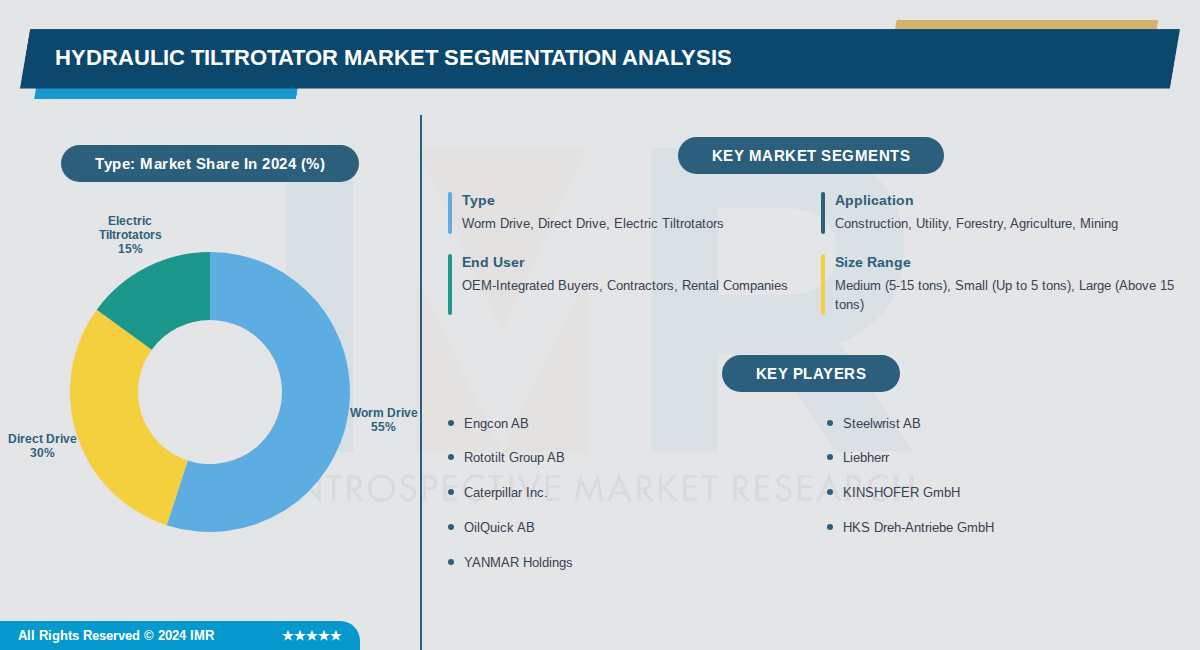
By Type, Worm Drive segment is expected to dominate the market during the forecast period
- Worm Drive tiltrotators dominate due to their superior torque delivery and reliability in heavy-duty applications like construction and utility work.
- They represent the highest volume sales as they offer cost-effective maintenance and proven durability in demanding environments.
By Application, Construction segment is expected to dominate the market during the forecast period
- Construction leads as it accounts for the largest demand driven by global infrastructure projects and urban development requiring precise excavation.
- Public-funded infrastructure in North America and Europe accelerates adoption, with construction and utility together holding over 70% market share.
By End User, OEM-Integrated Buyers segment is expected to dominate the market during the forecast period
- OEM-Integrated Buyers dominate due to factory-installed tiltrotators becoming standard in excavator fleets, especially in Scandinavia and North America.
- Large contractors prefer OEM integration for seamless compatibility, operator familiarity, and optimized cost-per-job metrics.
By Size Range, Medium (5-15 tons) segment is expected to dominate the market during the forecast period
- Medium size range leads as it matches the most common excavator classes used in construction, utility, and landscaping projects.
- This segment benefits from high versatility and compatibility with mid-sized fleets prevalent in urban infrastructure and contractor operations.
Hydraulic Tiltrotator Market Regional Insights:
Europe is the Largest Market for Hydraulic Tiltrotators, Holding Over 45% Share
- Europe dominates the global hydraulic tiltrotator market with a share exceeding 45%, driven by strong demand in key countries like Germany, France, Italy, and the UK. These nations lead due to advanced construction practices and high adoption of excavator attachments. The region's mature market is supported by detailed consumption forecasts for individual countries, indicating sustained leadership.
- Robust infrastructure development, large-scale construction and demolition activities, and stringent equipment standards fuel Europe's dominance. France and Germany are the biggest markets, propelled by ongoing investments in urban projects and excavation needs. Regulatory emphasis on efficient machinery further boosts hydraulic tiltrotator usage in medium-sized excavators.
- Major players such as Engcon AB, Steelwrist AB, and Rototilt Group AB, all based in Europe, control about 55% of the global market. These Swedish firms innovate in tiltrotator technology, with Europe hosting production and R&D hubs. Recent market reports highlight Europe's top position amid growing global demand.
Active Key Players in the Hydraulic Tiltrotator Market:
- Engcon AB (Sweden)
- Steelwrist AB (Sweden)
- Rototilt Group AB (Sweden)
- Liebherr (Switzerland)
- Caterpillar Inc. (USA)
- KINSHOFER GmbH (Germany)
- OilQuick AB (Sweden)
- HKS Dreh-Antriebe GmbH (Germany)
- YANMAR Holdings (Japan)
- SMP AB (Sweden)
- ACB+ (France)
- Lehnhoff Hart Stahl GmbH (Germany)
- Catsu Hydraulic (China)
- MTS Schrode AG (Sweden)
- Giant Hydraulic Tech (Taiwan)
- JK Technology (South Korea)
- Marttiini Metal Oy (Finland)
- Ju-Hyun (South Korea)
- Other Active Players
|
Hydraulic Tiltrotator Market |
|||
|
Base Year: |
2024 |
Forecast Period: |
2024-2035 |
|
Historical Data: |
2017 to 2024 |
Market Size in 2024: |
USD 1.2 Billion |
|
Forecast Period 2024-2035 CAGR: |
3.8 % |
Market Size in 2035: |
USD 1.8 Billion |
|
Segments Covered: |
By Type |
|
|
|
By Application |
|
||
|
By End User |
|
||
|
By Size Range |
|
||
|
By Region |
|
||
|
Key Market Drivers: |
|
||
|
Key Market Restraints: |
|
||
|
Key Opportunities: |
|
||
|
Companies Covered in the report: |
|
||
Chapter 1: Introduction
1.1 Scope and Coverage
Chapter 2: Executive Summary
Chapter 3: Market Landscape
3.1 Market Dynamics and Opportunity Analysis
3.1.1 Growth Drivers
3.1.2 Limiting Factors
3.1.3 Growth Opportunities
3.1.4 Challenges and Risks
3.2 Market Trend Analysis
3.3 Industry Ecosystem
3.4 Industry Value Chain Mapping
3.5 Strategic PESTLE Overview
3.6 Porter's Five Forces Framework
3.7 Regulatory Framework
3.8 Pricing Trend Analysis
3.9 Intellectual Property Review
3.10 Technology Evolution
3.11 Import-Export Analysis
3.12 Consumer Behavior Analysis
3.13 Investment Pocket Analysis
3.14 Go-To Market Strategy
Chapter 4: Hydraulic Tiltrotator Market by Type (2017-2035)
4.1 Hydraulic Tiltrotator Market Snapshot and Growth Engine
4.2 Market Overview
4.3 Worm Drive
4.3.1 Introduction and Market Overview
4.3.2 Historic and Forecasted Market Size in Value USD and Volume Units
4.3.3 Key Market Trends, Growth Factors, and Opportunities
4.3.4 Geographic Segmentation Analysis
4.4 Direct Drive
4.5 Electric Tiltrotators
Chapter 5: Hydraulic Tiltrotator Market by Application (2017-2035)
5.1 Hydraulic Tiltrotator Market Snapshot and Growth Engine
5.2 Market Overview
5.3 Construction
5.3.1 Introduction and Market Overview
5.3.2 Historic and Forecasted Market Size in Value USD and Volume Units
5.3.3 Key Market Trends, Growth Factors, and Opportunities
5.3.4 Geographic Segmentation Analysis
5.4 Utility
5.5 Forestry
5.6 Agriculture
5.7 Mining
Chapter 6: Hydraulic Tiltrotator Market by End User (2017-2035)
6.1 Hydraulic Tiltrotator Market Snapshot and Growth Engine
6.2 Market Overview
6.3 OEM-Integrated Buyers
6.3.1 Introduction and Market Overview
6.3.2 Historic and Forecasted Market Size in Value USD and Volume Units
6.3.3 Key Market Trends, Growth Factors, and Opportunities
6.3.4 Geographic Segmentation Analysis
6.4 Contractors
6.5 Rental Companies
Chapter 7: Hydraulic Tiltrotator Market by Size Range (2017-2035)
7.1 Hydraulic Tiltrotator Market Snapshot and Growth Engine
7.2 Market Overview
7.3 Medium (5-15 tons)
7.3.1 Introduction and Market Overview
7.3.2 Historic and Forecasted Market Size in Value USD and Volume Units
7.3.3 Key Market Trends, Growth Factors, and Opportunities
7.3.4 Geographic Segmentation Analysis
7.4 Small (Up to 5 tons)
7.5 Large (Above 15 tons)
Chapter 8: Company Profiles and Competitive Analysis
8.1 Competitive Landscape
8.1.1 Competitive Benchmarking
8.1.2 Hydraulic Tiltrotator Market Share by Manufacturer/Service Provider (2024)
8.1.3 Industry BCG Matrix
8.1.4 Partnerships, Mergers & Acquisitions
8.2 ENGCON AB
8.2.1 Company Overview
8.2.2 Key Executives
8.2.3 Company Snapshot
8.2.4 Role of the Company in the Market
8.2.5 Sustainability and Social Responsibility
8.2.6 Operating Business Segments
8.2.7 Product Portfolio
8.2.8 Business Performance
8.2.9 Recent News & Developments
8.2.10 SWOT Analysis
8.3 STEELWRIST AB
8.4 ROTOTILT GROUP AB
8.5 LIEBHERR
8.6 CATERPILLAR INC.
8.7 KINSHOFER GMBH
8.8 OILQUICK AB
8.9 HKS DREH-ANTRIEBE GMBH
8.10 YANMAR HOLDINGS
8.11 SMP AB
8.12 ACB+
8.13 LEHNHOFF HART STAHL GMBH
8.14 CATSU HYDRAULIC
8.15 MTS SCHRODE AG
8.16 GIANT HYDRAULIC TECH
8.17 JK TECHNOLOGY
8.18 MARTTIINI METAL OY
8.19 JU-HYUN
Chapter 9: Global Hydraulic Tiltrotator Market By Region
9.1 Overview
9.2. North America Hydraulic Tiltrotator Market
9.2.1 Key Market Trends, Growth Factors and Opportunities
9.2.2 Top Key Companies
9.2.3 Historic and Forecasted Market Size by Segments
9.2.4 Historic and Forecast Market Size by Country
9.3. Eastern Europe Hydraulic Tiltrotator Market
9.3.1 Key Market Trends, Growth Factors and Opportunities
9.3.2 Top Key Companies
9.3.3 Historic and Forecasted Market Size by Segments
9.3.4 Historic and Forecast Market Size by Country
9.4. Western Europe Hydraulic Tiltrotator Market
9.4.1 Key Market Trends, Growth Factors and Opportunities
9.4.2 Top Key Companies
9.4.3 Historic and Forecasted Market Size by Segments
9.4.4 Historic and Forecast Market Size by Country
9.5. Asia Pacific Hydraulic Tiltrotator Market
9.5.1 Key Market Trends, Growth Factors and Opportunities
9.5.2 Top Key Companies
9.5.3 Historic and Forecasted Market Size by Segments
9.5.4 Historic and Forecast Market Size by Country
9.6. Middle East & Africa Hydraulic Tiltrotator Market
9.6.1 Key Market Trends, Growth Factors and Opportunities
9.6.2 Top Key Companies
9.6.3 Historic and Forecasted Market Size by Segments
9.6.4 Historic and Forecast Market Size by Country
9.7. South America Hydraulic Tiltrotator Market
9.7.1 Key Market Trends, Growth Factors and Opportunities
9.7.2 Top Key Companies
9.7.3 Historic and Forecasted Market Size by Segments
9.7.4 Historic and Forecast Market Size by Country
Chapter 10: Analyst Viewpoint and Conclusion
Chapter 11: Research Methodology
11.1 Research Process
11.2 Primary Research
11.3 Secondary Research
Chapter 12: Case Study
Chapter 13: Appendix
13.1 Sources
13.2 List of Tables and Figures
13.3 Short Forms and Citations
13.4 Assumption and Conversion
13.5 Disclaimer
|
Hydraulic Tiltrotator Market |
|||
|
Base Year: |
2024 |
Forecast Period: |
2024-2035 |
|
Historical Data: |
2017 to 2024 |
Market Size in 2024: |
USD 1.2 Billion |
|
Forecast Period 2024-2035 CAGR: |
3.8 % |
Market Size in 2035: |
USD 1.8 Billion |
|
Segments Covered: |
By Type |
|
|
|
By Application |
|
||
|
By End User |
|
||
|
By Size Range |
|
||
|
By Region |
|
||
|
Key Market Drivers: |
|
||
|
Key Market Restraints: |
|
||
|
Key Opportunities: |
|
||
|
Companies Covered in the report: |
|
||


