




Wound Closure Market Synopsis:
Wound Closure Market Size Was Valued at USD 17.83 Billion in 2023, and is Projected to Reach USD 30.64 Billion by 2032, Growing at a CAGR of 6.20% From 2024-2032.
The wound closure market refers to devices or methods used to close of the wound surgically, for traumatic injury or chronic ulcers. This market comprises sutures, staples, adhesives, and wound dressings that are used in the health care systems to facilitate healing, reduce the risk of infection hazards, and to help patients recover fast. Thanks to new technologies, modern materials, and other significant developments, this market is expanding, developing into more and more of what is required for both professionals in and consumers of the field. The major trends influencing the expansion of the market consist of the growing prevalence of surgeries, the aging population, and the growing recognition for the latest wound care products.
The wound closure market remains a large specialized segment within the overall healthcare market due to developing tendencies toward the increased rate of chronic wound occurrence, surgeries, and elderly people. Wound closure material such as sutures and staples play crucial role in wound healing as do adhesive and the various wound closure devices while wound dressing is significant in the overall healing process and as additional barrier to infections. With regard to enhanced technology, the market has benefitted from enhanced and best practices in wound closure in addition to safety and usability. This growth is even complemented by the rising demand for minimally invasive surgeries that creates the need for efficient and efficient wound closure products.
This segment again sets the market according to the prominent market segmentation of products used in surgical, traumatic and chronic wound categories. New trends include diabetes which, obesity and other related vascular diseases have also forced many people to undergo surgery, which, in turn requires the use of proper closure methods. Secondly, because healthcare institutions are focusing on results of the treatment, more attention is paid to various methods of wound treatment. New product development serves market participants in their attempts to bring novelty satisfactory to the new requirements of healthcare players.
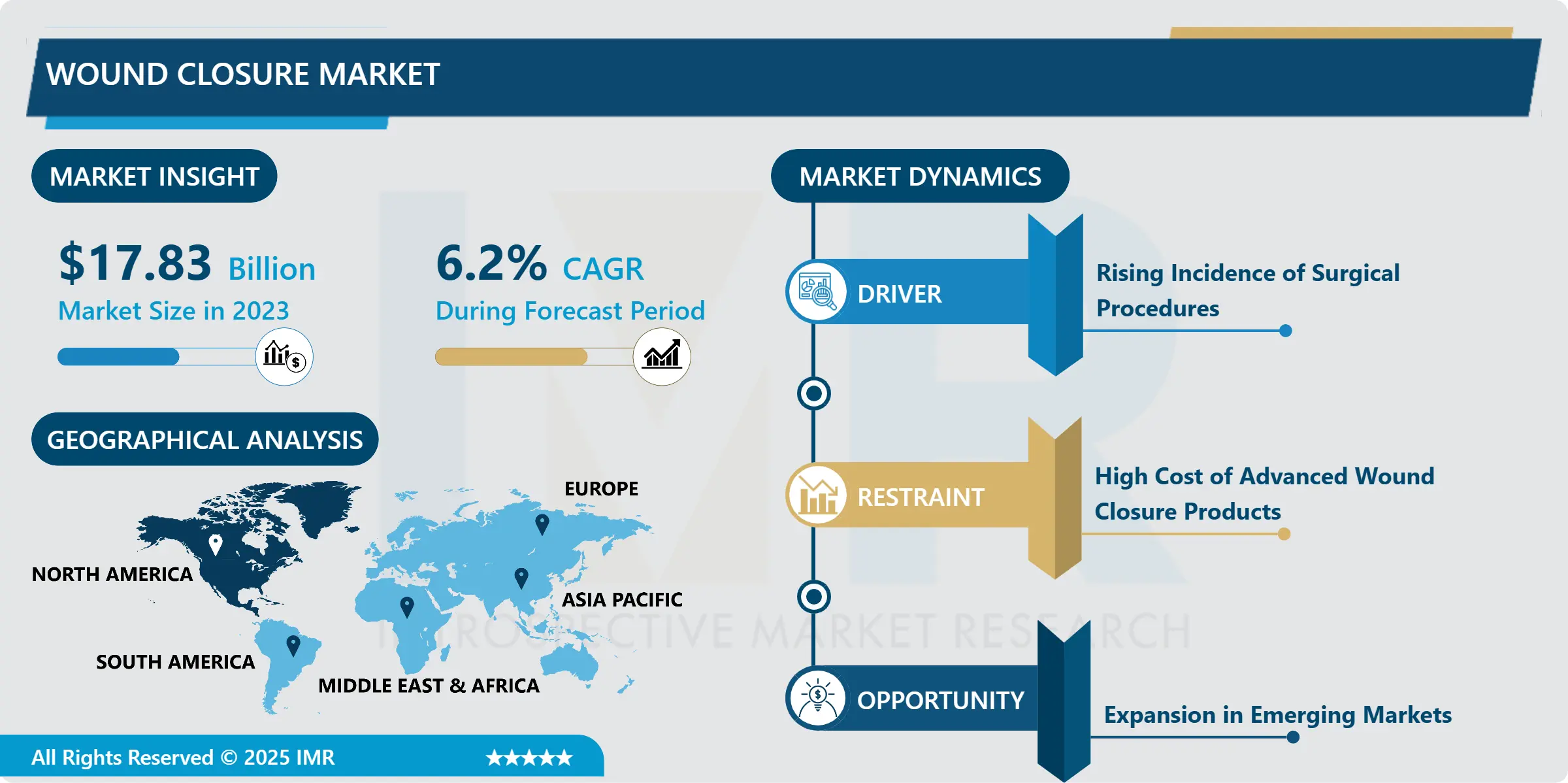
Wound Closure Market Trend Analysis:
Wound Closure Market Drivers:
Emerging Trends in the Wound Closure Market:
- Among the key drivers of the ongoing evolution of wound closure market, it is possible to separate the steady tendency of increasing popularity of such complex products as absorbable sutures and tissue adhesives. These solutions embrace the various techniques that will hasten recovery and reduce some of the setbacks like formation of scar and infections. It makes use of sutures that can be degraded and do not require to be removed thereby improving the patient compliance. Sutures may however, take time before the wound is properly closed; tissue adhesives quickly seal the wound hence protecting it and promote faster healing. The move towards advanced wound closure items is actually consistent with the ongoing concerns and objectives of the healthcare business to provide the best solutions to patients.
- Furthermore, the global rise in the preference for minimally invasive surgeries has greatly spurred the advancement of complicated wound closure solutions. It has become a trend among healthcare providers to seek technologies that heal wounds without causing lot of tissue damage hence the high preference for the advanced wound closure technologies. With advancement in technology more procedures are coming up as less invasive and hence wound closure solutions which can help maintain the skins integrity and also minimize scar formation are paramount. Such a development is supplemented by existing technologies like bioengineered material and nanotechnology product resulting to effective wound closure and better clinical outcomes. These trends give an overall view of transition period in the wound closure market based on innovation, focused care, and new development in surgical practice.
Wound Closure Market Opportunity:
Rise in Demand in the Wound Closure Market:
- The increasing number of chronic wounds, especially diabetic ulcers and pressure sores, creates a high level of demand for improved wound closure technologies. Currently the global trend reveals a growing incidence rate of diabetes and more people of an aging population are struggling to cope with these difficult diseases hence there is a concern by the healthcare practitioners to ensure that there is effective approach on how to manage these conditions. The need to manage chronic wounds has put pressure on the development of new wound care technologies, which comprises suture, staples, and adhesive systems. These innovations do more than help a wound heal quicker but also result in better outcomes for the patient the overall picture of health that is conducive to investors finding value in funding research and development. Various examples of tailored products illustrate that getting through patients’ doors means getting access to a significant new market and improving on business success.
- Besides the population growing in need of wound closure solutions, technology is evolving in ways that are changing the possibilities of wound care. Businesses are now offered excellent opportunities to create entirely new products that will have one or another useful function, including antimicrobial activity and introduction of bioactive elements that will help the body recover faster and avoid infection. Rising consciousness about appropriate means of wound closure and infection prevention and control has led to larger adoption of these enhanced techniques amongst healthcare organizations thereby adding to the market potentiality. In addition, the growth in the number of procedures in various surgical specialties over the years contribute to the market potential, given the importance of effective wound closure for surgeries. The above factors align this market for long-term growth of the sector and facilitate investments and innovations in the wound closure market.
Wound Closure Market Segment Analysis:
Wound Closure Market Segmented on the basis of Product Type, Application End User, and Region.
By Product Type, Haemostatic Agents segment is expected to dominate the market during the forecast period
-
Haemostatic agents are an item within a surgical setting because bleeding is a major issue that influences patient benefits. These agents are categorized into three main types: There are three types of haemostats including the active, passive, and the combined haemostat. The active haemostats enhance clot formation by offering surfaces that assist in the aggregation of platelets and are preferred in surgeries with likely massive hemorrhage. They are normally applied on site and will have the capability of activating the body’s natural coagulation mechanisms. On the other hand, passive haemostats work through the placement of a mechanical competency at the site of hemorrhage. They cause pressure at the site of injury and stimulate the clotting process through interaction with the blood; therefore appropriate for managing mild to moderate hemorrhage.
- There are obvious advantages of combination haemostats as they provide better solution to the problem than active and passive mechanisms of hemostasis. These agents are used in different bleeding situations as they can nbring into play several mechanisms to facilitate clot formation and reinforcement. Also, some of haemostatic agents are biologically related, meaning that they are made from human or animal tissues, and this is beneficial where they may development special properties that suit certain operations such as better compatibility with body tissues or rapid healing. The organisation of new haemostatic agents consistently acts as a factor in enhancing surgical practices meaning that health professionals have the adequate tools in controlling bleeding and enhance surgical experiences.
By End User, Hospitals and Ambulatory Surgical Centers segment expected to held the largest share
-
Medical and surgical centers are the largest customers for surgical consumables because they perform a broad category of surgeries. These facilities range from operating minor surgical procedures to major surgeries hence the need for inventories of surgical supplies to be readily available. The range of surgeries is great, and Helps needs to provide a great range of products as different procedures may call for different products such as sutures, haemostatic agents, and surgical instruments. This large number I believe helps maximize preparation of the surgical teams to handle any situation, thereby improving client outcomes.
- As a result of the operational pressures that are experienced in health facilities such as hospitals and ambulatory surgical centers, bulk purchasing of surgical consumables is adopted. Besides, there is a reduction in costs, an opportunity to maintain a constant availability of necessary products, as well as these institutions will remain ready for urgent and planned surgical interventions. For the facililties it makes it easier to avoid situations when they run out of some supplies so they do not have to continuously order small quantities. In addition, it is necessary to have the right stocks for surgical consumables so that various surgical processes are not prolonged, and the general accomplishment of patient care is not hampered.
Wound Closure Market Regional Insights:
North America is Expected to Dominate the Market Over the Forecast period
-
Several factors have therefore contributed to the high growth of the wound closure market in North America, such as increased incidence of chronic diseases and an aging population. Currently people live with chronic diseases like diabetes and obesity, this has lead to more surgeries and wound care. Another factor assisting the market is a well-established and sophisticated Healthcare industry of the region enabling use of health care technology products, advancement in innovation technology products. Among all countries, the United States has been identified to be a major player in this market because of its high health care spending which supports the creation and stake of efficient wound closure technologies.
- The needs of new generation wound closure products including the absorbable sutures, adhesive technologies & staplers are on rise as healthcare professionals aim at delivering better outcomes with fewer healing times. They not only enable a faster healing process but also reduce the inflammatory processes and with it the danger of infections and complications in connection with standard approaches in wound closure. An increased focus on patient safety and overall efficiency in surgical centers and hospitals will also propel the market growth for various types of sophisticated wound closure products in the future due to continuous advancements in the offerings of industry players. These findings are indicative of concern to enhance the calibre of surgical practices as well as patients’ care in North America.
Active Key Players in the Wound Closure Market
-
3M
- B. Braun Melsungen AG
- Baxter
- Boston Scientific Corporation
- CP Medical
- Cryolife
- Johnson and Johnson Service, Inc.
- Medtronic
- Smith & Nephew
- Stryker
- Other Active Players
|
Global Wound Closure Market |
|||
|
Base Year: |
2023 |
Forecast Period: |
2024-2032 |
|
Historical Data: |
2017 to 2023 |
Market Size in 2023: |
USD 17.83 Billion |
|
Forecast Period 2024-32 CAGR: |
6.20% |
Market Size in 2032: |
USD 30.64 Billion |
|
Segments Covered: |
By Product Type |
|
|
|
By Application |
|
||
|
By End User
|
|
||
|
By Region |
|
||
|
Key Market Drivers: |
|
||
|
Key Market Restraints: |
|
||
|
Key Opportunities: |
|
||
|
Companies Covered in the report: |
|
||
Chapter 1: Introduction
1.1 Scope and Coverage
Chapter 2:Executive Summary
Chapter 3: Market Landscape
3.1 Market Dynamics
3.1.1 Drivers
3.1.2 Restraints
3.1.3 Opportunities
3.1.4 Challenges
3.2 Market Trend Analysis
3.3 PESTLE Analysis
3.4 Porter's Five Forces Analysis
3.5 Industry Value Chain Analysis
3.6 Ecosystem
3.7 Regulatory Landscape
3.8 Price Trend Analysis
3.9 Patent Analysis
3.10 Technology Evolution
3.11 Investment Pockets
3.12 Import-Export Analysis
Chapter 4: Wound Closure Market by Product Type
4.1 Wound Closure Market Snapshot and Growth Engine
4.2 Wound Closure Market Overview
4.3 Sutures
4.3.1 Introduction and Market Overview
4.3.2 Historic and Forecasted Market Size in Value USD and Volume Units (2017-2032F)
4.3.3 Key Market Trends, Growth Factors and Opportunities
4.3.4 Sutures: Geographic Segmentation Analysis
4.4 Haemostatic Agents
4.4.1 Introduction and Market Overview
4.4.2 Historic and Forecasted Market Size in Value USD and Volume Units (2017-2032F)
4.4.3 Key Market Trends, Growth Factors and Opportunities
4.4.4 Haemostatic Agents: Geographic Segmentation Analysis
4.5 Staplers
4.5.1 Introduction and Market Overview
4.5.2 Historic and Forecasted Market Size in Value USD and Volume Units (2017-2032F)
4.5.3 Key Market Trends, Growth Factors and Opportunities
4.5.4 Staplers: Geographic Segmentation Analysis
4.6 Staples and Others)
4.6.1 Introduction and Market Overview
4.6.2 Historic and Forecasted Market Size in Value USD and Volume Units (2017-2032F)
4.6.3 Key Market Trends, Growth Factors and Opportunities
4.6.4 Staples and Others) : Geographic Segmentation Analysis
Chapter 5: Wound Closure Market by Application
5.1 Wound Closure Market Snapshot and Growth Engine
5.2 Wound Closure Market Overview
5.3 Gynaecology
5.3.1 Introduction and Market Overview
5.3.2 Historic and Forecasted Market Size in Value USD and Volume Units (2017-2032F)
5.3.3 Key Market Trends, Growth Factors and Opportunities
5.3.4 Gynaecology: Geographic Segmentation Analysis
5.4 Cardiology
5.4.1 Introduction and Market Overview
5.4.2 Historic and Forecasted Market Size in Value USD and Volume Units (2017-2032F)
5.4.3 Key Market Trends, Growth Factors and Opportunities
5.4.4 Cardiology: Geographic Segmentation Analysis
5.5 Orthopaedics
5.5.1 Introduction and Market Overview
5.5.2 Historic and Forecasted Market Size in Value USD and Volume Units (2017-2032F)
5.5.3 Key Market Trends, Growth Factors and Opportunities
5.5.4 Orthopaedics: Geographic Segmentation Analysis
5.6 Ophthalmic
5.6.1 Introduction and Market Overview
5.6.2 Historic and Forecasted Market Size in Value USD and Volume Units (2017-2032F)
5.6.3 Key Market Trends, Growth Factors and Opportunities
5.6.4 Ophthalmic: Geographic Segmentation Analysis
5.7 General Surgery and Others)
5.7.1 Introduction and Market Overview
5.7.2 Historic and Forecasted Market Size in Value USD and Volume Units (2017-2032F)
5.7.3 Key Market Trends, Growth Factors and Opportunities
5.7.4 General Surgery and Others) : Geographic Segmentation Analysis
Chapter 6: Wound Closure Market by End User
6.1 Wound Closure Market Snapshot and Growth Engine
6.2 Wound Closure Market Overview
6.3 Hospitals and Ambulatory Surgical Centers
6.3.1 Introduction and Market Overview
6.3.2 Historic and Forecasted Market Size in Value USD and Volume Units (2017-2032F)
6.3.3 Key Market Trends, Growth Factors and Opportunities
6.3.4 Hospitals and Ambulatory Surgical Centers: Geographic Segmentation Analysis
6.4 Specialty Clinics and Others)
6.4.1 Introduction and Market Overview
6.4.2 Historic and Forecasted Market Size in Value USD and Volume Units (2017-2032F)
6.4.3 Key Market Trends, Growth Factors and Opportunities
6.4.4 Specialty Clinics and Others) : Geographic Segmentation Analysis
Chapter 7: Company Profiles and Competitive Analysis
7.1 Competitive Landscape
7.1.1 Competitive Benchmarking
7.1.2 Wound Closure Market Share by Manufacturer (2023)
7.1.3 Industry BCG Matrix
7.1.4 Heat Map Analysis
7.1.5 Mergers and Acquisitions
7.2 JOHNSON AND JOHNSON SERVICE INC.
7.2.1 Company Overview
7.2.2 Key Executives
7.2.3 Company Snapshot
7.2.4 Role of the Company in the Market
7.2.5 Sustainability and Social Responsibility
7.2.6 Operating Business Segments
7.2.7 Product Portfolio
7.2.8 Business Performance
7.2.9 Key Strategic Moves and Recent Developments
7.2.10 SWOT Analysis
7.3 BAXTER
7.4 MEDTRONIC
7.5 CRYOLIFE
7.6 STRYKER
7.7 3M
7.8 CP MEDICAL
7.9 BOSTON SCIENTIFIC CORPORATION
7.10 SMITH & NEPHEW
7.11 B. BRAUN MELSUNGEN AG
7.12 OTHER ACTIVE PLAYERS
Chapter 8: Global Wound Closure Market By Region
8.1 Overview
8.2. North America Wound Closure Market
8.2.1 Key Market Trends, Growth Factors and Opportunities
8.2.2 Top Key Companies
8.2.3 Historic and Forecasted Market Size by Segments
8.2.4 Historic and Forecasted Market Size By Product Type
8.2.4.1 Sutures
8.2.4.2 Haemostatic Agents
8.2.4.3 Staplers
8.2.4.4 Staples and Others)
8.2.5 Historic and Forecasted Market Size By Application
8.2.5.1 Gynaecology
8.2.5.2 Cardiology
8.2.5.3 Orthopaedics
8.2.5.4 Ophthalmic
8.2.5.5 General Surgery and Others)
8.2.6 Historic and Forecasted Market Size By End User
8.2.6.1 Hospitals and Ambulatory Surgical Centers
8.2.6.2 Specialty Clinics and Others)
8.2.7 Historic and Forecast Market Size by Country
8.2.7.1 US
8.2.7.2 Canada
8.2.7.3 Mexico
8.3. Eastern Europe Wound Closure Market
8.3.1 Key Market Trends, Growth Factors and Opportunities
8.3.2 Top Key Companies
8.3.3 Historic and Forecasted Market Size by Segments
8.3.4 Historic and Forecasted Market Size By Product Type
8.3.4.1 Sutures
8.3.4.2 Haemostatic Agents
8.3.4.3 Staplers
8.3.4.4 Staples and Others)
8.3.5 Historic and Forecasted Market Size By Application
8.3.5.1 Gynaecology
8.3.5.2 Cardiology
8.3.5.3 Orthopaedics
8.3.5.4 Ophthalmic
8.3.5.5 General Surgery and Others)
8.3.6 Historic and Forecasted Market Size By End User
8.3.6.1 Hospitals and Ambulatory Surgical Centers
8.3.6.2 Specialty Clinics and Others)
8.3.7 Historic and Forecast Market Size by Country
8.3.7.1 Russia
8.3.7.2 Bulgaria
8.3.7.3 The Czech Republic
8.3.7.4 Hungary
8.3.7.5 Poland
8.3.7.6 Romania
8.3.7.7 Rest of Eastern Europe
8.4. Western Europe Wound Closure Market
8.4.1 Key Market Trends, Growth Factors and Opportunities
8.4.2 Top Key Companies
8.4.3 Historic and Forecasted Market Size by Segments
8.4.4 Historic and Forecasted Market Size By Product Type
8.4.4.1 Sutures
8.4.4.2 Haemostatic Agents
8.4.4.3 Staplers
8.4.4.4 Staples and Others)
8.4.5 Historic and Forecasted Market Size By Application
8.4.5.1 Gynaecology
8.4.5.2 Cardiology
8.4.5.3 Orthopaedics
8.4.5.4 Ophthalmic
8.4.5.5 General Surgery and Others)
8.4.6 Historic and Forecasted Market Size By End User
8.4.6.1 Hospitals and Ambulatory Surgical Centers
8.4.6.2 Specialty Clinics and Others)
8.4.7 Historic and Forecast Market Size by Country
8.4.7.1 Germany
8.4.7.2 UK
8.4.7.3 France
8.4.7.4 The Netherlands
8.4.7.5 Italy
8.4.7.6 Spain
8.4.7.7 Rest of Western Europe
8.5. Asia Pacific Wound Closure Market
8.5.1 Key Market Trends, Growth Factors and Opportunities
8.5.2 Top Key Companies
8.5.3 Historic and Forecasted Market Size by Segments
8.5.4 Historic and Forecasted Market Size By Product Type
8.5.4.1 Sutures
8.5.4.2 Haemostatic Agents
8.5.4.3 Staplers
8.5.4.4 Staples and Others)
8.5.5 Historic and Forecasted Market Size By Application
8.5.5.1 Gynaecology
8.5.5.2 Cardiology
8.5.5.3 Orthopaedics
8.5.5.4 Ophthalmic
8.5.5.5 General Surgery and Others)
8.5.6 Historic and Forecasted Market Size By End User
8.5.6.1 Hospitals and Ambulatory Surgical Centers
8.5.6.2 Specialty Clinics and Others)
8.5.7 Historic and Forecast Market Size by Country
8.5.7.1 China
8.5.7.2 India
8.5.7.3 Japan
8.5.7.4 South Korea
8.5.7.5 Malaysia
8.5.7.6 Thailand
8.5.7.7 Vietnam
8.5.7.8 The Philippines
8.5.7.9 Australia
8.5.7.10 New Zealand
8.5.7.11 Rest of APAC
8.6. Middle East & Africa Wound Closure Market
8.6.1 Key Market Trends, Growth Factors and Opportunities
8.6.2 Top Key Companies
8.6.3 Historic and Forecasted Market Size by Segments
8.6.4 Historic and Forecasted Market Size By Product Type
8.6.4.1 Sutures
8.6.4.2 Haemostatic Agents
8.6.4.3 Staplers
8.6.4.4 Staples and Others)
8.6.5 Historic and Forecasted Market Size By Application
8.6.5.1 Gynaecology
8.6.5.2 Cardiology
8.6.5.3 Orthopaedics
8.6.5.4 Ophthalmic
8.6.5.5 General Surgery and Others)
8.6.6 Historic and Forecasted Market Size By End User
8.6.6.1 Hospitals and Ambulatory Surgical Centers
8.6.6.2 Specialty Clinics and Others)
8.6.7 Historic and Forecast Market Size by Country
8.6.7.1 Turkiye
8.6.7.2 Bahrain
8.6.7.3 Kuwait
8.6.7.4 Saudi Arabia
8.6.7.5 Qatar
8.6.7.6 UAE
8.6.7.7 Israel
8.6.7.8 South Africa
8.7. South America Wound Closure Market
8.7.1 Key Market Trends, Growth Factors and Opportunities
8.7.2 Top Key Companies
8.7.3 Historic and Forecasted Market Size by Segments
8.7.4 Historic and Forecasted Market Size By Product Type
8.7.4.1 Sutures
8.7.4.2 Haemostatic Agents
8.7.4.3 Staplers
8.7.4.4 Staples and Others)
8.7.5 Historic and Forecasted Market Size By Application
8.7.5.1 Gynaecology
8.7.5.2 Cardiology
8.7.5.3 Orthopaedics
8.7.5.4 Ophthalmic
8.7.5.5 General Surgery and Others)
8.7.6 Historic and Forecasted Market Size By End User
8.7.6.1 Hospitals and Ambulatory Surgical Centers
8.7.6.2 Specialty Clinics and Others)
8.7.7 Historic and Forecast Market Size by Country
8.7.7.1 Brazil
8.7.7.2 Argentina
8.7.7.3 Rest of SA
Chapter 9 Analyst Viewpoint and Conclusion
9.1 Recommendations and Concluding Analysis
9.2 Potential Market Strategies
Chapter 10 Research Methodology
10.1 Research Process
10.2 Primary Research
10.3 Secondary Research
|
Global Wound Closure Market |
|||
|
Base Year: |
2023 |
Forecast Period: |
2024-2032 |
|
Historical Data: |
2017 to 2023 |
Market Size in 2023: |
USD 17.83 Billion |
|
Forecast Period 2024-32 CAGR: |
6.20% |
Market Size in 2032: |
USD 30.64 Billion |
|
Segments Covered: |
By Product Type |
|
|
|
By Application |
|
||
|
By End User
|
|
||
|
By Region |
|
||
|
Key Market Drivers: |
|
||
|
Key Market Restraints: |
|
||
|
Key Opportunities: |
|
||
|
Companies Covered in the report: |
|
||


