




Wind Turbine Scrap Market Synopsis
Wind Turbine Scrap Market Size Was Valued at USD 3.9 Billion in 2023, and is Projected to Reach USD 7.6 Billion by 2032, Growing at a CAGR of 7.7% From 2024-2032.
As such, the Global Wind Turbine Scrap embraces the process of reclaiming and preparing material from working wind turbines or those that have malfunctioned. Thus, this market separates out the components used in the construction of wind turbines such as blades, towers, nacelles that are predominantly fiberglass, steel and other composites. This has brought about change in sustainability and the creation of the circular economy, therefore, the interest in how these materials can be best recycles and reused. It has several chambers that involve the turbine makers, scrap dealers, recyclers, and other government and NGOs for the improved waste disposal and recovery of wastes.
This has led to the creation of the Global Wind Turbine Scrap Market since the World Wind Energy market is relatively ‘older’ and more Turbine parts are outdated. A reasonable expectation can be made that with heightened number of wind farms all around the world, there will be more scraps generated by old wind turbines. Now the number of statisti- cs predicting that thousand of wind turbines will be written off over the next decade creating a big market for scrap material. This in other way holds the prospect in order for recycling industry to pull out material such as steel and rare earth metals and reuse then in manufacturing new turbines and other industries.
Furthermore, the legal systems are transitioning to provide an appropriate means to manage the waste for the wind energy sector. ould have reached their useful life. More wind farms being developed around the globe mean more scrap to be produced as legacy structures, wind turbines. Current global forecasts are pointing to thousands of wind turbines set to reach the end of their operational life cycle and head to the scrap heap within the current year alone, let alone the upcoming decade. In doing so, this offers the recycling industry a chance to recover valuable feed stock including steel and other strategic metals required in new turbine production or in other applications.
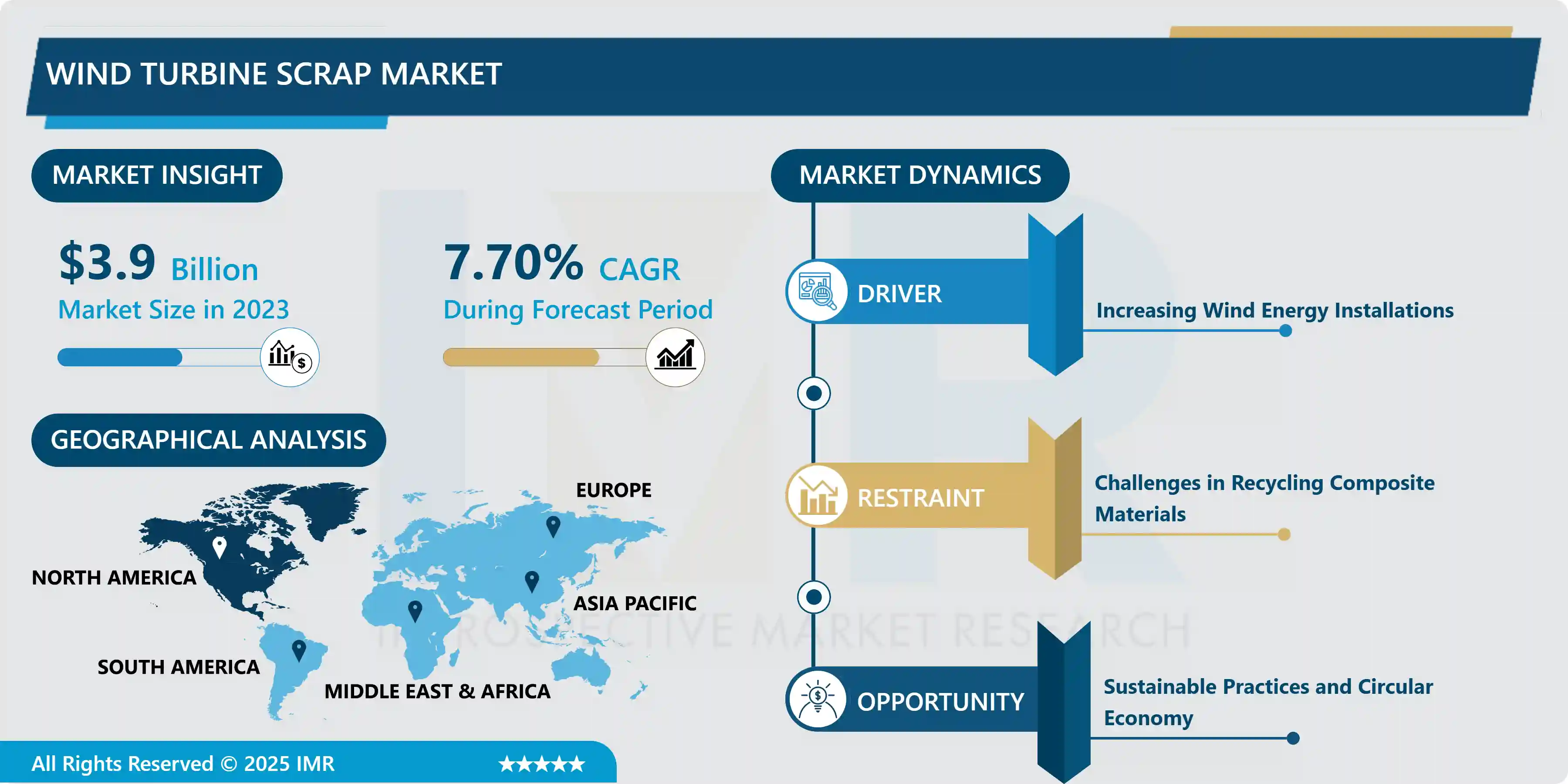
Wind Turbine Scrap Market Trend Analysis
Advancements in Recycling Technologies
- An active development in the Global Wind Turbine Scrap Market is the increase in recycler efficiency as a result of the development in new technologies in the field.. Existing practices in post-treatment of separate components of a wind turbine before recycling is moderately challenging in particular with composite blades. However, some of the new technologies under development which promise to improve the rate of recycling include pyrolysis, chemical recycling and new forms of shredding and sorting.
- For example, companies are exploring methods to break down fiberglass blades into reusable fibers, which can be integrated into other manufacturing processes, including construction materials and automotive parts. Also, new collaborations with investors and recycles so turbine manufacturers are encouraging additional sustainability of recycling solutions. Considering the further development of these technologies, they can become the main drivers of the wind turbine scrap market’s further development and contribute to the fulfillment of the sustainable development objectives of the renewable energy industry.
Increasing Decommissioning of Aging Wind Farms
- The higher rates of decommissioning old wind farms is a major opportunity for the Global Wind Turbine Scrap Market.. Since many turbines were installed in the first development periods of wind energy generation, there is a rising concern in managing end-of-life disposal and recycling. It also generates a market for the scrap processors and recyclers who can effectively handle the disassembly and reuse of the constitutive parts of turbines. It is even more so when backed by government promotion and provisions for renewable energy sources and incentives for investing in recycling systems. of wind energy begin to reach the end of their operational lifespan, there is a burgeoning need for effective and sustainable disposal and recycling solutions. This creates a lucrative market for scrap processors and recyclers who can efficiently manage the dismantling and repurposing of turbine materials.
- The opportunity is further amplified by government initiatives and incentives promoting renewable energy sources and sustainable practices, encouraging investment in recycling infrastructure. Firms that can establish effective capabilities of receiving, collecting, and processing the scrap from relic wind turbine plants will be in a good position to benefit from this venture, improving their market position and profitability levels.
Wind Turbine Scrap Market Segment Analysis:
Wind Turbine Scrap Market Segmented on the basis of Product and Service.
By Product, Iron and Steel segment is expected to dominate the market during the forecast period
- The Iron and Steel segment is expected to dominate the Global Wind Turbine Scrap Market during the forecast period due to the significant volume of these materials used in wind turbine construction. Wind turbines consist of substantial steel components, including towers, nacelles, and various structural supports, making iron and steel the most recyclable materials when turbines are decommissioned. As the focus on sustainability and circular economy principles intensifies, the demand for recycled steel is rising, driven by its wide application in construction, automotive, and manufacturing industries. The inherent value of iron and steel, combined with advances in recycling technologies that enhance material recovery rates, positions this segment favorably within the market.
By Service, Collection and Segregation segment expected to held the largest share
- It has been identified that the Collection and Segregation segment will continues to be the largest market segment in the Global Wind Turbine Scrap Market throughout the predicted period due to its importance in the recycling process.. Proper transportation, collection and sorting of the wind turbine scrap is critical in achieving maximum yields of materials on the type of metals, fiber composites, and other valuable metals such as rare earth metals. At the end of the useful life of wind farms, the amount of scrap produced requires proper organization of logistics in the handling and collection of materials safely and sustainably. Some of the players in this service have continued to incorporate sophisticated technologies that enhance the collection as well as segregation in the bid to bring down the operational costs of the service. Also, there is increasing concern on the management of waste through environmental consciousness and legal requirements of environmental friendly ways of waste disposal. ecycling process. Efficient collection and segregation of wind turbine scrap are essential for maximizing material recovery and ensuring the effective recycling of various components, including metals, composites, and rare earth elements. As wind farms reach the end of their operational life, the volume of scrap generated necessitates well-organized logistics and processes for the safe and sustainable collection of materials. Companies specializing in this service are increasingly adopting advanced technologies to streamline the collection and segregation processes, improving efficiency and reducing operational costs.
- Moreover, with the rising awareness of environmental sustainability and regulatory pressures to manage waste responsibly, the demand for professional collection and segregation services is on the rise. Also gaining from increased partnerships between turbine makers and recyclers to develop competitive end of life solutions for turbines is this segment. Apart from optimising the flow of material for resource recovery, the Collection and Segregation segment also contributes to development of circular economy within the wind energy industry. This segment will only increase in significance over time as the industry becomes more established to better accommodate the recycling of wind turbine scrap.
Wind Turbine Scrap Market Regional Insights:
North America is Expected to Dominate the Market Over the Forecast period
- The highest market share of Global Wind Turbine Scrap Market was contributed by North America in the year 2023 and this region holds 40% of this market.. The leadership can be explained by the fact that the wind energy investments are relatively high in the region, as well as the fact that there are more and more old wind farms that needs to be dismantled. There has also been a significant generation of scrap because the turbines within the wind power machines have now started to become obsolete especially within the United States. Furthermore, thanks to the government’s policy on sustainability and circular economy, there is a strong motivation to invent the high-tech recycling technologies for the parts of wind turbine. The availability of many players involved in the recycling and material recovery process contributes to extensive market strength in North America. Above all, the adoption of new legislation on containing wastage while promoting proper handling of waste will further augur well for the regional wind turbine scrap market.

Active Key Players in the Wind Turbine Scrap Market
- ABB Ltd. (Switzerland)
- Acciona Energy (Spain)
- Deloitte (United Kingdom)
- E.ON SE (Germany)
- Enercon GmbH (Germany)
- GE Renewable Energy (United States)
- Juwi AG (Germany)
- Nordex SE (Germany)
- Recycla (Germany)
- RGS Energy (United States)
- Senvion GmbH (Germany)
- Siemens Gamesa Renewable Energy (Spain)
- Suez Recycling and Recovery (France)
- Veolia Environmental Services (France)
- Vestas Wind Systems A/S (Denmark)
- Other key Players
|
Global Wind Turbine Scrap Market |
|||
|
Base Year: |
2023 |
Forecast Period: |
2024-2032 |
|
Historical Data: |
2017 to 2023 |
Market Size in 2023: |
USD 3.9 Bn. |
|
Forecast Period 2024-32 CAGR: |
7.7% |
Market Size in 2032: |
USD 7.6 Bn. |
|
Segments Covered: |
By Product |
|
|
|
By Service |
|
||
|
By Region |
|
||
|
Key Market Drivers: |
|
||
|
Key Market Restraints: |
|
||
|
Key Opportunities: |
|
||
|
Companies Covered in the report: |
|
||
Chapter 1: Introduction
1.1 Scope and Coverage
Chapter 2:Executive Summary
Chapter 3: Market Landscape
3.1 Market Dynamics
3.1.1 Drivers
3.1.2 Restraints
3.1.3 Opportunities
3.1.4 Challenges
3.2 Market Trend Analysis
3.3 PESTLE Analysis
3.4 Porter's Five Forces Analysis
3.5 Industry Value Chain Analysis
3.6 Ecosystem
3.7 Regulatory Landscape
3.8 Price Trend Analysis
3.9 Patent Analysis
3.10 Technology Evolution
3.11 Investment Pockets
3.12 Import-Export Analysis
Chapter 4: Wind Turbine Scrap Market by Product (2018-2032)
4.1 Wind Turbine Scrap Market Snapshot and Growth Engine
4.2 Market Overview
4.3 Iron and Steel
4.3.1 Introduction and Market Overview
4.3.2 Historic and Forecasted Market Size in Value USD and Volume Units
4.3.3 Key Market Trends, Growth Factors, and Opportunities
4.3.4 Geographic Segmentation Analysis
4.4 Plastic
4.5 Precious Metals
4.6 Fiber Glass Composites
4.7 Others
Chapter 5: Wind Turbine Scrap Market by Service (2018-2032)
5.1 Wind Turbine Scrap Market Snapshot and Growth Engine
5.2 Market Overview
5.3 Collection and Segregation
5.3.1 Introduction and Market Overview
5.3.2 Historic and Forecasted Market Size in Value USD and Volume Units
5.3.3 Key Market Trends, Growth Factors, and Opportunities
5.3.4 Geographic Segmentation Analysis
5.4 Recycling
5.5 Disposal
Chapter 6: Company Profiles and Competitive Analysis
6.1 Competitive Landscape
6.1.1 Competitive Benchmarking
6.1.2 Wind Turbine Scrap Market Share by Manufacturer (2024)
6.1.3 Industry BCG Matrix
6.1.4 Heat Map Analysis
6.1.5 Mergers and Acquisitions
6.2 ABB LTD. (SWITZERLAND)
6.2.1 Company Overview
6.2.2 Key Executives
6.2.3 Company Snapshot
6.2.4 Role of the Company in the Market
6.2.5 Sustainability and Social Responsibility
6.2.6 Operating Business Segments
6.2.7 Product Portfolio
6.2.8 Business Performance
6.2.9 Key Strategic Moves and Recent Developments
6.2.10 SWOT Analysis
6.3 ACCIONA ENERGY (SPAIN)
6.4 DELOITTE (UNITED KINGDOM)
6.5 E.ON SE (GERMANY)
6.6 ENERCON GMBH (GERMANY)
6.7 GE RENEWABLE ENERGY (UNITED STATES)
6.8 JUWI AG (GERMANY)
6.9 NORDEX SE (GERMANY)
6.10 RECYCLA (GERMANY)
6.11 RGS ENERGY (UNITED STATES)
6.12 SENVION GMBH (GERMANY)
6.13 SIEMENS GAMESA RENEWABLE ENERGY (SPAIN)
6.14 SUEZ RECYCLING AND RECOVERY (FRANCE)
6.15 VEOLIA ENVIRONMENTAL SERVICES (FRANCE)
6.16 VESTAS WIND SYSTEMS A/S (DENMARK)
6.17 OTHER KEY PLAYERS
6.18
Chapter 7: Global Wind Turbine Scrap Market By Region
7.1 Overview
7.2. North America Wind Turbine Scrap Market
7.2.1 Key Market Trends, Growth Factors and Opportunities
7.2.2 Top Key Companies
7.2.3 Historic and Forecasted Market Size by Segments
7.2.4 Historic and Forecasted Market Size by Product
7.2.4.1 Iron and Steel
7.2.4.2 Plastic
7.2.4.3 Precious Metals
7.2.4.4 Fiber Glass Composites
7.2.4.5 Others
7.2.5 Historic and Forecasted Market Size by Service
7.2.5.1 Collection and Segregation
7.2.5.2 Recycling
7.2.5.3 Disposal
7.2.6 Historic and Forecast Market Size by Country
7.2.6.1 US
7.2.6.2 Canada
7.2.6.3 Mexico
7.3. Eastern Europe Wind Turbine Scrap Market
7.3.1 Key Market Trends, Growth Factors and Opportunities
7.3.2 Top Key Companies
7.3.3 Historic and Forecasted Market Size by Segments
7.3.4 Historic and Forecasted Market Size by Product
7.3.4.1 Iron and Steel
7.3.4.2 Plastic
7.3.4.3 Precious Metals
7.3.4.4 Fiber Glass Composites
7.3.4.5 Others
7.3.5 Historic and Forecasted Market Size by Service
7.3.5.1 Collection and Segregation
7.3.5.2 Recycling
7.3.5.3 Disposal
7.3.6 Historic and Forecast Market Size by Country
7.3.6.1 Russia
7.3.6.2 Bulgaria
7.3.6.3 The Czech Republic
7.3.6.4 Hungary
7.3.6.5 Poland
7.3.6.6 Romania
7.3.6.7 Rest of Eastern Europe
7.4. Western Europe Wind Turbine Scrap Market
7.4.1 Key Market Trends, Growth Factors and Opportunities
7.4.2 Top Key Companies
7.4.3 Historic and Forecasted Market Size by Segments
7.4.4 Historic and Forecasted Market Size by Product
7.4.4.1 Iron and Steel
7.4.4.2 Plastic
7.4.4.3 Precious Metals
7.4.4.4 Fiber Glass Composites
7.4.4.5 Others
7.4.5 Historic and Forecasted Market Size by Service
7.4.5.1 Collection and Segregation
7.4.5.2 Recycling
7.4.5.3 Disposal
7.4.6 Historic and Forecast Market Size by Country
7.4.6.1 Germany
7.4.6.2 UK
7.4.6.3 France
7.4.6.4 The Netherlands
7.4.6.5 Italy
7.4.6.6 Spain
7.4.6.7 Rest of Western Europe
7.5. Asia Pacific Wind Turbine Scrap Market
7.5.1 Key Market Trends, Growth Factors and Opportunities
7.5.2 Top Key Companies
7.5.3 Historic and Forecasted Market Size by Segments
7.5.4 Historic and Forecasted Market Size by Product
7.5.4.1 Iron and Steel
7.5.4.2 Plastic
7.5.4.3 Precious Metals
7.5.4.4 Fiber Glass Composites
7.5.4.5 Others
7.5.5 Historic and Forecasted Market Size by Service
7.5.5.1 Collection and Segregation
7.5.5.2 Recycling
7.5.5.3 Disposal
7.5.6 Historic and Forecast Market Size by Country
7.5.6.1 China
7.5.6.2 India
7.5.6.3 Japan
7.5.6.4 South Korea
7.5.6.5 Malaysia
7.5.6.6 Thailand
7.5.6.7 Vietnam
7.5.6.8 The Philippines
7.5.6.9 Australia
7.5.6.10 New Zealand
7.5.6.11 Rest of APAC
7.6. Middle East & Africa Wind Turbine Scrap Market
7.6.1 Key Market Trends, Growth Factors and Opportunities
7.6.2 Top Key Companies
7.6.3 Historic and Forecasted Market Size by Segments
7.6.4 Historic and Forecasted Market Size by Product
7.6.4.1 Iron and Steel
7.6.4.2 Plastic
7.6.4.3 Precious Metals
7.6.4.4 Fiber Glass Composites
7.6.4.5 Others
7.6.5 Historic and Forecasted Market Size by Service
7.6.5.1 Collection and Segregation
7.6.5.2 Recycling
7.6.5.3 Disposal
7.6.6 Historic and Forecast Market Size by Country
7.6.6.1 Turkiye
7.6.6.2 Bahrain
7.6.6.3 Kuwait
7.6.6.4 Saudi Arabia
7.6.6.5 Qatar
7.6.6.6 UAE
7.6.6.7 Israel
7.6.6.8 South Africa
7.7. South America Wind Turbine Scrap Market
7.7.1 Key Market Trends, Growth Factors and Opportunities
7.7.2 Top Key Companies
7.7.3 Historic and Forecasted Market Size by Segments
7.7.4 Historic and Forecasted Market Size by Product
7.7.4.1 Iron and Steel
7.7.4.2 Plastic
7.7.4.3 Precious Metals
7.7.4.4 Fiber Glass Composites
7.7.4.5 Others
7.7.5 Historic and Forecasted Market Size by Service
7.7.5.1 Collection and Segregation
7.7.5.2 Recycling
7.7.5.3 Disposal
7.7.6 Historic and Forecast Market Size by Country
7.7.6.1 Brazil
7.7.6.2 Argentina
7.7.6.3 Rest of SA
Chapter 8 Analyst Viewpoint and Conclusion
8.1 Recommendations and Concluding Analysis
8.2 Potential Market Strategies
Chapter 9 Research Methodology
9.1 Research Process
9.2 Primary Research
9.3 Secondary Research
|
Global Wind Turbine Scrap Market |
|||
|
Base Year: |
2023 |
Forecast Period: |
2024-2032 |
|
Historical Data: |
2017 to 2023 |
Market Size in 2023: |
USD 3.9 Bn. |
|
Forecast Period 2024-32 CAGR: |
7.7% |
Market Size in 2032: |
USD 7.6 Bn. |
|
Segments Covered: |
By Product |
|
|
|
By Service |
|
||
|
By Region |
|
||
|
Key Market Drivers: |
|
||
|
Key Market Restraints: |
|
||
|
Key Opportunities: |
|
||
|
Companies Covered in the report: |
|
||


