




Wet Waste Management Market Synopsis:
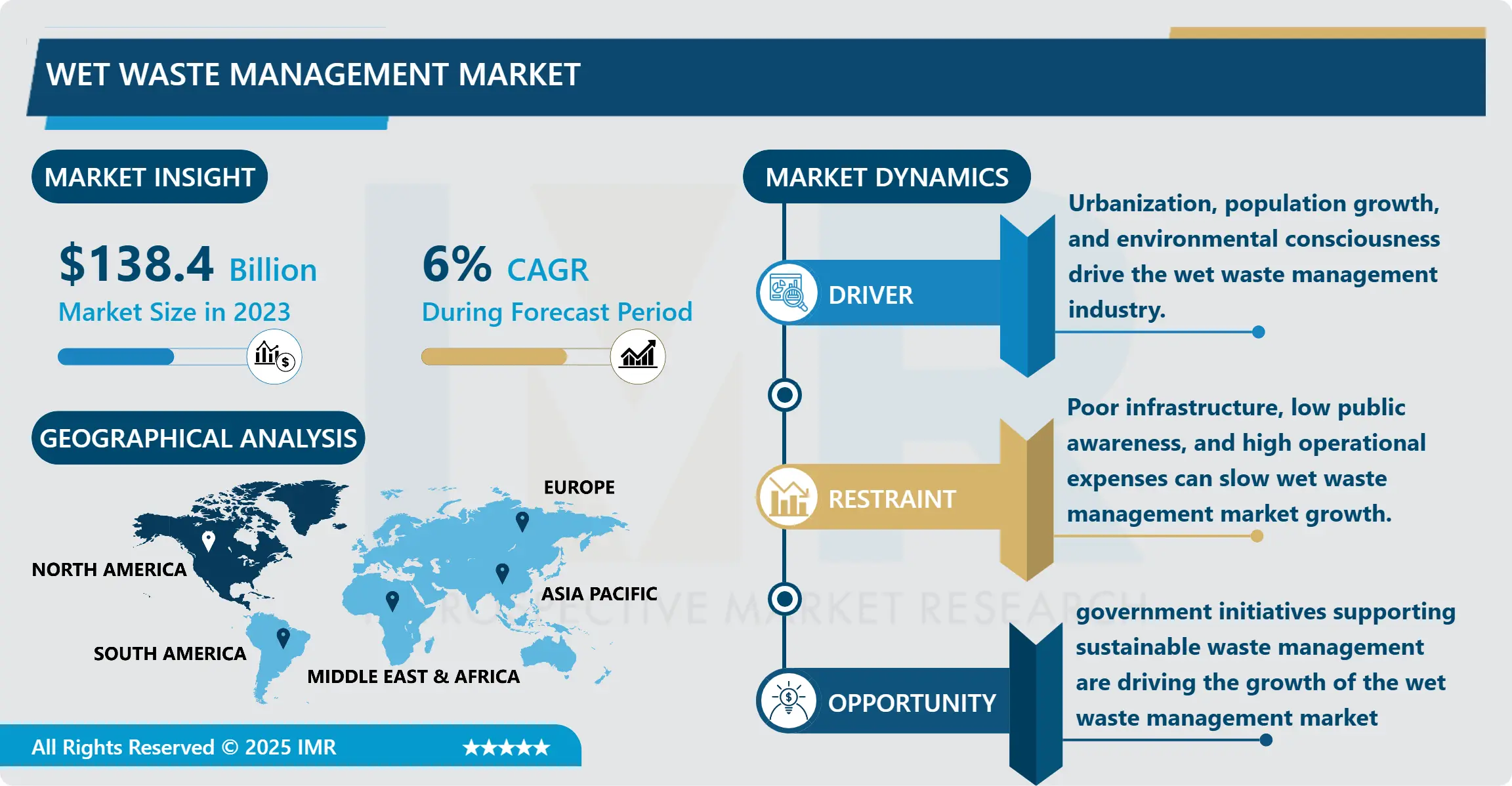
Wet Waste Management Market Size Was Valued at USD 138.4 Billion in 2023, and is Projected to Reach USD 229.8 Billion by 2032, Growing at a CAGR of 6% From 2024-2032.
The wet waste management business is emerging due to the increase in waste production as a result of the development and growth of population all over the world. Examining wet waste, organic waste that we come across daily, including the food waste, garden waste or any biodegradable waste, differ categorically from other types of waste we are familiar with in many ways. Currently, because most urban centers and municipalities are looking for efficient waste management systems, there is growing emphasis on eco-friendly measures such as recycling and composting as well as resource recovery. This trend is as a result of increased concern of the environment, the need to adopt better methods of waste disposal and legal requirements regarding reduction of waste that ends up in the landfill.
Wet waste management market is witnessing significant innovation, as regards the technological applications that are being made available to the industry for improvement in the processing and treatment of wet wastes. Methods like anaerobic digestion,composting and biogas production are getting popular now a days as not only reduce waste but also convert it into useful products like compost, biogas etc. These technologies assist in mitigation of green house gas emission and support the circular economy by reprocessing waste to obtain useful products. It is further estimated that as more organizations and governments embrace proper and efficient waste disposal system, then the market is bound to grow big.
However, there are some important issues that impact the wet waste management market these include: inadequate infrastructure, low level of awareness and lastly, the volatile standard practices around the world. Dealing with these issues is pivotal to successful provision of wet waste management strategies in a given area. But there is a firm focus on making sustainability an important goal for governments, companies, and consumers and as more attention is paid to recycling, recycling services are also improving. This commitment is expected to lead to further emergence and advancement in the wet waste management market and eventually promote a sustainable way of waste disposal and resources utilization.
Wet Waste Management Market Trend Analysis:
Rise in Organic Waste Recycling
-
One of the key drivers that can be so far observed in the wet waste management market is regarding the organic waste recycling. Today, as the topic of environmental protection and the use of environmental resources becomes more popular, municipalities and organizations become more active in organizing the collection and processing of organic waste. This trend includes pilot programs such as curbside composting in which residents of a community segregate their food waste and yard trimmings for pick up. Waste bio-recycling helps decreased the amount of methane emissions from landfills and at the same time gives all the necessary nutrients to the soil and boost the agricultural process. The change to organic waste recycling true is the move towards better waste management systems in the country.
Adoption of Advanced Waste Processing Technologies
-
Another major development is the use of high-performance waste treatment technologies, including biogas production and improved composting techniques. These technologies are far better methods than traditional practices of dealing with wet waste which cause environmental degradation since they can be turned into useful resources such as biogas and high-quality compost. Anaerobic digestion has especially been embraced due to the fact that, in addition to shrinking waste, it produces energy meaning that it as promotes energy security and sustainability objectives. The following stages of smart processes is also making these processes more efficient through the use of IoT based monitoring systems where the real-time data analytical features are improving waste management operations. Basically, this technological advancement is necessary to enhance the status of sustainability particularly in wet waste management systems.
Wet Waste Management Market Segment Analysis:
Wet Waste Management Market Segmented on the basis of by Service & Equipment, Source, Waste Type, application, and Region.
By Service & Equipment, Collection & Transportation segment is expected to dominate the market during the forecast period
-
In the wet waste management market, services and equipment are categorized into three primary segments: storage and conveyance, treatment and removal.” Collection and transportation segment includes proper vehicle and bins for collection of wet waste and without mixing other wastes to avoid foul smell. Afterwards, the processing segment employs several technologies of composting, anaerobic digestion, and fermentation with a viewpoint of transforming the organic waste into valuable and useful output like compost, biogas or bio fertilizer. Lastly, the disposal segment is designed towards the environmentally sound discharge of any material that can not go through the recycling process it normally involves landfilling or incineration. These services and equipment collectively constitute a framework for managing wet waste within a sustainable, resource recovery oriented perspective to the complexities of disposing of organic waste.
By Waste Type, Food Scrap segment expected to held the largest share
-
The wet waste management market has a number of waste classifications such as food waste, meat and bone waste, agricultural waste and medical waste which need to be handled differently. Sugal and Scavenging materials consist of peels of fruits and vegetables and leftovers such as spoilt food items which are many times part of wet waste in residential and commercial buildings. When this waste stream is properly managed through composting or anaerobic digestion it helps relieve pressure on the shrinking landfill capacity but also comes out with useful end product such as compost or biogas. Meat and bones are considered high risk waste in most cases because of the possible pathogen content and hazards therefore is usually disposed through incineration or by composting in specialized facilities. Any residue produced from crop planting and animal production e.g. crop residues and animals’ manure can be managed and used through composting or bioenergy addition to sustainable agriculture. While not comprising a large share of the wet waste, medical waste requires strict legislation and specific methods to eliminate possible risks, which may include burning or steam sterilization. In conjunction, the management of the different types of wastes depicted typifies the challenges and essence of sound approaches in the management of wet wastes in a bid to enhance environmental conservation and safety.
Wet Waste Management Market Regional Insights:
Asia-Pacific region holds a substantial market share in the global wet waste management market.
-
Currently, the Asia-Pacific region is identified to account for a large market share in the global wet waste management market thanks to urbanization rates, population expansion, as well as the growing concern for the environment. However, along with the increased population in cities of countries such as China, India, and Indonesia, the total quantum of wet waste being produced is skyrocketing and therefore, local as well as national governments are focusing on proper waste management. It is also noted that the region has trended towards increased use of the composting and recycling means due to new regulations and public campaigns against landfill wastes. Furthermore, capital expenditure for innovative waste management technologies are also improving the ability of the region to handle wet waste effectively, thus placing the Asia-Pacific on the map as a refuse destination for wet waste solutions.
Active Key Players in the Wet Waste Management Market
- Advanced Disposal Services Inc. (U.S.)
- Clean Harbors Inc. (U.S.)
- Covanta Energy Corporation (U.S.)
- Eco Wise Waste Management Pvt. Ltd. (India)
- Fomento de Construcciones y Contratas (Spain)
- Panda Recycling (Ireland).
- Progressive Waste Solution Ltd. (Canada)
- Remondis SE & Co. Kg (Germany)
- Republic Services Inc. (U.S.)
- Sampurn earth Environment Solutions Pvt. Ltd. (India)
- Stericycle (U.S.)
- SUEZ Environment Co. S.A. (France)
- Veolia Environment S.A. (France)
- Waste Management Inc. (U.S.)
- Waste Ventures India (India)
- Others Active Players
|
Wet Waste Management Market |
|||
|
Base Year: |
2023 |
Forecast Period: |
2024-2032 |
|
Historical Data: |
2017 to 2023 |
Market Size in 2023: |
USD 138.4 Billion |
|
Forecast Period 2024-32 CAGR: |
6% |
Market Size in 2032: |
USD 229.8 Billion |
|
Segments Covered: |
By Service & Equipment |
|
|
|
By Source |
|
||
|
By Waste Type |
|
||
|
By Region |
|
||
|
Key Market Drivers: |
|
||
|
Key Market Restraints: |
|
||
|
Key Opportunities: |
|
||
|
Companies Covered in the report: |
|
||
Chapter 1: Introduction
1.1 Scope and Coverage
Chapter 2:Executive Summary
Chapter 3: Market Landscape
3.1 Market Dynamics
3.1.1 Drivers
3.1.2 Restraints
3.1.3 Opportunities
3.1.4 Challenges
3.2 Market Trend Analysis
3.3 PESTLE Analysis
3.4 Porter's Five Forces Analysis
3.5 Industry Value Chain Analysis
3.6 Ecosystem
3.7 Regulatory Landscape
3.8 Price Trend Analysis
3.9 Patent Analysis
3.10 Technology Evolution
3.11 Investment Pockets
3.12 Import-Export Analysis
Chapter 4: Wet Waste Management Market by Service & Equipment (Collection & Transportation, Processing, Disposal), Source (Industrial, Municipal, Commercial, Healthcare & Medical), Waste Type
4.1 Wet Waste Management Market Snapshot and Growth Engine
4.2 Wet Waste Management Market Overview
4.3 Food Scrap
4.3.1 Introduction and Market Overview
4.3.2 Historic and Forecasted Market Size in Value USD and Volume Units (2017-2032F)
4.3.3 Key Market Trends, Growth Factors and Opportunities
4.3.4 Food Scrap: Geographic Segmentation Analysis
4.4 Meat & Bones
4.4.1 Introduction and Market Overview
4.4.2 Historic and Forecasted Market Size in Value USD and Volume Units (2017-2032F)
4.4.3 Key Market Trends, Growth Factors and Opportunities
4.4.4 Meat & Bones: Geographic Segmentation Analysis
4.5 Agricultural Waste
4.5.1 Introduction and Market Overview
4.5.2 Historic and Forecasted Market Size in Value USD and Volume Units (2017-2032F)
4.5.3 Key Market Trends, Growth Factors and Opportunities
4.5.4 Agricultural Waste: Geographic Segmentation Analysis
4.6 Medical Waste)
4.6.1 Introduction and Market Overview
4.6.2 Historic and Forecasted Market Size in Value USD and Volume Units (2017-2032F)
4.6.3 Key Market Trends, Growth Factors and Opportunities
4.6.4 Medical Waste) : Geographic Segmentation Analysis
Chapter 5: Company Profiles and Competitive Analysis
5.1 Competitive Landscape
5.1.1 Competitive Benchmarking
5.1.2 Wet Waste Management Market Share by Manufacturer (2023)
5.1.3 Industry BCG Matrix
5.1.4 Heat Map Analysis
5.1.5 Mergers and Acquisitions
5.2 CLEAN HARBORS INC. (U.S.)
5.2.1 Company Overview
5.2.2 Key Executives
5.2.3 Company Snapshot
5.2.4 Role of the Company in the Market
5.2.5 Sustainability and Social Responsibility
5.2.6 Operating Business Segments
5.2.7 Product Portfolio
5.2.8 Business Performance
5.2.9 Key Strategic Moves and Recent Developments
5.2.10 SWOT Analysis
5.3 SUEZ ENVIRONMENT CO. S.A. (FRANCE)
5.4 VEOLIA ENVIRONMENT S.A. (FRANCE)
5.5 REPUBLIC SERVICES INC. (U.S.)
5.6 WASTE MANAGEMENT INC. (U.S.)
5.7 COVANTA ENERGY CORPORATION (U.S.)
5.8 ADVANCED DISPOSAL SERVICES INC. (U.S.)
5.9 STERICYCLE (U.S.)
5.10 PROGRESSIVE WASTE SOLUTION LTD. (CANADA)
5.11 REMONDIS SE & CO. KG (GERMANY)
5.12 SAMPURN(E)ARTH ENVIRONMENT SOLUTIONS PVT. LTD. (INDIA)
5.13 ECO WISE WASTE MANAGEMENT PVT. LTD. (INDIA)
5.14 WASTE VENTURES INDIA (INDIA)
5.15 FOMENTO DE CONSTRUCCIONES Y CONTRATAS (SPAIN)
5.16 PANDA RECYCLING (IRELAND)
5.17 OTHER ACTIVE PLAYERS
Chapter 6: Global Wet Waste Management Market By Region
6.1 Overview
6.2. North America Wet Waste Management Market
6.2.1 Key Market Trends, Growth Factors and Opportunities
6.2.2 Top Key Companies
6.2.3 Historic and Forecasted Market Size by Segments
6.2.4 Historic and Forecasted Market Size By Service & Equipment (Collection & Transportation, Processing, Disposal), Source (Industrial, Municipal, Commercial, Healthcare & Medical), Waste Type
6.2.4.1 Food Scrap
6.2.4.2 Meat & Bones
6.2.4.3 Agricultural Waste
6.2.4.4 Medical Waste)
6.2.5 Historic and Forecast Market Size by Country
6.2.5.1 US
6.2.5.2 Canada
6.2.5.3 Mexico
6.3. Eastern Europe Wet Waste Management Market
6.3.1 Key Market Trends, Growth Factors and Opportunities
6.3.2 Top Key Companies
6.3.3 Historic and Forecasted Market Size by Segments
6.3.4 Historic and Forecasted Market Size By Service & Equipment (Collection & Transportation, Processing, Disposal), Source (Industrial, Municipal, Commercial, Healthcare & Medical), Waste Type
6.3.4.1 Food Scrap
6.3.4.2 Meat & Bones
6.3.4.3 Agricultural Waste
6.3.4.4 Medical Waste)
6.3.5 Historic and Forecast Market Size by Country
6.3.5.1 Russia
6.3.5.2 Bulgaria
6.3.5.3 The Czech Republic
6.3.5.4 Hungary
6.3.5.5 Poland
6.3.5.6 Romania
6.3.5.7 Rest of Eastern Europe
6.4. Western Europe Wet Waste Management Market
6.4.1 Key Market Trends, Growth Factors and Opportunities
6.4.2 Top Key Companies
6.4.3 Historic and Forecasted Market Size by Segments
6.4.4 Historic and Forecasted Market Size By Service & Equipment (Collection & Transportation, Processing, Disposal), Source (Industrial, Municipal, Commercial, Healthcare & Medical), Waste Type
6.4.4.1 Food Scrap
6.4.4.2 Meat & Bones
6.4.4.3 Agricultural Waste
6.4.4.4 Medical Waste)
6.4.5 Historic and Forecast Market Size by Country
6.4.5.1 Germany
6.4.5.2 UK
6.4.5.3 France
6.4.5.4 The Netherlands
6.4.5.5 Italy
6.4.5.6 Spain
6.4.5.7 Rest of Western Europe
6.5. Asia Pacific Wet Waste Management Market
6.5.1 Key Market Trends, Growth Factors and Opportunities
6.5.2 Top Key Companies
6.5.3 Historic and Forecasted Market Size by Segments
6.5.4 Historic and Forecasted Market Size By Service & Equipment (Collection & Transportation, Processing, Disposal), Source (Industrial, Municipal, Commercial, Healthcare & Medical), Waste Type
6.5.4.1 Food Scrap
6.5.4.2 Meat & Bones
6.5.4.3 Agricultural Waste
6.5.4.4 Medical Waste)
6.5.5 Historic and Forecast Market Size by Country
6.5.5.1 China
6.5.5.2 India
6.5.5.3 Japan
6.5.5.4 South Korea
6.5.5.5 Malaysia
6.5.5.6 Thailand
6.5.5.7 Vietnam
6.5.5.8 The Philippines
6.5.5.9 Australia
6.5.5.10 New Zealand
6.5.5.11 Rest of APAC
6.6. Middle East & Africa Wet Waste Management Market
6.6.1 Key Market Trends, Growth Factors and Opportunities
6.6.2 Top Key Companies
6.6.3 Historic and Forecasted Market Size by Segments
6.6.4 Historic and Forecasted Market Size By Service & Equipment (Collection & Transportation, Processing, Disposal), Source (Industrial, Municipal, Commercial, Healthcare & Medical), Waste Type
6.6.4.1 Food Scrap
6.6.4.2 Meat & Bones
6.6.4.3 Agricultural Waste
6.6.4.4 Medical Waste)
6.6.5 Historic and Forecast Market Size by Country
6.6.5.1 Turkiye
6.6.5.2 Bahrain
6.6.5.3 Kuwait
6.6.5.4 Saudi Arabia
6.6.5.5 Qatar
6.6.5.6 UAE
6.6.5.7 Israel
6.6.5.8 South Africa
6.7. South America Wet Waste Management Market
6.7.1 Key Market Trends, Growth Factors and Opportunities
6.7.2 Top Key Companies
6.7.3 Historic and Forecasted Market Size by Segments
6.7.4 Historic and Forecasted Market Size By Service & Equipment (Collection & Transportation, Processing, Disposal), Source (Industrial, Municipal, Commercial, Healthcare & Medical), Waste Type
6.7.4.1 Food Scrap
6.7.4.2 Meat & Bones
6.7.4.3 Agricultural Waste
6.7.4.4 Medical Waste)
6.7.5 Historic and Forecast Market Size by Country
6.7.5.1 Brazil
6.7.5.2 Argentina
6.7.5.3 Rest of SA
Chapter 7 Analyst Viewpoint and Conclusion
7.1 Recommendations and Concluding Analysis
7.2 Potential Market Strategies
Chapter 8 Research Methodology
8.1 Research Process
8.2 Primary Research
8.3 Secondary Research
|
Wet Waste Management Market |
|||
|
Base Year: |
2023 |
Forecast Period: |
2024-2032 |
|
Historical Data: |
2017 to 2023 |
Market Size in 2023: |
USD 138.4 Billion |
|
Forecast Period 2024-32 CAGR: |
6% |
Market Size in 2032: |
USD 229.8 Billion |
|
Segments Covered: |
By Service & Equipment |
|
|
|
By Source |
|
||
|
By Waste Type |
|
||
|
By Region |
|
||
|
Key Market Drivers: |
|
||
|
Key Market Restraints: |
|
||
|
Key Opportunities: |
|
||
|
Companies Covered in the report: |
|
||


