




Wearable Artificial Kidney Market Synopsis:
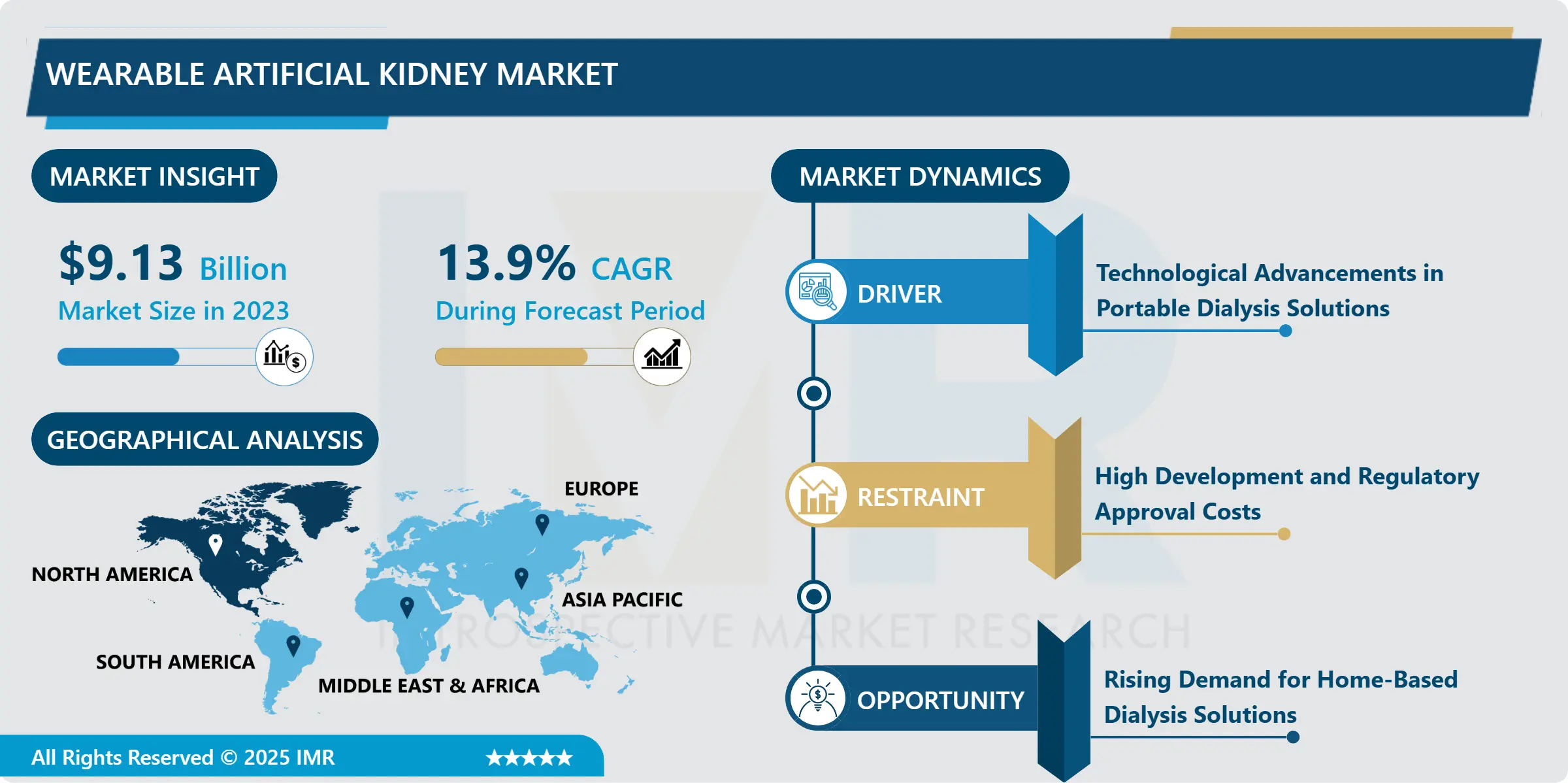
Wearable Artificial Kidney Market Size Was Valued at USD 9.13 Billion in 2023, and is Projected to Reach USD 29.46 Billion by 2032, Growing at a CAGR of 13.9% From 2024-2032.
The Wearable Artificial Kidney (WAK) Market focuses on the development, production, and distribution of portable dialysis devices that offer continuous treatment for individuals with end-stage renal disease (ESRD). These wearable devices replicate the kidney's filtration function, aiming to provide greater mobility, enhanced patient comfort, and improved quality of life over traditional dialysis methods.
The wearable artificial kidney (WAK) market is a novel market in renal healthcare that breaks the mold with features that eliminate the issues inherent with conventional dialysis procedures. With traditional HD and PD, patients need to adhere to highly rigid time tables and spend many hours connected to large stationary devices. However, a wear able artificial kidney will allow for ongoing hemodialysis that is not disrupted by daily activities and events. It has a great potential to give freedom to patients to manage their time and be out of dependence of healthcare centres and treatments.
As we have observed, the market is still at its nascent stage, with a number of commodities in research and developmental stage and others in trial as well as in experimentation stages. Enumerated as follows are the advancement in the following fields that has led to the miniaturization and high efficiency of the WAK systems; nanotechnology, microelectronics, and batteries. Health care regulatory bodies including the Food and Drug Administration of United States are also participating to set some rules and standards and approve these devices for enhancing patients safety and device qualities. Although one could argue that the market has not grown into this role optimally it has the potential of changing the face of kidney care in a way that will make dialysis available and accessible to the rural patient or the patient with access to a healthcare facility.
Wearable Artificial Kidney Market Trend Analysis:
Miniaturization of Dialysis Components
- Wearable artificial kidney market is experiencing innovations due to the trend of miniaturization in the dialysis components. Scientists are working on designing and synthesising miniature lows-profile relief parts to replicate the kidney’s tasks inside a single integrated machine. Recent development in micro fluidics, nanotechnology and in biomaterial science also made design and fabrication of very small filters, pumps sensors possible and inserting them in wearable platforms has become a technical possibility. For instance, miniaturization of the membrane is better for toxins removal, while sensors represent real-time blood chemistry and regulate filtration.
- As the sizes keep getting smaller, the prospect that WAKs could be turned into commonly prescribed treatments increases. The above devices are far less burdening than traditional dialysis and allow patients to continue an active way of living. While the miniaturization trend is a powerful driver for accelerating device adoption due to improved comfort and convenience of WAKs, the concept is appealing to the healthcare providers as well since the potential to address many dialysis center concerns and expand the availability of renal care in areas with limited access.
Rising Demand for Home-Based Dialysis Solutions
- An increase in preference for home-based options for dialysis opening up a big opportunity for the wearable artificial kidney market. Given the fact that healthcare systems all over the world receives a large inflow of patient’s every day, there is a trend of moving some of the treatments to patient’s home. WAKs fit squarely into this goal because patients are able to get constant treatment in the form of peritoneal dialysis inside the comfort of their homes without necessarily requiring aggressive equipment or constant clinic visits.
- Home-based flexible WAK solutions allow ESRD patients to maintain much more control over their lives than is possible through traditional dialysis programs. They do away with the requirement to seek constant healthcare facility services hence the costs incurred in the process, in addition to lowering down overall healthcare expenditure. This demand for home-based solutions is further propelled by the growing incidence and awareness of chronic kidney disease (CKD) and End Stage Renal Disease (ESRD) and the management options for the latter as populations across the world age and as the numbers of people being diagnosed with kidney diseases rise. As home-care and patient centred care models become the norm due to changed health policies, WAK supply chains are poised to benefit from appropriate increased market-size customers seeking affordable, convenient treatment solutions.
Wearable Artificial Kidney Market Segment Analysis:
Wearable Artificial Kidney Market Segmented on the basis of product type, application, component, and Region.
By Product Type, Hemodialysis segment is expected to dominate the market during the forecast period
- The wearable artificial kidney market based on product type includes the hemodialysis machine, peritoneal dialysis machine and other dialysis technologies. Currently, WAK devices developed using hemodialysis as the base remain the most popular arising from the fact that the overall operation of this modality of dialysis is anchored on well-developed technology. These devices replicates the functionality of a permanent hemodialysis machine encased in wearable appliance that is capable of constant filtration and removal of toxins from the blood.
- On the other hand, peritoneal dialysis based wearable kidney, also attracts attention especially if home-care is considered. Comparing to PD WAKs are less invasive and they employ patient’s peritoneum lining of the abdomen to perform the filtering. Coming to this product type lends hope for patients who are looking for an option other than blood-based dialysis. The variation in individual products in WAK market proves the versatility of the company in meeting the patients’ needs and treatment choices thus expanding the opportunity to offer wearable dialysis devices.
By Application, Hospitals segment expected to held the largest share
- Wearable artificial kidney market is also categorized by its application mainly in the hospital, home care, and other applications. Hospitals feature as the biggest use case today as the majority of wearable artificial kidney devices are in active clinical trials or early-stage integration, limiting the patient usage environment to hospital settings.
- Some of the application areas that have surged include home care settings due to the possibility of freeing the patients from set rigid dialysis schedules, and numerous visits to hospitals. Self, portable WAK devices enable patient to administer their treatment right from the comfort of their homes. This transition to home care settings is especially attractive to both healthcare practitioners who experience inadequate bed availability and increased patient volumes, as well as to patients who avoid the inconveniences of routine hospital visits.
Wearable Artificial Kidney Market Regional Insights:
North America is Expected to Dominate the Market Over the Forecast period
- North America still holds the largest share in the wearable artificial kidney market as a result of enhanced healthcare systems, high spending, and rising prevalence of kidney diseases in the region accompanied by high R &D investments. ESRD rates are high in the United States. This provides adequate impetus for the development of dialysis options. Thanks to the vigorous support from healthcare organizations and authorities, North America has the leading role in WAK research, clinical trials, and approvals.
- Furthermore, wearable artificial kidneys are useful for North America’s patient-centered and home-based care delivery system. Other authorities like the FDA, have also indicated their willingness to fast track approval on medical devices that are categorized as breakthrough; a factor that also propels WAK innovations. Such a regional orientation is a double-edged sword that simultaneously promotes market development and sets world standards in the use of wearable kidneys.
Active Key Players in the Wearable Artificial Kidney Market
- Asahi Kasei Corporation (Japan)
- AWAK Technologies Pte. Ltd. (Singapore)
- B. Braun Melsungen AG (Germany)
- Baxter International Inc. (USA)
- DaVita Inc. (USA)
- Diality Inc. (USA)
- Fresenius Medical Care AG & Co. KGaA (Germany)
- Medtronic plc (Ireland)
- Nephria Bio (Switzerland)
- Nipro Corporation (Japan)
- NxStage Medical, Inc. (USA)
- Quanta Dialysis Technologies Ltd. (UK)
- Other Active Players
Key Industry Developments in the Wearable Artificial Kidney Market:
- In June 2023, AWAK Technologies announced the launch of a pivotal clinical trial for an improved automated wearable artificial kidney peritoneal dialysis device. This wearable and ultra-portable device allows patients with end-stage renal diseases to receive dialysis on-the-go.
|
Wearable Artificial Kidney Market |
|||
|
Base Year: |
2023 |
Forecast Period: |
2024-2032 |
|
Historical Data: |
2017 to 2023 |
Market Size in 2023: |
USD 9.13 Billion |
|
Forecast Period 2024-32 CAGR: |
13.9% |
Market Size in 2032: |
USD 29.46 Billion |
|
Segments Covered: |
By Product Type |
|
|
|
By Application |
|
||
|
By Component |
|
||
|
By Region |
|
||
|
Key Market Drivers: |
|
||
|
Key Market Restraints: |
|
||
|
Key Opportunities: |
|
||
|
Companies Covered in the report: |
|
||
Chapter 1: Introduction
1.1 Scope and Coverage
Chapter 2:Executive Summary
Chapter 3: Market Landscape
3.1 Market Dynamics
3.1.1 Drivers
3.1.2 Restraints
3.1.3 Opportunities
3.1.4 Challenges
3.2 Market Trend Analysis
3.3 PESTLE Analysis
3.4 Porter's Five Forces Analysis
3.5 Industry Value Chain Analysis
3.6 Ecosystem
3.7 Regulatory Landscape
3.8 Price Trend Analysis
3.9 Patent Analysis
3.10 Technology Evolution
3.11 Investment Pockets
3.12 Import-Export Analysis
Chapter 4: Wearable Artificial Kidney Market by Product Type
4.1 Wearable Artificial Kidney Market Snapshot and Growth Engine
4.2 Wearable Artificial Kidney Market Overview
4.3 Hemodialysis
4.3.1 Introduction and Market Overview
4.3.2 Historic and Forecasted Market Size in Value USD and Volume Units (2017-2032F)
4.3.3 Key Market Trends, Growth Factors and Opportunities
4.3.4 Hemodialysis: Geographic Segmentation Analysis
4.4 Peritoneal Dialysis
4.4.1 Introduction and Market Overview
4.4.2 Historic and Forecasted Market Size in Value USD and Volume Units (2017-2032F)
4.4.3 Key Market Trends, Growth Factors and Opportunities
4.4.4 Peritoneal Dialysis: Geographic Segmentation Analysis
4.5 Others
4.5.1 Introduction and Market Overview
4.5.2 Historic and Forecasted Market Size in Value USD and Volume Units (2017-2032F)
4.5.3 Key Market Trends, Growth Factors and Opportunities
4.5.4 Others: Geographic Segmentation Analysis
Chapter 5: Wearable Artificial Kidney Market by Application
5.1 Wearable Artificial Kidney Market Snapshot and Growth Engine
5.2 Wearable Artificial Kidney Market Overview
5.3 Hospitals
5.3.1 Introduction and Market Overview
5.3.2 Historic and Forecasted Market Size in Value USD and Volume Units (2017-2032F)
5.3.3 Key Market Trends, Growth Factors and Opportunities
5.3.4 Hospitals: Geographic Segmentation Analysis
5.4 Home Care Settings
5.4.1 Introduction and Market Overview
5.4.2 Historic and Forecasted Market Size in Value USD and Volume Units (2017-2032F)
5.4.3 Key Market Trends, Growth Factors and Opportunities
5.4.4 Home Care Settings: Geographic Segmentation Analysis
5.5 Others
5.5.1 Introduction and Market Overview
5.5.2 Historic and Forecasted Market Size in Value USD and Volume Units (2017-2032F)
5.5.3 Key Market Trends, Growth Factors and Opportunities
5.5.4 Others: Geographic Segmentation Analysis
Chapter 6: Wearable Artificial Kidney Market by Component
6.1 Wearable Artificial Kidney Market Snapshot and Growth Engine
6.2 Wearable Artificial Kidney Market Overview
6.3 Sensors
6.3.1 Introduction and Market Overview
6.3.2 Historic and Forecasted Market Size in Value USD and Volume Units (2017-2032F)
6.3.3 Key Market Trends, Growth Factors and Opportunities
6.3.4 Sensors: Geographic Segmentation Analysis
6.4 Dialysate Solution
6.4.1 Introduction and Market Overview
6.4.2 Historic and Forecasted Market Size in Value USD and Volume Units (2017-2032F)
6.4.3 Key Market Trends, Growth Factors and Opportunities
6.4.4 Dialysate Solution: Geographic Segmentation Analysis
6.5 Batteries
6.5.1 Introduction and Market Overview
6.5.2 Historic and Forecasted Market Size in Value USD and Volume Units (2017-2032F)
6.5.3 Key Market Trends, Growth Factors and Opportunities
6.5.4 Batteries: Geographic Segmentation Analysis
6.6 Others)
6.6.1 Introduction and Market Overview
6.6.2 Historic and Forecasted Market Size in Value USD and Volume Units (2017-2032F)
6.6.3 Key Market Trends, Growth Factors and Opportunities
6.6.4 Others) : Geographic Segmentation Analysis
Chapter 7: Company Profiles and Competitive Analysis
7.1 Competitive Landscape
7.1.1 Competitive Benchmarking
7.1.2 Wearable Artificial Kidney Market Share by Manufacturer (2023)
7.1.3 Industry BCG Matrix
7.1.4 Heat Map Analysis
7.1.5 Mergers and Acquisitions
7.2 BAXTER INTERNATIONAL INC. (USA)
7.2.1 Company Overview
7.2.2 Key Executives
7.2.3 Company Snapshot
7.2.4 Role of the Company in the Market
7.2.5 Sustainability and Social Responsibility
7.2.6 Operating Business Segments
7.2.7 Product Portfolio
7.2.8 Business Performance
7.2.9 Key Strategic Moves and Recent Developments
7.2.10 SWOT Analysis
7.3 FRESENIUS MEDICAL CARE AG & CO. KGAA (GERMANY)
7.4 DAVITA INC. (USA)
7.5 B. BRAUN MELSUNGEN AG (GERMANY)
7.6 ASAHI KASEI CORPORATION (JAPAN)
7.7 AWAK TECHNOLOGIES PTE. LTD. (SINGAPORE)
7.8 MEDTRONIC PLC (IRELAND)
7.9 NIPRO CORPORATION (JAPAN)
7.10 OTHER ACTIVE PLAYERS
Chapter 8: Global Wearable Artificial Kidney Market By Region
8.1 Overview
8.2. North America Wearable Artificial Kidney Market
8.2.1 Key Market Trends, Growth Factors and Opportunities
8.2.2 Top Key Companies
8.2.3 Historic and Forecasted Market Size by Segments
8.2.4 Historic and Forecasted Market Size By Product Type
8.2.4.1 Hemodialysis
8.2.4.2 Peritoneal Dialysis
8.2.4.3 Others
8.2.5 Historic and Forecasted Market Size By Application
8.2.5.1 Hospitals
8.2.5.2 Home Care Settings
8.2.5.3 Others
8.2.6 Historic and Forecasted Market Size By Component
8.2.6.1 Sensors
8.2.6.2 Dialysate Solution
8.2.6.3 Batteries
8.2.6.4 Others)
8.2.7 Historic and Forecast Market Size by Country
8.2.7.1 US
8.2.7.2 Canada
8.2.7.3 Mexico
8.3. Eastern Europe Wearable Artificial Kidney Market
8.3.1 Key Market Trends, Growth Factors and Opportunities
8.3.2 Top Key Companies
8.3.3 Historic and Forecasted Market Size by Segments
8.3.4 Historic and Forecasted Market Size By Product Type
8.3.4.1 Hemodialysis
8.3.4.2 Peritoneal Dialysis
8.3.4.3 Others
8.3.5 Historic and Forecasted Market Size By Application
8.3.5.1 Hospitals
8.3.5.2 Home Care Settings
8.3.5.3 Others
8.3.6 Historic and Forecasted Market Size By Component
8.3.6.1 Sensors
8.3.6.2 Dialysate Solution
8.3.6.3 Batteries
8.3.6.4 Others)
8.3.7 Historic and Forecast Market Size by Country
8.3.7.1 Russia
8.3.7.2 Bulgaria
8.3.7.3 The Czech Republic
8.3.7.4 Hungary
8.3.7.5 Poland
8.3.7.6 Romania
8.3.7.7 Rest of Eastern Europe
8.4. Western Europe Wearable Artificial Kidney Market
8.4.1 Key Market Trends, Growth Factors and Opportunities
8.4.2 Top Key Companies
8.4.3 Historic and Forecasted Market Size by Segments
8.4.4 Historic and Forecasted Market Size By Product Type
8.4.4.1 Hemodialysis
8.4.4.2 Peritoneal Dialysis
8.4.4.3 Others
8.4.5 Historic and Forecasted Market Size By Application
8.4.5.1 Hospitals
8.4.5.2 Home Care Settings
8.4.5.3 Others
8.4.6 Historic and Forecasted Market Size By Component
8.4.6.1 Sensors
8.4.6.2 Dialysate Solution
8.4.6.3 Batteries
8.4.6.4 Others)
8.4.7 Historic and Forecast Market Size by Country
8.4.7.1 Germany
8.4.7.2 UK
8.4.7.3 France
8.4.7.4 The Netherlands
8.4.7.5 Italy
8.4.7.6 Spain
8.4.7.7 Rest of Western Europe
8.5. Asia Pacific Wearable Artificial Kidney Market
8.5.1 Key Market Trends, Growth Factors and Opportunities
8.5.2 Top Key Companies
8.5.3 Historic and Forecasted Market Size by Segments
8.5.4 Historic and Forecasted Market Size By Product Type
8.5.4.1 Hemodialysis
8.5.4.2 Peritoneal Dialysis
8.5.4.3 Others
8.5.5 Historic and Forecasted Market Size By Application
8.5.5.1 Hospitals
8.5.5.2 Home Care Settings
8.5.5.3 Others
8.5.6 Historic and Forecasted Market Size By Component
8.5.6.1 Sensors
8.5.6.2 Dialysate Solution
8.5.6.3 Batteries
8.5.6.4 Others)
8.5.7 Historic and Forecast Market Size by Country
8.5.7.1 China
8.5.7.2 India
8.5.7.3 Japan
8.5.7.4 South Korea
8.5.7.5 Malaysia
8.5.7.6 Thailand
8.5.7.7 Vietnam
8.5.7.8 The Philippines
8.5.7.9 Australia
8.5.7.10 New Zealand
8.5.7.11 Rest of APAC
8.6. Middle East & Africa Wearable Artificial Kidney Market
8.6.1 Key Market Trends, Growth Factors and Opportunities
8.6.2 Top Key Companies
8.6.3 Historic and Forecasted Market Size by Segments
8.6.4 Historic and Forecasted Market Size By Product Type
8.6.4.1 Hemodialysis
8.6.4.2 Peritoneal Dialysis
8.6.4.3 Others
8.6.5 Historic and Forecasted Market Size By Application
8.6.5.1 Hospitals
8.6.5.2 Home Care Settings
8.6.5.3 Others
8.6.6 Historic and Forecasted Market Size By Component
8.6.6.1 Sensors
8.6.6.2 Dialysate Solution
8.6.6.3 Batteries
8.6.6.4 Others)
8.6.7 Historic and Forecast Market Size by Country
8.6.7.1 Turkiye
8.6.7.2 Bahrain
8.6.7.3 Kuwait
8.6.7.4 Saudi Arabia
8.6.7.5 Qatar
8.6.7.6 UAE
8.6.7.7 Israel
8.6.7.8 South Africa
8.7. South America Wearable Artificial Kidney Market
8.7.1 Key Market Trends, Growth Factors and Opportunities
8.7.2 Top Key Companies
8.7.3 Historic and Forecasted Market Size by Segments
8.7.4 Historic and Forecasted Market Size By Product Type
8.7.4.1 Hemodialysis
8.7.4.2 Peritoneal Dialysis
8.7.4.3 Others
8.7.5 Historic and Forecasted Market Size By Application
8.7.5.1 Hospitals
8.7.5.2 Home Care Settings
8.7.5.3 Others
8.7.6 Historic and Forecasted Market Size By Component
8.7.6.1 Sensors
8.7.6.2 Dialysate Solution
8.7.6.3 Batteries
8.7.6.4 Others)
8.7.7 Historic and Forecast Market Size by Country
8.7.7.1 Brazil
8.7.7.2 Argentina
8.7.7.3 Rest of SA
Chapter 9 Analyst Viewpoint and Conclusion
9.1 Recommendations and Concluding Analysis
9.2 Potential Market Strategies
Chapter 10 Research Methodology
10.1 Research Process
10.2 Primary Research
10.3 Secondary Research
|
Wearable Artificial Kidney Market |
|||
|
Base Year: |
2023 |
Forecast Period: |
2024-2032 |
|
Historical Data: |
2017 to 2023 |
Market Size in 2023: |
USD 9.13 Billion |
|
Forecast Period 2024-32 CAGR: |
13.9% |
Market Size in 2032: |
USD 29.46 Billion |
|
Segments Covered: |
By Product Type |
|
|
|
By Application |
|
||
|
By Component |
|
||
|
By Region |
|
||
|
Key Market Drivers: |
|
||
|
Key Market Restraints: |
|
||
|
Key Opportunities: |
|
||
|
Companies Covered in the report: |
|
||


