




Global Virtual Schools Market Overview
Global Virtual Schools Market size was valued at USD 3.29 Billion in 2023 and is projected to reach USD 10.89 Billion by 2032, growing at a CAGR of 14.23% from 2024 to 2032.
The virtual school also referred to as an e-school, online school, or cyber-campus offers a full-time, successive program of synchronous and/or asynchronous instruction by using various developed technologies and the internet in a distributed environment. In the environment of a virtual school, students can communicate with the teacher and other students. Virtual education is mostly adopted by high school, college, or graduate school. Students, who are preparing for competitive exams like to prefer virtual school programs. The coursework is delivered by E-mail, Video conferencing, DVD, Printed materials, and Web conferencing depending on the program. Virtual learning allows individuals to earn transferable credits, take recognized examinations, or advance to the next level of education over the Internet. Virtual schools offer various benefits such as students participating in classes on their own schedule and can learn at their own pace. Additionally, virtual schools are affordable, time-saving, and focus on other productive activities Thus, their growing adoption boosts the growth of the market.
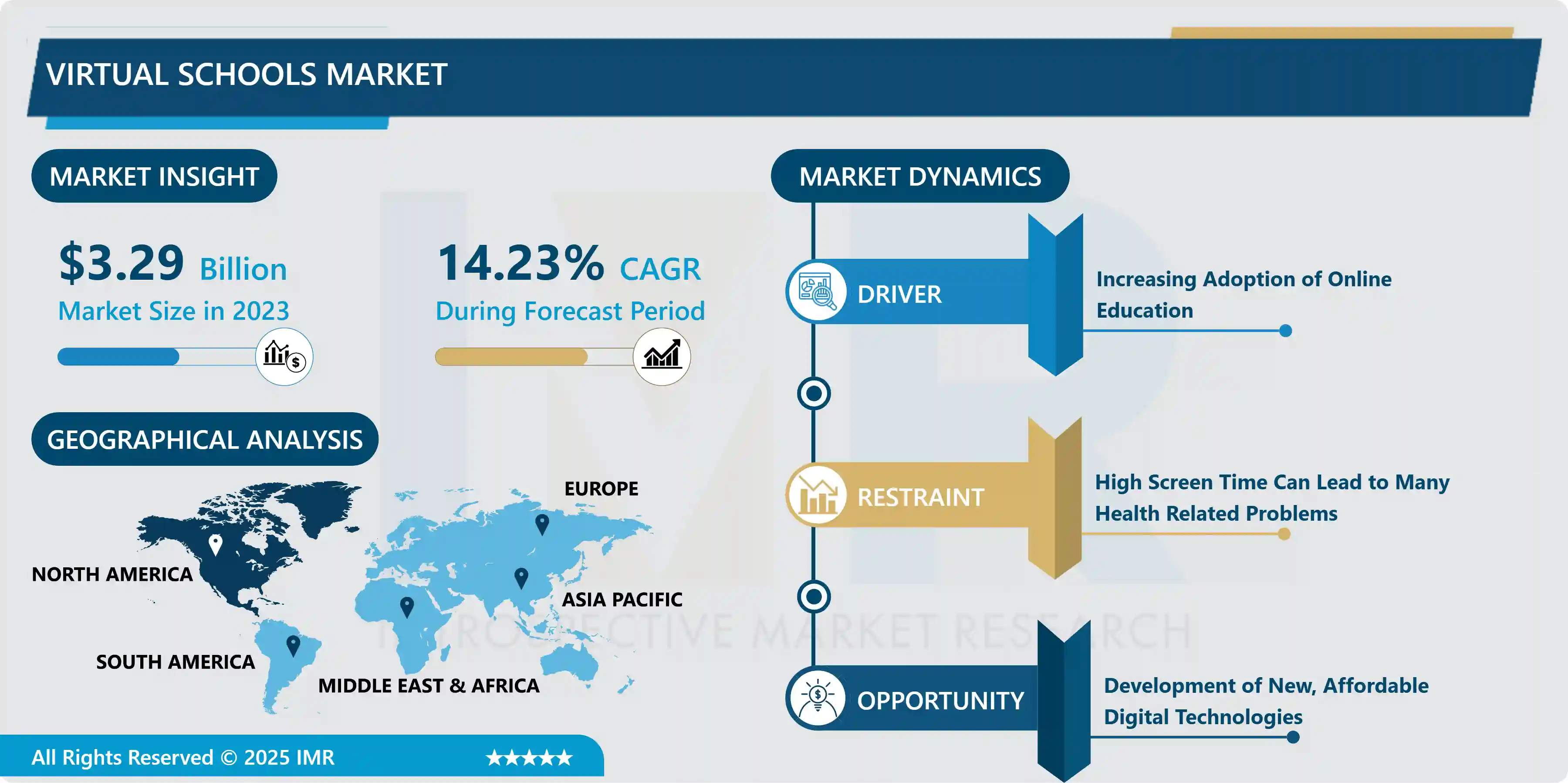

Market Dynamics And Factors For Virtual Schools Market
Drivers:
Increasing Adoption of Online Education
The Rapid growth of communication technologies (ICTs) develops the application of e-learning in the education area, which contains people can adopt online learning or teaching resources without location limitations. The demand for online education increases owing to it providing flexibility to students, Peoples likes to prefer online platforms for learning, growing internet connectivity, and rising adoption of smartphones. For instance, in accordance with Statista, North America has a massive adoption rate of smartphones with 82% of total mobile connections. Additionally, a growing number of online platforms, technological development in the online sector, lower hosting costs, increasing internet penetration, and growing demand for educational content help to increase the adoption of online education. Online education gives a number of benefits such as it offers real-world skills, and more individual attention, helping to become self-disciplined, and promoting lifelong learning that helps to rise demand for online education. Due to COVID 19, In the last two years, the adoption of online education is increased in the education sector to learn students and in corporate sectors to provide training to employees. Thus, the growing adoption of online education that boosts the market of virtual schools market.
Restraints:
High Screen Time Can Lead to Many Health-Related Problems
For online education, students need to spend more time on screen. According to Statista, in June 2020, 62% of parents in the US region stated that their kids in the teens aged 14-17 were spending more than four hours on the screen since, the COVID-19 pandemic. Too much screen time leads to various side effects such as obesity, sleep problems, chronic neck and back problems, depression, anxiety, and lower test scores in children. The high screen time also impacts heart health which leads to a high risk of diabetes and a rise in blood pressure and cholesterol level. According to National Institutes of Health study children who spent their time more than 2 hours in a day on any electronic devices scored lower on thinking and language tests and those who spent more than 7 hours on screen time suffered from thinning of the brain cortex which causes the difficult to think and reasoning. These major side effects related to health are anticipated to restrict the growth of the virtual school’s market in the forecast year.
Opportunity:
Development of New, Affordable Digital Technologies
The advancement in the technology and tools which are used in virtual schools to improve online learning that offers a lucrative opportunity for the virtual schools market. The growing adoption of cloud-based solutions in virtual schools with high investment in the development of the security and stability of cloud-based education systems by market players. Artificial intelligence development and advancement in the IoT will help to enhance the user experience in online education networks. Augmented reality in education contains global perspectives through virtual field trips, allowing students to engage with other cultures. This tool helps students which are engaged in struggling with geometry to manipulate 3D geometric forms. Additionally, the growing demand for collaboration-based education in developing regions such as India, and China is a remunerative opportunity for the market of virtual schools in the forecast period.
Segmentation Analysis Of Virtual Schools Market
By Type, profit EMO is expected to have the largest share in the virtual school market during the forecast period. Education management organizations (EMOs) are largely for-profit firms that offer “whole-school operation” services to public school agencies. The EMOs are generally organized for corporate entities. They focused on offering educational services to corporations and other businesses. The number of virtual schools managed by ‘For Profit-EMO’. The growing number of students enrolling accounts in EMO-operated schools boosts the virtual school market.
By Application, the High School segment is anticipated to dominate the virtual schools market share over the forecast period. Most secondary school students like to learn on online platforms to save their time and focus on other activities that help to grow the market. Virtual schools provide the opportunity for students to take advanced placement or college-level courses. Virtual schools also provide some courses that are not available in the student’s home high schools. The students from the rural areas choose online high schools if a brick-and-mortar school is too far from home. Some high schools in rural areas make a partnership with third-party education providers for part-time and full-time online instruction. The rising adoption of the developed technology in high schools helps to increase the market of virtual schools in the analysis period.
Regional Analysis Of Virtual Schools Market
North America is projected to maximum market share of the virtual schools market in the projected period owing to the growing usage of mobile devices and internet penetration. Domestic colleges in this region offer online distance learning courses for students as well as working people, which drives the market for virtual schools. The adoption of virtual schools in this region is high because of huge investments by the service provider. Due to the outbreak of COVID-19, rising R&D investments hastened the requirement and demand for online education. To avoid viral infection people, choose distance learning online for their kids. Thus, in the last two years, the demand for virtual schools in this region is high. People are aware of the benefits of virtual schools, the rising popularity of education apps, adoption of various support solutions and tools such as learning management solutions (LMS) and enterprise resource planning (ERP), as well as augmented reality (AR), virtual reality (VR), blended learning solutions, and student assessment software. These factors also help to increase the adoption of virtual learning which boosts the market of virtual schools in this region.
Europe is the second dominated region in the virtual schools market. In this region, high adoption of advanced technologies such as learning management solutions (LMS) and enterprise resource planning (ERP), augmented reality (AR), virtual reality (VR), blended learning solutions, and student assessment software in the education sectors. Thus, increasing the adoption of online education in this region gives more benefits to students. Most schools and colleges in Europe adopt online learning by using digital technologies. Apart from this, an increase in the number of smartphone users supports the rising adoption of virtual learning. Statista stated that in 2021, 77.64% smartphone penetration rate in the Europe region. Apart from this, various corporate sectors in this region choose virtual schools to provide training to their employees. These all key factors propel the growth of the virtual school market in the forecast period.
Covid-19 Impact Analysis On Virtual Schools Market
COVID-19 began in Wuhan (China) in December 2019 and has since suddenly grown across the globe. In terms of confirmed cases and reported deaths, the US, India, Brazil, Russia, France, the UK, Turkey, Italy, and Spain are among the countries that have been most severely impacted. Due to lockdowns, travel restrictions, and business closures, COVID-19 has had an impact on the businesses and industries of numerous nations. The shutdown of various plants and factories has had a detrimental influence on the production, delivery schedules, and sales of goods on the international market. Only a few businesses have already warned of potential delivery delays and eventual sales declines. The outbreak of COVID-19 has significantly changed the education system and learning process. To avoid the spread of COVID infection, the government closed schools and colleges. Thus, most students in the world adopt virtual learning. Additionally, digitalization and smart technological adoption in the education system is increased. Therefore, COVID-19 has positively impacted the virtual schools Market.
Top Key Players Covered In Virtual Schools Market
- K12 Inc. (Herndon, VA)
- Connections Academy (Maryland)
- Mosaica Education (US)
- Pansophic Learning (Virginia)
- Florida Virtual School(FLVS) (US)
- Charter Schools USA (US)
- Lincoln Learning Solutions (US)
- Inspire Charter Schools (US)
- Abbotsford Virtual Schools (Canada)
- Alaska Virtual Schools
- Basehor-Linwood Virtual School (US)
- Acklam Grange (UK)
- Illinois Virtual School (IVS) (US)
- Virtual High School (VHS) (US)
- Aurora College (Canada)
- Wey Education Schools Trust (UK)
- N High School
- Beijing Changping School (China), and other major players.
Key Industry Development –
- In April 2023, Echo360 unveiled a suite of EdTech SaaS platforms, including EchoPollTM for interactive polling, EchoVideoTM with upgraded editing tools and accessibility features, and ExamViewTM offering advanced assessment capabilities. These new launches are designed to revolutionize learning experiences by focusing on engagement, accessibility, and efficient workflows, reinforcing Echo360’s status as a leader in the EdTech sector.
- In January 2023, Creative Galileo, an ed-tech startup, unveiled Toondemy, a new educational app. Designed for children aged 3-10, the app aligns with NEP, NCERT, and CBSE standards to foster cognitive development, build foundational skills, teach phonics, and encourage innovative thinking.
|
Global Virtual Schools Market |
|||
|
Base Year: |
2023 |
Forecast Period: |
2024-2032 |
|
Historical Data: |
2016 to 2023 |
Market Size in 2023: |
USD 3.29 Bn. |
|
Forecast Period 2022-28 CAGR: |
14.23% |
Market Size in 2032: |
USD 10.89 Bn. |
|
Segments Covered: |
By Type |
|
|
|
By Application |
|
||
|
By Region |
|
||
|
Key Market Drivers: |
|
||
|
Key Market Restraints: |
|
||
|
Key Opportunities: |
|
||
|
Companies Covered in the report: |
|
||
Chapter 1: Introduction
1.1 Scope and Coverage
Chapter 2:Executive Summary
Chapter 3: Market Landscape
3.1 Market Dynamics
3.1.1 Drivers
3.1.2 Restraints
3.1.3 Opportunities
3.1.4 Challenges
3.2 Market Trend Analysis
3.3 PESTLE Analysis
3.4 Porter's Five Forces Analysis
3.5 Industry Value Chain Analysis
3.6 Ecosystem
3.7 Regulatory Landscape
3.8 Price Trend Analysis
3.9 Patent Analysis
3.10 Technology Evolution
3.11 Investment Pockets
3.12 Import-Export Analysis
Chapter 4: Virtual Schools Market by Type (2018-2032)
4.1 Virtual Schools Market Snapshot and Growth Engine
4.2 Market Overview
4.3 For-profit EMO
4.3.1 Introduction and Market Overview
4.3.2 Historic and Forecasted Market Size in Value USD and Volume Units
4.3.3 Key Market Trends, Growth Factors, and Opportunities
4.3.4 Geographic Segmentation Analysis
4.4 Non-profit EMO
Chapter 5: Virtual Schools Market by Application (2018-2032)
5.1 Virtual Schools Market Snapshot and Growth Engine
5.2 Market Overview
5.3 Elementary Schools
5.3.1 Introduction and Market Overview
5.3.2 Historic and Forecasted Market Size in Value USD and Volume Units
5.3.3 Key Market Trends, Growth Factors, and Opportunities
5.3.4 Geographic Segmentation Analysis
5.4 Middle Schools
5.5 High Schools
5.6 Adult Education
Chapter 6: Company Profiles and Competitive Analysis
6.1 Competitive Landscape
6.1.1 Competitive Benchmarking
6.1.2 Virtual Schools Market Share by Manufacturer (2024)
6.1.3 Industry BCG Matrix
6.1.4 Heat Map Analysis
6.1.5 Mergers and Acquisitions
6.2 GOOGLE(US)
6.2.1 Company Overview
6.2.2 Key Executives
6.2.3 Company Snapshot
6.2.4 Role of the Company in the Market
6.2.5 Sustainability and Social Responsibility
6.2.6 Operating Business Segments
6.2.7 Product Portfolio
6.2.8 Business Performance
6.2.9 Key Strategic Moves and Recent Developments
6.2.10 SWOT Analysis
6.3 FACEBOOK(US)
6.4 IBM(US)
6.5 LINKEDIN(US)
6.6 ORACLE(US)
6.7 NETFLIX(US)
6.8 ALIBABA(CHINA)
6.9 TECENT(CHINA)
6.10 AIRBNB(US)
6.11 HUAWEI(CHINA)
6.12 BAIDU(CHINA)
6.13 AMAZON(US)
6.14 OTHER KEY PLAYERS
Chapter 7: Global Virtual Schools Market By Region
7.1 Overview
7.2. North America Virtual Schools Market
7.2.1 Key Market Trends, Growth Factors and Opportunities
7.2.2 Top Key Companies
7.2.3 Historic and Forecasted Market Size by Segments
7.2.4 Historic and Forecasted Market Size by Type
7.2.4.1 For-profit EMO
7.2.4.2 Non-profit EMO
7.2.5 Historic and Forecasted Market Size by Application
7.2.5.1 Elementary Schools
7.2.5.2 Middle Schools
7.2.5.3 High Schools
7.2.5.4 Adult Education
7.2.6 Historic and Forecast Market Size by Country
7.2.6.1 US
7.2.6.2 Canada
7.2.6.3 Mexico
7.3. Eastern Europe Virtual Schools Market
7.3.1 Key Market Trends, Growth Factors and Opportunities
7.3.2 Top Key Companies
7.3.3 Historic and Forecasted Market Size by Segments
7.3.4 Historic and Forecasted Market Size by Type
7.3.4.1 For-profit EMO
7.3.4.2 Non-profit EMO
7.3.5 Historic and Forecasted Market Size by Application
7.3.5.1 Elementary Schools
7.3.5.2 Middle Schools
7.3.5.3 High Schools
7.3.5.4 Adult Education
7.3.6 Historic and Forecast Market Size by Country
7.3.6.1 Russia
7.3.6.2 Bulgaria
7.3.6.3 The Czech Republic
7.3.6.4 Hungary
7.3.6.5 Poland
7.3.6.6 Romania
7.3.6.7 Rest of Eastern Europe
7.4. Western Europe Virtual Schools Market
7.4.1 Key Market Trends, Growth Factors and Opportunities
7.4.2 Top Key Companies
7.4.3 Historic and Forecasted Market Size by Segments
7.4.4 Historic and Forecasted Market Size by Type
7.4.4.1 For-profit EMO
7.4.4.2 Non-profit EMO
7.4.5 Historic and Forecasted Market Size by Application
7.4.5.1 Elementary Schools
7.4.5.2 Middle Schools
7.4.5.3 High Schools
7.4.5.4 Adult Education
7.4.6 Historic and Forecast Market Size by Country
7.4.6.1 Germany
7.4.6.2 UK
7.4.6.3 France
7.4.6.4 The Netherlands
7.4.6.5 Italy
7.4.6.6 Spain
7.4.6.7 Rest of Western Europe
7.5. Asia Pacific Virtual Schools Market
7.5.1 Key Market Trends, Growth Factors and Opportunities
7.5.2 Top Key Companies
7.5.3 Historic and Forecasted Market Size by Segments
7.5.4 Historic and Forecasted Market Size by Type
7.5.4.1 For-profit EMO
7.5.4.2 Non-profit EMO
7.5.5 Historic and Forecasted Market Size by Application
7.5.5.1 Elementary Schools
7.5.5.2 Middle Schools
7.5.5.3 High Schools
7.5.5.4 Adult Education
7.5.6 Historic and Forecast Market Size by Country
7.5.6.1 China
7.5.6.2 India
7.5.6.3 Japan
7.5.6.4 South Korea
7.5.6.5 Malaysia
7.5.6.6 Thailand
7.5.6.7 Vietnam
7.5.6.8 The Philippines
7.5.6.9 Australia
7.5.6.10 New Zealand
7.5.6.11 Rest of APAC
7.6. Middle East & Africa Virtual Schools Market
7.6.1 Key Market Trends, Growth Factors and Opportunities
7.6.2 Top Key Companies
7.6.3 Historic and Forecasted Market Size by Segments
7.6.4 Historic and Forecasted Market Size by Type
7.6.4.1 For-profit EMO
7.6.4.2 Non-profit EMO
7.6.5 Historic and Forecasted Market Size by Application
7.6.5.1 Elementary Schools
7.6.5.2 Middle Schools
7.6.5.3 High Schools
7.6.5.4 Adult Education
7.6.6 Historic and Forecast Market Size by Country
7.6.6.1 Turkiye
7.6.6.2 Bahrain
7.6.6.3 Kuwait
7.6.6.4 Saudi Arabia
7.6.6.5 Qatar
7.6.6.6 UAE
7.6.6.7 Israel
7.6.6.8 South Africa
7.7. South America Virtual Schools Market
7.7.1 Key Market Trends, Growth Factors and Opportunities
7.7.2 Top Key Companies
7.7.3 Historic and Forecasted Market Size by Segments
7.7.4 Historic and Forecasted Market Size by Type
7.7.4.1 For-profit EMO
7.7.4.2 Non-profit EMO
7.7.5 Historic and Forecasted Market Size by Application
7.7.5.1 Elementary Schools
7.7.5.2 Middle Schools
7.7.5.3 High Schools
7.7.5.4 Adult Education
7.7.6 Historic and Forecast Market Size by Country
7.7.6.1 Brazil
7.7.6.2 Argentina
7.7.6.3 Rest of SA
Chapter 8 Analyst Viewpoint and Conclusion
8.1 Recommendations and Concluding Analysis
8.2 Potential Market Strategies
Chapter 9 Research Methodology
9.1 Research Process
9.2 Primary Research
9.3 Secondary Research
|
Global Virtual Schools Market |
|||
|
Base Year: |
2023 |
Forecast Period: |
2024-2032 |
|
Historical Data: |
2016 to 2023 |
Market Size in 2023: |
USD 3.29 Bn. |
|
Forecast Period 2022-28 CAGR: |
14.23% |
Market Size in 2032: |
USD 10.89 Bn. |
|
Segments Covered: |
By Type |
|
|
|
By Application |
|
||
|
By Region |
|
||
|
Key Market Drivers: |
|
||
|
Key Market Restraints: |
|
||
|
Key Opportunities: |
|
||
|
Companies Covered in the report: |
|
||


