




Veterinary Dermatology Drugs Market Synopsis:
The Veterinary Dermatology Drugs Market Size Was Valued at USD 3.21 Billion in 2023, and is Projected to Reach USD 6.25 Billion by 2032, Growing at a CAGR of 7.68 % From 2024-2032.
The Veterinary Dermatology Drugs Market can be defined as the market of drugs that are prescribed for the treatment of skin disorders in animals including domestic animals and livestock. These are bacterial and fungal skin infections, skin parasite infestations, skin reactions including allergic or autoimmune reactions in animals, domestic and livestock. Their market primarily focuses on pet owners and Vet persons or establishments because of the advancement in veterinary sciences, increased pet adoption rates, and awareness regarding pet health.
In the present world economy, The Veterinary Dermatology Drugs Market is coming up consistently due to development of skin diseases in pets as well as farm animals. Dog and cats are among the animals which are affected by allergies, new infections and dermatitis due to allergens, poor nutrition and parasitic attack. The market’s growth also stems from multiple doctors’ prescription and patient’s request for these products, including antibiotics, antifungal agents, and anti-inflammatory drugs.
However, historic expansion, increased rate of pet adoption, and increased spending on pet care prolong the growth of this market. The livestock also has a lot of contribution as skin diseases cut down production rates that call for veterinary services. This means that veterinary clinics, internet chemist, and the outlet are strategic in ensuring delivery of these medicines a reality.
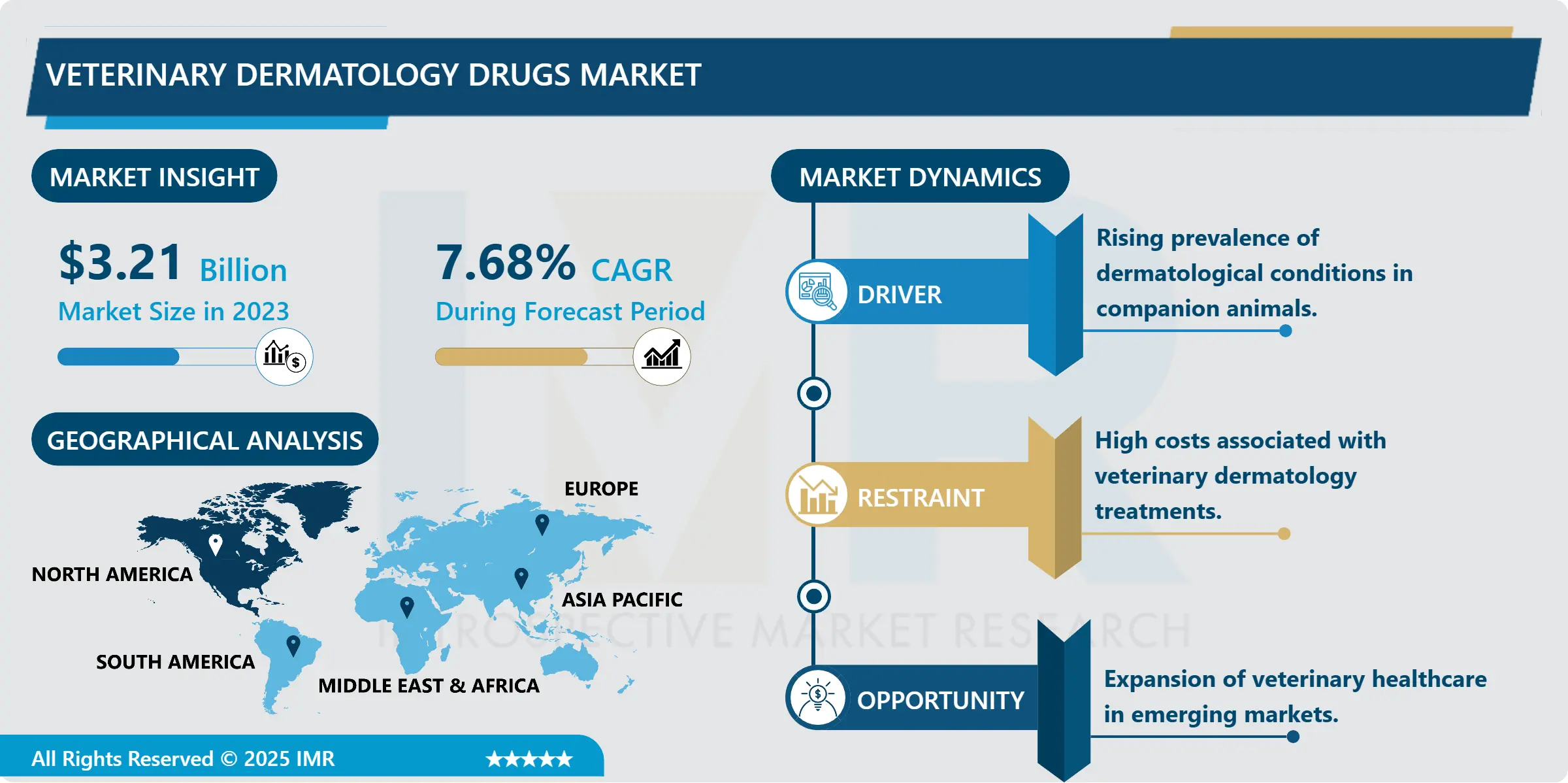
Veterinary Dermatology Drugs Market Trend Analysis:
Rising Focus on Advanced Formulations
- Largely, the Veterinary Dermatology Drugs Market benefits from state-of-the-art anatomic and disease-targeted solutions. These convenience and effectiveness enhancements in product handling have urged some pharmaceutical firms to engineer such products as trans-dermal patches, medicated shampoos, and spot-on treatments. Not only do these formulations increase client compliance because pet owners are more likely to use these products, but side effects are minimized making treatments for animals less hazardous. Veterinary medicine has also incorporated biotechnology in delivery of tailored treatment for particular skin diseases based on genetics and other conditions relating to the animal.
Growth in Emerging Markets
- New entrant is threatened by the Veterinary Dermatology Drugs Market as new markets available to the market for growth. Pet owning markets and people’s concerns for the pet’s health in the countries in Asia-Pacific, Latin America and Middle East area are growing. As noted in these areas, there are development of Veterinary healthcare clinic and diagnostic centres by governments and other private bodies. This trend together with the increasing online sales is expected to lead to a huge unsaturated market which can be met by veterinary dermatology drugs. These regions represent good points of entry as the clients’ demand for cheaper and easily accessible treatment escalates, hence, viable market specialties
Veterinary Dermatology Drugs Market Segment Analysis:
Veterinary Dermatology Drugs Market Segmented on the basis of drug type, animal type, distribution channel, and Region.
By Drug Type, the Antibiotics segment is expected to dominate the market during the forecast period
- Regionally, according to the division that exists at present in the Veterinary Dermatology Drugs Market, the Antibiotics segment is expected to maintain dominance in the Veterinary Dermatology Drugs Market for the predicted time period. Another class of antimicrobials used in skin disease includes the antibiotics where pyoderma and folliculitis in dogs, cats as well as other companion animals cannot be treated. These infections cause complications, and this makes the pet owners to look for vet services if not treated.
By Animal Type, the dog segment is expected to hold the largest share
- The Companion Animal segment is further sub segmented into Dog, Cat and Other Small Animals the Dog segment is expected to hold the largest share in the Veterinary Dermatology Drugs Market this is due to high incidence of skin disorders in dogs. A skin conditions such as allergies, hot spots or parasitic skin diseases affect dogs often, which makes medication necessary. Dogs are mostly outdoor animals and since it’s cold season they are most likely to develop skin issues that need immediate attention.
Veterinary Dermatology Drugs Market Regional Insights:
North America is Expected to Dominate the Market Over the Forecast period
- The subsequent veterinary pet health care structure in North America and higher level of awareness among the pet owners have contributed towards the largest market share for veterinary dermatology drugs in North America in the forecast period. The region has a high incidence of pet ownership and an increasing trend in the number of pet-bearing, especially in the USA and Canada. Skin-related diseases and issues are mostly treated by professional vets for pets in North America which provides constant demand for dermatological products.
- The number of many reputed pharmaceutical players and research facilities is cardinal for the growth of the North American market. The companies expend a good amount on Research and Development to come up with new and particular treatments for animal skin diseases. In addition, the also government regulations and policies that tend to promote animal welfare and animal health care also endorse regional domination.
Active Key Players in the Veterinary Dermatology Drugs Market
- Bayer Animal Health (Germany)
- Boehringer Ingelheim (Germany)
- Ceva Santé Animale (France)
- Dechra Pharmaceuticals (United Kingdom)
- Elanco Animal Health (United States)
- Idexx Laboratories (United States)
- Merck Animal Health (United States)
- Norbrook Laboratories (United Kingdom)
- Vetoquinol (France)
- Virbac (France)
- Zoetis (United States)
- Kyoritsu Seiyaku (Japan)
- Phibro Animal Health Corporation (United States)
- Zydus Animal Health (India)
- Heska Corporation (United States)
- Other Active Players
|
Global Veterinary Dermatology Drugs Market |
|||
|
Base Year: |
2023 |
Forecast Period: |
2024-2032 |
|
Historical Data: |
2017 to 2023 |
Market Size in 2023: |
USD 3.21 Billion |
|
Forecast Period 2024-32 CAGR: |
7.68 % |
Market Size in 2032: |
USD 6.25 Billion |
|
Segments Covered: |
By Drug Type |
|
|
|
By Animal Type |
|
||
|
By Distribution Channel |
|
||
|
By Region |
|
||
|
Key Market Drivers: |
|
||
|
Key Market Restraints: |
|
||
|
Key Opportunities: |
|
||
|
Companies Covered in the report: |
|
||
Chapter 1: Introduction
1.1 Scope and Coverage
Chapter 2:Executive Summary
Chapter 3: Market Landscape
3.1 Market Dynamics
3.1.1 Drivers
3.1.2 Restraints
3.1.3 Opportunities
3.1.4 Challenges
3.2 Market Trend Analysis
3.3 PESTLE Analysis
3.4 Porter's Five Forces Analysis
3.5 Industry Value Chain Analysis
3.6 Ecosystem
3.7 Regulatory Landscape
3.8 Price Trend Analysis
3.9 Patent Analysis
3.10 Technology Evolution
3.11 Investment Pockets
3.12 Import-Export Analysis
Chapter 4: Veterinary Dermatology Drugs Market by Animal Type
4.1 Veterinary Dermatology Drugs Market Snapshot and Growth Engine
4.2 Veterinary Dermatology Drugs Market Overview
4.3 Companion Animals Farm Animals
4.3.1 Introduction and Market Overview
4.3.2 Historic and Forecasted Market Size in Value USD and Volume Units (2017-2032F)
4.3.3 Key Market Trends, Growth Factors and Opportunities
4.3.4 Companion Animals Farm Animals: Geographic Segmentation Analysis
Chapter 5: Veterinary Dermatology Drugs Market by Hospital Type
5.1 Veterinary Dermatology Drugs Market Snapshot and Growth Engine
5.2 Veterinary Dermatology Drugs Market Overview
5.3 Surgery Medicine Consultation
5.3.1 Introduction and Market Overview
5.3.2 Historic and Forecasted Market Size in Value USD and Volume Units (2017-2032F)
5.3.3 Key Market Trends, Growth Factors and Opportunities
5.3.4 Surgery Medicine Consultation: Geographic Segmentation Analysis
Chapter 6: Veterinary Dermatology Drugs Market by Sector
6.1 Veterinary Dermatology Drugs Market Snapshot and Growth Engine
6.2 Veterinary Dermatology Drugs Market Overview
6.3 Public Private
6.3.1 Introduction and Market Overview
6.3.2 Historic and Forecasted Market Size in Value USD and Volume Units (2017-2032F)
6.3.3 Key Market Trends, Growth Factors and Opportunities
6.3.4 Public Private: Geographic Segmentation Analysis
Chapter 7: Company Profiles and Competitive Analysis
7.1 Competitive Landscape
7.1.1 Competitive Benchmarking
7.1.2 Veterinary Dermatology Drugs Market Share by Manufacturer (2023)
7.1.3 Industry BCG Matrix
7.1.4 Heat Map Analysis
7.1.5 Mergers and Acquisitions
7.2 BAYER ANIMAL HEALTH (GERMANY)
7.2.1 Company Overview
7.2.2 Key Executives
7.2.3 Company Snapshot
7.2.4 Role of the Company in the Market
7.2.5 Sustainability and Social Responsibility
7.2.6 Operating Business Segments
7.2.7 Product Portfolio
7.2.8 Business Performance
7.2.9 Key Strategic Moves and Recent Developments
7.2.10 SWOT Analysis
7.3 BOEHRINGER INGELHEIM (GERMANY)
7.4 CEVA SANTÉ ANIMALE (FRANCE)
7.5 DECHRA PHARMACEUTICALS (UNITED KINGDOM)
7.6 ELANCO ANIMAL HEALTH (UNITED STATES)
7.7 IDEXX LABORATORIES (UNITED STATES)
7.8 MERCK ANIMAL HEALTH (UNITED STATES)
7.9 NORBROOK LABORATORIES (UNITED KINGDOM)
7.10 VETOQUINOL (FRANCE)
7.11 VIRBAC (FRANCE)
7.12 ZOETIS (UNITED STATES)
7.13 KYORITSU SEIYAKU (JAPAN)
7.14 PHIBRO ANIMAL HEALTH CORPORATION (UNITED STATES)
7.15 ZYDUS ANIMAL HEALTH (INDIA)
7.16 HESKA CORPORATION (UNITED STATES)
7.17 OTHER ACTIVE PLAYERS
Chapter 8: Global Veterinary Dermatology Drugs Market By Region
8.1 Overview
8.2. North America Veterinary Dermatology Drugs Market
8.2.1 Key Market Trends, Growth Factors and Opportunities
8.2.2 Top Key Companies
8.2.3 Historic and Forecasted Market Size by Segments
8.2.4 Historic and Forecasted Market Size By Animal Type
8.2.4.1 Companion Animals Farm Animals
8.2.5 Historic and Forecasted Market Size By Hospital Type
8.2.5.1 Surgery Medicine Consultation
8.2.6 Historic and Forecasted Market Size By Sector
8.2.6.1 Public Private
8.2.7 Historic and Forecast Market Size by Country
8.2.7.1 US
8.2.7.2 Canada
8.2.7.3 Mexico
8.3. Eastern Europe Veterinary Dermatology Drugs Market
8.3.1 Key Market Trends, Growth Factors and Opportunities
8.3.2 Top Key Companies
8.3.3 Historic and Forecasted Market Size by Segments
8.3.4 Historic and Forecasted Market Size By Animal Type
8.3.4.1 Companion Animals Farm Animals
8.3.5 Historic and Forecasted Market Size By Hospital Type
8.3.5.1 Surgery Medicine Consultation
8.3.6 Historic and Forecasted Market Size By Sector
8.3.6.1 Public Private
8.3.7 Historic and Forecast Market Size by Country
8.3.7.1 Russia
8.3.7.2 Bulgaria
8.3.7.3 The Czech Republic
8.3.7.4 Hungary
8.3.7.5 Poland
8.3.7.6 Romania
8.3.7.7 Rest of Eastern Europe
8.4. Western Europe Veterinary Dermatology Drugs Market
8.4.1 Key Market Trends, Growth Factors and Opportunities
8.4.2 Top Key Companies
8.4.3 Historic and Forecasted Market Size by Segments
8.4.4 Historic and Forecasted Market Size By Animal Type
8.4.4.1 Companion Animals Farm Animals
8.4.5 Historic and Forecasted Market Size By Hospital Type
8.4.5.1 Surgery Medicine Consultation
8.4.6 Historic and Forecasted Market Size By Sector
8.4.6.1 Public Private
8.4.7 Historic and Forecast Market Size by Country
8.4.7.1 Germany
8.4.7.2 UK
8.4.7.3 France
8.4.7.4 The Netherlands
8.4.7.5 Italy
8.4.7.6 Spain
8.4.7.7 Rest of Western Europe
8.5. Asia Pacific Veterinary Dermatology Drugs Market
8.5.1 Key Market Trends, Growth Factors and Opportunities
8.5.2 Top Key Companies
8.5.3 Historic and Forecasted Market Size by Segments
8.5.4 Historic and Forecasted Market Size By Animal Type
8.5.4.1 Companion Animals Farm Animals
8.5.5 Historic and Forecasted Market Size By Hospital Type
8.5.5.1 Surgery Medicine Consultation
8.5.6 Historic and Forecasted Market Size By Sector
8.5.6.1 Public Private
8.5.7 Historic and Forecast Market Size by Country
8.5.7.1 China
8.5.7.2 India
8.5.7.3 Japan
8.5.7.4 South Korea
8.5.7.5 Malaysia
8.5.7.6 Thailand
8.5.7.7 Vietnam
8.5.7.8 The Philippines
8.5.7.9 Australia
8.5.7.10 New Zealand
8.5.7.11 Rest of APAC
8.6. Middle East & Africa Veterinary Dermatology Drugs Market
8.6.1 Key Market Trends, Growth Factors and Opportunities
8.6.2 Top Key Companies
8.6.3 Historic and Forecasted Market Size by Segments
8.6.4 Historic and Forecasted Market Size By Animal Type
8.6.4.1 Companion Animals Farm Animals
8.6.5 Historic and Forecasted Market Size By Hospital Type
8.6.5.1 Surgery Medicine Consultation
8.6.6 Historic and Forecasted Market Size By Sector
8.6.6.1 Public Private
8.6.7 Historic and Forecast Market Size by Country
8.6.7.1 Turkiye
8.6.7.2 Bahrain
8.6.7.3 Kuwait
8.6.7.4 Saudi Arabia
8.6.7.5 Qatar
8.6.7.6 UAE
8.6.7.7 Israel
8.6.7.8 South Africa
8.7. South America Veterinary Dermatology Drugs Market
8.7.1 Key Market Trends, Growth Factors and Opportunities
8.7.2 Top Key Companies
8.7.3 Historic and Forecasted Market Size by Segments
8.7.4 Historic and Forecasted Market Size By Animal Type
8.7.4.1 Companion Animals Farm Animals
8.7.5 Historic and Forecasted Market Size By Hospital Type
8.7.5.1 Surgery Medicine Consultation
8.7.6 Historic and Forecasted Market Size By Sector
8.7.6.1 Public Private
8.7.7 Historic and Forecast Market Size by Country
8.7.7.1 Brazil
8.7.7.2 Argentina
8.7.7.3 Rest of SA
Chapter 9 Analyst Viewpoint and Conclusion
9.1 Recommendations and Concluding Analysis
9.2 Potential Market Strategies
Chapter 10 Research Methodology
10.1 Research Process
10.2 Primary Research
10.3 Secondary Research
|
Global Veterinary Dermatology Drugs Market |
|||
|
Base Year: |
2023 |
Forecast Period: |
2024-2032 |
|
Historical Data: |
2017 to 2023 |
Market Size in 2023: |
USD 3.21 Billion |
|
Forecast Period 2024-32 CAGR: |
7.68 % |
Market Size in 2032: |
USD 6.25 Billion |
|
Segments Covered: |
By Drug Type |
|
|
|
By Animal Type |
|
||
|
By Distribution Channel |
|
||
|
By Region |
|
||
|
Key Market Drivers: |
|
||
|
Key Market Restraints: |
|
||
|
Key Opportunities: |
|
||
|
Companies Covered in the report: |
|
||


