




Uveitis Treatment Market Synopsis:
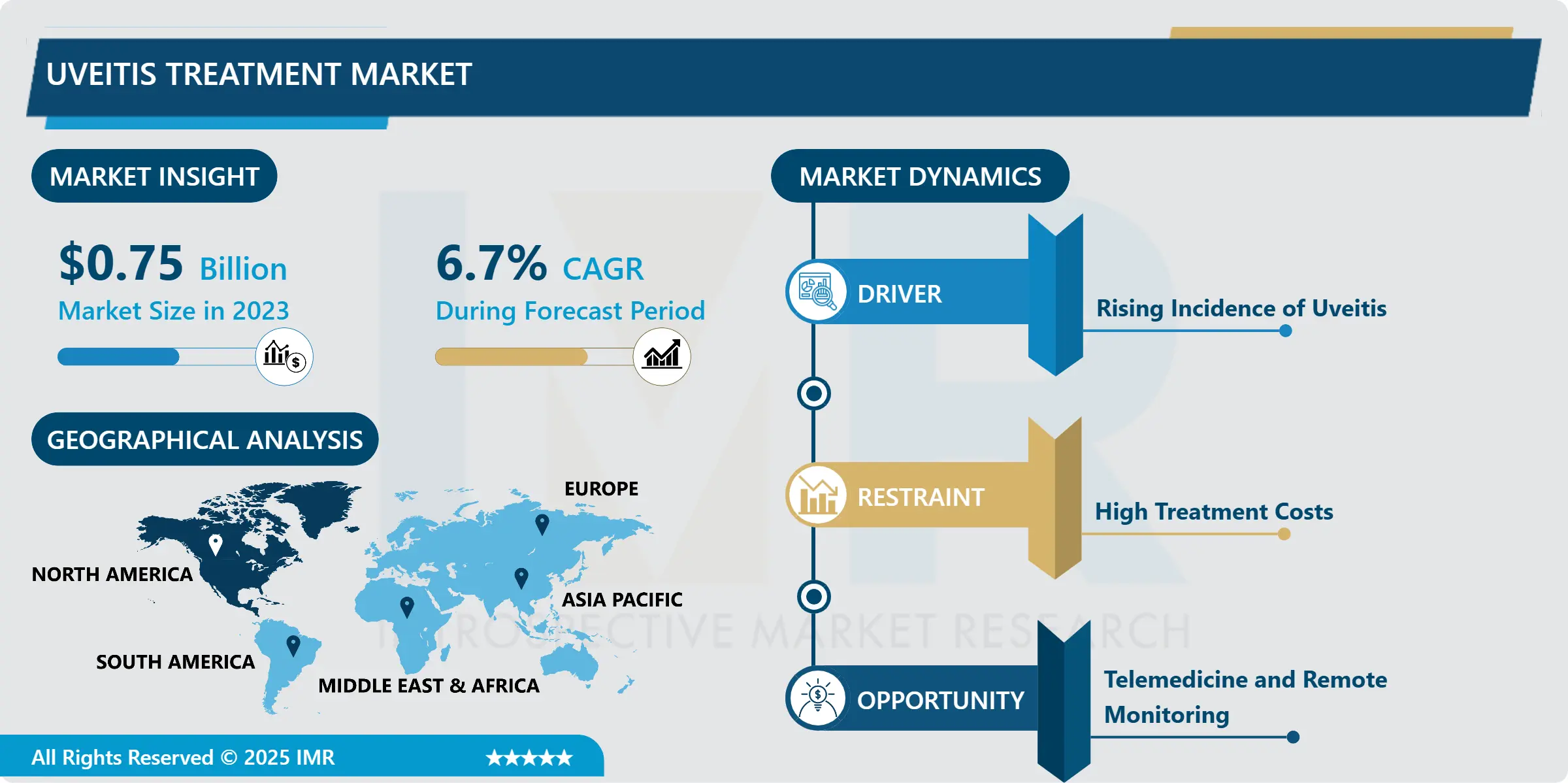
Uveitis Treatment Market Size Was Valued at USD 0.75 Billion in 2023, and is Projected to Reach USD 1.34 Billion by 2032, Growing at a CAGR of 6.70% From 2024-2032.
The market for uveitis treatment includes all the medicines and injections which are used to controlling uveitis, a medical condition in which the uvea layer of the eye becomes inflamed. This market involves medications including corticosteroids, immunosuppressive agents, biologic agents and surgery in severe situations. The goals of treatment are anti-inflammatory, analgesic and to preserve vision and they apply to the classifications of anterior, intermediate, posterior, and panuveitis. The market is inherently growing due to a rise in uveitis incidences occasioned by factors such as autoimmune diseases, infections and accident; in addition, there is enhanced awareness in eye health and improved therapeutic methods.
The Uveitis Treatment Market is a special segment of the global ophthalmic pharmaceutical market that is dedicated to providing treatment to uveitis, which is an inflammatory disease of the uveal tract of the eye.. Uveitis can cause severe damage to vision and has to be treated with appropriate therapeutic approaches. The market is filled with available treatments, which are corticosteroids, immunosuppressants and biologic medication that addresses each type of uveitis categories that include anterior, intermediate, posterior and pan-uveitis. An upsurge in the frequency of autoimmune diseases and infections that cause uveitis has fuelled the market for new strategy to treat the disease, hence promoting market growth.
Advances in both pharmacology and drug delivery have made the efficacy of treatment and hence the compliance of patients even better as we speak. Targeted biologics and genetics therapies, which started gaining reputation as new-generation therapies, have made a strong addition to the market. Also, awareness among physicians and patients about uveitis has raised early diagnosis and treatment start, which should improve the perceived market opportunity in the future. North America and Europe have a high incidence of uveitis due to improved healthcare systems and rising research efforts directed toward new uveitis therapies.
Uveitis Treatment Market Trend Analysis:
Advances in Targeted Therapies and Drug Delivery Systems
-
Uveitis itself is an inflammation of the uveal tract of the eye and if left untreated could cause serious complications in the form of irreversible vision loss. This has been greatly accelerated by the rise in incidence of uveitis and appreciation for the consequences of the disease a result of which there is immeasurable demand for therapeutic interferences. Thus, in response to this need there is a significant trend towards the development of distinct treatment approaches. These are biologic drugs that provide durability and better safety profile compared to ordinary corticosteroids and small-molecule therapies. Such a shift in treatment approaches is a reflection of ongoing paradigm changes in ophthalmology that emphasize a patient- and disease-related approach to therapy that tries to match the particular disease phenotype to the patient’s geno- and phenotype.
- Technological developments in drug delivery systems are also adding to the already defining role in the uveitis treatment market. These new releases including the implantable devices and sustained release formulations are making treatment regimens more effective with less dosing regimens, hence better therapeutic results. All these formations are very important for enhancing patient compliance as the diseases like uveitis are often chronic and would necessitate long term treatment. Also, continued innovation and active clinical trials continue to add new product entries into the system, which suggest a sound and active market growth pattern. Being a global market of ophthalmology, the rise of uveitis treatment market is expected to be driven by both targeted therapies and advanced drug delivery systems with more and more healthcare professionals paying attention to the time- and efficiency- sensitive disease.
Advancements in Biologics and Personalized Medicine in Uveitis Treatment
-
Biologics and targeted therapies are at the forefront in the more exciting development of the treatment of uveitis market. As the physiopathological details of uveitis become unravelled, this has made big-pharma pay more attention to and invest in molecules that interact with extent bohemian channels and target selected immunological pathways. This precision medicine strategy means that treatments are much more effective anything else while the side effects of the traditional systemic therapies are minimized. Bolstering the therapeutic power of biologics revealed that patients in need of treatment for a variety of diseases, receive safer and more effective options that take into account all the features of their pathogenesis, dramatically changing the therapeutic arsenal.
- In addition, advances in targeted therapies increase new opportunities for creating better treatment for patients with uveitis. Based on genetic and molecular differences between people, the treatments that the doctors prescribe have to reflect each patient’s exact needs. However, this strategy does not only optimize the outcomes of the treatment but also contributes to developing greater job satisfaction and patient involvement in their treatment processes. Future advancement of the field is expected to enhance the use of better diagnostics and appropriate treatment plans for the disease; thus, supporting the need for innovation in treating uveitis.
Uveitis Treatment Market Segment Analysis:
Uveitis Treatment Market Segmented on the basis of Treatment, Disease, Cause, Distribution Channel, Region.
By Treatment , Corticosteroids segment is expected to dominate the market during the forecast period
-
Prednisone is particularly well utilized in the treatment of the uveitis because of its strong anti-inflammatory effects. These medications act against specific elements of the immune system and prevent an inflammation process occurring in uveitis. Oral corticosteroids help patients with acute exacerbations of uveitis by reducing pain, redness and light sensitivity quickly, because they act systemically. Agents administered sublocally, either by intraocular injection or topical application to the eye, have a higher specificity for the target area and produce less general systemic side-effects. Thus, flexibility of the routes of administration enables practitioners to design patient care plans according to each patients’ characteristics and the particular stage of their illness.
- Despite its usefulness corticosteroids should be used sparingly owing to the side effects that arise from long term use and include elevated intraocular pressure, cataract formation as well as system effects. Therefore, after symptoms improve, it is seen that ophthalmologists avoid using corticosteroids and prefer to maintain the treatment regimen with other complementary forms of care, especially in patients with chronic uveitis. It is important to check up on the treatment plan periodically to determines whether it is effective or if there are side effects being experienced. Through proper strategies on corticosteroid therapy the outcomes of the patients can be improved without having to face so many complications arising from their use.
By Distribution Channel, Hospital Pharmacies segment expected to held the largest share
-
Despite its usefulness corticosteroids should be used sparingly owing to the side effects that arise from long term use and include elevated intraocular pressure, cataract formation as well as system effects. Therefore, after symptoms improve, it is seen that ophthalmologists avoid using corticosteroids and prefer to maintain the treatment regimen with other complementary forms of care, especially in patients with chronic uveitis. It is important to check up on the treatment plan periodically to determines whether it is effective or if there are side effects being experienced. Through proper strategies on corticosteroid therapy the outcomes of the patients can be improved without having to face so many complications arising from their use.
- Also, the hospital pharmacies are part of the patient’s care team working with other care givers in the provision of pharmacotherapy to the patients. They engage with medical teams for purposes of pursuing distinctive and specific plans of the patient that include their needs, medical conditions, and possible drug combinations. In addition to the traditional supply of drugs, hospital pharmacists perform clinical roles like evaluation of the therapeutic effectiveness, counselling clients and healthcare professionals on the planned medication use, and patient counselling. This support not only enhances the utilization of medicine thus increasing medication compliance but also greatly reduces adverse outcomes thus providing proper care…through the duration of the patient’s hospital stay.
Uveitis Treatment Market Regional Insights:
North America is Expected to Dominate the Market Over the Forecast period
-
In North America, it has been found that the uveitis treatment has a good market growth due to presence of well-developed healthcare and medical facilities. This infrastructure helps the practitioners offer appropriate ophthalmic specialized services hence diagnosing and treating uveitis as required. Further, there is a shift in the practices which include increasing prescription of biologics and target drugs that have greatly improved the patient’s experience. This is underlined by a rising number of clinical trials focused to progress various therapeutic approaches to uveitis indicating the region’s directions to enhance uveitis treatments. They not only help bring in new treatments in the market but also show a good relationship between the pharmaceutical firms and research facilities hence improving the market environment.
- In addition, the continually growing prevalence of autoimmune diseases, which are associated with uveitis, has pushed people to seek effective ways of managing the condition. With the increasing popularization of these diseases among doctors and patients, priority is given to prevention and individual approaches to combating diseases. The involvement of prominent pharmaceutical firms in North America is central to this process, as such firms immediately and continuously apply innovation, brought about by research and development, in the delivery of therapies. Thus, desired healthcare environment, the level of implementation of new therapy conceptualizations, along with a specific proactive strategy toward autoimmune related uveitis makes North American market dominate the global uveitis treatment marketplace.
Active Key Players in the Uveitis Treatment Market
-
AbbVie Inc.
- Bausch Health Companies Inc.
- EyePoint Pharmaceuticals, Inc.
- Novartis AG
- Ocular Therapeutix, Inc.
- Ophthotech Corporation
- Pfizer Inc.
- Regeneron Pharmaceuticals Inc.
- Santen Pharmaceutical Co., Ltd.
- Other Active Players
|
Global Uveitis Treatment Market |
|||
|
Base Year: |
2023 |
Forecast Period: |
2024-2032 |
|
Historical Data: |
2017 to 2023 |
Market Size in 2023: |
USD 0.75 Billion |
|
Forecast Period 2024-32 CAGR: |
6.70% |
Market Size in 2032: |
USD 1.34 Billion |
|
Segments Covered: |
By Treatment |
|
|
|
By Disease |
|
||
|
By Cause |
|
||
|
By Distribution Channel |
|
||
|
By Region |
|
||
|
Key Market Drivers: |
|
||
|
Key Market Restraints: |
|
||
|
Key Opportunities: |
|
||
|
Companies Covered in the report: |
|
||
Chapter 1: Introduction
1.1 Scope and Coverage
Chapter 2:Executive Summary
Chapter 3: Market Landscape
3.1 Market Dynamics
3.1.1 Drivers
3.1.2 Restraints
3.1.3 Opportunities
3.1.4 Challenges
3.2 Market Trend Analysis
3.3 PESTLE Analysis
3.4 Porter's Five Forces Analysis
3.5 Industry Value Chain Analysis
3.6 Ecosystem
3.7 Regulatory Landscape
3.8 Price Trend Analysis
3.9 Patent Analysis
3.10 Technology Evolution
3.11 Investment Pockets
3.12 Import-Export Analysis
Chapter 4: Uveitis Treatment Market by Treatment
4.1 Uveitis Treatment Market Snapshot and Growth Engine
4.2 Uveitis Treatment Market Overview
4.3 Corticosteroids
4.3.1 Introduction and Market Overview
4.3.2 Historic and Forecasted Market Size in Value USD and Volume Units (2017-2032F)
4.3.3 Key Market Trends, Growth Factors and Opportunities
4.3.4 Corticosteroids: Geographic Segmentation Analysis
4.4 Immunosuppressant
4.4.1 Introduction and Market Overview
4.4.2 Historic and Forecasted Market Size in Value USD and Volume Units (2017-2032F)
4.4.3 Key Market Trends, Growth Factors and Opportunities
4.4.4 Immunosuppressant: Geographic Segmentation Analysis
4.5 Monoclonal Antibodies
4.5.1 Introduction and Market Overview
4.5.2 Historic and Forecasted Market Size in Value USD and Volume Units (2017-2032F)
4.5.3 Key Market Trends, Growth Factors and Opportunities
4.5.4 Monoclonal Antibodies: Geographic Segmentation Analysis
4.6 Cycloplegic Agents
4.6.1 Introduction and Market Overview
4.6.2 Historic and Forecasted Market Size in Value USD and Volume Units (2017-2032F)
4.6.3 Key Market Trends, Growth Factors and Opportunities
4.6.4 Cycloplegic Agents: Geographic Segmentation Analysis
4.7 Antibiotics
4.7.1 Introduction and Market Overview
4.7.2 Historic and Forecasted Market Size in Value USD and Volume Units (2017-2032F)
4.7.3 Key Market Trends, Growth Factors and Opportunities
4.7.4 Antibiotics: Geographic Segmentation Analysis
4.8 Antivirals
4.8.1 Introduction and Market Overview
4.8.2 Historic and Forecasted Market Size in Value USD and Volume Units (2017-2032F)
4.8.3 Key Market Trends, Growth Factors and Opportunities
4.8.4 Antivirals: Geographic Segmentation Analysis
4.9 Antifungal and Analgesics
4.9.1 Introduction and Market Overview
4.9.2 Historic and Forecasted Market Size in Value USD and Volume Units (2017-2032F)
4.9.3 Key Market Trends, Growth Factors and Opportunities
4.9.4 Antifungal and Analgesics: Geographic Segmentation Analysis
Chapter 5: Uveitis Treatment Market by Disease
5.1 Uveitis Treatment Market Snapshot and Growth Engine
5.2 Uveitis Treatment Market Overview
5.3 Anterior Uveitis
5.3.1 Introduction and Market Overview
5.3.2 Historic and Forecasted Market Size in Value USD and Volume Units (2017-2032F)
5.3.3 Key Market Trends, Growth Factors and Opportunities
5.3.4 Anterior Uveitis: Geographic Segmentation Analysis
5.4 Posterior Uveitis
5.4.1 Introduction and Market Overview
5.4.2 Historic and Forecasted Market Size in Value USD and Volume Units (2017-2032F)
5.4.3 Key Market Trends, Growth Factors and Opportunities
5.4.4 Posterior Uveitis: Geographic Segmentation Analysis
5.5 Intermediate Uveitis and Panuveitis
5.5.1 Introduction and Market Overview
5.5.2 Historic and Forecasted Market Size in Value USD and Volume Units (2017-2032F)
5.5.3 Key Market Trends, Growth Factors and Opportunities
5.5.4 Intermediate Uveitis and Panuveitis: Geographic Segmentation Analysis
Chapter 6: Uveitis Treatment Market by Cause
6.1 Uveitis Treatment Market Snapshot and Growth Engine
6.2 Uveitis Treatment Market Overview
6.3 Infectious and Non-infectious
6.3.1 Introduction and Market Overview
6.3.2 Historic and Forecasted Market Size in Value USD and Volume Units (2017-2032F)
6.3.3 Key Market Trends, Growth Factors and Opportunities
6.3.4 Infectious and Non-infectious: Geographic Segmentation Analysis
Chapter 7: Uveitis Treatment Market by Distribution Channel
7.1 Uveitis Treatment Market Snapshot and Growth Engine
7.2 Uveitis Treatment Market Overview
7.3 Hospital Pharmacies
7.3.1 Introduction and Market Overview
7.3.2 Historic and Forecasted Market Size in Value USD and Volume Units (2017-2032F)
7.3.3 Key Market Trends, Growth Factors and Opportunities
7.3.4 Hospital Pharmacies: Geographic Segmentation Analysis
7.4 Retail Pharmacies
7.4.1 Introduction and Market Overview
7.4.2 Historic and Forecasted Market Size in Value USD and Volume Units (2017-2032F)
7.4.3 Key Market Trends, Growth Factors and Opportunities
7.4.4 Retail Pharmacies: Geographic Segmentation Analysis
7.5 Online Pharmacies and Others
7.5.1 Introduction and Market Overview
7.5.2 Historic and Forecasted Market Size in Value USD and Volume Units (2017-2032F)
7.5.3 Key Market Trends, Growth Factors and Opportunities
7.5.4 Online Pharmacies and Others: Geographic Segmentation Analysis
Chapter 8: Company Profiles and Competitive Analysis
8.1 Competitive Landscape
8.1.1 Competitive Benchmarking
8.1.2 Uveitis Treatment Market Share by Manufacturer (2023)
8.1.3 Industry BCG Matrix
8.1.4 Heat Map Analysis
8.1.5 Mergers and Acquisitions
8.2 ABBVIE INC.
8.2.1 Company Overview
8.2.2 Key Executives
8.2.3 Company Snapshot
8.2.4 Role of the Company in the Market
8.2.5 Sustainability and Social Responsibility
8.2.6 Operating Business Segments
8.2.7 Product Portfolio
8.2.8 Business Performance
8.2.9 Key Strategic Moves and Recent Developments
8.2.10 SWOT Analysis
8.3 SANTEN PHARMACEUTICAL CO. LTD.
8.4 BAUSCH HEALTH COMPANIES INC.
8.5 REGENERON PHARMACEUTICALS INC.
8.6 EYEPOINT PHARMACEUTICALS INC.
8.7 NOVARTIS AG
8.8 OCULAR THERAPEUTIX INC.
8.9 OPHTHOTECH CORPORATION
8.10 PFIZER INC
8.11 OTHER ACTIVE PLAYERS
Chapter 9: Global Uveitis Treatment Market By Region
9.1 Overview
9.2. North America Uveitis Treatment Market
9.2.1 Key Market Trends, Growth Factors and Opportunities
9.2.2 Top Key Companies
9.2.3 Historic and Forecasted Market Size by Segments
9.2.4 Historic and Forecasted Market Size By Treatment
9.2.4.1 Corticosteroids
9.2.4.2 Immunosuppressant
9.2.4.3 Monoclonal Antibodies
9.2.4.4 Cycloplegic Agents
9.2.4.5 Antibiotics
9.2.4.6 Antivirals
9.2.4.7 Antifungal and Analgesics
9.2.5 Historic and Forecasted Market Size By Disease
9.2.5.1 Anterior Uveitis
9.2.5.2 Posterior Uveitis
9.2.5.3 Intermediate Uveitis and Panuveitis
9.2.6 Historic and Forecasted Market Size By Cause
9.2.6.1 Infectious and Non-infectious
9.2.7 Historic and Forecasted Market Size By Distribution Channel
9.2.7.1 Hospital Pharmacies
9.2.7.2 Retail Pharmacies
9.2.7.3 Online Pharmacies and Others
9.2.8 Historic and Forecast Market Size by Country
9.2.8.1 US
9.2.8.2 Canada
9.2.8.3 Mexico
9.3. Eastern Europe Uveitis Treatment Market
9.3.1 Key Market Trends, Growth Factors and Opportunities
9.3.2 Top Key Companies
9.3.3 Historic and Forecasted Market Size by Segments
9.3.4 Historic and Forecasted Market Size By Treatment
9.3.4.1 Corticosteroids
9.3.4.2 Immunosuppressant
9.3.4.3 Monoclonal Antibodies
9.3.4.4 Cycloplegic Agents
9.3.4.5 Antibiotics
9.3.4.6 Antivirals
9.3.4.7 Antifungal and Analgesics
9.3.5 Historic and Forecasted Market Size By Disease
9.3.5.1 Anterior Uveitis
9.3.5.2 Posterior Uveitis
9.3.5.3 Intermediate Uveitis and Panuveitis
9.3.6 Historic and Forecasted Market Size By Cause
9.3.6.1 Infectious and Non-infectious
9.3.7 Historic and Forecasted Market Size By Distribution Channel
9.3.7.1 Hospital Pharmacies
9.3.7.2 Retail Pharmacies
9.3.7.3 Online Pharmacies and Others
9.3.8 Historic and Forecast Market Size by Country
9.3.8.1 Russia
9.3.8.2 Bulgaria
9.3.8.3 The Czech Republic
9.3.8.4 Hungary
9.3.8.5 Poland
9.3.8.6 Romania
9.3.8.7 Rest of Eastern Europe
9.4. Western Europe Uveitis Treatment Market
9.4.1 Key Market Trends, Growth Factors and Opportunities
9.4.2 Top Key Companies
9.4.3 Historic and Forecasted Market Size by Segments
9.4.4 Historic and Forecasted Market Size By Treatment
9.4.4.1 Corticosteroids
9.4.4.2 Immunosuppressant
9.4.4.3 Monoclonal Antibodies
9.4.4.4 Cycloplegic Agents
9.4.4.5 Antibiotics
9.4.4.6 Antivirals
9.4.4.7 Antifungal and Analgesics
9.4.5 Historic and Forecasted Market Size By Disease
9.4.5.1 Anterior Uveitis
9.4.5.2 Posterior Uveitis
9.4.5.3 Intermediate Uveitis and Panuveitis
9.4.6 Historic and Forecasted Market Size By Cause
9.4.6.1 Infectious and Non-infectious
9.4.7 Historic and Forecasted Market Size By Distribution Channel
9.4.7.1 Hospital Pharmacies
9.4.7.2 Retail Pharmacies
9.4.7.3 Online Pharmacies and Others
9.4.8 Historic and Forecast Market Size by Country
9.4.8.1 Germany
9.4.8.2 UK
9.4.8.3 France
9.4.8.4 The Netherlands
9.4.8.5 Italy
9.4.8.6 Spain
9.4.8.7 Rest of Western Europe
9.5. Asia Pacific Uveitis Treatment Market
9.5.1 Key Market Trends, Growth Factors and Opportunities
9.5.2 Top Key Companies
9.5.3 Historic and Forecasted Market Size by Segments
9.5.4 Historic and Forecasted Market Size By Treatment
9.5.4.1 Corticosteroids
9.5.4.2 Immunosuppressant
9.5.4.3 Monoclonal Antibodies
9.5.4.4 Cycloplegic Agents
9.5.4.5 Antibiotics
9.5.4.6 Antivirals
9.5.4.7 Antifungal and Analgesics
9.5.5 Historic and Forecasted Market Size By Disease
9.5.5.1 Anterior Uveitis
9.5.5.2 Posterior Uveitis
9.5.5.3 Intermediate Uveitis and Panuveitis
9.5.6 Historic and Forecasted Market Size By Cause
9.5.6.1 Infectious and Non-infectious
9.5.7 Historic and Forecasted Market Size By Distribution Channel
9.5.7.1 Hospital Pharmacies
9.5.7.2 Retail Pharmacies
9.5.7.3 Online Pharmacies and Others
9.5.8 Historic and Forecast Market Size by Country
9.5.8.1 China
9.5.8.2 India
9.5.8.3 Japan
9.5.8.4 South Korea
9.5.8.5 Malaysia
9.5.8.6 Thailand
9.5.8.7 Vietnam
9.5.8.8 The Philippines
9.5.8.9 Australia
9.5.8.10 New Zealand
9.5.8.11 Rest of APAC
9.6. Middle East & Africa Uveitis Treatment Market
9.6.1 Key Market Trends, Growth Factors and Opportunities
9.6.2 Top Key Companies
9.6.3 Historic and Forecasted Market Size by Segments
9.6.4 Historic and Forecasted Market Size By Treatment
9.6.4.1 Corticosteroids
9.6.4.2 Immunosuppressant
9.6.4.3 Monoclonal Antibodies
9.6.4.4 Cycloplegic Agents
9.6.4.5 Antibiotics
9.6.4.6 Antivirals
9.6.4.7 Antifungal and Analgesics
9.6.5 Historic and Forecasted Market Size By Disease
9.6.5.1 Anterior Uveitis
9.6.5.2 Posterior Uveitis
9.6.5.3 Intermediate Uveitis and Panuveitis
9.6.6 Historic and Forecasted Market Size By Cause
9.6.6.1 Infectious and Non-infectious
9.6.7 Historic and Forecasted Market Size By Distribution Channel
9.6.7.1 Hospital Pharmacies
9.6.7.2 Retail Pharmacies
9.6.7.3 Online Pharmacies and Others
9.6.8 Historic and Forecast Market Size by Country
9.6.8.1 Turkiye
9.6.8.2 Bahrain
9.6.8.3 Kuwait
9.6.8.4 Saudi Arabia
9.6.8.5 Qatar
9.6.8.6 UAE
9.6.8.7 Israel
9.6.8.8 South Africa
9.7. South America Uveitis Treatment Market
9.7.1 Key Market Trends, Growth Factors and Opportunities
9.7.2 Top Key Companies
9.7.3 Historic and Forecasted Market Size by Segments
9.7.4 Historic and Forecasted Market Size By Treatment
9.7.4.1 Corticosteroids
9.7.4.2 Immunosuppressant
9.7.4.3 Monoclonal Antibodies
9.7.4.4 Cycloplegic Agents
9.7.4.5 Antibiotics
9.7.4.6 Antivirals
9.7.4.7 Antifungal and Analgesics
9.7.5 Historic and Forecasted Market Size By Disease
9.7.5.1 Anterior Uveitis
9.7.5.2 Posterior Uveitis
9.7.5.3 Intermediate Uveitis and Panuveitis
9.7.6 Historic and Forecasted Market Size By Cause
9.7.6.1 Infectious and Non-infectious
9.7.7 Historic and Forecasted Market Size By Distribution Channel
9.7.7.1 Hospital Pharmacies
9.7.7.2 Retail Pharmacies
9.7.7.3 Online Pharmacies and Others
9.7.8 Historic and Forecast Market Size by Country
9.7.8.1 Brazil
9.7.8.2 Argentina
9.7.8.3 Rest of SA
Chapter 10 Analyst Viewpoint and Conclusion
10.1 Recommendations and Concluding Analysis
10.2 Potential Market Strategies
Chapter 11 Research Methodology
11.1 Research Process
11.2 Primary Research
11.3 Secondary Research
|
Global Uveitis Treatment Market |
|||
|
Base Year: |
2023 |
Forecast Period: |
2024-2032 |
|
Historical Data: |
2017 to 2023 |
Market Size in 2023: |
USD 0.75 Billion |
|
Forecast Period 2024-32 CAGR: |
6.70% |
Market Size in 2032: |
USD 1.34 Billion |
|
Segments Covered: |
By Treatment |
|
|
|
By Disease |
|
||
|
By Cause |
|
||
|
By Distribution Channel |
|
||
|
By Region |
|
||
|
Key Market Drivers: |
|
||
|
Key Market Restraints: |
|
||
|
Key Opportunities: |
|
||
|
Companies Covered in the report: |
|
||


